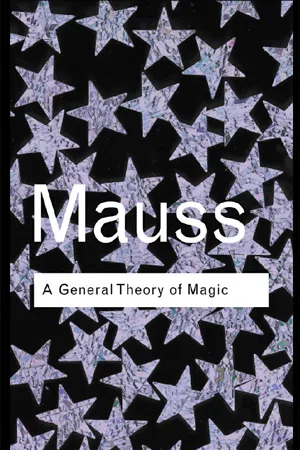
First written by Marcel Mauss and Henri Humbert in 1902, A General Theory of Magic gained a wide new readership when republished by Mauss in 1950. As a study of magic in 'primitive' societies and its survival today in our thoughts and social actions, it represents what Claude Lévi-Strauss called, in an introduction to that edition, the astonishing modernity of the mind of one of the century's greatest thinkers. The book offers a fascinating snapshot of magic throughout various cultures as well as deep sociological and religious insights still very much relevant today. At a period when art, magic and science appear to be crossing paths once again, A General Theory of Magic presents itself as a classic for our times.
- 192 pages
- English
- ePUB (mobile friendly)
- Available on iOS & Android
eBook - ePub
A General Theory of Magic
About this book
Information
1
SOURCES AND HISTORICAL BACKGROUND
For a long time, magic has been a matter for speculation. However, the studies of ancient philosophers, alchemists and theologians were purely practical in nature and belong more to the history of magic itself than to the history of those scientific studies which have been devoted to the subject. The first in this list is the work of the brothers Grimm, which inaugurated a long series of studies of which our researches are a continuation.
Today we have good monographs on most of the important magical themes. Data have been collected both from a historical as well as an analytical point of view, and we can now call on a whole range of knowledge. On the other hand a certain number of theoretical ideas have become established, including the notion of ‘survival’ and that of ‘sympathetic magic’ .
Our immediate predecessors are the scholars of the anthropological school who have already produced a sufficiently coherent theory of magic. E. B. Tylor, in his Primitive Culture , deals with the subject twice. He first associates magical demonology with primitive animism. In his second volume he mentions— and he is one of the first to do so— ‘sympathetic magic’ this term covers those magical rites which follow the so-called laws of sympathy. Like produces like; contact results in contagion; the image produces the object itself; a part is seen to be the same as the whole. Tylor’ s main aim was to show that these rites played a role in the system of survivals. In fact, Tylor offers no other explanation of magic than the one provided by his general theory of animism. George Wilken and Sidney Hartland also studied magic: the former in connexion with animism and shamanism, the latter in relation to life tokens, equating sympathetic magic with those bonds which are said to exist between a man and the object or being with which his life is bound up.
With J. G. Frazer and W. Lehmann we finally have genuine theories of magic. Frazer’ s ideas, as they are set out in the second edition of The Golden Bough , provide, as we believe, the clearest expression of a whole tradition to which the works of Tylor, Sir Alfred Lyall, F. B. Jevons, A. Lang and H. Oldenberg all belong. Despite divergent opinions in matters of detail, all these writers agree in calling magic a kind of pre-science; and as it is the basis of Frazer’ s theories we shall begin by discussing this aspect. As far as Frazer is concerned, magical actions are those which are destined to produce special effects through the application of two laws of sympathetic magic— the law of similarity and the law of contiguity. He formulates these in the following way: ‘Like produces like; objects which have been in contact, but since ceased to be so, continue to act on each other at a distance after the physical contact has been severed.’ One might add, as a corollary: ‘The part is to the whole as the image is to the represented object.’ Thus the definitions of the anthropological school tend to confuse ‘magic’ with ‘sympathetic magic’. Frazer’ s ideas are dogmatic in this regard; he expresses no doubts and offers no exceptions to his rules. Sympathy is a sufficient and inevitable feature of magic; all magical rites are sympathetic and all sympathetic ritual is magical. It is true that magicians perform ritual which is akin to religious prayers and sacrifice— and not always in parody or imitation. It is also true that priests in a number of societies have a remarkable predisposition towards magical practices. But these facts, we are told, are but the encroachments of recent times and should be excluded from our general definition, which is only concerned with pure magic.
From this first proposition it is possible to deduce others. In the first place magical rites act upon their object directly without any mediation by a spiritual agent; moreover, their effectiveness is automatic. However, as far as these two properties are concerned, the first is not universal, since it is admitted that magic— in its degenerate phase, when it became contaminated by religion— has borrowed figures of gods and demons from religion. The truth of the second proposition is not affected by this, since in the cases where we have intermediaries, the magical rite acts on them in the same way as it does on external phenomena; magic forces and constrains, while religion conciliates. This last property, which seems to distinguish magic from religion in every case where there is a temptation to confuse the two, remains— according to Frazer— the most permanent general feature of magic.
This theory involves a hypothesis of much wider import. Magic, thus defined, becomes the earliest form of human thought. It must have once existed in its pure state; mankind, originally, thought only in magical terms. The predominance of magical ritual in primitive cults and folklore provide— so it is thought— strong proof in support of this argument. Moreover, it is maintained that these magical states of mind still exist among a few central Australian tribes whose totemic rites are purely magical in character. Magic is, therefore, the foundation of the whole mystical and scientific universe of primitive man. It is the first stage in the evolution of the human mind which he determined— or even conjectured. Religion grew up out of the failures and mistakes of magic. Originally man unhesitatingly expressed his ideas and their associations in concrete form. He thought he would create those things suggested to him by his mind; he imagined he was master of the external world in the same way as he was master of his own movements. But he finally realized that the world was resisting his attempts to do so. Immediately he endowed his universe with mysterious powers, of the kind he once arrogated to himself. Once upon a time man himself was god, now he peopled the world with gods. These gods were no longer bent to his will, but he attached himself to them in worship, through sacrifice and prayer. Frazer, it is true, presents these hypotheses with many careful reservations; nevertheless, he is determined to stick to them. He rounds the theory off by explaining how the human mind, following on from religion, moved off in the direction of science. Once man became capable of noting the errors of religion he returned to a straightforward application of the principle of causality. But from this time onwards it is a matter of experimental causality and not magical causality. Later we shall return in detail to different aspects of this theory.
Lehmann’ s work is a study in psychology, prefaced by a short history of magic. He begins by pointing out some contemporary facts. Magic, which he defines as ‘the practising of superstitions’ — that is, ‘beliefs which are neither religious nor scientific’ — exists in our society in the observable forms of spiritualism and occultism. He attempts, therefore, to analyse the principal experiences of spirits through the processes of experimental psychology and he manages to discover in it (and also, as a corollary, in magic) illusions prejudices and errors of perception caused by these anticipatory phenomena.
All these studies betray one common feature, or error. No attempt has been made to enumerate fully the different categories of magical facts and, as a result, it is doubtful whether, at this stage, it is possible to propose a scientific scheme which could embrace the whole subject. The only attempt so far made— by Frazer and Jevons— to circumscribe magic, has been spoilt by the authors’ prejudices. They used so-called ‘typical data’ , assumed the existence of a period in the past when magic existed in its purest state, and then reduced the whole to facts of sympathetic magic. However, they failed to prove the legitimacy of their selection. They ignored a considerable body of practices which are called magical by all those who perform the rites and also those who observe them; as well as incantations and rituals involving demons, properly so called. If one ignores the old definitions and sets up in their place a class of ideas and practices which are so narrowly limited that they exclude magical phenomena which only seem to be magical, we must again ask how it is possible to explain those illusions which have induced so many people to accept facts as magical which, by themselves, are not. We are still waiting in vain for an explanation of this. We may also be told that the phenomena of sympathetic magic form a natural and independent class of facts which it is important to distinguish. This may be so. In this case we should need proof that they have produced expressions, images and social attitudes which are sufficiently distinct for us to be able to accept that they clearly do form a separate class from the rest of magic. We, it should be added, believe that this is not so. In any case, it would then be necessary to make it clear that we were being given only a theory of sympathetic actions, not a theory of magic in general. In fact, nobody so far has been able to produce a clear, complete and wholly satisfactory idea of magic which we could make use of. As a result we are reduced to providing one for ourselves.
In order to succeed in this aim, we determined not to restrict our studies to one or two magical systems, but to consider the largest number possible. We do not believe that an analysis of a single system, however well chosen, would be sufficient to deduce laws, applicable to all magical phenomena, since our uncertainty about the actual boundaries of magic leads us to doubt whether we could find the totality of magical phenomena in one magical system. On the other hand, we propose studying as many heterogeneous systems as possible. In doing so we may be able to establish whether magic— no matter how it varies in relation to other categories of social phenomena from culture to culture— involves, in some degree, the same basic elements and whether it is on the whole everywhere the same. Above all we must make parallel studies of magical systems of both primitive and differentiated societies. In the former we shall find the most perfect form, the basic phenomena of magic from which others derive; in the latter, with their more complex organization and more distinct institutions, we shall find data which are more intelligible to us and which will provide insights into the functioning of the primitive systems.
We have taken care to use only the most reliable material which gives a complete coverage of magic in the society concerned. This, of course, drastically reduces the field of our observations, but it is essential to rely on facts, which as far as possible are beyond criticism. We have included the magic of certain Australian tribes;1 a number of Melanesian societies;2 two Iroquois nations, the Cherokee and Huron, and the Algonquin magic of the Ojibway.3 We have also included ancient Mexican magic;4 the contemporary system of the Straits Settlements in Malay,5 and two of the forms magic has assumed in India— contemporary folk magic of the north-western states and the quasi-scientific form it took under the direction of certain Brahmans of the literary period known as Vedic.6 While we are unfortunate in the quality of material in the Semitic languages, we have not neglected this subject entirely.7 Studies of Greek and Latin magic8 have been particularly useful in the study of magical representations and the functioning of a well-differentiated magic. We have also used well attested material taken from the history of magic in the Middle Ages9 and from French, Germanic, Celtic and Finnish folklore.
NOTES
1 The Arunta:— B. Spencer and F. J. Gillen, The Native Tribes of Central Australia , London, 1898; Pitta-Pitta and neighbouring tribes in central Queensland— W. Roth, Ethnographical Studies among the North-Western Central Queensland Aborigines , Brisbane, 1897. G. Kurnai; Murring and neighbouring tribes of the south-east— L. Fison and A. W. Howitt, Kamilaroi and Kurnai , 1885; ‘On some Australian beliefs’ , Journal of the Anthropological Institute , 1883, xiii, p. 185 et seq. ; ‘Australian medicine-men’ , J. A. I. , xvi, p. 30 et seq. ‘Notes on Australian songs and song-makers’ , J. A. I , xvii, p. 30 et seq. These precious documents are often incomplete, particularly as far as incantations are concerned.
2 The Banks Islands, Solomon Islands and the New Hebrides— R. H.
Codrington, The Melanesians, their Anthropology and Folklore , Oxford, 1890; as well as this capital study we have used a certain number of ethnographical works, including those of M. Gray on the Tanna (Proceedings of the Australian Association for the Advancement of Science , January 1892); cf. Sidney H. Ray, ‘Some notes on the Tannese’ , Internationales Archiv fü r Ethnographie , 1894, vii, p. 227 et seq. These writings are of interest since they provide information on the subject of mana , but they are incomplete so far as details on ritual, incantations and the general system of magic and the magician are concerned.
Codrington, The Melanesians, their Anthropology and Folklore , Oxford, 1890; as well as this capital study we have used a certain number of ethnographical works, including those of M. Gray on the Tanna (Proceedings of the Australian Association for the Advancement of Science , January 1892); cf. Sidney H. Ray, ‘Some notes on the Tannese’ , Internationales Archiv fü r Ethnographie , 1894, vii, p. 227 et seq. These writings are of interest since they provide information on the subject of mana , but they are incomplete so far as details on ritual, incantations and the general system of magic and the magician are concerned.
3 Among the Cherokee we have proper texts, ritual manuscripts written by magicians, in Sequoyah characters; J. Mooney has collected almost 550 formulas and rituals and has often succeeded in obtaining some of the best commentaries: The Sacred Formulas of the Cherokees , 7th Annual Report of the Bureau of American Ethnology, 1891; Myths of the Cherokee , 19th Ann. Rep. Bur. Amer. Ethn., 1900. For the Huron we have used only the excellent material of J. N. B. Hewitt on the orenda and we give an account of them later on. Ojibway pictograms (Algonquin), depicting initiation in diverse magical societies have also been of great value. Both written texts and figures are included in the work of W. J. Hoffman, The Mide’ wiwin of the Ojibwa , 7th Ann. Rep. Bur. Amer. Ethn., 1887.
4 For Mexican magic see the illustrated manuscripts in Spanish and Nahuatl made for Sahagun, published, translated and commentated by E. Seler, ‘Zauberei und Zauberer im Alten Mexico’ , in Verö ff a.d. Kgl. Mü s. f. Vö lkerk , vii, 2, pp. 2– 4, in which the material is excellent if brief.
5 The book by W. W. Skeat, Malay Magic , London, 1889, contains excellent factual reports, well analysed and complete, and observed by the author himself or collected in a notable series of magical manuscripts and treatises.
6 The Hindus have left us an incomparable body of magical texts: hymns and formulas in the Atharva Veda , ed. R. Roth and W. D. Whitney, 1856; edited with commentaries by Sâ yana, Bombay, 1895– 1900, 4 vols; translated by A. Weber, Books I– VI in Indische Studien , vols 1118; translation by V. Henry, Books VII– XIV, Paris, Maisonneuve, 188796; translation with commentary and a choice of sacred songs, M. Bloomfield, ‘Hymns of the Atharva-Veda’ , in Sacred Books of the East , vol.42, Oxford, 1897; ritual texts of the Kauç ika-Sutra (ed. Bloomfield, J. Amer. Oriental Soc. , 1890, xiv: partial translation with notes by W. Caland, Altindisches Zauberritual , Amsterdam, 1900; A. Weber, ‘Omina und Portenta’ , in Abhdl d. Kgl. Ak. d. Wiss. , Berlin, 1858, pp. 344413). However, it should be pointed out that we are aware that these inaccurately dated texts present only a single Hindu tradition, a literary tradition of a single Brahmanical school, belonging to the Atharva-Veda. It therefore does not cover all Brahman magic, any more, of course, than it represents all the magic of ancient India. For modern India we have mainly relied on the collection by W. Crooke, The Popular Religion and Folklore of Northern India , 2 vols, London, 1896. It has a certain number of gaps, above all as far as details of ritual and textual formula are concerned.
7 For Assyrian magic we possess some exorcism rites only: C. Fossey, La Magie assyrienne , Paris 1902. We have only fragmentary material on Hebrew magic: T. W. Davies, Magic, Divination and Demonology among the Hebrews , Leipzig, 1898; L. Blau, Das altjü dische Zauberwesen , Strass-burg, 1898. We have not included any discussion on Arab magic.
8 One of the authors has already provided an account of the...
Table of contents
- COVER PAGE
- TITLE PAGE
- COPYRIGHT PAGE
- FOREWORD
- PROLOGUE
- 1 SOURCES AND HISTORICAL BACKGROUND
- 2 A DEFINITION OF MAGIC
- 3 THE ELEMENTS OF MAGIC
- 4 AN ANALYSIS AND EXPLANATION OF MAGIC
- 5 CONCLUSION
Trusted by 375,005 students
Access to over 1.5 million titles for a fair monthly price.
Study more efficiently using our study tools.
Frequently asked questions
Yes, you can cancel anytime from the Subscription tab in your account settings on the Perlego website. Your subscription will stay active until the end of your current billing period. Learn how to cancel your subscription
No, books cannot be downloaded as external files, such as PDFs, for use outside of Perlego. However, you can download books within the Perlego app for offline reading on mobile or tablet. Learn how to download books offline
Perlego offers two plans: Essential and Complete
- Essential is ideal for learners and professionals who enjoy exploring a wide range of subjects. Access the Essential Library with 800,000+ trusted titles and best-sellers across business, personal growth, and the humanities. Includes unlimited reading time and Standard Read Aloud voice.
- Complete: Perfect for advanced learners and researchers needing full, unrestricted access. Unlock 1.5M+ books across hundreds of subjects, including academic and specialized titles. The Complete Plan also includes advanced features like Premium Read Aloud and Research Assistant.
We are an online textbook subscription service, where you can get access to an entire online library for less than the price of a single book per month. With over 1.5 million books across 990+ topics, we’ve got you covered! Learn about our mission
Look out for the read-aloud symbol on your next book to see if you can listen to it. The read-aloud tool reads text aloud for you, highlighting the text as it is being read. You can pause it, speed it up and slow it down. Learn more about Read Aloud
Yes! You can use the Perlego app on both iOS and Android devices to read anytime, anywhere — even offline. Perfect for commutes or when you’re on the go.
Please note we cannot support devices running on iOS 13 and Android 7 or earlier. Learn more about using the app
Please note we cannot support devices running on iOS 13 and Android 7 or earlier. Learn more about using the app
Yes, you can access A General Theory of Magic by Marcel Mauss in PDF and/or ePUB format, as well as other popular books in Social Sciences & Anthropology. We have over 1.5 million books available in our catalogue for you to explore.