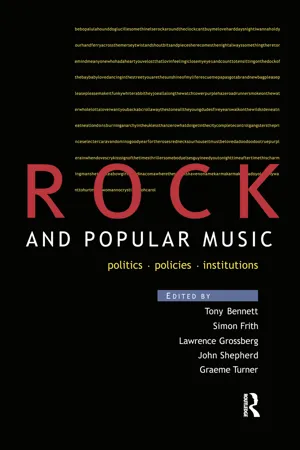
Rock and Popular Music examines the relations between the policies and institutions which regulate contemporary popular music and the political debates, contradictions and struggles in which those musics are involved.
International in its scope and conception, this innovative collection explores the reasons for and ways in which governments have sought either to support or prohibit popular music in Canada, Australia and Europe as well as the impact of broadcasting policies in forming and shaping different musical communities.
Rock and Popular Music is a unique collection suggesting significant new directions for the study of contemporary popular musics.
eBook - ePub
Rock and Popular Music
Politics, Policies, Institutions
- 320 pages
- English
- ePUB (mobile friendly)
- Available on iOS & Android
eBook - ePub
Rock and Popular Music
Politics, Policies, Institutions
About this book
Information
Part I
GOVERNMENT AND ROCK
INTRODUCTION
Government and rock: it's probably not the first connection one would make in describing the social or economic relations which structure the rock music industry in most western countries. Rock's ritual representation of itself as an oppositional, resistant form may not have entirely obscured its close articulation to capital but it has certainly established rock music as a ‘dirty’ category of social practice—from which governments have customarily kept their distance. The contributors to this section all document governments’ wariness about including the rock industry (unlike the opera or the film industry) within national agendas for cultural or industrial policy. Yet despite what Simon Frith calls rock's ‘buccaneering image’, which situates it paradoxically as one of the least protected and most radically free market or ‘commercial’ of the culture industries, it is also true that rock music has enjoyed an indirect relationship with governments for a long time. In Australia, direct support is relatively recent but there, as in Canada, a local content quota for music broadcast on radio has existed for many years, operating as a crucial factor in maintaining a market for local musicians and composers. In Britain, according to Frith, ‘the very emergence of a specific British rock music would have been impossible without the subsidized spaces, resources and audiences provided by art schools and the college circuit’. In the GDR, Peter Wicke and John Shepherd report that the rock industry was a central concern for state cultural policy precisely because of its political ‘dirtiness’, as a key site where cultural change might be managed. And, of course, the trade in recorded music and copyrights has long been a matter of international law, negotiated and regulated through national governments.
What the following chapters reveal, however, is that government intervention in the rock industry is becoming increasingly explicit, increasingly programmatic and institutional; within Europe, North America and Australia the role of government has become a crucial factor in the structural organization of rock music at the local, the national and ultimately at the global level. The kinds of interventions vary, as do the objectives nominated as their legitimate targets. Rock music's cultural location as a ‘youth culture’ form, its construction as a ‘problem’ for those maintaining taste and order, has led to its incorporation into social welfare policies and programmes. Paul Rutten describes the placement of rock music upon such an agenda in his account of the Dutch industry's attempts to move itself off the government's social welfare budget and on to the arts budget. Rock's youthful demographic, as well as its often chaotic commercial conditions—the level of facilities in venues, the degree of unionization of musicians, the informality of fees and contracts, and so on—has seen it become popular as a site of job training within locally based industry development and employment programmes. Simon Frith's chapter outlines a series of such programmes funded by local, rather than national, government in the United Kingdom. Marcus Breen and Will Straw describe the placement of the rock industry within, respectively, Australia and Canada, as ultimately to do with the defence of national identity through the maintenance of the local music industry against the threat of domination, largely from America. And from America, Steve Jones reveals that Americans’ fears of losing control of their own market are expressed in legislation around the issues of immigration, copyright and the regulation of the trade in imported records.
The variations and contrasts between the positions described and taken in these chapters are complex, but it is interesting to note the degree to which they vary according to the political, national and cultural context from which they emerge. Frith's piece is perhaps the most western European, linking with Rutten's in its highlighting of the importance of local industry structures for generating employment, as well as in its insistence on the need for the maintenance of local cultural difference— working to protect this difference from within the large globalizing ‘leisure industries’. That this involves working with contradictions, Frith is happy to admit:
But then rock musicians are used to working with contradictions, oriented as they are to both the locality, the community, and to the mass pop media, to radio and records, to stardom and sales. Making it locally and making it nationally have never been the same thing; ‘selling out’ has always been essential to the British rock career.
Such contradictions, organized as they are around notions of the local and the national and implicitly invoking constructions of the ‘authentic’ and the ‘commercial’, are thrown into sharp relief by the view from eastern Europe — from what was the GDR. Wicke and Shepherd's account of the incorporation of rock music into the state challenges many western assumptions about the nature of rock music and its industrial structure:
the organization of rock culture in the GDR, as in other eastern European countries, provided a situation free of the commercialism which leftist critics have often argued detracts from the supposed political authenticity and creative integrity of rock music in the West. While not suggesting that market forces guarantee political and cultural freedom, it is none the less possible to demonstrate that the imposition of a political and cultural system where commercial forces are forbidden necessarily gives rise to an undemocratic and hierarchical control of cultural life. If the production and distribution of cultural artefacts is not organized in some meaningful relationship to market forces, then the question arises as to the economic and valuative criteria which should underwrite processes of production and distribution, and the political mechanisms through which these criteria should be negotiated. Socialist cultural politics as developed in eastern Europe failed to give any meaningful answers to these questions.
What emerges from Wicke and Shepherd's chapter is almost the reverse of the other chapters in this section—a tale of the comprehensive integration of the rock music industry into the institutional and administrative structure of the state. Within that structure, the idea of ‘commercialism’ disappeared (there was no relation between audience demand, performers’ popularity and sales, for instance); interestingly, Wicke and Shepherd argue, the inevitable outcome of this strategy was the explicit politicization of the music and the culture around it, a politicization they suggest played a central role in the GDR's destruction.
The lobbyists for the Dutch rock industry in Rutten's chapter are pursuing something rather like the situation Wicke and Shepherd describe: the achievement of cultural respectability for rock music in Holland, a respectability signified by a right to subsidies and state support as an acknowledgement of the music's importance to the national culture. The bifurcation in funding strategies Rutten outlines—at one extreme, an ever more elitist construction of rock as art and, at the other, the placement of rock music as a community, craft-based, amateur activity—reflects the contradictions in the industry's campaign and in the discourses used to situate rock music within the local, or national, culture.
Rutten's account implies that the preservation of ‘the local’ is the most important objective for the Dutch industry; Frith is more explicit when he claims that ‘the national’ no longer matters in cultural politics—the local and the global are what is important now. The ‘postcolonial’ perspectives from Straw and Breen, however, don't see it that way. For Breen, speaking from Australia, the globalization of the music industries holds specific problems for the nation: ‘the operations of the transnationals pose real difficulties’, he says, ‘for postcolonial societies which, if they are not alert to the dangers, run the risk of inadvertently conceding intellectual and social spaces won through constant struggle for national, cultural and economic identity’. Breen represents the push for government assistance to the Australian rock music industry in quite different terms to those used by the Dutch ‘popcollectives’. ‘Rock as art’ is a very minor discourse within Australian history. Rather, the Australian government became interested in rock music's potential as an export industry, investing primarily in trade and training initiatives; Breen's account suggests that this is the result of pragmatic lobbying which ostensibly addressed one goal—economic development—while serving another much more romantic end—that of protecting the specificity of locally produced music.
Will Straw's chapter is a history of the English Canadian recording industry, rather than an account of government policy. Indeed, he notes that the Canadian government's support of the local industry has long been a point of resistance to the globalization of the music industries, is well documented by academic analysis, and provides a standard object of study within university courses on communications and the media. What Straw details is how Canadian recording companies have survived through under-writing their production of local material by operating as distributors for foreign producers. These are independent companies, therefore, who ‘sell out’ to the transnationals but who also serve as ‘important’ models of survival for local music producers. Significantly, even such commercially successful Canadian companies advocate protectionist regulation—continued government subsidies, and tighter Canadian content rules for radio. According to Straw, their contribution is more than a local one; ‘the “independent” record companies which emerged in the 1970s [have] helped to give English Canadian music a place within ongoing debates over the substance of national identity’.
Of course, it is international law which threatens to make national, culturally protectionist strategies irrelevant. Increasingly, as Rutten points out, the music industry is realizing that the product it actually sells is not an object (tapes, records, CDs) but copying and performing rights. Increasingly, too, smaller countries such as Australia are recognizing that the point at which government intervention needs to occur is not through the regulation of production or distribution but in the drafting of national and international legal and trade agreements. As the problems multiply with the increase in technological options for recording and for playing back copyright lyrics and sounds, so the need for international agreements becomes more urgent.
It is perhaps ironic that this issue should be raised from within an account of the American music industry, given the place the Americans occupy within the demonologies of globalization. However, whereas the European and Australian accounts see the American industry as, more or less, a globalized structure, Steve Jones's chapter reveals that Americans’ concerns for the preservation of their musical identity are not very different from those expressed by Marcus Breen's Australians. Their degree of industrial muscle is, however, and it is significant that the responses to the perceived threats to the American industry are not developed through the ‘soft’ areas of cultural or social welfare policy, but through specific legislation on trade and immigration. Jones outlines a series of measures: they include restricting the access of foreign musicians and foreign recordings through immigration and trade laws, and sharpening copyright law so as to define specific sounds as individual property in order to combat technologies such as sampling. Within these measures, we can detect a move away from the protection of the national, and towards the protection of the individual's interest; what Jones describes is the development of a secure legal and competitive environment within which American musicians may sell their labour at home.
Jones's article is not the only one to highlight the importance of copyright, now and in the future, as the key mechanism for regulating the trade in music across national boundaries. Breen, Rutten and Straw also mention this. It would certainly appear that whereas the 1970s and 1980s placed rock music on policy agendas roughly contained within the range of industrial, cultural and social welfare options covered in this section, the 1990s are increasingly likely to subject the rock industry to the harder edge of governmental interest—as a problem of international law, and as a bargaining chip within arguments about the mythical ‘level playing field’ so continuously and chimerically pursued by the GATT talks over the last five years.
1
POPULAR MUSIC AND THE LOCAL STATE
British governments have never shown much interest in pop music (even if ministers have always been happy to exploit photo opportunities with pop stars). At least since the Beatles, the British music business has been successful enough not to need industrial support, and pop has never been thought worthy of cultural subsidy. More than any other form of contemporary culture, it is thought to be best defined by market forces. The suggestion is made recurrently, for example (and most authoritatively in the latest government inquiry into broadcasting, the Peacock report), that as a public service broadcaster, the BBC has no brief to run Radio 1. Pop radio too should, by definition, be ‘commercial’.
As the continuing arguments about Radio 1 make clear, though, British popular music has always been shaped by indirect state support. The post-punk development of British independent music would have been quite different without John Peel's determinedly non-commercial Radio 1 show; the very emergence of a specific British rock music would have been impossible without the subsidized spaces, resources and audiences provided by art schools and the college circuit.
The music industry itself (in the institutional person of its trade organization, the British Phonograph Industry or BPI) has always therefore had an ambiguous attitude to its own cultural status. On the one hand, it is happy to temper market competition with establishment deals (with the BBC, with the Musicians Union, with the copyright agencies); on the other hand, its assertive pursuit of market advantage leads to endless violations of its own rules (around chart hyping, for instance). On the one hand, it likes its buccaneering image; on the other hand, it deplores its association with excess.
The industry's poor ‘image’ was thus blamed for its failure to persuade the government to include a blank tape levy in the 1988 Copyright Act. The BPI proceeded to invest hugely in one of the Conservative government's pet schemes, a City Technology College focused on the performing arts scheduled to open in late 1991. The state/industry relation here is peculiar: the industry (for political and PR reasons) is supporting a state project rather than the state supporting an industrial infrastructure. The suggestion remains, in government and industry alike, that whatever talents may emerge from the new School for the Performing Arts, their success will be a triumph of the ‘free’ market.
Now change focus, from the national to the local music scene. Here a quite different set of political arguments can be described. In the 1980s, the decade of Thatcherism, there was a burst of state intervention in music-making: popular music became the focus for both cultural and industrial policy. By the end of the decade John Street and Michael Stanley had found four different kinds of municipal musical investment: in recording studios, in venues, in concert promotion and in training schemes. Twenty-four local authorities were involved in one or other of these activities (Street and Stanley n.d.).
In this paper I want to consider what such activities imply—for popular music on the one hand, and for cultural policy on the other. What needs stressing is that British state policy on music is still a local phenomenon (the national culture of popular music has not changed). In considering local government in Britain in the 1980s, two points should be remembered. First, municipal councils were by and large Labour councils. They were therefore concerned to develop alternative policies to Thatcherism but had to operate under increasingly tight political and financial constraints. Second, the pressing economic problem in the cities concerned was how to replace jobs being lost in the manufacturing industry, how to benefit from the growing service sector.
These factors combined to produce what became known as ‘culture industry policy’, pioneered by the Greater London Council (and GLEB, the Greater London Enterprise Board) at the beginning of the 1980s, but developed by most of Britain's big city authorities after the GLC's abolition. The policy meant thinking about local culture in terms of employment and industry—how many jobs were there in the local arts?—and trying to develop new opportunities for artistic production—how many jobs could there be? The implications of this approach for popular music can best be explored through a case study.
CULTURE INDUSTRY POLICY: RED TAPE STUDIOS
The Sheffield ‘Music Factory’ project was originally drawn up by the City Council's Employment Department in response to lobbying by local musicians for rehearsal space and recording facilities. The project was conceived as ‘a municipal enterprise venture enabling the...
Table of contents
- Cover Page
- Half Title page
- Culture: Policies and Politics
- Title Page
- Copyright Page
- Contents
- Contributors
- Series Editors' Preface
- Preface
- Acknowledgements
- Introduction
- Part I Government and Rock
- Introduction
- 1 Popular Music and the Local State
- 2 ‘The Cabaret is Dead': Rock Culture as State Enterprise—The Political Organization of Rock in East Germany1
- 3 Popular Music Policy: A Contested Area—the Dutch Experience
- 4 The English Canadian Recording Industry Since 19701
- 5 Making Music Local
- 6 Who Fought the Law? The American Music Industry and the Global Popular Music Market
- Part II Broadcasting: Music, Policies, Cultures and Communities
- Introduction
- 7 Radio Space and Industrial Time: The Case of Music Formats1
- 8 Policing French-Language Music on Canadian Radio: The Twilight of the Popular Record Era?
- 9 Who Killed the Radio Star? The Death of Teen Radio in Australia
- 10 From State Monopoly to Commercial Oligopoly. European Broadcasting Policies and Popular Music Output Over the Airwaves
- Part III Rock and Politics
- Introduction
- 11 Feminist Musical Practice: Problems and Contradictions
- 12 The Framing of Rock: Rock and the New Conservatism
- 13 Beat in the System
- 14 Black Popular Music: Crossing Over or Going Under?
- 15 Aboriginal Rock Music: Space and Place
- Afterword: Music Policy, Aesthetic and Social Difference1
- Name Index
- Subject Index
Trusted by 375,005 students
Access to over 1.5 million titles for a fair monthly price.
Study more efficiently using our study tools.
Frequently asked questions
Yes, you can cancel anytime from the Subscription tab in your account settings on the Perlego website. Your subscription will stay active until the end of your current billing period. Learn how to cancel your subscription
No, books cannot be downloaded as external files, such as PDFs, for use outside of Perlego. However, you can download books within the Perlego app for offline reading on mobile or tablet. Learn how to download books offline
Perlego offers two plans: Essential and Complete
- Essential is ideal for learners and professionals who enjoy exploring a wide range of subjects. Access the Essential Library with 800,000+ trusted titles and best-sellers across business, personal growth, and the humanities. Includes unlimited reading time and Standard Read Aloud voice.
- Complete: Perfect for advanced learners and researchers needing full, unrestricted access. Unlock 1.5M+ books across hundreds of subjects, including academic and specialized titles. The Complete Plan also includes advanced features like Premium Read Aloud and Research Assistant.
We are an online textbook subscription service, where you can get access to an entire online library for less than the price of a single book per month. With over 1.5 million books across 990+ topics, we’ve got you covered! Learn about our mission
Look out for the read-aloud symbol on your next book to see if you can listen to it. The read-aloud tool reads text aloud for you, highlighting the text as it is being read. You can pause it, speed it up and slow it down. Learn more about Read Aloud
Yes! You can use the Perlego app on both iOS and Android devices to read anytime, anywhere — even offline. Perfect for commutes or when you’re on the go.
Please note we cannot support devices running on iOS 13 and Android 7 or earlier. Learn more about using the app
Please note we cannot support devices running on iOS 13 and Android 7 or earlier. Learn more about using the app
Yes, you can access Rock and Popular Music by Tony Bennett,Simon Frith,Larry Grossberg,John Shepherd,Graeme Turner in PDF and/or ePUB format, as well as other popular books in Media & Performing Arts & Popular Culture in Art. We have over 1.5 million books available in our catalogue for you to explore.