- 352 pages
- English
- ePUB (mobile friendly)
- Available on iOS & Android
eBook - ePub
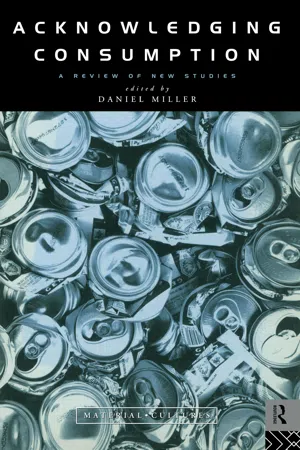
Acknowledging Consumption
About this book
A multi-disciplinary overview providing new theories, critical analyses and the latest reasearch on this very fashionable topic. Includes chapters on consumption studies in anthropology, economics, history, sociology and many more areas.
Information
1
CONSUMPTION AS THE VANGUARD OF HISTORY A Polemic by Way of an Introduction1
Daniel Miller
THE CONSUMER AS GLOBAL DICTATOR
This introduction examines the evidence presented in the subsequent chapters that there has been a considerable and relatively sudden expansion of interest in the topic of consumption throughout the social sciences. I shall argue that this is not merely one more topic to be added to various subdisciplines or bandwagons of academic concern. Rather it is a remarkably delayed acknowledgement of social and economic transformations at a global level that had previously suffered from extraordinary academic neglect. My argument is that consumption has become the vanguard of history and that there are clear reasons why the social sciences should previously have failed to acknowledge this development. The remaining chapters provide the evidence that they are now starting to address the consequences of these changes through developing the required perspectives and research. The introduction is intended as an explicit return to the ‘grand narrative’ tradition, which ironically has become most derided just as the moment when it has become most authentic to history as global-local articulation.
The subsequent chapters provide much of the evidence to support such a strong statement. Although addressing a variety of disciplines, each with its own historical trajectory, what is striking in their juxtaposition within this volume is that the study of consumption does not seem to represent merely an additional accretion—an extra topic to add to a list of previous concerns. Rather, in many cases the topic of consumption seems to present a fundamental challenge to the basic premises that have sustained each discipline up to the present. That this should happen in a single discipline might call for little further comment, but that there seems to be emerging evidence for an ‘across the board’ sea-change suggests something rather more fundamental with regard to the significance of consumption itself. Such studies may not only cause us to rethink our conception of consumption but also point to the need for a radical rethinking of areas of already acknowledged importance such as economics and politics.
At first the significance of the new study of consumption seems to arise almost fortuitously out of particular histories of particular disciplines. Fine shows how neoclassical economics has used tautology and subterfuge to deny the presence of a consumer that would destroy its key premises, while even the more promising approaches from political economy are still radically challenged by a clear focus upon consumption. Campbell argues that what seemed to be merely a pendulum swing away from productionist interests in sociology is actually a more profound questioning of the presumptions of the discipline as a whole. For psychology, Lunt suggests a similar potential but for now this remains only a ‘pollutant’ upon the purity of established psychology. Perhaps most surprising is Belk’s argument that even marketing studies has only within the last decade started to repudiate formally an unholy mixture of economics and psychoanalysis in order to acknowledge consumers, replete with the complex social relations within which they practise actual consumption.
We can see therefore that each discipline has its own specific grounds for viewing these new studies as of particular importance. But in a sense this begs a larger set of questions. Why should anthropology have previously been so ensconced in this romantic antipathy to the world of goods? Why should economics have succeeded for so long as an ideological abstraction based on quite bizarre models of how social beings actually act in the world? Why have we been so ready to accept premises and beliefs that, once put under the perspective of consumption, come to look so patently absurd? In particular, why should this be so within academic disciplines that are supposed to have been more self-critical than mere colloquial discourse?
The answer I believe lies in the hegemonic control by two major political ideologies conventionally termed the ‘right’ and the ‘left’, which first defined themselves by mutual opposition but second combine in their opposition to the notion of consumption as a political activity. These ideologies developed through the cold war oppositions between socialist and market economies. But they are more than political parties. They have emerged as the paradigmatic dimension upon which are clustered most ‘opinions’ held by modern populations with regard to anything from political preference to general orientation and behaviour. Defining themselves largely by opposition, the right and the left were thereby enabled to act for many decades as relatively abstracted theoretical structures increasingly protected from their consequences for the daily life of mass populations. This situation has recently changed and the rise of an explicit concern with consumption is symptomatic of this change.
I want to argue that the key to the prior political consensus by opposition and its protection from global realities was the rise to power of one particular academic discipline which attempted, where possible, to shift the world in the direction of increasing compliance with its abstract models. In short, modern politics has become a mere dependant of modern economics. What both resisted was historical change that threatens to make them increasingly impotent against the power of modern consumption processes. We are all brought up within the subsequent ideologies and it is therefore extremely difficult for us, as also for politicians, to acknowledge the degree to which economic instruments such as the International Monetary Fund and political parties of left and right are increasingly the agents, not of international capitalists so much as of international shopping. Both politicians and economists are, of course, having to rethink their roles in terms of global change. Thanks to the development of electronic communications, this is itself not mere pretension. Both in the financial centres, such as stock markets, and also in ordinary living rooms, computer screens and television may make global events closer to ‘home’ than neighbourhood events (e.g. Morley 1992:270–289).
Occasionally, however, there are also meetings when in effect ‘the globe’ delegates individuals to negotiate political and economic interests in a forum which comes closer to the traditions of ‘face to face’ encounters. One such example was the conference in Rio in 1992, which was largely concerned with environmental change and development. Many anecdotes abound about this conference, but one is of particular importance for the present topic. Not long before the conference it is said that various Third World countries requested that the topic of First World consumption be placed high on the agenda. The reasons for this request were evident enough to those who made it. From their perspective, on the periphery of the world economy, they were often subject to the clear and unmitigated consequences of certain economic shifts that are much more muddied and confused when they occur in the metropolitan core. The change in one commodity price such as bananas or Bauxite can spell the difference between poverty and fortune for many such countries. In earlier periods producers knew little as to the forces that created shifts in such demand. A famine might arise in eighteenth-century India because a fashion for calico in Europe persuaded many peasants to give up growing food in preference for either growing more cotton or taking to weaving. When that fashion changed, for no apparent reason, the peasant starved.
Today, however, the links between First World ‘taste’ and Third World suffering are understood by the producing nations and it has become evident that increasingly their destiny has become, in effect, a secondary effect of shifts in First World consumption patterns. Furthermore it was also the unspoken premise to both First and Third World delegates at Rio that First World consumption was the primary problem with respect to those environmental issues that were the official focus of concern. First World consumption was not, however, discussed in Rio and according to the anecdote (pers. comm. Desmond McNeil) there was an informal agreement that the Third World would not raise this as an issue if reciprocally the First World did not raise the issue of population control.
When First World consumption does inevitably come on the agenda, it will expose one of the most severe problems of the contemporary world, which is an increasing deficit in the concept of democratic politics. Officially, politics in democratic societies is the supreme exercise of the sovereign will of the mass population through the ballot box. This creates every few years a rise to consciousness and responsibility among the population as to a crucial decision, the consequences of which they must live with for the next period of history (hence the common post-election car sticker ‘Don’t blame me, I didn’t vote for them’). This then is the decision whose consequences are evident, the moment in which the population is itself politicised. In Trinidad (and I suspect elsewhere) there is a joke that makes the rounds at wedding receptions in which the best man notes that the wife will make all the unimportant decisions, such as the household budget, the children’s schooling etc., while the husband will make the important decision, as to who will win the next election. To varying degrees in most democratic countries there is a similar division of ‘significance’ between the properly politicised and the daily mundane world, and this is very commonly based also on a conception of gender differentiation.
The truth of this joke lies in the burden of responsibility taken by the housewife in everyday decision-making with regard to the use of household income on household expenditure. It is evident to all that most such decisions are in themselves trivial: the choice between two brands of the same product or between a cosmetic and a household cleaner. This hardly seems to bear the same weight as a change in government and anyway is generally regarded as merely the tail-end of capitalist strategic planning for profitability. This particular tail, however, is increasingly wagging the dog. As capitalism has become more sophisticated, it has harnessed the new forms of communication and driven deeper into competitive commoditisation of ever more niches of ordinary life. In the major supermarket chains of First World countries, for example, the display consists of an extraordinary range of food and non-food items. The aggregate decisions of housewives are relayed on a daily basis as the nature of demand. The supermarkets themselves have been pushed towards a relatively low percentage of profit extraction. Indeed, bulk-buying warehouses such as Cost-Co are likely to drive profit margins in Britain still lower: while in the United States the success of these out-of-town warehouses which are developing for each product range is credited with the relatively cheap prices of goods compared to Europe. Such margins are acceptable since, given the high volume of sales, the final profits can be impressive. Although each chain attempts to tempt customers with innovations and strategic plans, in general it is both economies of scale and the speed by which they can respond to shifting aggregate ‘taste’ that is the key to their success. Today they are able to restock almost on a daily basis with instant knowledge of the pattern of purchases. Their ability to analyse purchasing patterns through point of sale electronics makes them also the vanguard of marketing research.
This volume of sales has become the apex to increasing vertical integration whereby the retailers become ever more dominant over distribution and indeed manufacture. The degree to which First World economies have become concentrated around relatively few key retail operations has varied. This is partly in relation to the differences between commodity fields (see Fine and Leopold 1993) and partly in relation to different state attitudes to what threaten to become close to oligopolies if not monopolies (see Wrigley 1993a; Wrigley 1993b). Furthermore this may not be evident to consumers, since retailers in, for example, clothing, divide into six or eleven different stores in order to segment the market (Crewe and Foster 1993). Through vertical integration it is retailers who inform marketing and advertising as to trends in demand, and this in turn is fed back to producers and designers who are told to come up with a new (e.g. low-fat, or conspicuously more safety-conscious, or less gendered) version of a familiar commodity in order to fulfil this aspiration. This represents a distinct shift from the period when producers determined their own priorities and looked for ways to persuade the population to purchase the result (e.g. Galbraith 1969). It also represents an increasing move from opposition to collusion between producers and consumers. We see here only the beginnings of a larger trend which should not be overgeneralised. As anyone who has worked in business will testify, there are plenty of instances where, despite all the information on consumption available, brand managers do their work without much of a clue as to how to interpret or respond to changes in demand.
Retailers in turn feed back the demands for increasing economies of scale and, as the delegates of Rio might have observed (had they been given the opportunity!), this results in quite extraordinary road haulage and other polluting consequences since an international division of labour and an international competition for low-priced commodities create individual supermarket products combining ingredients of astonishingly far-flung origins and varied zones of primary processing. Supermarket and chainstore competition also act to suppress farm and other production level prices to their minimum. Although they may face considerable opposition from producer interests, as reflected in the European Common Agricultural Policy, such resistance is increasingly regarded as a tired legacy of an older ideology which should be removed. The major supermarket chains are often quite effective at squeezing out the middleman through this vertical integration. In general they thereby favour the overproduction of basic foodstuffs across the globe to help force down prices through overcompetition between producing nations, while retaining the power to shift quickly their source of raw materials to whichever gives the lowest costs at that time. In Chapter 4 Fine provides a concise review of some key recent developments in food retailing and the increasing significance of retailing in the British economy as a whole. This provides an example of what Jackson and Thrift in Chapter 6 call international ‘chains’, which seem to have developed far more quickly than our ability to trace and analyse them. It is not surprising then that retailing has a prominent role in several other chapters of this volume, including that of Glennie (Chapter 5), where it provides the main case-study.
But it would be quite wrong to identify the supermarket manager as the ‘villain’ of the piece, as a replacement of the role of the ‘top-hat’ capitalist of Marxist rhetoric and political imagery. The supermarket may gain considerable profits, but this is based upon the increasing scale of the enterprise, alongside a profit margin that otherwise might be seen as quite low. Certainly top managers and shareholders may gain disproportionate material rewards from this process. Today, however, most of the ‘value’ extracted from labour does not take the form of profits, but is manifested in benefits to First World consumers. Prices in real terms for non-basic foodstuffs have often dropped. Retailers whose long-term perspective persuaded them to cut prices rather than take quick profits have generally increased market share and survived best (Hallsworth 1992:43–49). But the improvement of value based on the rise of production efficiency and mass marketing is much more evident when price is broadened to the more general concept of convenience, where, as Becker and others noted, time is as important a measure of value as price. The majority of First World consumers have been almost entirely relieved of seasonality, of distance (once they possess a car) and of scarcity.
Supermarkets provide substances that would once have been rare and of prohibitive cost but now serve as mundane accompaniments for weekly purchasing. For the First World consumer, capitalism has in many respects ‘delivered the goods’, with vast increases in real wealth for all but a substantial minority. This is particularly the case when those benefits of welfare provision that are paid for by taxes on business are included. The rich of previous centuries might well look enviously at the possessions and mobility of the lower-middle class of today (this is not the less true for being a cliché). It is not just, as some suggest, a case of home commodities and appliances replacing the servants, since today it is the households of those who would once have been servants that also have the basic appliances and associated mass commodities. Overall low rewards for labour, while still creating handsome profits for transnational companies, are above all a means for ensuring low prices for consumers.
In the voluminous writings about post-Fordism there has certainly been considerable concern to document the shifts that have occurred in the global economy in recent decades. Yet it is remarkable how little acknowledgement is given to consumption. As Fine notes, this literature has re-established the assumed primacy of production that it was in part intended to critique. Consumption is either disregarded or reduced to postmodern style as a kind of ideological reflection of changes in production (as in Harvey 1989). An exception is Robin Murray, who pointed out ‘The groundwork for the new system was laid not in manufacturing but in retailing’ (Murray 1989:42). He notes four related changes:
- the ability of shops to use new information technology to match exactly supply to demand;
- the market niching of stores now carefully differentiated by segments defined by marketing research and recognised by designers;
- the dynamic forms of customisation with flexible automation;
- the degree of subcontracting by new firms such as Benetton.
What is missing even here, however, is the acknowledgement that retailing was in turn responding to the new forms of demand that preceded such commercial movements. This is the demand that followed from a global shift towards the pluralism of ‘roots’, ‘regionalism’, ‘identity politics’, ‘religious revivals’ and other anti-modernist movements that arose very quickly after 1968. This preceded and made essential the development of computer aided technology as providing the appropriate flexibility in production and distribution. It is this phenomenon that is misunderstood in most of the writings on postmodernism.
This does not mean that consumption has somehow overcome capitalism. Such a conclusion would have to assume that the interests of capitalism are necessarily opposed to those of consumer demand. Instead it may be that this new power of consumers actually assists capitalism’s search for profits. Instead of having to put considerable time and money into finding markets for goods and persuading consumers to buy, a manufacturing and distribution system that largely responds to consumers makes considerable potential savings in storage, in advertising and in reducing wasted investment. Theoretically, then, a demand-led capitalism should increase its potential profitability In practice, as noted above, it is more likely that the benefits would largely be shunted into better value for consumers. None of this represents an argument ...
Table of contents
- COVER PAGE
- TITLE PAGE
- COPYRIGHT PAGE
- MATERIAL CULTURES
- FIGURES
- CONTRIBUTORS
- 1: CONSUMPTION AS THE VANGUARD OF HISTORY A POLEMIC BY WAY OF AN INTRODUCTION
- 2: STUDIES IN THE NEW CONSUMER BEHAVIOUR
- 3: THE SOCIOLOGY OF CONSUMPTION
- 4: FROM POLITICAL ECONOMY TO CONSUMPTION1
- 5: CONSUMPTION WITHIN HISTORICAL STUDIES
- 6: GEOGRAPHIES OF CONSUMPTION
- 7: PSYCHOLOGICAL APPROACHES TO CONSUMPTION VARIETIES OF RESEARCH—PAST, PRESENT AND FUTURE
- 8: CONSUMPTION STUDIES AS THE TRANSFORMATION OF ANTHROPOLOGY
- 9: THEORIES OF CONSUMPTION IN MEDIA STUDIES
Trusted by 375,005 students
Access to over 1.5 million titles for a fair monthly price.
Study more efficiently using our study tools.
Frequently asked questions
Yes, you can cancel anytime from the Subscription tab in your account settings on the Perlego website. Your subscription will stay active until the end of your current billing period. Learn how to cancel your subscription
No, books cannot be downloaded as external files, such as PDFs, for use outside of Perlego. However, you can download books within the Perlego app for offline reading on mobile or tablet. Learn how to download books offline
Perlego offers two plans: Essential and Complete
- Essential is ideal for learners and professionals who enjoy exploring a wide range of subjects. Access the Essential Library with 800,000+ trusted titles and best-sellers across business, personal growth, and the humanities. Includes unlimited reading time and Standard Read Aloud voice.
- Complete: Perfect for advanced learners and researchers needing full, unrestricted access. Unlock 1.5M+ books across hundreds of subjects, including academic and specialized titles. The Complete Plan also includes advanced features like Premium Read Aloud and Research Assistant.
We are an online textbook subscription service, where you can get access to an entire online library for less than the price of a single book per month. With over 1.5 million books across 990+ topics, we’ve got you covered! Learn about our mission
Look out for the read-aloud symbol on your next book to see if you can listen to it. The read-aloud tool reads text aloud for you, highlighting the text as it is being read. You can pause it, speed it up and slow it down. Learn more about Read Aloud
Yes! You can use the Perlego app on both iOS and Android devices to read anytime, anywhere — even offline. Perfect for commutes or when you’re on the go.
Please note we cannot support devices running on iOS 13 and Android 7 or earlier. Learn more about using the app
Please note we cannot support devices running on iOS 13 and Android 7 or earlier. Learn more about using the app
Yes, you can access Acknowledging Consumption by Daniel Miller in PDF and/or ePUB format, as well as other popular books in Social Sciences & Consumer Behaviour. We have over 1.5 million books available in our catalogue for you to explore.