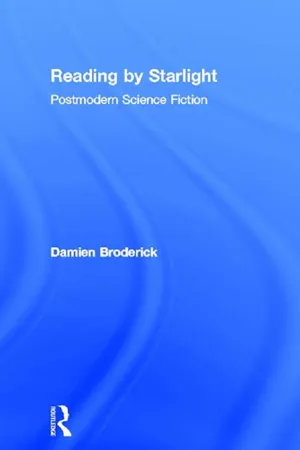
Reading by Starlight explores the characteristics in the writing, marketing and reception of science fiction which distinguish it as a genre.
Damien Broderick explores the postmodern self-referentiality of the sci-fi narrative, its intricate coded language and discursive `encyclopaedia'. He shows how, for perfect understanding, sci-fi readers must learn the codes of these imaginary worlds and vocabularies, all the time picking up references to texts by other writers.
Reading by Starlight includes close readings of paradigmatic cyberpunk texts and writings by SF novelists and theorists including Isaac Asimov, Arthur C. Clarke, Brian Aldiss, Patrick Parrinder, Kim Stanley Robinson, John Varley, Roger Zelazny, William Gibson, Fredric Jameson and Samuel R. Delaney.
- 216 pages
- English
- ePUB (mobile friendly)
- Available on iOS & Android
eBook - ePub
About this book
Information
Part I
MODERN SCIENCE FICTION
1
NEW WORLD, NEW TEXTS
A very secret revolution, which bears no name: objective knowledge, supposed, has taken the place of the subject. This transformation gives rise to a new world, to new texts, to another kind of thought.
(Michel Serres)1
Abstract thoughts in a blue room: Nominative, genitive, elative, accusative one, accusative two, ablative, partitive, illative, instructive, abessive, adessive, inessive, essive, allative, translative, comitative. Sixteen cases of the Finnish noun. Odd, some languages get by with only singular and plural. The American Indian languages even failed to distinguish number. Except Sioux, in which there was a plural only for animate objects. The blue room was round and warm and smooth. No way to say warm in French. There was only hot and tepid. If there's no word for it, how do you think about it?
(Samuel R.Delany)2
Sf? Already we are in trouble, because these initials are the accepted abbreviation of a whole sheaf of classificatory terms applied to texts produced and received in ways marked only (as we shall see) by certain generic, modal or strategic family resemblances. Sf, or sometimes SF, can stand for ‘scientifiction’, ‘science fiction’, ‘space fiction’, ‘science fantasy’, ‘speculative fiction’, ‘structural fabulation’ (just possibly including ‘surfiction’), perhaps ‘specular feminism’ and, in sardonic homage to right-wing sf at its most florid, ‘speculative fascism’.
A mass media version is the odious ‘sci fi’, a journalistic term3 taken over with bleak wit by some practitioners to denote junk sf—which is to say, crudely wrought or ill-conceptualised entertainments constructed around a few poorly understood narrative devices ripped rootless from any but the most meagre ‘sf mega-text’4 or shared universe established by generations of earlier sf-canonical writers. Those exhausted tropes are all too familiar: mad scientists, galumphing robots, thundering spaceships, ray-gun battles, cosy holocausts.
A mass media version is the odious ‘sci fi’, a journalistic term3 taken over with bleak wit by some practitioners to denote junk sf—which is to say, crudely wrought or ill-conceptualised entertainments constructed around a few poorly understood narrative devices ripped rootless from any but the most meagre ‘sf mega-text’4 or shared universe established by generations of earlier sf-canonical writers. Those exhausted tropes are all too familiar: mad scientists, galumphing robots, thundering spaceships, ray-gun battles, cosy holocausts.
In the first part of this book I restrict my attention largely to what has come to be called ‘Modern science fiction’,5 which hasn't got much in common with literary modernism. In the second half, we turn to writing that is better dubbed ‘postmodern’, this time in both senses of the word. Taken together, these comprise the corpus of commercial, usually American, post-World War II sf writing readily available in English.6
THE LINEAGE OF SF
Like parvenus attempting to purchase respectability by the adoption of extinct arms, some sf enthusiasts have sought to establish a direct lineage springing from, for example, the ancient Mesopotamian Epic of Gilgamesh, and passing through the non-realistic chapters of various sacred scriptures to Lucian of Samosata's True History (c. 150), More's Utopia (1516), Bacon's New Atlantis (1627), Kepler's Somnium (1634), and scores of other texts, not excluding myths, legends, folklore and fables.7 None of this, finally, is persuasive. Sf, which is often crucially concerned with the strictly unforeseeable social consequences of scientific and technological innovation, is principally a diachronic medium—that is, a medium of historical, cumulative change, in which each step is unlike the last.8 Myth, by contrast, operates typically and primarily in a synchronic or ‘timeless’ dimension, while fairytale, and often legend and archaic ‘history’, tracks the ‘cyclical’ time of individual psychic and social development.9
In Billion Year Spree10 Brian Aldiss argued for Mary Shelley's Frankenstein (1818) as the Ur-sf novel, a view which has prevailed widely without much acknowledgement, to Aldiss's public annoyance, that his was the case which established it. Subsequently he remarked that
perhaps the quest for the First SF Novel, like the first flower of spring, is chimerical. But the period where we should expect to look for such a blossoming is during the Industrial Revolution, and perhaps just after the Napoleonic Wars, when changes accelerated by industry and war have begun to bite, with the resultant sense of isolation of the individual from and in society.11
The late Dr Isaac Asimov, sf practitioner and interested observer, summed up this case for a recent emergence of sf as a distinctive kind of writing:
True science fiction deals with human science, with the continuing advance of knowledge, with the continuing ability of human beings to make themselves better understand the universe and even to alter some parts of it for their own comfort and security by the ingenuity of their ideas. If that is so, then science fiction becomes quite a modern phenomenon and cannot claim the respectability of age.12
Leaving aside the remarkable complacency of this passage, surely humans have employed systematised knowledge prior to the present blessed epoch?
Well, explains Asimov, it is the rate and scale of the thing which is crucial. Until recently, ‘such advances were made so slowly...that individual human beings were not particularly aware of change in the course of their own lifetimes.... It is characteristic of technology, however, that it is cumulative. The further it advances the faster it advances.’ Eventually, the pace hotted up to the point where individuals could appreciate from the testimony of their own lives that ‘the world was changing and that it was human thought and human ingenuity that was the agent of the change’:
We can then define science fiction as that branch of literature that deals with the human response to changes in the level of science and technology —it being understood that the changes involved would be rational ones in keeping with what was known about science, technology and people.
True science fiction...could not have been written prior to the nineteenth century then, because it was only with the coming of the Industrial Revolution in the last few decades of the eighteenth century that the rate of technological change became great enough to notice in a single lifetime.
(Asimov et al. 1983, pp. 10–11)
More than a generic description, this is a fervent valorisation of sf as, quite explicitly and with no indication of the problematics involved in the claim, ’today's literature; and, more than that, tomorrow's’ (ibid., p. 12).
Asimov's account unblushingly echoes a clarion call raised thirty years earlier by John W.Campbell, Jr, usually regarded as the prime shaper of Modern science fiction. Introducing his landmark volume The Astounding Science Fiction Anthology,13 drawn from the magazine he edited, Campbell announced a stunningly hubristic agenda:
Science fiction is the literature of the Technological Era. It, unlike other literatures, assumes that change is the natural order of things, that there are goals ahead larger than those we know. That the motto of the technological civilization is true: ‘There must be a better way of doing this!’
Basically, of course, the science fictioneer is simply the citizen of the Technological Era, whose concern is, say, the political effect of a United States base on the Moon.
(Campbell, 1952, pp. xiii, xv)
In all truth, Campbell's innovative stable of writers produced work far more various and provocative than such a one-dimensional, gung-ho programme would seem to encourage or even permit. Still, as writer, editor and bullying folk-theoretician, Campbell was so saliently placed during the rise of Modern sf that his manifesto is worth citing at some length. Like the stories it prefaced, it was ‘representative of the moods and forces at work in the development of the new literature of the Technological Era’:
It is essential in the nature of things that there is, at such a period of changeover, two different literatures. One, the old, will at this period be bitter, confused, disillusioned, and angry. Those novelists dealing with broad themes will have stories of neurotic, confused and essentially homeless-ghost people: people who are trying to live by conventions that have been shattered and haven't been able to build new ones, who have seen every effort to build a new stable society wrecked by new forces.
The new literature will tend to be filled with a touch of unreality, but will tell of goals and directions and solid hopes. Naturally it has a touch of unreality; the old goals are gone, the new ones not yet here. Therein is the implicit unreality of any hopeful, optimistic literature of such a period; it asserts that the goal is real, but not yet achieved. Most people want goals that someone has already achieved and reported on fully.14
(ibid., p. xiv; italics in original)
Does this make sf the peak of literature to date? Given the textual surface of some of the effective but strikingly primitive stories he included in his anthology—‘The creature crept. It whimpered from fear and pain, a thing, slobbering sound horrible to hear. Shapeless, formless thing yet changing shape and form with every jerky movement’15—Campbell wisely failed to go so far in his claims. ‘Science fiction isn't as yet the mature literature it should be, and will be,’ he confessed. Still, its prospects were firm. It ‘has a place that never existed before—but will exist forevermore’ (ibid., p. xv).
DEFINITIONS
There has been no lack of attempts to reach a satisfactory definition of this ‘new literature’. The first edition of the authoritative Encyclopedia of Science Fiction, edited by Peter Nicholls et al.,16 cited no less than 22 such definitions plus several additional caveats, before summarising (rather feebly): ‘A survey of the accounts of the genre quoted above reveals two main expectations: that a work of sf should be concerned with the extension of scientific knowledge and all manner of consequences thereof; and that it should be imaginatively and intellectually adventurous; and even the former is not universally accepted’ (Nicholls et al., 1979, p. 161).
Sf historian Brian Stableford asserts that the earliest use of the expression is found in one William Wilson's A Little Earnest Book Upon a Great Old Subject (1851), in which, discussing ‘the Poetry of Science’, he defined Science Fiction as a kind of literature ‘in which the revealed truths of science may be given, interwoven with a pleasing story which may itself be poetical and true—thus circulating a knowledge of the Poetry of Science, clothed in a garb of the Poetry of Life’.17
This can be seen, though, as merely an elaboration of the project glimpsed prophetically half a century earlier by Wordsworth in his Preface to the second edition of Lyrical Ballads: The remotest discoveries of the Chemist, the Botanist, or the Mineralogist, will be as proper objects of the Poet's art as any upon which it can be employed, if the time should ever come when these things shall be familiar to us...as enjoying and suffering beings.’18 In short: nothing human is alien to the poet, and if the human practice of science should ever receive general currency its subject matter will perforce enter the discourse of letters. An example of just this is Don DeLillo's White Noise,19 a novel dealing with industrial and intellectual pollution—hardly sf by contemporary standards. The fifties retro image many people have today of sf, pulp magazine tales of brass-bra'd space kittens struggling in the ghastly clutches of bug-eyed monsters, was not quite what either Wilson or Wordsworth had in mind.
The nineteenth century was thick with rudimentary sf of one kind or another. Darko Suvin's bibliography of sf books published between 1848 and 1900 in the UK comprises 72 pages.20 The two innovative giants are usually held to be Jules Verne and H.G.Wells, the first preceding the second by some 30 years.21 The definitions immanent in their works have proved fecund: Verne playing with the known, to the best of his ability, mining newspapers for plausible details, Wells inventing from first principles. An important shared characteristic of the ‘scientific romances’ and ‘extraordinary voyages’ of Wells and Verne was their work's accessibility to a wide general readership. Sf had not yet become stigmatised as a genre for undersexed male adolescent swots and underachieving white-collar wage-slaves—partly because it had not yet largely been restructured to that purpose, as it was shortly to be, by commercial interests.
Generic sf was given its definition in the first issue (April 1926) of the bedsheetsized pulp Amazing Stories magazine. Hugo Gernsback editorialised:
By ‘scientifiction’22 I mean the Jules Verne, H.G.Wells and Edgar Allan Poe type of story—a charming romance intermingled with scientific fact and prophetic vision.... Not only do these amazing tales make tremendously interesting reading—they are always instructive. They supply knowledge... in a very palatable form.... New inventions pictured for us in the scientifiction of today are not at all impossible of realisation tomorrow.23
Campbell, as noted earlier, presented sf as the optimistic literature of the future. Moreover, he proposed what has been termed in a borrowing from physics the Gedankenexperiment—or ‘thought-experiment’—paradigm:
Scientific methodology involves the proposition that a well-constructed theory will not only explain away known phenomena, but will also predict new and undiscovered phenomena. Science fiction tries to do much the same24—and write up, in story form, what the results look like when applied not only to machines but to human society as well.25
A MYTHOLOGY OF TOMORROW
At an extreme remove from Campbell's positivist prospectus, sf is often claimed as the myth-form of the industrial age. Whether or not sf is best identified as myth, it clearly has this much in common with myths and dreams as we have come to understand them in an era shaped by structuralism and psychoanalysis: science fiction stories make little sense in isolation from others of their kind. Without its unorthodox vocabulary and grammar, its generic intertextuality, science fiction is next to meaningless. Once acquired, it becomes a tongue muscular in the expression of cognitive excitement, wonder, awe, astonishment: states and emotions repressed in a workaday world. More, these sentiments are linked, in sf, to the century's motor: to knowledge sought and gained by science.
The couple is not direct. If dreams often express wishes and fears we would rather disown (like the ‘black arts’ of magic), science fiction is an outlet for what might be called ‘black science’. Dreams of omnipotence through abstract knowledge, hunger for gods out of the machine. These are dangerous desires. They lead too easily to goose-stepping, to napalm nightmares: all the monsters bred, as Goya foresaw, of the dreams of reason. They are, in short, a regression to the pleasures of infancy, the endlessly accepted temptation to which commercial sf all too often delivers itself.
Indeed, more than two decades ago, the fine sf writer a...
Table of contents
- Cover Page
- Half Title Page
- POPULAR FICTIONS SERIES
- Title Page
- Copyright Page
- Dedication
- Contents
- Acknowledgements
- Introduction
- Part I Modern Science Fiction
- 1 New World, New Texts
- 2 Generic Engineering
- 3 Genre or Mode?
- 4 The Uses of Otherness
- 5 Reading the Episteme
- 6 Dreams of Reason and Unreason
- 7 The Stars My Dissertation
- Part II Postmodern Science Fiction
- 8 Making Up Worlds
- 9 Allography and Allegory
- 10 Sf as a Modular Calculus
- 11 The Multiplicity of Worlds, of Others
- 12 The Autumnal City
- Notes
- Bibliography
- Index
Trusted by 375,005 students
Access to over 1.5 million titles for a fair monthly price.
Study more efficiently using our study tools.
Frequently asked questions
Yes, you can cancel anytime from the Subscription tab in your account settings on the Perlego website. Your subscription will stay active until the end of your current billing period. Learn how to cancel your subscription
No, books cannot be downloaded as external files, such as PDFs, for use outside of Perlego. However, you can download books within the Perlego app for offline reading on mobile or tablet. Learn how to download books offline
Perlego offers two plans: Essential and Complete
- Essential is ideal for learners and professionals who enjoy exploring a wide range of subjects. Access the Essential Library with 800,000+ trusted titles and best-sellers across business, personal growth, and the humanities. Includes unlimited reading time and Standard Read Aloud voice.
- Complete: Perfect for advanced learners and researchers needing full, unrestricted access. Unlock 1.5M+ books across hundreds of subjects, including academic and specialized titles. The Complete Plan also includes advanced features like Premium Read Aloud and Research Assistant.
We are an online textbook subscription service, where you can get access to an entire online library for less than the price of a single book per month. With over 1.5 million books across 990+ topics, we’ve got you covered! Learn about our mission
Look out for the read-aloud symbol on your next book to see if you can listen to it. The read-aloud tool reads text aloud for you, highlighting the text as it is being read. You can pause it, speed it up and slow it down. Learn more about Read Aloud
Yes! You can use the Perlego app on both iOS and Android devices to read anytime, anywhere — even offline. Perfect for commutes or when you’re on the go.
Please note we cannot support devices running on iOS 13 and Android 7 or earlier. Learn more about using the app
Please note we cannot support devices running on iOS 13 and Android 7 or earlier. Learn more about using the app
Yes, you can access Reading by Starlight by Damien Broderick in PDF and/or ePUB format, as well as other popular books in Literature & Literary Criticism. We have over 1.5 million books available in our catalogue for you to explore.