Imperial Germany, 1871-1918 explores the rise of Germany as a nation state and a European power centre, through to the humiliation of the state in the First World War. Covering both domestic and foreign policy, this key text combines historical detail, questions and analysis and evaluation of primary sources.
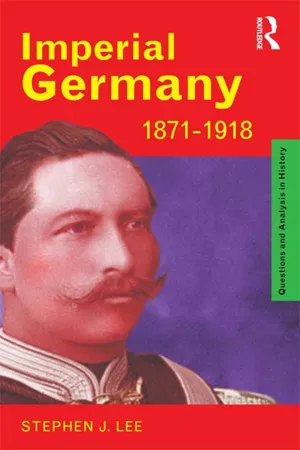
- 144 pages
- English
- ePUB (mobile friendly)
- Available on iOS & Android
eBook - ePub
Imperial Germany 1871-1918
1
THE FORMATION AND STRUCTURE
OF THE GERMAN EMPIRE
BACKGROUND NARRATIVE
The German Empire (sometimes referred to as the Kaiserreich) was formally proclaimed in the Hall of Mirrors in the Palace of Versailles on 18 January 1871. This somewhat strange venue was a result of the way in which the new state was put together.
Before 1866 ‘Germany’ had been a loose term. Its political form was the German Confederation, set up at the Congress in Vienna (1815) to replace the Holy Roman Empire—the so-called ‘thousand-year Reich’ which had been founded in the ninth century by Charlemagne and ended in 1806 by Napoleon. The German Confederation had comprised most of Prussia, the Austrian and Bohemian provinces of the Austrian Empire and thirty-nine smaller states which had their own rulers. The Confederation had a central Diet, or executive council, but no overall executive apart from the nominal presidency of Austria.
Before the late 1850s moves towards closer unity had been sporadic and unpredictable. One underlying impetus had been cultural, with the emphasis on a shared heritage and common linguistic identity greatly accentuated by the Romantic movement. Another trend had been an early alliance between lallied to popular uprisings, overthrew liberalism and nationalism. In 1848 liberals allied to popular uprisings, overthrew the governments in Berlin, Munich and Vienna, and forced the election of the Frankfurt Assembly. This sought to establish a united Germany based on a progressive constitution, only to find the forces of counterrevolution, led by Austria, too strong: the scheme had therefore collapsed. A third force had been economic, with the growth of the Zollverein, or customs union, which had linked most of the smaller German states with Prussia but had excluded the whole of Austria.
There had, therefore, been long-term influences behind the emergence of a German state. But unification meant directing the cultural and economic flows into a more viable political channel. From the late 1850s the influence of Prussia increased. The impetus was accelerated rapidly by Wilhelm I of Prussia who began to think in terms of Prussian dominance over Germany in 1861. This involved doubling the Prussian army, and securing the approval of the Prussian Landtag (or parliament) for an increase of 400,000 men. The resulting constitutional conflict was won by Otto von Bismarck, appointed Minister President of Prussia in 1862. Over the next nine years Bismarck involved Prussia in three wars, during which the smaller German states were removed from the presidency of Austria, the German Confederation was dissolved and Prussia expanded to form a new and more fully integrated Germany. In retrospect the events from 1863 to 1871 seem to have led inexorably to German unity, although there has been some dispute among historians as to how much of this was intentional. This is examined in Analysis 1.
The outline chronology is as follows: the conflicts started in 1864 when Christian IX attempted to incorporate the neighbouring duchies of Schleswig and Holstein into his kingdom of Denmark. These had previously been under the rule of the Danish monarch but separate from the state of Denmark. Since Holstein was predominantly German speaking, it received the support of a number of smaller German states. Prussia and Austria quickly entered the fray and sent troops to prevent the annexation. The outcome of a one-sided conflict was the Treaty of Vienna (1864), whereby the King of Denmark renounced all claim to the duchies. By the Convention of Gastein (1865) between Austria and Prussia, the former was to administer Holstein and the latter Schleswig.
This arrangement soon produced a conflict between Prussia and Austria. Prussian rule over Schleswig was far tighter than that of Austria over Holstein; the result was an accusation that dissidents in Holstein were seeking to undermine Schleswig. In a dispute over the future of the two duchies, Prussia declared war on Austria in 1866, most of the smaller German states siding with the Austrians. Prussian armies quickly defeated Saxony, Hesse and Hanover, while the Austrians were defeated at Sadowa, or Königgratz, within six weeks. By the Treaty of Prague the German Confederation was dissolved and Austria gave up all claim to control within Germany. Prussia proceeded to annex both Schleswig and Holstein, as well as Hanover, and to convert the rest of the smaller states of north and central Germany into a new North German Confederation closely controlled by Prussia.
The three south German states of Bavaria, Baden and Württemberg were not included until 1871, when the North German Confederation was transformed into the German Empire. The catalyst for this was a third war, this time between Prussia—or the North German Confederation—and France. The traditional view is that Bismarck provoked the French Emperor, Napoleon III, into committing a series of diplomatic blunders, thereby alienating the south Germans who had initially looked to France for support against Prussia. In 1870 Bismarck rewrote and published a telegram sent to him by Wilhelm I of Prussia. In its edited version this gave the impression that Wilhelm had insulted the French government in his dealings with it about the possibility of the throne of Spain being occupied by a junior member of the house of Hohenzollern; this would have provided a link, however tenuous, with Prussia. Napoleon III, confident of victory, declared war on Prussia, only to see the French armies defeated at Metz and Sedan. He was forced to abdicate, and, by the Treaty of Frankfurt (1871), France surrendered Alsace and Lorraine to Germany.
The newly proclaimed German Empire was in theory a federation of autonomous, mostly monarchical states. In practice, it was dominated by Prussia, the king of which was also the Emperor, or Kaiser. The Minister President of Prussia was usually the Imperial Chancellor: until 1890 both positions were held by Bismarck. The extent of the liberal and authoritarian influence on the institutions of the Reich are examined in Analysis 2.
ANALYSIS (1):
HOW WAS GERMANY UNITED?
The narrative answer to this question has already been provided. There are, however, two issues connected to these events which need to be analysed. First, was a united Germany actually planned by those who brought it about? And second, was Prussia necessarily the natural core for this unity?
There was for a long time a tendency to see the whole process of German unification as planned and systematic. Grant Robertson, for example, maintained that it was a ‘marvellous march of events, in which each stage seems to slip into its pre-appointed place’. (1) The argument that unification was preplanned may be summarised as follows: Bismarck helped precipitate the events which brought about unification. He involved Prussia in the war against Denmark. He insisted on the separate administration of Schleswig and Holstein which he later exploited to provoke a war with Austria in 1866. He then encouraged Napoleon III to make claims against the southern German states, Belgium and Luxembourg. At the same time, he developed a series of agreements to isolate Napoleon III, including a generous Treaty of Prague with Austria, a diplomatic accord with Russia over Polish refugees fleeing into Prussia, and an alliance with Italy (1866). He then manipulated the crisis over the Spanish candidature, knowing full well that his version of the Ems telegram would provoke Napoleon III into a declaration of war on Prussia. To an extent Bismarck himself started the myth. In 1862 he provided Disraeli with an outline of his intentions: ‘When the army has been brought to such a state as to command respect, then I shall take the first opportunity to declare war with Austria, burst asunder the German Confederation, and give Germany a national union under the leadership of Prussia.’ (2)
In the fullness of time this approach came to be strongly challenged as revisionist historians stressed that the whole process of unification was entirely fortuitous and not deliberately engineered by Bismarck. A.J.P.Taylor believed that German unity occurred despite Bismarck, who wanted no further war after that with Austria in 1866: ‘In truth, the French blundered into a war which was not unwelcome to them: and Bismarck, though taken by surprise, turned their blunder to his advantage.’ (3) Taylor denied that Bismarck had any blueprint or plan for German unity. It could certainly be argued that any of Bismarck's statements about his proposals for the future were sufficiently vague to lack the element of planning which a blueprint involves. That they were eventually fulfilled can therefore be seen as pure coincidence.
Additional evidence against the original ‘intentionalist’ argument comes from the diplomatic situation in Europe at the time. Unification was therefore due quite as much to the conjunction of uniquely favourable external factors as to the insight of Bismarck. What he did was to manipulate events as they occurred rather than shape them from the outset. The main external impediments to German unification had been the position of Austria and the attitudes of Russia and France. Austria had been severely weakened by the upheavals of the mid-nineteenth century. From 1815 her position in Germany and Italy had rested on close collaboration with Russia which, indeed, had helped put down the revolution of Hungary against Austria in 1848–49. But the Crimean War (1854–56) and consequent Russian defeat meant the withdrawal of Russia into a period of diplomatic isolation and the connection with Austria was cut. This coincided with an increase of Italian nationalism which resulted in a weakened Austria being driven from northern Italy by a combination of Piedmontese and French troops in 1860. Already undermined in Italy, Austria was not ideally placed to resist the march of Prussia in Germany. Meanwhile, France was being seen increasingly as the most likely aggressor in Europe. This was certainly the view of British statesmen like Palmerston, who were concerned at the prospect of French expansion at the expense of Belgium and Luxembourg, a scenario Palmerston had already helped to prevent while he had been Foreign Secretary during the 1830s. In the circumstances, therefore, Bismarck had to work no harder at discrediting and isolating France in Europe than he had over weakening the position of Austria in Germany. They were simply happening.
These represent the poles of interpretation. But there is a viable alternative. It is possible to combine the exigencies of the situation in Europe with the actions taken by Bismarck to develop a scenario in which unity was intended, but the measures taken were purely in response to the situations as they arose. The emphasis is therefore restored to Bismarck as interventionist—but primarily as a pragmatist and opportunist. Indeed, it seems that this is how he saw himself. He regarded events as part of an irresistible ‘time stream of history’. He believed that ‘One cannot make history.’ It was, nevertheless, possible to be part of that time stream by understanding and manipulating events. ‘Man cannot create the current of events. He can only float with it and steer.’ (4) It was, however, essential to be able to pursue several strategies simultaneously. As one after the other was closed off by events the one that remained would appear to have been planned from the outset. Bismarck therefore tended to delay vital decisions until the situation was entirely clear—this enabled him to move history into one of the channels which had always existed as a possibility. This ‘strategy of alternatives’ is one way of understanding his dealings with Austria and France. In the case of Austria he followed several lines. He promoted an alliance in 1864; he followed this by the Convention of Gastein which, he hoped, would induce Austria to yield to Prussia the lion's share of control in northern Germany. If it did not, then the situation in Schleswig and Holstein could be used at some time in the future to precipitate a conflict between Austria and Prussia. Similarly, Bismarck followed several courses in his diplomacy with France. He kept Napoleon III friendly by vague hints of territorial gain in the area of the southern Rhineland. At the same time, he was in no hurry to complete unification with the south, hoping that this might be accomplished through peaceful means, possibly through the establishment of a common Federal Customs Council. Eventually, however, it became clear that Baden, Württemberg and Bavaria were too friendly with France for Bismarck's liking. He therefore used the diplomatic blunders of Napoleon III to drive a wedge between France and the south German states: he publicised Napoleon's demands for the Saarland and for Bavarian and Hessian territory in the Rhine area. He was not, however, convinced until 1870 that Prussia would benefit from war with France. The Hohenzollern candidature offered him the opportunity to bring to a head a crisis with France: one of the channels he had anticipated.
It is arguable, therefore, that German unification was intended but not planned. In which case was the Prussian base its most logical form?
In some ways it was not. Almost all the smaller German states supported Austria in the Confederation Diet over the constitutional crisis concerning Schleswig and Holstein in 1866. Many mobilised against Prussia and ended up united by conquest; some states, like Hanover, lost their separate identities altogether and ended up being absorbed into Prussia itself. In a sense, therefore, unification was imposed upon the smaller German states against their preference for a looser and more traditional association with both Prussia and Austria. The parliamentary approach to the problems of the 1860s favoured Austria. The military approach was Prussia's and the smaller states had to be brought into submission to Prussia, and Austria herself defeated.
Even then the process was incomplete and Bismarck faced the suspicion, even hostility, of the southern states; hence his delay in trying to incorporate them and the need to use Napoleon III's blunders. It is sometimes argued that the southern states’ continued preference for Austria was primarily for religious reasons. This may well have been the case with Bavaria, the population of which was predominantly Catholic. But Baden and Württemberg had strong Protestant traditions going back to the sixteenth-century Reformation. We should therefore be suspicious of this line of reasoning. It seems that it was a case of the south Germans being more wary of Prussia than feeling an attachment to Austria.
All this might appear to point to the Prussian initiative for unification being one which was entirely artificial and brutally imposed. In a sense this is what Bismarck said when he warned the Prussian Landtag in the Army Bill debate of 1862 that Prussian predominance in Germany must be based on military security. ‘Germany looks not to Prussia's Liberalism but to her power… The questions of the day will not be decided by speeches and majority decisions… but by blood and iron.’ (5) We could see this as a continuation of a traditional approach based on Prussian expansion within Germany rather than Prussian leadership over Germany. This had certainly been the aim of Frederick the Great (1740–86), who extended Prussia by absorbing Silesia and part of Saxony. Bismarck has often been seen as his natural successor; not being a ‘German’ nationalist, his premise was that ‘Prussians we are and Prussians we shall remain.’
Yet it is possible to move so far in this direction that we can end up with the view ...
Table of contents
- Front Cover
- Half Title
- QUESTIONS AND ANALYSIS IN HISTORY
- Title Page
- Copyright
- Contents
- Series Preface
- Acknowledgements
- 1 The formation and structure of the German Empire
- 2 Domestic policies, 1871–90
- 3 Foreign and colonial policies, 1871–90
- 4 Domestic policies, 1890–1914
- 5 Foreign and imperial policies, 1890–1914
- 6 Economy and society, 1871–1914
- 7 War and collapse, 1914–18
- Notes
- Bibliography
- Index
Trusted by 375,005 students
Access to over 1.5 million titles for a fair monthly price.
Study more efficiently using our study tools.
Frequently asked questions
Yes, you can cancel anytime from the Subscription tab in your account settings on the Perlego website. Your subscription will stay active until the end of your current billing period. Learn how to cancel your subscription
No, books cannot be downloaded as external files, such as PDFs, for use outside of Perlego. However, you can download books within the Perlego app for offline reading on mobile or tablet. Learn how to download books offline
Perlego offers two plans: Essential and Complete
- Essential is ideal for learners and professionals who enjoy exploring a wide range of subjects. Access the Essential Library with 800,000+ trusted titles and best-sellers across business, personal growth, and the humanities. Includes unlimited reading time and Standard Read Aloud voice.
- Complete: Perfect for advanced learners and researchers needing full, unrestricted access. Unlock 1.5M+ books across hundreds of subjects, including academic and specialized titles. The Complete Plan also includes advanced features like Premium Read Aloud and Research Assistant.
We are an online textbook subscription service, where you can get access to an entire online library for less than the price of a single book per month. With over 1.5 million books across 990+ topics, we’ve got you covered! Learn about our mission
Look out for the read-aloud symbol on your next book to see if you can listen to it. The read-aloud tool reads text aloud for you, highlighting the text as it is being read. You can pause it, speed it up and slow it down. Learn more about Read Aloud
Yes! You can use the Perlego app on both iOS and Android devices to read anytime, anywhere — even offline. Perfect for commutes or when you’re on the go.
Please note we cannot support devices running on iOS 13 and Android 7 or earlier. Learn more about using the app
Please note we cannot support devices running on iOS 13 and Android 7 or earlier. Learn more about using the app
Yes, you can access Imperial Germany 1871-1918 by Stephen J. Lee in PDF and/or ePUB format, as well as other popular books in History & 19th Century History. We have over 1.5 million books available in our catalogue for you to explore.