eBook - ePub
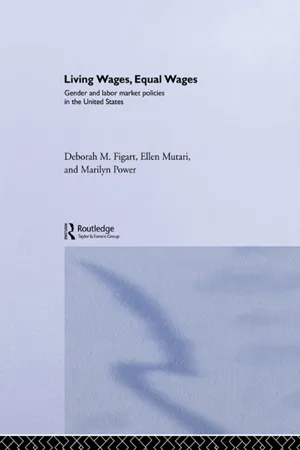
Living Wages, Equal Wages: Gender and Labour Market Policies in the United States
- 272 pages
- English
- ePUB (mobile friendly)
- Available on iOS & Android
eBook - ePub
Living Wages, Equal Wages: Gender and Labour Market Policies in the United States
About this book
Wage setting has historically been a deeply political and cultural as well as economic process. This informative and accessible book explores how US wage regulations in the twentieth century took gender, race-ethnicity and class into account. Focusing on social reform movements for living wages and equal wages, it offers an interdisciplinary account of how women's work and the remuneration for that work has changed along with the massive transformations in the economy and family structures.
The controversial issue of establishing living wages for all workers makes this book both a timely and indispensable contribution to this wide ranging debate, and it will surely become required reading for anyone with an interest in modern economic issues.
Part I
Laying the Groundwork
Methodological Frameworks and Theoretical Perspectives
1 Introduction
Living Wages, Equal Wages, and the Value of Women’s Work
Throughout history and across cultures, women have always worked, and their work has been essential in providing food, clothing, and shelter for their families. That work has taken many forms, from gathering wild food to churning butter, from selling handicrafts in the marketplace to working in a textile factory, from assisting executives to caring for the sick, from selling real estate to designing web pages and computer software. But women’s work was not always work for a wage. In fact, at the beginning of the twentieth century, waged work was viewed as an essential part of men’s, but not women’s, identities.
Wage labor, in contrast to owning a farm or being an independent artisan, was once viewed as undesirable and analogous to slavery. In the nineteenth-century United States, the growth of industrialization and the influx of landless immigrants meant that an increasing proportion of people, especially men, came to rely on working for a wage as a means of provisioning. Breadwinning came to be viewed no longer as subjection to a master, but rather as a means to economic independence. By the turn of the twentieth century, working men joined unions and struggled with employers to achieve a family wage, defined as a wage sufficient to support a dependent wife and children.1
As masculinity was redefined to incorporate and legitimate wage labor, a family structure based upon a male breadwinner and female homemaker was idealized. The fact that some women also worked for wages became increasingly problematic. Women were largely excluded from wage labor unless their families had no other means of providing for their needs. This escape clause in the idealized vision of the male breadwinner family actually accounted for a substantial amount of economic activity in the formal and informal economy. Daughters in immigrant families, widows, and other poor women, including a higher proportion of African American than white women, participated in waged work. Other women continued their work in farming or handicrafts, took in boarders, did laundry at home, and performed a variety of other income-generating activities. This was market-oriented work, but it took place on the periphery of capitalist production.
Gradually over the twentieth century, women’s productive work came to be incorporated into the industrialized economy. What was once made in the home – clothing and canned food, for example – was now produced in factories and purchased for use in the home. At the same time, women began to enter wage labor in rapidly expanding numbers.
From the moment women became an established presence in wage labor, questions were raised about what their labor should be worth. The struggle of male workers for a family wage implied the presence of a wife who did not financially support herself or children. Mothering was identified as women’s primary life purpose. Should women, then, be paid as much as men, or should they be paid less, so as to maintain their dependent relation to men? Would paying women “too much” encourage them to abandon their roles as wives and mothers for lives of alleged waged comfort and ease? Would paying them “too little” injure their health (and therefore their futures as mothers) or drive them into prostitution? Was the relative value of mothering versus paid labor different for working-class and nonwhite women than their white, middle-class sisters? Debate over women’s wages ranged over the entire twentieth century and continues today. And, as these questions make clear, it was not simply a debate over objective market values. What women should be doing and how women should live were questions that infused the debate from the beginning, with class and race-ethnicity playing central, although not always explicit, roles. Men, too, have gender, and debates over their wages were also inflected with gender, race-ethnicity, and class implications. As Nancy Fraser and Linda Gordon comment, “The family wage . . . was a vehicle for elaborating meanings of dependence and independence that were deeply inflected by gender, race, and class” (1994: 319).
Women’s and men’s wages therefore derived from a complex interaction of social and cultural assumptions, market forces, and government regulation. This book traces the debates leading to government regulations and policies regarding wages over the course of the twentieth century to illustrate this interaction. Public policy discussions offer a rare opportunity to examine the underlying assumptions about wage setting during a particular historical period. During debates over wage regulations and practices, economic actors often pause to articulate implicit wage theories, that is, what they see as the basis for setting wages. These implicit wage theories affect wage outcomes directly, as these same actors (employers, unions, etc.) interact in labor markets.
Wage theories also operate indirectly. Succinctly, implicit wage theories affect wage regulations which, in turn, affect wage-setting processes. Although, in the final analysis, wages may be set by firms interacting with employees or employee organizations, these market transactions are embedded in a social fabric constituted by such institutions as the state and families. Therefore, we view the process of wage setting as something that can be studied at the macro and meso (organizational, institutional) levels as well as the micro. Our research is meant to supplement microeconomic studies of wages, not supplant them. Wage setting, we argue, is a deeply political and cultural, as well as an economic, process. By recognizing that wages serve multiple functions and contain multiple meanings, we can better grasp the complexity of wage-setting processes.
We identify three implicit wage theories in twentieth-century debates over regulations in the United States: wages as a living, as a price, and as a social practice. By wages as a living we mean the argument that the purpose of the wage is to provide an adequate level of support for the worker (and, for some theorists, her dependents as well). Arguments for wages as a living were particularly prevalent among classical political economists of the eighteenth and nineteenth centuries, and continue to be espoused by political economists and political activists up to the present. Wages as a price focuses on the equality between remuneration and an employee’s contribution to production. In addition, this intellectual construct treats the wage-setting process as analogous to that of any other commodity price, as an amount arrived at through the workings of supply and demand in the marketplace. While all schools of economic thought recognize the role of markets in wage setting, a narrow focus on wages as a price is primarily characteristic of mainstream, neoclassical economics.
To these two standard economic views we add wages as a social practice. The concept of wages as a social practice emphasizes the socially and historically specific process of wage setting. Wages are a means of reinforcing or changing cultural understandings of workers’ appropriate “places.” As a concrete social practice, wages shape as well as reflect gender, class, and race-ethnicity. Both mainstream and heterodox economic theories have tended to neglect this dimension of wages and therefore present incomplete analyses of wages. Rather than recounting alternative theories of discrimination and explanations of the wage gap between men and women, our detailed study of wage policies shows that the wage-setting process, itself, is gendered and racialized.
Working Women: A Turning Point
To set the stage, we will begin by describing a contentious conference on women in industry held by the Women’s Bureau of the U.S. Department of Labor in 1923. By this time, wage labor for women was causing social and political controversy. The January 1923 conference was attended by invited delegates from all over the country, some representing unions, but many more from women’s colleges, women’s clubs and religious associations, and social work organizations. They gathered for three days to hear and discuss testimony from employers, academics, activists, and representatives of the Women’s and Children’s Bureaus. The focus of the conference was on labor law, and the event was pervaded by underlying tension over the issue of protective legislation, the gender-specific labor laws that were passed in many states during the Progressive Era.2 This tension was exacerbated by a very recent decision by the Federal Court of Appeals overturning Washington, DC’s minimum wage law for women. The case was headed for the Supreme Court where, contrary to a number of determinedly optimistic predictions by women present at the conference, the Appeals Court decision would be upheld, effectively closing the door on gender-specific protective legislation.
The Women’s Bureau had, since its inception three years earlier, consistently supported protective legislation for women workers.3 Although the roster of experts included a few, largely from management, who opposed such legislation, most of the speakers strongly supported it. Nevertheless, many also made clear that their ultimate goal was gender-neutral protective laws. This was clearly a politically strategic event, held at a politically delicate moment, staged to influence policy at the national level. The discourse among the delegates, as well as the roster selected by the Women’s Bureau, illustrates the complex political-economic environment in which the regulation of wages takes place. Let’s look more closely at this moment in 1923 to examine the forces that were at play.4
At the macroeconomic level, industrialization was firmly established, and the country was urbanizing rapidly. The 1920 Census was the first to record more of the population living in urban than in rural areas (with “urban” defined as towns of 2,500 or more). Mass-produced consumer goods, canned foods, and electric household appliances were becoming commonplace, and the first wave of suburbanization had begun. The period from 1915 to 1920 had seen a 100 percent rise in prices, largely but not entirely due to World War I. Politically, the country had entered a period of reaction. A vicious political purge had resulted in the jailing and deportation of immigrants accused of holding socialist or anarchist views. Highly restrictive immigration laws were looming on the horizon, soon to slam the door shut on a decades-long wave of immigration.
In 1923, social movements on behalf of working women were at a turning point. Class divisions were reflected in differing political and economic concerns. As thousands of young immigrant women had entered sweatshop industries, a growing number of affluent women had completed college, in some cases creating careers for themselves in the new field of social work. Women with high school educations, generally “native born,” were entering the expanding and newly feminized clerical occupations. In the parlance of the time, they went into “business,” with the status and respectability associated with white blouses and a clean, quiet working environment. For middle-class women who saw the possibility of increased opportunity, gender-specific protective legislation seemed an impediment. The National Woman’s Party (NWP), headed by Alice Paul, represented this view. The NWP was increasingly adamant in its opposition to any gendered legislation, including minimum wages (which they had originally exempted from disapproval). As a result, the NWP was particularly at odds with the Women’s Bureau. They had been invited to the 1923 conference, but agreed to come only if they were given a speaking slot. When this was refused, Alice Paul tendered an indignant refusal to participate that Women’s Bureau Director Mary Anderson read to the assembled delegates with what we suspect was disingenuous regret. Anderson, a Swedish immigrant and former factory worker in the shoe trade, had previously organized women workers into unions with the Women’s Trade Union League. Her strategic emphasis was on the problems of working-class women.5
In addition to class discord, racial differences were also being articulated. While no African American women were on the roster of “expert” speakers, three delegates were present from the National Association of Colored Women. All three spoke during the open discussion period, and each stressed the terrible conditions facing black women workers, reminded the organizations present that much of the protective legislation they had lobbied for excluded the industries in which black women predominated, and urged the white women to recognize the importance of solidarity across racial lines. Nannie H. Burroughs, an activist and educator who was listed as representing both Mississippi and Pennsylvania, challenged the audience most directly, noting that “57 percent of the colored women in this country who are wage earners work in the homes of the white women.” The delegates at this conference, she pointed out, could engage in their public lives “because there are women back in their homes now who are caring for their children, who are laundering their clothes, who are looking after their work . . . ”, while the delegates attended to the “interests of the white race of this country” (100–1).6
Women’s recent acquisition of the vote, with passage of the Nineteenth Amendment in 1920, added both excitement and urgency to the gathering. It is probable that suffrage made the views of the women delegates of more interest to the politicians of Washington. Additionally, World War I created job opportunities for many new women workers. The conference delegates were addressed by the Secretary of Labor, received by President Warren G. Harding, and given a reception by the “ladies of the Cabinet” – that is, the wives of the Cabinet members. And the excitement of the group over the presence at the meeting of several women elected to the House of Representatives comes across clearly in the transcript. But the aftermath of suffrage left the feminist movement without a unifying cause. For feminists working to better the conditions of women in the economic arena, women’s suffrage created concern that the nation would consider the problems of women solved. In fact, the subsequent Supreme Court decision invalidating Washington, DC’s minimum wage would in part be based on the assertion that, having attained suffrage, women no longer needed special protection.
The rise of anticommunism and anti-immigrant sentiment, growing class divides among women, and the advent of suffrage were new themes permeating the conference. But they coexisted with an older theme that suffused much of the discussion. That young women worked for wages had become an established fact, but not one that sat easily with many of the presenters. More than one suggested that wage work for women was only desirable in the face of desperate economic circumstances. Too many women, speakers argued, worked for frivolous reasons, because they desired luxuries. This became symbolized as a quest for “silk underwear,” to which Melinda Scott of the United Textile Workers retorted “Who has a better right to have them than those who work for them?” (118). Most notably, a number of delegates, particularly but not exclusively representing religious organizations, expressed their concerns that women were turning away from their true calling as mothers. Management representatives echoed this view, essentially “taking the pledge” in many cases not to hire women with children. While a few voices dissented and many speakers dodged the issue, the sacred duty of women to bear and raise children was a recurrent theme. Speaker after speaker warned that advocates for women in industry must not violate this primary role.
The opening presentation by Secretary of Labor James J. Davis is worth looking at, as he managed to merge traditional labor union concerns with political conservatism and a celebration of motherhood, in essence reflecting all of the forces converging to affect the regulation of women’s wages. In the course of a rambling speech, he supported the limiting of immigration and the deportation of “Reds,” restrictions on child labor, support for disabled workers and the unemployed, equal pay for equal work for women workers, and the elimination from industry of women with small children. Reflecting the emotional tone used by many speakers on the topic, Davis stated virtually at the beginning of his speech, “For I say to...
Table of contents
- Cover
- Half Title
- Title Page
- Copyright
- Contents
- List of illustrations
- Series editor’s preface
- Acknowledgments
- List of abbreviations
- Part I: Laying the groundwork: methodological frameworks and theoretical perspectives
- Part II: Wage regulations in the twentieth century
- Part III: The century ahead
- Notes
- References
- Index
Trusted by 375,005 students
Access to over 1.5 million titles for a fair monthly price.
Study more efficiently using our study tools.
Frequently asked questions
Yes, you can cancel anytime from the Subscription tab in your account settings on the Perlego website. Your subscription will stay active until the end of your current billing period. Learn how to cancel your subscription
No, books cannot be downloaded as external files, such as PDFs, for use outside of Perlego. However, you can download books within the Perlego app for offline reading on mobile or tablet. Learn how to download books offline
Perlego offers two plans: Essential and Complete
- Essential is ideal for learners and professionals who enjoy exploring a wide range of subjects. Access the Essential Library with 800,000+ trusted titles and best-sellers across business, personal growth, and the humanities. Includes unlimited reading time and Standard Read Aloud voice.
- Complete: Perfect for advanced learners and researchers needing full, unrestricted access. Unlock 1.5M+ books across hundreds of subjects, including academic and specialized titles. The Complete Plan also includes advanced features like Premium Read Aloud and Research Assistant.
We are an online textbook subscription service, where you can get access to an entire online library for less than the price of a single book per month. With over 1.5 million books across 990+ topics, we’ve got you covered! Learn about our mission
Look out for the read-aloud symbol on your next book to see if you can listen to it. The read-aloud tool reads text aloud for you, highlighting the text as it is being read. You can pause it, speed it up and slow it down. Learn more about Read Aloud
Yes! You can use the Perlego app on both iOS and Android devices to read anytime, anywhere — even offline. Perfect for commutes or when you’re on the go.
Please note we cannot support devices running on iOS 13 and Android 7 or earlier. Learn more about using the app
Please note we cannot support devices running on iOS 13 and Android 7 or earlier. Learn more about using the app
Yes, you can access Living Wages, Equal Wages: Gender and Labour Market Policies in the United States by Deborah M. Figart,Ellen Mutari,Marilyn Power in PDF and/or ePUB format, as well as other popular books in Economics & Business General. We have over 1.5 million books available in our catalogue for you to explore.