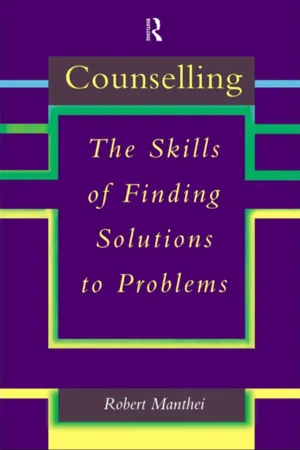
Developing the ideas of his best-selling textbook Counselling: The Skills of Problem-Solving, Robert Manthei shows how to define and solve problems. Step-by-step he explains how to work in a planned way to enhance the client's self-understanding and increase their ability to find solutions to other problems in the future.
Counselling has proved itself an invaluable resource for counsellors at every stage of their career and for anyone using counselling skills as a part of their work. This new edition is completely revised and introduces:
* a solution-focused model
* new material on: cross-cultural counselling
ethics
self-evaluation
professionalism
advocacy and mediation
stress
supervision
and retains:
* a skills-based approach
* the stage-by-stage model
* examples
* exercises.
- 216 pages
- English
- ePUB (mobile friendly)
- Available on iOS & Android
eBook - ePub
About this book
Information
Chapter 1
Introduction
Counselling is becoming increasingly professionalised. As this happens, there is a need to show how, with training and practice, it can be performed more effectively. This is a challenging task, and this book does not claim to cover all aspects of counselling. Its main contribution is to show how people can be helped by the ethical use of certain practical skills within the finding-solutions-to-problems model of counselling.
The focus of the book: finding solutions to problems
The purpose of this book is to describe how people seeking counselling can be helped to solve their problems. For clients, this process of finding successful solutions to problems should also lead to enhanced self-understanding and an increased ability to find solutions to other problems in the future. The term counselling is employed here to cover the various skills and principles of helping used in this process. Although the skills and principles that follow are described within a face-to-face relationship between two or more people (counsellor and client(s)), it is recognised that the essentials of individual counselling are directly applicable to other settings as well.
The approach presented assumes that it is imperative for counsellors to work within a framework or model that ensures that their counselling is a planned, intentional activity. Counselling should never be a wholly subjective process that is guided by whim, hunches and the random use of techniques. While the intuitive side of counselling is acknowledged, more emphasis is placed in this book on the thoughtful application of observable skills guided by sound principles of helping.
The focus is on giving counsellors a structure for dealing with client problems that is neither too loose nor too restrictive and one which allows a variety of skills to be used, depending on the counsellor’s purpose and the client’s needs at any particular time. The central features, described in chapters 5, 6 and 7, include a range of verbal skills that can be used at each stage of the finding-solutions-toproblems model of helping. This is preceded, in chapters 2, 3 and 4 by a discussion of cross-cultural competence, counsellors’ self-awareness and their role in the counselling relationship, and the process of finding solutions to problems.
Throughout the book there is an emphasis on values, attitudes, skills, and ideas that can be readily learnt and put into practice by counsellors working in a wide variety of settings. There are several assumptions in this book about counselling which should be made explicit. Firstly, the counselling skills described focus on influencing people through talking. Other techniques (such as the use of specialised tests, equipment or medication) or the specialised knowledge that is required to work effectively in particular settings (e.g., hospitals, substance abuse clinics, child-care centres), raise complex issues about the rights of clients and the qualifications of counsellors and are considered beyond the scope of this book.
Secondly, the model of helping and the interpersonal skills described are not presumed to be neutral or value-free. Rather, counselling, whatever the approach used, is taken to represent a set of beliefs and assumptions about people, about interpersonal relationships, and about ways of influencing others. For example, when a counsellor and client represent different cultures, genders, lif fe experiences, world views, ages, religions and income levels, such differences ferences will very often have important effects on counselling. Thirdly since such differences ferences are present in every counselling relationship, counsellors must also learn to be comfortable fortable with diversity and competent to deal with it (see chapter 2).
Another basic issue concerning values is whether, in any particular case, face-to- face counselling is in fact the most appropriate way of helping. Instead of encouraging clients to keep making appointments to discuss their problems, the counsellor may be well advised to suggest other means of improvement such as participation in drama, music, physical activity, a change of diet, meditation, or one of the many other forms of helping described in chapter 9. Broadly construed, counselling encompasses a wide variety of helping roles besides the traditional face-to-face relationship with an individual client. It is important that counsellors be knowledgeable about such alternatives, and when they seem appropriate, encourage clients to try them.
Effective counselling requires much more than the practice of particular verbal skills. Counsellors need to know themselves well. They need to know and understand other people. They need to know about and be able to work effectively with cultural differences. They need to know a good deal about social institutions and their information fluences, and they need realistic knowledge about the forces in society which create advantages and disadvantages: the market-place, politics, racism, sexism, and similar forms of prejudice. Power and status issues underlie many of society’s problems, and as discussed later in this chapter, they are also present within counselling relationships, no matter how much counsellors would like to minimise them or deny their importance. This book does not deal directly with all of these important topics, but no one should claim competence as a counsellor without some knowledge of them.
The finding-solutions-to-problems model for counselling is a skills-based, problem-solving model that emphasises solutions rather than difficulties and client strengths and abilities rather than deficits. The model is flexible and robust enough for counsellors to incorporate aspects of other approaches. There are, however, several important themes and assumptions about counselling and counsellors that underlay the specific model presented in this book:
- All counselling can be thought of as a process of problem-solving, a commonly used, meta-theoretical approach identified by Dixon and Glover (1984). Within this meta-model, however, there are different approaches to and perspectives of problems. One such perspective, solution-focused counselling, will be presented as a preferred form of brief, client-respectful counselling (see chapter 3).
- Many people need help in coping with their difficulties. In general, counselling seeks to help people manage their affairs more effectively in daily life, not to find a cure for some diagnosed personality deficit.
- Because positive outcomes are usually achieved in five to ten sessions (Lambert & Cattani-Thompson, 1996), counselling should be planned to be as brief and simple as possible.
- Most people who seek counselling have within themselves most of the resources for coping which counsellors can help them to identify and strengthen.
- While counsellors offer a variety of counselling skills within a relationship of caring, respect and optimism, ultimately it is the client who determines the nature of the problem, the goals to be achieved and the success of counselling.
- People usually respond better to counselling when they feel some degree of sincerity, warmth, acceptance and empathy towards them, and their counsellor’s optimism and confidence about the resolution of their problems. • The activity of counselling is usefully described as the appropriate use of specific, definable skills at each stage of the helping process (see chapters 5,6 and 7).
- The definition of counselling should not be restricted to face-to-face work with clients. It is much more broadly based than that and includes a variety of other change agent roles, activities and skills, including consultation and training, family counselling, group work, social work, teaching, supervision, and administration (see chapter 9).
- All counselling involves cultural differences (Pedersen & Ivey, 1993). Since counselling cannot be divorced from these considerations, it is essential that all counsellors develop competence in cross-cultural interactions (see chapter 2).
- Counsellors must be self-aware—of their values, beliefs, biases, cultural capital, motivation and desire to help others. An attitude of critical self-reflection—of oneself and one’s work—must be central to every counsellor’s work (see chapter 3).
- Counsellors have responsibilities as professionals to their clients, their colleagues and to the wider community (see chapter 8).
- Counsellors have an ethical duty to maintain and develop themselves professionally by undergoing supervision and continuing their education.
Learning the material presented in this book should be seen as the beginning of your training as a counsellor. It will give you a sound model for conceptualising your work with clients, teach you the necessary skills to implement the model, and encourage you to practise cultural sensitivity and critical self-reflection in your work. However, your on-going training and development should continue for as long as you counsel (see chapter 10).
What is counselling?
It is useful to consider at the outset some of the ways in which counselling relationships differ from ordinary social interaction between friends, acquaintances, and colleagues. There are, of course, many similarities, but in counselling certain features are evident to a greater degree. People start to become clients when they seek help or begin to express their concerns to another person who is willing to listen, clarify what is heard, and help them find solutions using interpersonal skills of the kinds described in this book. Many of these skills are not unique to counselling, but the relationship in which they occur approximates counselling when the relationship is voluntary; when it provides hope, healing and comfort (Peavy, 1996); when it is based on the understanding that there will exist a high degree of confidentiality and when it includes agreement on the personal responsibility of the client. In addition, counsellors do not allow their counselling relationships to be compromised by any other relationships they might have with their clients (called boundary violations (Sheppard, 1994), for example, as friends or business associates. The more clearly these features are apparent, the more appropriate it is to regard the relationship as counselling.
Like related activities such as teaching, administering, or leading others, counselling can seem somewhat mysterious. But it should not be regarded as a mystique or special gift bestowed on only a few individuals. While it may be true that some people seem to be effective as counsellors without having studied counselling systematically, enough progress has been made in studying and teaching the counselling process to justify confidence in describing it as observable skills used in a planned and intentional way, within a certain kind of relationship and for the purpose of helping clients find solutions to their problems.
A skills-based approach to training
If counselling is to be demystified and made more widely available to clients, the first step is to describe the process and its component skills in language that is both clear and non-technical. There are many possible views of the counselling process, but for learning and teaching purposes it is particularly useful to view it as a series of purposeful, goal-oriented interactions within an authentic relationship, consisting of certain behaviours by one person which partly influence the way the other person responds. What the counsellor says usually has some effect on what the client says, and vice versa. This perspective is not intended to diminish the importance of qualitative factors such as the degree of empathy shown by the counsellor. These factors can be extremely important in counselling and it is essential that counsellors are knowledgeable about them. This book, however, deals with these matters only briefly; its main focus is on explicating specific interactions and their effects within a finding-solutions- to-problems model.
A skills-based approach has been used for several reasons:
- Skills-based training approaches have been shown to be more effective in training counsellors than alternatives (Pedersen & Ivey 1993, p. 2). By teaching identifiable skills that are embedded within a sound model or framework of helping, trainees can more quickly develop competency, confidence and greater clarity about the structure and aims of the process.
- A skills-based approach helps to demystify counselling and makes its practices and techniques more accessible to students and the public. Skills-based training also reduces the likelihood of the trainer being seen or portrayed as a guru—one whose skill and insight is unfathomable and therefore unattainable by others.
- A skills approach will increase a counsellor’s range of options and possibilities in working with clients, a notion described by Ivey et al. (1993) as counsellor intentionality.
- The teaching, supervision, assessment and monitoring of counselling practices can be based on specific, observable behaviours using a common terminology and a language that is relatively objective, neutral and one that clarifies the process rather than obscures what takes place. Skills training can still allow for less easily identifiable factors such as personal qualities, attitudes and processes of decision-making to be taught, discussed and evaluated.
In practice, the use of specific skills and techniques is common to virtually every model of counselling. Effective counsellors, whatever model they follow, use different skills at different times according to what seems to be most helpful. For example, in the early stages of counselling when one is trying to get a clear view both of what is working well for the client and what is not (the problem), it is usually best to listen carefully and to take note of the client’s overt behaviours, abilities and concerns. At other times, influencing clients by encouraging them to do something may be much more appropriate. For example, sometimes a counsellor will purposely ignore obvious signs of anxiety in a client. At other times the signs may be commented on openly but neutrally, but nothing more is done, thus indicating an acceptance of the behaviour. Alternatively, a counsellor may decide to try to reduce the anxiety level so a freer discussion can take place. Whatever is decided, counsellors must not only be aware of the likely consequences of such variations but also have the skill to carry out their intentions. Exactly what the counsellor decides to do is, of course, both a personal and professional decision—a function of training, experience, knowledge and the approach to counselling being used.
There are limitations to skills-based training, of course, and these need to be borne in mind when using this book. First, skills are not in and of themselves therapeutic—they are merely verbal techniques that may prompt, provoke or promote solution-finding thought, self-assessment, and/or action, but to do so they must still be used with care, good judgement and theoretical intention. Second, skills themselves are not culturally neutral. This cannot be stressed enough. They need to be tested, modified and adapted to fit particular cultures and contexts (Pedersen & Ivey, 1993).
Third, there can be a period early in skills-based counsellor training when counsellors report feeling less natural and increasingly awkward in their counselling styles. They almost invariably report, however, that as their familiarity with the skills and their competence in using them increase, so too do their feelings of fluency and naturalness. Because of this, it is useful to forewarn counsellors at the beginning of their training and to reassure them that their initial awkwardness will gradually evolve into greater confidence and self-assurance with the skills.
Research and theory in counselling
In spite of clear evidence that counselling is effective when compared with notreatment and placebo controls, it is important to emphasise, that so far, years of careful comparative studies have failed to show consistently that any one theory or approach is generally superior to any other (Lambert & Cattani-Thompson, 1996; Seligman, 1996). In fact, there is a growing belief that no single approach is adequate for use with all client problems (Norcross & Grencavage, 1989). There are a number of reasons for this belief. The main ones are:
- It is extremely difficult and expensive to design controlled studies which satisfactorily compare even just two theories, and even more difficult to generalise empirically-derived results from such studies to actual counselling settings (Seligman, 1996).
- The hope that sophisticated, comparative methods such as meta-analysis would show which theories were best has not yet been realised either (Ivey et al., 1987; Lambert & Cattani-Thompson, 1996). It should be noted, however, that this does not mean that counselling, generally speaking, is ineffective— only that it is very difficult to show that one particular approach is best. Nevertheless, it is now widely accepted that counselling is indeed effective, that client gains are made in a relatively short period of time and that those gains are maintained over time (Lambert & Cattani-Thompson, 1996; Seligman, 1996).
- Because of the cross-fertilisation of ideas through journals, training programmes and professional organisations, it is most unlikely that any theory is now distinctly different from all others in the way it is practised. In fact, it is currently accepted that common factors across approaches, rather than specific differences, account for a sizeable proportion of the improvement in clients due to counselling (Lambert & Cattani-Thompson, 1996).
- Individual differences between clients require different approaches, so that unless a counsellor has the means, ability and the desire to match every client to a distinct theory and set of techniques, some sort of eclecticism seems inevitable.
- Finally, research has shown that the best predictors of counselling outcome are not specific approaches, but client variables and relationship factors— in that order (Lambert & Cattani-Thompson, 1996).
Using research on counselli...
Table of contents
- Cover Page
- Title Page
- Copyright Page
- Preface
- Acknowledgements
- Chapter 1 Introduction
- Chapter 2 Counselling and Culture
- Chapter 3 The counsellor and the Counselling Relationship
- Chapter 4 Finding Solutions to Problems
- Chapter 5 Beginning the Search for Solutions to Problems
- Chapter 6 Developing the Search Chapter for Solutions
- Chapter 7 Completing the Search for Solutions
- Chapter 8 Working as a Professional Chapter Counsellor
- Chapter 9 Related counselling roles and activities
- Chapter 10 Developing Competence
- References
- Answers to Exercises
- Appendix A
- Appendix B
Trusted by 375,005 students
Access to over 1.5 million titles for a fair monthly price.
Study more efficiently using our study tools.
Frequently asked questions
Yes, you can cancel anytime from the Subscription tab in your account settings on the Perlego website. Your subscription will stay active until the end of your current billing period. Learn how to cancel your subscription
No, books cannot be downloaded as external files, such as PDFs, for use outside of Perlego. However, you can download books within the Perlego app for offline reading on mobile or tablet. Learn how to download books offline
Perlego offers two plans: Essential and Complete
- Essential is ideal for learners and professionals who enjoy exploring a wide range of subjects. Access the Essential Library with 800,000+ trusted titles and best-sellers across business, personal growth, and the humanities. Includes unlimited reading time and Standard Read Aloud voice.
- Complete: Perfect for advanced learners and researchers needing full, unrestricted access. Unlock 1.5M+ books across hundreds of subjects, including academic and specialized titles. The Complete Plan also includes advanced features like Premium Read Aloud and Research Assistant.
We are an online textbook subscription service, where you can get access to an entire online library for less than the price of a single book per month. With over 1.5 million books across 990+ topics, we’ve got you covered! Learn about our mission
Look out for the read-aloud symbol on your next book to see if you can listen to it. The read-aloud tool reads text aloud for you, highlighting the text as it is being read. You can pause it, speed it up and slow it down. Learn more about Read Aloud
Yes! You can use the Perlego app on both iOS and Android devices to read anytime, anywhere — even offline. Perfect for commutes or when you’re on the go.
Please note we cannot support devices running on iOS 13 and Android 7 or earlier. Learn more about using the app
Please note we cannot support devices running on iOS 13 and Android 7 or earlier. Learn more about using the app
Yes, you can access Counselling by Robert Manthei in PDF and/or ePUB format, as well as other popular books in Psychology & Education in Psychology. We have over 1.5 million books available in our catalogue for you to explore.