eBook - ePub
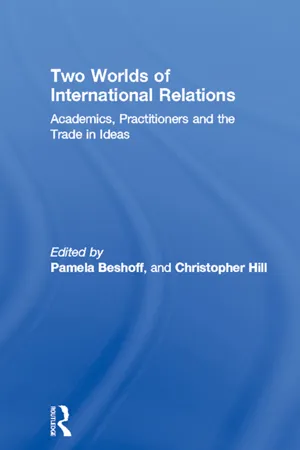
Two Worlds of International Relations
Academics, Practitioners and the Trade in Ideas
- 256 pages
- English
- ePUB (mobile friendly)
- Available on iOS & Android
eBook - ePub
Two Worlds of International Relations
Academics, Practitioners and the Trade in Ideas
About this book
The aims of this book are to discover how significant academic work in international relations has become for practitioners involved in policy formulation and implementation, and to examine the impact of the policy community on academic work and academic values.
On the academic side, theoretical, historical and political economy perspectives are presented. On the practitioner side, there are contributions from diplomats, lawyers and parliamentarians. The principal question at issue is whether, if there is a natural partnership between the modern academic and foreign policy makers, there needs to be preserved a respectful distance between the two worlds.
Information
Part I
Introduction
1
Academic International Relations
The siren song of policy relevance
Christopher Hill
The relationship between academics and policy practitioners has become steadily more significant over the course of this century, as the pace of social and scientific change has accelerated and the activities of governments have diversified. Policy-makers have needed to draw on outside sources of knowledge and judgement, while scholars have often been eager to make their own contribution to policy debates on the best ways forward. Yet in moving closer together both sides have suffered damage as well as benefited from new opportunities. The best-known examples are the exaggerated status given to the ‘science’ of geopolitics by the Nazis, and the prostitution of some Soviet science, notably psychiatry, under Stalinism.
In this story the social science of International Relations (IR) appears as a sub-theme. It can be treated as a detailed case-study of issues which are relevant across the board to anyone concerned with the nature and uses of knowledge. But International Relations also has its peculiarities, mostly deriving from three phenomena: the secretive and security-biased nature of its subject-matter; the controversial, even incendiary, quality of many of the debates which occur across national frontiers; and the temptation by many governments or parts of governments to involve themselves in the generation of ideas and analysis which is usually such a crucial part of the process of political change.
The point at which policy and research come together, notably in international relations, is therefore a sensitive area,1 particularly for the academic, who tends to need more practical help from practitioners than he or she has to offer in return. But the conjunction also produces at least one sizeable advantage in the longer term. It tends to focus both sides’ attention on the fundamental issue of purpose. Where it is all too easy for politicians to become preoccupied with day-to-day, superficial, matters, social science scholarship may take refuge in the arcane, the technical or the antiquarian. Each approach can be shaken into considering its ultimate worth and direction by challenges from the other. This was the case from the late 1930s on for academic students of international relations, as the rise of Hitler compelled the gradual abandonment of the legalistic idealism which had dominated the subject’s first few decades. Conversely, over the last thirty years academic writing on regional integration has provided the conceptual framework for much thinking and debate about future directions for the European Communities.2
Such collisions between the two worlds have become increasingly common since 1945, as the size of the university sector has increased in most developed countries and as the dire consequences of foreign policy mistakes for ordinary citizens have become starkly apparent. Yet there has been little self-analysis by the participants in this uneasy dialogue. In International Relations only Tanter and Ullman have produced a major publication on the relationship between policy-making and academic life, and that was a very diverse collection of essays some twenty years ago.3 Since that time there have been many developments in which the interaction between the two worlds of policy and of ideas has been evident—such as the rise of international terrorism, a greater concern with human rights, and the passing of terms such as ‘interdependence’ or ‘underdevelopment’ from works of theory into common political usage. The time is therefore ripe to take a close and analytical look at the two worlds and the extent of their mutual impact.
There are five major questions which arise from the relationship between policy-making and scholarship, and the contributors to this book have been asked to take one or more of them as their startingpoint:
- How far do academics and policy-makers define problems in the same way? Can the theoretical debate about competing ‘paradigms’4 illuminate policy choices?
- Do decision-makers increasingly rely on outside sources of expertise, whether technical, historical or regional?
- Is theory, as Friedrich von Hayek once suggested, the ultimate source of power because new ideas promote change?
- Do International Relations academics take too many cues from politicians? What are the proprieties which should govern the agenda and conduct of research?
- How can academic findings be conveyed to the world of action? Is the indirect route (i.e. via scholarly publication) enough, or should knowledge be mobilised through the use of the media, conferences and political contacts?
These questions are specific to the theme and apply to practitioners as much as scholars. But behind them lie three critical dilemmas of International Relations as a social science, which will be the subject of this chapter, written as is it from an academic viewpoint. They can also be presented as questions:
First is the issue of how far the subject of International Relations should be preoccupied by the contemporary world, and in particular by the current news agenda. This may be termed the history question.
The second issue is the place of normative concerns in our subject, which deals primarily with politics and therefore finds it particularly difficult to be ‘value-free’. This may be termed the ideology question.
The third dilemma revolves around the issue of academic independence, how to identify threats to it and how far to go in its defence. This is the professional question.
International Relations specialists naturally face other important questions, such as the relationship between theory and empiricism, the problem of sources and the very standing of the kind of knowledge we lay claim to. But methodological and epistemological concerns are both narrower or wider than the interests of the informed practitioner or ordinary citizen, and are subsidiary to the main theme of this book. Yet while work can be produced which is of compelling interest despite not tackling fundamental philosophical issues, any writing in International Relations which does not consider, at least implicitly, the big dilemmas of ‘history’, ‘ideology’ and ‘professionalism’ will be at best superficial and at worst dishonest.
THE HISTORY QUESTION
Right from its beginnings the academic subject of International Relations has been driven by the issues of high politics of the day. Indeed it was born out of the new determination in 1919 at the Paris Peace Conference to build a better world order in which the crudities of power politics would be constrained by law and collective security. The first chair in the subject, at Aberystwyth in Wales, was named after Woodrow Wilson, and the major figures of the first wave in Britain, such as Philip Noel Baker, Hersh Lauterpacht and Alfred Zimmern were very much dedicated to providing the intellectual underpinnings for the new international system. They were doing, in fact, applied social science.5 Equally, in the United States one of the most prominent writers on international relations in the 1930s was Charles Beard, who articulated the dominant preference of the day for isolationism over both power politics and collective security. Writers in London were usually in contact with the Royal Institute of International Affairs, which under Toynbee quickly became the centre of an intellectual network, but the huge size of the United States and a rather less comparative approach to the subject meant that the Council of Foreign Relations took far longer to establish systematic contact with the academic world.6
In broad-brush terms, the subject has continued as it began. After the Second World War the return to the balance of power between the major powers was reflected in the universities in the dominance of realism.7 This in turn gradually gave way to a revived liberalism as the Cold War started to thaw, and the consequences of economic interdependence became manifest. In both phases those who could interpret the state of the world to the citizenry also became gurus in their profession: E.H. Carr with appeasement, Raymond Aron with containment, Paul Kennedy on the supposed decline of American power. Interestingly those most successful at doing so were usually those of an interdisciplinary cast of mind, able and willing to range back and forth across the social sciences.
Now it is almost de rigueur for anyone teaching or researching international relations to have expertise on some aspect of contemporary affairs. By definition this usually means an empirical knowledge, and there are both rewards and sanctions for so doing. Endless opportunities exist for commentary on radio and television (even away from metropolie, on local stations), while managerial notions of productivity and ‘usefulness’ are spreading throughout higher education and imposing subtle pressures on researchers not to follow interests whose harvest might only be gleaned indirectly or in the longer term, for every institution now needs its staff to earn regular outside plaudits if it is to prosper in a competitive market-place.8
Such demands do not prevent equal and opposite disparagements of contributions to public debate—and even of the subject as a whole—as ‘higher journalism’. During the Gulf War of 1991 the media showed insatiable demand for expert commentary, in which, by the nature of things, and ‘against the best academic instincts a simple framework of cause and effect [was] established, quite contrary to the principles of research and analysis’.9 In other words, academics who wished to contribute to the public debate had little choice but to make what were for them abnormally bold judgements, while neither their more reticent peers nor an often sceptical public showed much understanding of their dilemma. It is impossible to avoid becoming involved during some great drama if one’s knowledge and values are engaged (money is hardly the draw), but the consequences are usually unsatisfying.10 The quality press sometimes provides opportunities for reflective analysis, but if one wishes to contribute to radio or television it is very much on the medium’s own terms.
In many who stay well away from current affairs (sometimes because they have not been asked to join in) the pendulum effect can be observed. That is, anxious lest International Relations seem the kind of thing that any half-decent political columnist can run up after a visit to Washington and Moscow, they tend to lard their work with scholarly references, establishing seriousness more through philosophy, history and law than through any distinctive approach of International Relations. Equally, legitimisation and mystique may be achieved through tedious professional introspection, elevating methodological issues to an unjustified prominence.11
The consequence of the pendulum effect is that the academic profession is itself internally divided between those who regard themselves as real scholars partly because they do not get involved in contemporary affairs, and those who are scornful of the ‘ivory tower’ syndrome establishing itself in the social sciences. A small number of writers straddles the two positions, usually in some discomfort. Hedley Bull was perhaps the most successful at gaining respect on both sides. Professional journals reflect the divide clearly. The World Today (UK), Foreign Affairs (US), Politique Etrangère (FR) and Aussenpolitik (FRG) to take examples from four different countries, are largely policy-directed journals. The Review of International Studies, Millennium, World Politics and International Organisation are largely academic in their content and readership (the fact that two are British and two American reflects the dominance of the Anglo-Saxon countries in the theoretical aspects of IR, if not in the policy debates). Although some journals, like International Affairs (London) or the International Journal (Toronto) work heroically back and forth across the divide, they tend to end up respected by all but followed by none.
It can be argued, with justice, that even the theorists follow an agenda derived from the movement of events—and indeed that there is an inevitability about doing so in the ‘longue durée’ Integration theory flourished while the European Economic Community enjoyed its honeymoon period, yet dropped dramatically below the academic horizon once the impact of Gaullism began to be felt in the later 1960s. The American study of International Relations in particular, partially dependent as it is on grants from the big research foundations, tends to suffer from preoccupying intellectual fashions, which in turn derive from the latest (seemingly cataclysmic) shift in world affairs (i.e. principally from what the US government does). Thus the rise of OPEC spawned a whole school of writers on interdependence, while the end of the Cold War has brought a sense of desperation to the hundreds of experts on strategic studies, who now rightly fear that they could be out of a job. The point is not that scholarship should not respond to major changes in the world; it is rather that the opportunity costs of so doing are not always appreciated in terms of the atrophying of important but suddenly unfashionable areas where the lack of expertise may indeed be keenly felt once the wheel eventually turns again in their favour. In sinology, for example, the USA suddenly discovered after the opening to Peking in 1971 that it needed all the experts it had neglected to bring on during the years in which Communist China was being shunned as a pariah.
Furthermore, it is in practice all too easy to move from a concern with understanding the changing nature (say) of the international system, or the forces which are shaping it, to the far narrower agenda of what the government of one’s home country, or the leaders of the bloc to which one’s country belongs, is attempting to achieve. This means that academics become, almost without noticing it, reactive to the initiatives of others, rather than pursuing their own professional concerns, which would otherwise intersect with policy issues only occasionally. Creativity is thus attenuated, while th...
Table of contents
- Cover
- Half Title
- Full Title
- Copyright
- Dedication
- Contents
- Notes on contributors
- Preface
- Part I Introduction
- Part II The academic perspective
- Part III The practitioner’s viewpoint
- Part IV Practical dilemmas and the two worlds
- Part V Conclusion
- Index
Trusted by 375,005 students
Access to over 1.5 million titles for a fair monthly price.
Study more efficiently using our study tools.
Frequently asked questions
Yes, you can cancel anytime from the Subscription tab in your account settings on the Perlego website. Your subscription will stay active until the end of your current billing period. Learn how to cancel your subscription
No, books cannot be downloaded as external files, such as PDFs, for use outside of Perlego. However, you can download books within the Perlego app for offline reading on mobile or tablet. Learn how to download books offline
We are an online textbook subscription service, where you can get access to an entire online library for less than the price of a single book per month. With over 1.5 million books across 990+ topics, we’ve got you covered! Learn about our mission
Look out for the read-aloud symbol on your next book to see if you can listen to it. The read-aloud tool reads text aloud for you, highlighting the text as it is being read. You can pause it, speed it up and slow it down. Learn more about Read Aloud
Yes! You can use the Perlego app on both iOS and Android devices to read anytime, anywhere — even offline. Perfect for commutes or when you’re on the go.
Please note we cannot support devices running on iOS 13 and Android 7 or earlier. Learn more about using the app
Please note we cannot support devices running on iOS 13 and Android 7 or earlier. Learn more about using the app
Yes, you can access Two Worlds of International Relations by Pamela Beshoff,Christopher Hill in PDF and/or ePUB format, as well as other popular books in Politics & International Relations & Diplomacy & Treaties. We have over 1.5 million books available in our catalogue for you to explore.