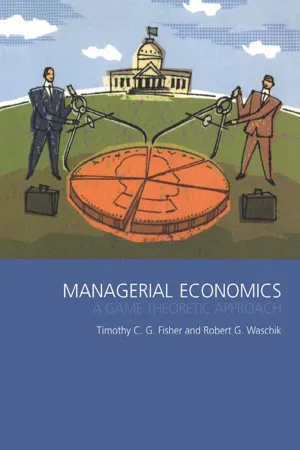
- 344 pages
- English
- ePUB (mobile friendly)
- Available on iOS & Android
eBook - ePub
About this book
This book can be used as a way of introducing business and management students to economic concepts as well as providing economics students with a clear grasp of how to use the skills they will need in the world of business.
Topics covered include:
*product differentiation
*price discrimination
*hiring and training workers
*labor-management relations
*international trade
A host of key features are employed to add colour to the text including case studies, examples and discussion questions. Scenarios presented centre upon a diverse range of subjects and firms including Eurostar, NHL hockey equipment, Chevrolet, Philips and pension plans.
Chapter 1
Introduction
On August 27, 2001, Northwest Airlines, the fourth largest US carrier, announced it was reducing fares on domestic and international flights by as much as 25 percent. For example, the price of a round-trip ticket from Detroit to Paris fell from $679 to $512. Not only were fares reduced, but the normal 21-day advance purchase requirement for the cheap fares was cut to 14 days and tickets purchased over the web were eligible for an additional 5 percent discount. This was obviously a boon to travelers. But imagine what the situation was like at Northwest’s main rivals: American Airlines, United Airlines, and Delta Air Lines. The cut in fares was significant and Northwest had advertised that it was going to last for at least four months. The other airlines had to react quickly or risk losing business to Northwest.1 Given the slim profit margins enjoyed by airlines in 2001, it’s probably not overstating the case too much to say that a quick and sensible reaction to Northwest’s fare-cutting was vital to the profitability of the other airlines.
Moreover, imagine the situation at Northwest when someone first came up with the idea of a fare cut. One of their main concerns would have been: how are the other airlines going to react? Because Northwest’s managers are well aware that the other airlines are operating on the brink of profitability, they must have expected that American, United, and Delta were going to react to the fare reductions offered by Northwest. Thus, when deciding to cut fares, Northwest’s managers also must have taken into consideration how rival airlines would react.
There is nothing particularly special about this example. It merely serves to illustrate a central theme of this book: planning ahead and anticipating how rivals might react – in other words strategy – is a vital component of business. Anyone who plays a sport or takes part in a competition intuitively knows strategy is important. Business is no different. How firms react to things their rivals do is a critical part of decision-making within any firm.
A more common-place example takes place in almost every major city on every continent several times a year: gasoline price wars. If you drive a car, you will be especially aware of the price of gasoline and you will have noticed how the price fluctuates from one week to the next. For example, in Sydney, Australia, the price of petrol may vary by up to 20 percent in any given month. It is unlikely that the underlying cost of drilling, transporting, refining, and distributing the product varies by anything like as much as 20 percent a month. The price changes are much more likely to be the result of competition between firms for market share.
But the same underlying forces are at work here as in the air fares example. Each time a firm decides to cut (or raise) its price, it has to take into account how its competitors are going to react. In other words, firms have to take into account how their competitors are going to react to their decisions, and, as a result, firms have to come up with ways of dealing with their competitors’ reaction. Put another way: strategy is vital to firms in a competitive business environment.
Both examples presented so far have been about the strategic aspects of pricing. But strategic issues are not confined to decisions about prices. Advertising is used heavily in some industries, especially beer and detergent retailing. We shall see that advertising plays a strategic role in positioning a firm’s product relative to rival products. Investment, too, has a strategic element. Toyota Canada recently completed construction on a C$500 million expansion to its Cambridge, Ontario, factory where the Corolla model is produced. This signals to Toyota’s competitors that the firm is committed to producing more Canadian-built cars in the foreseeable future, which has implications for pricing and production levels for any firm that produces a product to rival the Toyota Corolla. Mergers and acquisitions have a strategic element as well, as do research and development. All these strategic issues are discussed in various chapters of this book.
1.1 The use of game theory
Any student of economics knows about the demand and supply model. This simple yet remarkably powerful set of tools describes how markets made up of participants acting purely in their own self interest determine overall prices and production levels. On the demand side of the market, consumers make decisions about how to allocate a fixed set of resources to consume goods and services to make themselves as well off as possible. On the supply side of the market, firms produce goods and services. Firms are assumed to minimize costs and maximize profits, given the structure of competition. The simplest markets describe firms with no market power (perfect competition) or one firm with complete market power (monopoly).
But very few firms fit this description of the supply side of the market. It is certainly not the case that Northwest Airlines or United Airlines, Shell or BP, or Toyota or General Motors operate in a market where they have either no market power or complete market power. If we want to describe how decisions made by managers to maximize profits or minimize costs in any of these companies are made, we need to expand our demand and supply model to allow us to consider the strategic effect that decisions made by managers have on the market. The missing element from the simple demand and supply model is the fact that what a manager in one firm does will affect the behavior of other managers in the same market. All managers know this. Managers at Northwest know that managers at United and other airlines will respond to their pricing strategy, and an important part of their job is understanding how United will respond to their pricing strategy.
We have argued that strategy is at the center of important business decisions. Now you might think that there are probably as many strategies as there are business situations. This, after all, is the implicit view of case study analysis employed by many business schools. A case study is deliberately anecdotal: cases tell a story, and every story is different. Since every story is different, it might seem very difficult to come up with any general system of analyzing business situations.
But this is precisely what we will attempt to accomplish through the use of game theory, the mathematical science of conflict and cooperation. We will show that many business situations can be deconstructed to a few basic conditions that can be systematically analyzed. We will also see how it is possible to break down strategy into component parts and analyze the role played by each part. Thus, through game theory we will develop a general approach to understanding what strategy is and how choices of strategy effect the outcome of certain situations. Theoretical analysis is all very well in the classroom, but it will never completely take the place of experience. That is why each chapter in the book contains several cases to illustrate and expand on the theoretical material and to tie it in to the real world.
1.2 Traditional managerial economics
What is so special about our approach to managerial economics? The answer is simple: the focus on strategy. Traditionally, managerial economics has simply been treated as intermediate microeconomics adapted for business students. This approach does not take into account a major development in economics that has taken place in the last 20 years: the use of game theory.
Ignoring game theory in economics is a bit like analyzing a successful professional sports team and focusing on the physical fitness of the athletes. Certainly, physical fitness is an important element of success in sport. But in the modern era where each team has the ability to ensure all its players are at the peak of their physical condition, physical fitness surely is not the key to the difference between winning and losing. Successful teams are those that have the best strategies, whether it be a strategy for getting players, a strategy for trading players, or strategy (tactics) employed during the game. Sir Alex Ferguson of Manchester United and Fabio Capello of AS Roma don’t command the highest salaries because they know how to get their soccer players into shape. They are well paid because their strategies for success have been shown to work.
1.3 Overview of the book
This book is divided into three parts: basic theory, applications of game theory to interactions between firms, and applications of game theory to interactions within the firm. The first part, comprising Chapters 1–4, covers the basic economic tools of the firm. The second part, comprising Chapters 5–12, introduces game theory, which is our basic tool for analyzing strategic behavior, and applications of the tools to strategic interaction between firms. The third part of the book, comprising Chapters 13–16, analyzes strategic interaction within a firm.
In Chapter 2, we step back from the manager’s role at the firm and examine the question of why firms exist in the first place. Obviously, if we have no idea why firms exist it will be difficult to figure out what the firm is supposed to do and, therefore, impossible to figure out what the manager is supposed to do. By analyzing the main reasons why firms exist we can begin to think about what sorts of problems the manager is likely to face and the strategies that are likely to come into play.
Chapter 3 serves two purposes. First, to provide some basic tools that will be used in the book. Second, to serve as a brief review of introductory economics and re-acquaint readers with terms that will be used in the book. The chapter is one of the few parts of the book that looks like a conventional managerial economics text. Here we analyze the two extreme competitive situations a firm can find itself in: a very large number of rivals (perfect competition) and no rivals (monopoly). These polar opposite cases are useful for introducing terminology about firms that will be used in the book. They are also useful because they represent cases where strategy plays a relatively minor role, meaning we can focus on the more mundane aspects of the firm’s operation.
Chapter 4 continues with the analysis of a monopoly firm in order to introduce the notion of price discrimination. In particular, we look at various pricing methods that firms may use in order to squeeze more revenue from their customers. The many clever pricing practices that firms use are discussed here.
Chapter 5 introduces game theory. Here we define what is meant by a “game,” what is meant by “strategy,” and so on. We also introduce various types of games that will appear, in different contexts, throughout the book. This chapter is the core building block for much of the material that follows in the book.
Chapter 6 contains our first analysis of strategy in a business setting. We examine the relatively straightforward case of an industry that contains two fi...
Table of contents
- Cover
- Half Title
- Title Page
- Copyright Page
- Table of Contents
- List of figures
- List of tables
- Preface
- Acknowledgments
- 1 Introduction
- Part I Theory
- Part II Strategic Interaction between Firms
- Part III Strategic Interaction within Firms
- Answers to odd-numbered problems
- index
Trusted by 375,005 students
Access to over 1.5 million titles for a fair monthly price.
Study more efficiently using our study tools.
Frequently asked questions
Yes, you can cancel anytime from the Subscription tab in your account settings on the Perlego website. Your subscription will stay active until the end of your current billing period. Learn how to cancel your subscription
No, books cannot be downloaded as external files, such as PDFs, for use outside of Perlego. However, you can download books within the Perlego app for offline reading on mobile or tablet. Learn how to download books offline
Perlego offers two plans: Essential and Complete
- Essential is ideal for learners and professionals who enjoy exploring a wide range of subjects. Access the Essential Library with 800,000+ trusted titles and best-sellers across business, personal growth, and the humanities. Includes unlimited reading time and Standard Read Aloud voice.
- Complete: Perfect for advanced learners and researchers needing full, unrestricted access. Unlock 1.5M+ books across hundreds of subjects, including academic and specialized titles. The Complete Plan also includes advanced features like Premium Read Aloud and Research Assistant.
We are an online textbook subscription service, where you can get access to an entire online library for less than the price of a single book per month. With over 1.5 million books across 990+ topics, we’ve got you covered! Learn about our mission
Look out for the read-aloud symbol on your next book to see if you can listen to it. The read-aloud tool reads text aloud for you, highlighting the text as it is being read. You can pause it, speed it up and slow it down. Learn more about Read Aloud
Yes! You can use the Perlego app on both iOS and Android devices to read anytime, anywhere — even offline. Perfect for commutes or when you’re on the go.
Please note we cannot support devices running on iOS 13 and Android 7 or earlier. Learn more about using the app
Please note we cannot support devices running on iOS 13 and Android 7 or earlier. Learn more about using the app
Yes, you can access Managerial Economics by Tim Fisher,Robert Waschik in PDF and/or ePUB format, as well as other popular books in Economics & Business General. We have over 1.5 million books available in our catalogue for you to explore.