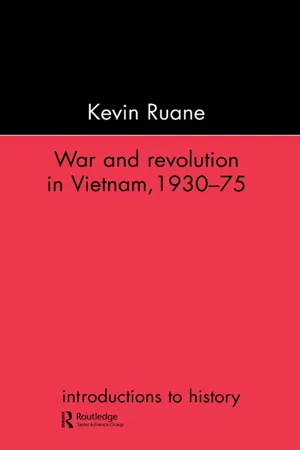
- 148 pages
- English
- ePUB (mobile friendly)
- Available on iOS & Android
eBook - ePub
War and Revolution in Vietnam
About this book
Written for undergradaute courses on postwar American foreign policy, Southeast Asian history, the Cold War, the Vietnam war, international relations, decolonization, and third world communism, this introduction uses the wealth of recent research to place the Vietnam war within the contexts of European colonization, American Cold War strategy and Vietnam's own political history
CHAPTER ONE
The making and unmaking of a revolution, 1930–46
In February 1930, a small group of Vietnamese communists met together in Hong Kong. Political exiles from their own country where they were wanted by the French colonial authorities, the gathering took place—legend has it—at a football match. By the time the final whistle blew, a single and united Vietnamese Communist Party had been formed. Presiding over the conference was Ho Chi Minh, a well-known nationalist and communist.1 Ho and his comrades committed themselves to the creation of an independent and communist Vietnam, hence to two revolutions, a national and a social. In pursuit of these goals, they would eventually humble a European colonial power and bring to its knees the world’s first superpower.
It is impossible to separate the early fortunes of Vietnamese communism and nationalism in the twentieth century from the career of Ho Chi Minh. Ho was born in 1890, just three years after French imperial expansion in Southeast Asia had climaxed in the establishment of the Union of Indochina. In conquering Vietnam, the French had divided the country into three administrative sectors, roughly commensurate with its traditional-historical regional composition. The three kys of Vietnam—Tonkin (the north), Annam (the centre) and Cochinchina (the south)—were combined with Laos and Cambodia to form French Indochina. It was in Annam, in Nghe An province, that Ho Chi Minh was brought up. Encouraged by the patriotic fervour of his father and affected by the injustices of colonialism that he witnessed on a daily basis, by late adolescence he had evidently developed a rudimentary nationalist consciousness. In 1911, then aged twenty-one, Ho secured a menial job on a French liner operating out of Saigon. What prompted his decision to leave Vietnam is unclear. Indeed, as one of his biographers has pointed out, due to the paucity of reliable documentary evidence, the story of much of Ho’s life is ‘fragmentary, open to dispute, a mere approximation of the truth’ (Lacouture 1968, 4). There is, nevertheless, little doubt that his subsequent travels were crucial to his political development and proved, in retrospect, to be the making of Ho the nationalist, the communist and the revolutionary. After several years at sea, in 1917 Ho arrived in France. There, however, he encountered not the superior civilization depicted in colonial propaganda, but a country buckling under the strain of the First World War—a country from which Vietnam’s independence might yet be wrested.
Ho quickly established himself as the chief spokesman for the expatriate-Vietnamese nationalist community in Paris and, in this capacity, he petitioned the great powers gathered at the 1919 Versailles peace conference in the hope of securing their support for the principle of freedom for all colonial peoples. When this démarche achieved nothing, a disappointed Ho looked elsewhere for inspiration and soon found it in the success of the Russian Revolution which, in 1917, had shown that a ruling élite, no matter how powerful and entrenched, could be overthrown. Ho went on to join the French Socialist Party and, when the Party split in December 1920 on the question of affiliation to the Third Communist International (Comintern), he sided with the radical minority that broke away to form the French Communist Party and accept direction from Moscow. Ho’s decision was influenced by the Socialist Party’s lack of interest in colonial issues and, more positively, by the political philosophy of the Russian leader, Lenin. In his celebrated Theses on the National and Colonial Question, published in 1920, Lenin had urged communists in colonial areas to join with peasants and patriotic elements within the urban middle class to confront and destroy their imperialist masters, whereupon the communists could dispense with their moderate allies and assume power in their own right. In Marxism-Leninism, therefore, Ho found both a means of realizing his nationalist objectives and an attractive blueprint for Vietnam’s post-colonial future (Ho Chi Minh 1973, 250–2).
By 1923, Ho had emerged as the French Communist Party’s leading voice on colonial matters. In fact, so effective was he in this role, that he was invited by Comintern to study Marxist ideology at its headquarters in the Soviet Union, a singular honour. Ho arrived in Moscow in January 1924 at the moment of Lenin’s death, an event that saddened and troubled him. ‘In his lifetime he was our father, teacher, comrade, and adviser’, Ho wrote in a tribute in Pravda. But Ho also questioned, on behalf of colonial peoples everywhere, whether Lenin’s successors would likewise ‘spare their time and efforts in concerning themselves with our liberation’ (Fall 1967, 39–40). Ho was right to be worried. Whereas Lenin had acknowledged the revolutionary potential of the peasantry and had advocated worker—peasant alliances in backward countries, the new Kremlin leadership lionized the industrial proletariat as the only vehicle of revolution. Ho, representing a predominantly peasant constituency in Vietnam, strongly disputed this view at the Fifth Comintern Congress in 1924 but was, he later recalled, a ‘voice crying in the wilderness’ (Duiker 1995, 27).
Towards the end of 1924, Ho was sent by Comintern to Guangzhou (Canton) in southern China at a point when the dominant Chinese nationalist movement, the Guomindang, was in alliance with both the Soviet Union and the Chinese Communist Party. Aware that neither Comintern nor the French communists viewed Vietnamese emancipation as a priority, Ho took the opportunity to organize the younger and most zealous elements in the large expatriate Vietnamese community in Guangzhou into an embryonic revolutionary organization. Anti-colonial discontent was widespread in Vietnam, whether amongst the peasantry, which made up almost 90 per cent of the population, the small industrial working class or the urban educated, professional and commercial strata of society. But when, on occasion, this discontent had converted itself into open protest, it had been localized, uncoordinated and easily suppressed by the French. To Ho, the way to realize the latent revolutionary potential of the Vietnamese was to create a small but highly-motivated organization that could unite and then lead the masses in pursuit of self-determination and an egalitarian society. Such, indeed, were the aims of the Vietnamese Revolutionary Youth League, the fruit of Ho’s labours in China. The League, however, was something less than a fully fledged Communist Party, and Ho accepted that its members would require extensive ideological and revolutionary induction before that appellation could be justified. Initial training occurred at a self-styled ‘institute’ in Guangzhou itself, with the most promising recruits despatched to Moscow to complete their education at the Stalin School for the Toilers of the East. By the late 1920s, it is estimated that the League had over 1,000 activists inside Vietnam, promoting its revolutionary-nationalist programme and recruiting new members. This, however, was as far as the League got. The accession of the bitterly anti-communist Chiang Kai-shek to the Guomindang leadership in 1927 brought with it an abrupt and bloody end to the modus vivendi with the Chinese communists. In the ensuing chaos, the League disbanded in an act of self-preservation and Ho escaped back to Moscow. By 1929, its residual leadership had succumbed to factionalism, one wing maintaining that national liberation had to take precedence over all else, another—dominated by Comintern-trained ideologues—insisting on the primacy of class struggle and an end to recruitment from all sources other than the small Vietnamese industrial proletariat. There is little question that Ho Chi Minh’s sympathies lay with the nationalist faction.
At the start of 1930, Comintern, keen to heal this rift, ordered the Hong Kong ‘unity’ conference referred to earlier. However, the unity that emerged involved more concessions to the Comintern faction than the nationalists, with the formation of a Vietnamese Communist Party perhaps the biggest concession of all. Whilst Moscow quickly gave the new Party its seal of approval, Ho, from a nationalist standpoint, must have had doubts about the wisdom of the decision. National independence—Ho’s first goal if not Comintern’s—undoubtedly required the active involvement of the widest possible range of anti-French opinion in Vietnam, but a revolutionary movement that espoused overtly communist objectives for the post-liberation period risked alienating the very non-communists needed to make the national revolution in the first place. On 18 February 1930, following the appointment of a provisional Central Committee to reside inside Vietnam, the new Party issued a manifesto in which, for the moment at least, national and social goals were in rough equilibrium. It comprised ten points:
1) To overthrow French imperialism, feudalism, and the reactionary Vietnamese capitalist class.
2) To make Indochina completely independent.
3) To establish a worker-peasant and soldier government.
4) To confiscate the banks and other enterprises belonging to the imperialists and put them under the control of the worker-peasant and soldier government.
5) To confiscate the whole of the plantations and property belonging to the imperialists and the Vietnamese reactionary capitalist class and distribute them to poor peasants.
6) To implement the eight-hour working day.
7) To abolish public loans and poll tax. To waive unjust taxes hitting the poor people.
8) To bring back all freedoms to the masses.
9) To carry out universal education.
10) To implement equality between man and woman.
(Fall 1967, 129–30)
By the autumn of 1930, however, a combination of Comintern injunctions and the alacrity with which the dominant Moscow faction in the Central Committee acted upon them, resulted in the reworking of the Party programme to conform more closely to the preferences of the Soviet Union. In 1928, Comintern had called upon its members in colonial areas to ‘bolshevize’ both their organizations and revolutionary aims. However, in its initial desire to give equal prominence to national and social objectives, and to promote a broad-based alliance of workers, peasants and progressive bourgeois elements in pursuit of its aims, the Party had fallen out of step with Comintern. Therefore, in October 1930, the Vietnamese communists voted to relegate national liberation to a position of secondary importance, to prioritize the social revolution, and to acknowledge the industrial working class as the engine of that revolution. The Party’s name was also altered from the Vietnamese to the Indochinese Communist Party (ICP), presumably to encourage co-ordinated action throughout the region, although the Vietnamese communists were to remain the backbone of the Party.
For Ho, these changes must have been hard to accept. In under a year, his nationalist agenda and his pragmatic ‘united front’ strategy had become marginalized within the Party he had done so much to create. Historians have devoted considerable time and attention to the question of Ho’s priorities. Was he a communist first and foremost? Or did his nationalist aims predominate? The answer, it seems, is that he was both in equal measure; he wanted Vietnam to be free and communist. On the other hand, so great was Ho’s patriotic fervour, that many writers now agree that he was not fighting to liberate Vietnam from the French (and, later, from the Americans and their Vietnamese proxies) simply to deliver it up to another external power, whether it was the Soviet Union or, after 1949, Communist China. In that sense, Ho was less of an international communist than his early Moscow connections might suggest. As his troubled relationship with Comintern in the 1930s shows, he was much more an independent nationalist-communist.
The early 1930s were lean years for the ICP, years of survival rather than advancement of the revolutionary cause: 1931 was especially bleak, with brutal French retaliation following communist involvement in major peasant revolts in central Vietnam. According to communist sources, the embryonic Party apparatus was decimated, with 2,000 members killed and over 50,000 supporters arrested. Up to 90 per cent of the Party’s Vietnam-based leadership were imprisoned or executed (Duiker 1996, 41–2). Ho Chi Minh, however, witnessed these events at a distance: arrested in Hong Kong by the British, he was later released and, in 1933, returned to Moscow. Those Party cadres that survived the French repression stayed on in Vietnam and set about building a permanent base in the northwest of the country, in the mountainous area known as the Viet Bac. Inaccessibility to the French was the initial attraction of a mountain redoubt, but in time the decision came to acquire greater significance as it ensured that communism was more deeply rooted in northern Vietnam than in the south.
The Comintern faction continued to dominate ICP decision-making throughout the 1930s and, as such, the industrial proletariat rather than the peasantry remained the principal target of Party propaganda and recruitment. To others in the Party—to that section identified with the absent Ho Chi Minh—this approach constituted a wanton disregard for the revolutionary potential of the rural masses. In the summer of 1935, however, Comintern suddenly announced a dramatic shift in its world outlook, calling on communists everywhere to promote ‘popular fronts’ in an effort to counter the growing menace of fascism. All anti-fascists were to be considered potential allies, regardless of class complexion, as Moscow, unnerved by the threat from Nazi Germany, put the defence of the Soviet Union before all other considerations, even ideological consistency. In many ways, Moscow’s new line resembled Ho Chi Minh’s preferred method of dealing with the problem of French rule in Vietnam. As a consequence, the pragmatic-nationalist wing of the ICP began to reassert itself at the expense of the doctrinaire graduates of the Stalin School. But Ho would have been less happy with Moscow’s insistence on a policy of neutrality towards the French: communists in Vietnam were free to participate in a broad-based anti-fascist coalition, but were forbidden from using it to undermine French rule. From the Soviet standpoint, this made good sense, as communist-led anti-colonial activity would run counter to its European objective of a collective security agreement with France (and Britain) against Germany. But to Ho, this must have been further proof that Comintern was merely an arm of Soviet foreign policy, and that the promotion of international revolution—and more particularly the Vietnamese revolution—was of little concern to the Kremlin.
None the less, the ICP endorsed the new approach out of respect for international communist discipline, and in May 1936 received a quick reward when a Popular Front government in France granted the ICP semi-legal status and released large numbers of political prisoners from Vietnamese jails. The Party made the most of its freedom, openly organizing and recruiting amongst urban workers and the peasantry. But the respite from repression was short-lived. The collapse of the French Popular Front in 1938 brought a clawing back of concessions by its right-wing successor, a proccss that gathered pace following the outbreak of the Second World War in Europe in September 1939. Thereafter, with the Soviet Union in effective alliance with France’s traditional enemy, Germany, the colonial security forces in Vietnam turned on the ICP with a vengeance. Faced with the threat of extinction, elements of the Central Committee issued a call for a general uprising leading to national liberation. In the event, the move from political to armed struggle was hopelessly premature, and French suppression of poorly organized insurrections in Tonkin and Cochinchina in 1939 and 1940 was fierce and effective, especially in the south. It appears to have been the Comintern-trained members who bore the brunt of the French onslaught, for they were never to be a force again. Significantly, their demise ensured that those who would go on to rebuild and lead the Party would be advocates, like Ho, of the creative adaptation of Comintern injunctions to suit the social, economic and political conditions peculiar to Vietnam and, by extension, the particular needs of the Vietnamese revolution (Kahin 1986, 10).
In June 1940, the war in Europe had an even more far-reaching impact on the Vietnamese situation when France capitulated to Germany and the umbilical cord linking it to its overseas empire was severed. In Vietnam, an isolated French administration was powerless to resist occupation by an expansionist Japan. From the summer of 1941 onwards, the French ran Indochina on behalf of the Japanese who, in turn, derived considerable military-strategic advantages from its geographical position. The wider war that engulfed Asia and the Pacific following the Japanese attack on Pearl Harbor in December 1941 initially made little difference to the Vietnamese, most of whom continued to labour under what Ho Chi Minh called a ‘double yoke’ of imperialism (Gettleman 1995, 4). Yet, difficult as the years of Japanese occupation were, to Ho and other ICP leaders viewing the situation from southern China, they were not without their compensations. Working on the premise that Japan would eventually be defeated, a moment of opportunity (thoi co) would present itself—the chance to fill the ensuing power vacuum before the French re-filled it. But success in this endeavour would require intensive preparation.
With this consideration in mind, Ho secretly entered Vietnam in February 1941, the first time he had set foot in his country for thirty years. His travels, and then his Comintern commitments and the effectiveness of French colonial security had contributed to his lengthy exile, but in May 1941 Ho presided over the ÌCP Central Committee’s Eighth Plenum, held at Pac Bo in Tonkin. By the close of this momentous meeting, agreement had been reached on the construction of a Vietnamese Independence League (Viet Nam Doc Lap Dong Minh) Hoi, otherwise known as the Vietminh. Although the Vietminh was to be organized and directed by the ICP, Ho and his colleagues determined to do so with a hidden hand. The appeal of Marxism-Leninism was never going to be sufficient to establish the kind of mass organization needed to defeat the French and the Japanese. An appeal to the deep-seated nationalism of the Vietnamese people, on the other hand, had far greater potential, especially in tandem with a commitment to economic justice and social welfare for all. The intention, in short, was to create a patriotic-nationalist umbrella organization, but with the handle of the umbrella held firmly in concealed communist hands. Come thoi co (the Allied defeat of Japan), the Vietminh would seize power in the name of the Vietnamese people. Then, after the national revolution had been consolidated, the ICP would gradually assert itself within the Vietminh and proceed with the execution of its political and social agenda.
For Ho, a further reason for obscuring the ICP’s control of the Vietminh was the hope of winning international support for Vietnamese independence. In particular, the American government, by its very public championing of the principle of self-determination for all peoples, encouraged nationalists in colonial areas to believe that, come the end of the war, they would have powerful support for their cause. Had Ho and the Vietminh been aware of it, they would have drawn even more encouragement from President Franklin D.Roosevelt’s strong personal interest in the fate of Indochina in general and of Vietnam in particular—an interest derived from firm anti-colonial convictions, a perception of French rule as especially harsh, a contempt for the meekness of the French capitulation to Germany in 1940, and a detestation of Vichy France’s subsequent collaboration, not just with Germany in Europe but with Japan in Southeast Asia. The result was a determination, oft and simply stated during the war, that ‘French Indochina must not be turned back to the French’ (LaFeber 1975, 1285). Instead, Roosevelt wanted the territories placed under a paternalistic ‘trustee’, answerable to the nascent United Nations, that would guide them to full independence over a period of twenty or thirty years. Yet, for all his enthusiasm, Roosevelt’s plan never came to fruition.
One reason was the President’s choice of trustee. Geographical proximity and political orientation suggested the Guomindang, but Roosevelt’s belief that China would emerge from the war united under Chiang Kai-shek and able to assume international responsibilities was a serious delusion, confirmed in the spring of 1944 when nationalist-communist tensions, in abeyance since the Japanese invasion, resurfaced and a resumption of civil war threatened. British opposition was another impediment. The Churchill government was alarmed lest a precedent be established whereby all colonies—including British territory in Asia then occupied by Japan—would be given over to the United Nations. In consequence, London’s criticism of the trusteeship concept was unrelenting. But perhaps the strongest argument against the scheme arose in the context of the growing Anglo—American confrontation with the Soviet Union in 1944–5 over the future of Eastern Europe. With the Grand Alliance increasingly unlikely to outlive...
Table of contents
- Cover
- Halftitle
- Title
- Copyright
- Contents
- Preface
- 1. The making and unmaking of a revolution, 1930–46
- 2. Colonial reconquest or Cold War conflict?: The French war, 1946–54
- 3. Nation building: North and South Vietnam, 1954–61
- 4. Insurgency and counter-insurgency: The struggle for South Vietnam, 1961–5
- 5. The American war, 1965–9
- 6. A war of peace, 1969–75
- 7. Conclusion
- Glossary
- Select bibliography
- Index
Trusted by 375,005 students
Access to over 1.5 million titles for a fair monthly price.
Study more efficiently using our study tools.
Frequently asked questions
Yes, you can cancel anytime from the Subscription tab in your account settings on the Perlego website. Your subscription will stay active until the end of your current billing period. Learn how to cancel your subscription
No, books cannot be downloaded as external files, such as PDFs, for use outside of Perlego. However, you can download books within the Perlego app for offline reading on mobile or tablet. Learn how to download books offline
Perlego offers two plans: Essential and Complete
- Essential is ideal for learners and professionals who enjoy exploring a wide range of subjects. Access the Essential Library with 800,000+ trusted titles and best-sellers across business, personal growth, and the humanities. Includes unlimited reading time and Standard Read Aloud voice.
- Complete: Perfect for advanced learners and researchers needing full, unrestricted access. Unlock 1.5M+ books across hundreds of subjects, including academic and specialized titles. The Complete Plan also includes advanced features like Premium Read Aloud and Research Assistant.
We are an online textbook subscription service, where you can get access to an entire online library for less than the price of a single book per month. With over 1.5 million books across 990+ topics, we’ve got you covered! Learn about our mission
Look out for the read-aloud symbol on your next book to see if you can listen to it. The read-aloud tool reads text aloud for you, highlighting the text as it is being read. You can pause it, speed it up and slow it down. Learn more about Read Aloud
Yes! You can use the Perlego app on both iOS and Android devices to read anytime, anywhere — even offline. Perfect for commutes or when you’re on the go.
Please note we cannot support devices running on iOS 13 and Android 7 or earlier. Learn more about using the app
Please note we cannot support devices running on iOS 13 and Android 7 or earlier. Learn more about using the app
Yes, you can access War and Revolution in Vietnam by Kevin Ruane in PDF and/or ePUB format, as well as other popular books in History & Asian History. We have over 1.5 million books available in our catalogue for you to explore.