![]()
The use of visual tools makes therapy concrete and facilitates the concentration of the client on a specific theme. To this, two other advantages are added. The first is that the therapist always chooses visual objects regularly found in daily life. The fact that the client will see them again between sessions reinforces the benefits of the intervention. The second is that the objects are generally available and inexpensive. Consequently, the therapist can be equipped for a minimal cost, and even make a gift of one or another of the objects to clients, to encourage them to pursue their reflections after the session.
Sheet of Paper
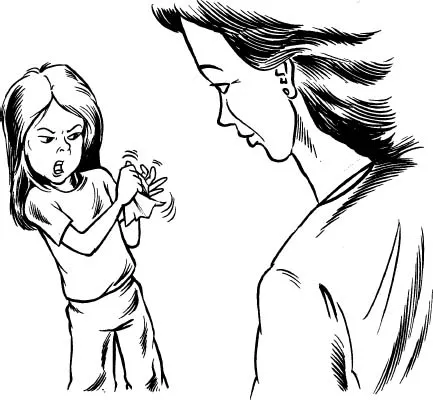
A piece of paper can represent a relationship between two people. When smooth and clean, it symbolizes an agreeable and satisfying relationship; whereas when it is rumpled, torn or stained, it represents an unhealthy and harmful relationship.
Example 1
The Cost of Anger
A therapist is working with Charles, a client who has substantial difficulty with anger management. Charles says that he does not understand his wife’s “excessive” reactions when he loses his temper.
Charles:
She knows very well that I’m not mean. I explode like that, but afterwards, it’s over. It’s always the same! She says she can’t take it anymore and that if I don’t change, she’ll leave me.
Therapist:
If I understand you correctly, Charles, you blow off steam at Holly, saying a bunch of things that you don’t really mean. Then you promptly forget them. But you don’t understand why she doesn’t forget them, too. Is that it?
Charles:
Yes, that’s it!
Therapist:
Let’s take a piece of paper. You see, it’s nice and smooth and clean. Let’s say that it represents your relationship with Holly, so I’ll write “Charles and Holly” on it. (The therapist writes the two names.) What number, on a scale of 0 to 10, would you say expresses your attachment to this relationship?
Charles:
A 10, easily!
Therapist:
Now let’s look at what happens when you are angry. (The therapist imitates Charles when he loses his temper, based on the information provided by Charles, all the while vigorously crumpling the paper.) “I told you to have supper ready at six because I’ve got a meeting! You’re a total airhead! You know that it was important to me—you could’ve made an effort for once! What do I have to do to knock some sense into you?” (The sheet of paper is completely crumpled and partially torn.)
Charles:
(Perplexed, he watches attentively.)
Therapist:
(Again playing the role of the client, the therapist tries to smooth out the sheet of paper as much as possible, while apologizing.) “Oh, I’m sorry. I didn’t mean to say that! You know that that meeting makes me nervous. Forget all that now. It’s over!” (The sheet of paper is still wrinkled despite the therapist’s efforts to make it smooth again. Charles remains open mouthed, clearly touched by the analogy.) What do you think of this demonstration, Charles?
Charles:
I understand much better why Holly reacts like she does, if she feels like that….
Therapist:
I have the impression that that’s exactly what she’s been trying to say to you for some time. You know, it’s human to get angry; no matter how much we try to understand one another, I don’t think we can completely avoid feeling angry sometimes. But it’s very useful to learn how to manage those feelings in a healthy way. Would you be interested in trying?
Charles:
(Convinced.) Yes, absolutely!
Example 2
Relationship Assessment between a Girl and Her Father
A mother consults a therapist to get help for her 8-year-old daughter. The parents divorced 4 months ago and their shared custody of their only child has provoked a lot of confusion. The mother says that the father is violent and that, even if he has never yet hit the child, he would be capable of killing her. The gun collection that her ex-husband continues to enlarge worries her a lot. Because the mother has no proof to support her suspicions, the little girl is supposed to spend every other week at her father’s home. After each visit, she comes back upset and the next week returns to her father’s house with dread. Her anxiety, which seems to get worse with every visit, has gotten so bad that she has difficulty sleeping and concentrating in class. She has also developed many psychosomatic problems. In the following example, the therapist is alone with the child and is trying to determine if the facts as presented by the mother are correct or exaggerated.
Julie:
Papa is a little different. He can’t do two things at the same time.
Therapist:
What do you mean?
Julie:
Like, when I get home from school, he can’t talk to me because he says he has to cook. When we’re at the table, he doesn’t want to talk to me either because he says we’re eating. And it’s the same thing after dinner when we’re clearing the table.
Therapist:
Okay, Julie. Let’s say that this piece of paper represents your feelings when you are with your father. (Slightly crumples one corner of the paper.) Do you feel a little like that when you are at his house?
Julie:
Oh, no! When I go to his house, I feel like this! (Julie takes the paper from the therapist’s hands and crumples it completely.) And when I get back to Mom’s, I don’t have time to calm down and smooth things out before I have to go back to Dad’s already. (The child is clearly frightened.)
This example clearly demonstrates how a simple piece of paper can help clarify the condition of a relationship.
Example 3
The “Secret” Paper
A third experience that can be created using paper consists of taking a piece of paper without saying a word and writing the word “secret” in the center while the client is watching. Then, the therapist asks the young client to fold the paper in half, then in quarters, then in eighths, and to keep folding it smaller and smaller.
Therapist:
That paper really reminds me of you. I think that you’re a little like that piece of paper, all folded in on itself to hide a secret. I’d really like to help you with that secret, but because of the way you hide it, it’s really difficult for me to find any way to help you. Do you think that you could open up that paper a little bit and share the secret with me?
(Depending on the response of the client, and thanks to the concrete metaphor that the therapist has just created, many options are now available. You can ask the child to unfold the paper a little bit to represent how far he is willing to go in unveiling his secret to you. You can ask him what you could do to help him open the paper. Or, you can explore different aspects of the secret.)
Have you had that secret for a long time? Has it always been so hidden? Did you promise someone never to tell? Is there someone you’d feel comfortable revealing the secret to?
Modeling Clay
Modeling clay (such as Play-Doh) can be mixed, unmixed, and remodeled. It also has a sticky and adherent nature, like some kinds of memories and experiences. It proves to be very appropriate to illustrate many aspects of the therapeutic process.
Example 1
Those Who Want to Fix Everything in a Single Meeting,
Despite Having Some Serious Problems
Gerald is 62 and has a painful and burdensome past. Despite a generally unsatisfactory existence, his immediate motivation for coming to therapy was to get help fixing a problem with his wife. According to Gerald, his wife opposes most of his plans, screams at him all day long, humiliates him, and accuses him over trivialities whenever she has the chance. For his part, the client says he submits silently. On the other hand, the client resists exploring his past and shares information about it in tiny bits and pieces. Despite this, the therapist is able to glean enough information to recog...