- 256 pages
- English
- ePUB (mobile friendly)
- Available on iOS & Android
eBook - ePub
About this book
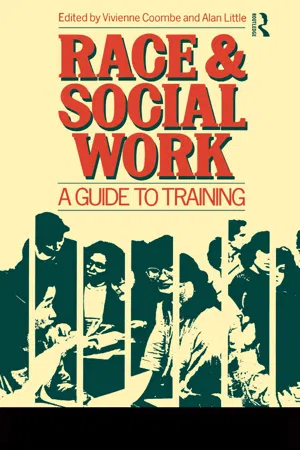
A comprehensive training guide for social workers involved in training students that provides invaluable resource material in this important area.
Information
SECTION THREE
Social Work Responses and Practice
So far we have looked at the general issues of race in society and have had a glimpse of some minority communities. The latter should have given an understanding of various cultures, although this is not to say that an understanding of culture is solely or even primarily necessary. It is all too easy to dismiss some cultural issues as quaint, quirky, restrictive, or rigid. What is important is to understand their frames of reference and collective experience; there also needs to be a sense of ‘putting oneself in place of the other’ in social work terms.
The practice issues that now need to be explored relate to (a) service delivery and (b) individual responses. How are my department’s responses affecting the service provided to ethnic minorities? And what kind of service am I giving to ethnic minority people? On the first issue the views of contributors indicate that social services departments are still not doing enough; and on the second that practitioners could be undermining the values of ethnic minority families, and that racism is often evident in their practice.
As with the previous two sections of this book, the contributors to Section Three are mainly from minority communities and have experience of working in the areas they cover. A relatively new post in some social services departments is that of Race Relations Adviser, and Russell Profitt describes their role in Chapter 9. Shama Ahmed in Chapter 10 shows why ethnic records need to be kept, and how this can be done. The response of the probation service to the needs of ethnic minorities is examined in Chapter 11 by Pat Whitehouse. He looks at the position of black people in the criminal justice system, focuses on the use of social enquiry reports and the messages they convey to the courts, and questions their benefit to offenders. Once again, inherent racism is the main stumbling block.
Josie Durrant outlines in Chapter 12 strategies for dealing with day care for under-fives and gives examples of the way she perceives racism in that area of work. The residential care of black children is examined by Vivienne Coombe in Chapter 13; despite the chapter’s title, one of the fundamental points made is that more preventive work should be undertaken and more resources (time and money) allocated to obviate reception into care.
Chapters 14 and 15 by Shama Ahmed and Mary James provide an interesting combination on fostering and adoption. Ahmed discusses the attitudes of social workers to different family patterns and suggests that they tend to have an assimilationist approach. The cogent point is made that, even when departments have policies about recruiting black families, institutional and personal racism prevent their implementation; in other words, social workers can and do refuse to place black children in black homes. The problem is therefore not one of home finding but of overcoming firmly held notions of white superiority in social work practice. James takes a retrospective look at the placement of black children in white homes over the last twenty years. She traces the tentative attempts made to challenge that policy and recruit black families, and discusses the fears of white adopters with black children. She gives examples of her organization’s success in the recruitment of black families who have been able and willing to take on the challenge of caring for their community’s children
The subject of mental health is dealt with by Aggrey Burke in Chapter 16 and by Nick Farrar and Indrani Sircar in Chapter 17. Burke looks at some of the precipitating factors in mental illness amongst West Indians and sees the labelling process as perhaps being more harmful than their reaction to a particular crisis. Farrar and Sircar provide a perspective on stress in Asian families and the methods used to cope with this, for example in their use of the hakim. They outline the good practice in Lynfield Mount Hospital of having specific clinics and workers to provide a more caring and effective service to Asian families—a practice that has unfortunately not been replicated elsewhere.
Vernon Tudor in Chapter 18 uses the area of Brixton to highlight some of the needs of black teenagers in inner-city areas. He points to the inadequacies of statutory provision, for example in the field of mental health, and the failure of agencies to tackle fundamental problems despite recommendations in various reports. He makes a perceptive comment on the potential of young people to organize collectively for change: a potential he believes they have not yet recognized.
Ethnic minority elderly are covered in Chapter 19 by Vivienne Coombe.
It would appear that the most positive responses so far have come, not from statutory bodies, but from the voluntary sector. Minority communities all appear to want their own provision, and examples are given of self-help groups providing sheltered accommodation, luncheon clubs, and day centres. The main obstacle to such provision surviving or growing is the uncertainty of funding.
It would appear that the most positive responses so far have come, not from statutory bodies, but from the voluntary sector. Minority communities all appear to want their own provision, and examples are given of self-help groups providing sheltered accommodation, luncheon clubs, and day centres. The main obstacle to such provision surviving or growing is the uncertainty of funding.
While in Sections One and Two the ‘Suggestions and Exercises’ were grouped together at the end of the section, in Section Three they appear at the end of the individual chapters to which they are relevant.
CHAPTER 9
The Role of the Race Adviser
Russell Profitt
Introduction
Local authorities usually provide most of the services available to a local community. They are usually the largest of local employers. They exercise a considerable degree of influence on local public opinion and, through finance, on the pattern of local developments, and are usually the major financer of the voluntary sector. In recognition of this, and of the need for a positive action strategy if racial discrimination and disadvantage are to be overcome, Section 71 of the Race Relations Act 1976 places a duty on every local authority to make ‘appropriate arrangements’ with a view to ensuring that their various functions are carried out with due regard to the need to eliminate unlawful racial discrimination, and to promote equality of opportunity and good relations between persons of different racial groups.
As a result and because of pressure from local black communities, some authorities have responded by appointing additional members of staff so that particular attention can be paid to working out the detailed implications of this duty, and to ensure that appropriate responses follow. Such employees are often termed Race Relations Advisers or, in a move seen to be more positive, Race Equality Advisers. These have either been appointed to ‘key’ council departments, such as Social Services or Housing, or they make up a team, part of which is based centrally within, say, the Chief Executive’s Department and part in other departments. Together they often operate as the Race Relations/Race Equality Unit.
Advisers or units are often created in addition to continued authority support for initiatives within the voluntary sector, such as the local Community Relations Council. Indeed, one of the issues almost inevitably thrown up by the creation of Race Units or Advisers is the future role of local Community Relations Councils. Local circumstances vary, and ways in which this issue is resolved will partly depend on local factors; but the issue has to be properly tackled if Community Relations Council and Race Unit are not to work at cross purposes. It is particularly important that the Community Relations Council is involved at the earliest point in discussions concerning the establishment of Race Adviser posts or units.
Role of the Race Adviser
Given the range of functions of a local authority as outlined above, and if research evidence is to be believed regarding the enormous gulf that exists between the provision of those services and the needs of the ethnic minority communities (Smith 1976, Klug and Gordon 1983), Race Advisers will need to play, or be able to play, a wide variety of roles, and not just be confined to one. Such roles will vary depending on whether the adviser is centrally based, or works within a department. Essentially, however, if the adviser is based in a service department, such as Education or Social Services, he or she will need to be assured that the racial dimension is being recognized in both the provision and the future development of services. Inevitably this will involve the adviser in the field of training.
In departments where loans or grants are made, such as Leisure Services or Development, the adviser will, amongst other things, need to be clear that steps are being taken to establish fair and equitable practices. This will involve keeping and monitoring ethnic records so that efforts made to create balance can be demonstrated. In all events the Race Adviser will need to play a key role in the personnel functions of the authority or department, including participating in the recruitment and selection of staff; he or she needs to be assured of, and needs to provide an input on, efforts made to create equality of opportunity for ethnic minority employees.
In specific terms, in say a social services department, the task needs to be managed in a number of ways. Consultation, particularly with ethnic minority clients and staff, is of paramount importance. Only in this way can advice and decision-making be informed. Effective links with ethnic minority community groups and individuals, and with specialist Section 11 or otherwise financed employees, need to be established. A comprehensive set of guidelines on practice need to be devised through consultation, providing an anti-racist action programme for the department.
Such guidelines should outline areas of concern, as well as the expected practice, related to arrangements for the care of under-fives, of adolescents, and of the elderly, for example. Other matters that need to be similarly addressed include dietary practices, training, recruitment, promotion, and relationships with both voluntary organizations and statutory organizations including the health services and the juvenile justice system.
The Race Adviser needs also to provide a lead in terms of reports to management and council committees on race equality issues, although this would not be their exclusive domain. Heads of sections should also be encouraged and enabled to do likewise. Such reports should inform and/or update the authority on the implementation of guidelines, as well as on the practical implications of features identified through ethnic record-keeping or similar monitoring.
The Race Adviser’s job description must therefore adequately reflect the need for all these roles. Support must be provided so that he or she can effectively coordinate, initiate, evaluate, and criticize those steps taken or not taken, either centrally or within a department, to fulfil Section 71 of the Race Relations Act.
At a more problematic level, the authority—councillors and employees— needs to recognize that besides his or her general role the adviser has a specific duty to respond positively to the needs of the ethnic minority community. This is ‘problematic’ because it seems that the task is rarely understood, let alone accepted by all concerned. Inevitably this leads to misunderstandings or frustrations.
The manner in which these tasks are performed is important. If they are not undertaken, it is unlikely that racist practices within the authority will be effectively countered, or that proper steps will be taken towards the creation of racial equality.
Framework of operation
Little evidence exists on the effectiveness or otherwise of Race Advisers; but the available documentation suggests that, if the race issue is to be taken seriously and within the ‘mainstream’ of the authority’s activities, certain administrative arrangements are essential.
Firstly, at officer level, it should be recognized that the Chief Executive has responsibility for the overall co-ordination of race initiatives. A Principal Race Adviser—who relates directly to the Chief Executive and other chief officers, as a member of the chief officers team—should play the supporting role. This is to ensure that the responsibility for equality practices is understood within the authority, and leads to action as appropriate.
At a departmental level the Race Adviser should also relate directly to the Chief Officer. To do anything otherwise, in structural terms, runs the risk of leaving the issue on the margin, rather than taking action so that its potential as a corporate issue, of relevance to every aspect of the authority’s activities, can be fully explored. Through being a member of the management team of the authority or department concerned, the adviser not only learns of and has the potential to influence all policy matters. He or she is also able to bring to senior management’s attention those matters of specific concern where action is required.
Secondly, the way racial issues are dealt with by the elected council members also needs to be clearly thought through. Practice suggests that in order to have a valuable potential for change, advisers need to report directly to committee chairs and to committees, without necessarily ha...
Table of contents
- Cover Page
- Title Page
- Copyright Page
- Notes On Contributors
- Introduction
- Section One: Racism In Society
- Section Two: Ethnic Minority Communities
- Section Three: Social Work Responses and Practice
Trusted by 375,005 students
Access to over 1.5 million titles for a fair monthly price.
Study more efficiently using our study tools.
Frequently asked questions
Yes, you can cancel anytime from the Subscription tab in your account settings on the Perlego website. Your subscription will stay active until the end of your current billing period. Learn how to cancel your subscription
No, books cannot be downloaded as external files, such as PDFs, for use outside of Perlego. However, you can download books within the Perlego app for offline reading on mobile or tablet. Learn how to download books offline
Perlego offers two plans: Essential and Complete
- Essential is ideal for learners and professionals who enjoy exploring a wide range of subjects. Access the Essential Library with 800,000+ trusted titles and best-sellers across business, personal growth, and the humanities. Includes unlimited reading time and Standard Read Aloud voice.
- Complete: Perfect for advanced learners and researchers needing full, unrestricted access. Unlock 1.5M+ books across hundreds of subjects, including academic and specialized titles. The Complete Plan also includes advanced features like Premium Read Aloud and Research Assistant.
We are an online textbook subscription service, where you can get access to an entire online library for less than the price of a single book per month. With over 1.5 million books across 990+ topics, we’ve got you covered! Learn about our mission
Look out for the read-aloud symbol on your next book to see if you can listen to it. The read-aloud tool reads text aloud for you, highlighting the text as it is being read. You can pause it, speed it up and slow it down. Learn more about Read Aloud
Yes! You can use the Perlego app on both iOS and Android devices to read anytime, anywhere — even offline. Perfect for commutes or when you’re on the go.
Please note we cannot support devices running on iOS 13 and Android 7 or earlier. Learn more about using the app
Please note we cannot support devices running on iOS 13 and Android 7 or earlier. Learn more about using the app
Yes, you can access Race and Social Work by V Coombe,A Little in PDF and/or ePUB format, as well as other popular books in Social Sciences & Health Care Delivery. We have over 1.5 million books available in our catalogue for you to explore.