- English
- ePUB (mobile friendly)
- Available on iOS & Android
eBook - ePub
About this book
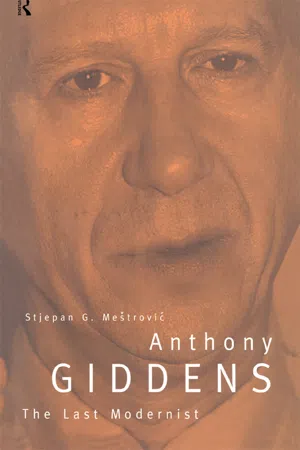
Anthony Giddens is arguably the world's leading sociologist. In this controversial contribution to the Giddens debate, Stjepan Mestrovic takes up and criticizes the major themes of his work - particularly the concept of 'high modernity' as opposed to 'postmodernity' and his attempted construction of a 'synthetic' tradition based on human agency and structure.
Testing Giddens' theories against what is happening in the real world from genocide in Africa to near secession in Quebec, Mestrovic discerns in the construction of synthetic traditions not the promise of freedom held out by Giddens but rather the ominous potential for new forms of totalitarian control.
Information
1: INTRODUCTION
This is not a book about Giddens and his work in the conventional sense of introducing the reader to the major tenets of structuration theory or the other aspects of Giddens's thought. Such aims are achieved admirably in books written by Ian Craib (1992), Ira Cohen (1989), and others whose works are reviewed briefly in chapter 2. Rather, this book uses the work of Anthony Giddens as a vehicle to engage in a broad discussion of modernity, postmodernity, culture, and the relevance of classical social theory for contemporary times. In sum, I treat Giddens's work as representative of what I consider to be wrong with modern sociology. Some readers might expect my criticisms to come from a sympathetic reading, for example that Giddens's ambiguities and contradictions would be noted, but that his statements would then be accorded the best reasonable interpretation and only problems that still remain be seriously criticized. But mine is not a sympathetic reading. Instead, it is polemical, but it is not aimed at Giddens personally as much as at Giddens as representative of tendencies that I find objectionable in modern sociology. Let me note that good examples of the sort of work I offer here are to be found in David Riesman's Thorstein Veblen (1995), Douglas Kellner's Jean Baudrillard (1989), and C.Wright Mills's The Sociological Imagination (1959), books that range far beyond Veblen, Baudrillard, and Parsons in their respective discussions. The authors of these polemics admit that they are not overly fond of the vehicles they use for their discussions (Veblen, Baudrillard, Parsons), and I hereby confess that I am not overly fond of Giddens's work either. Nevertheless, I hope to fill a needed gap in the existing literature on Giddens as well as these other topics by:
- focusing on theorists whom and theories that Giddens and other contemporary theorists tend to neglect, such as the works of David Riesman, Wilhelm Wundt, Georg Simmel, and Thorstein Veblen;
- examining these neglected theories and theorists in a cultural context, namely, taking into account the people, habits of the heart (popularized admirably by Bellah et al. 1985), traditions, customs, and intellectual currents that surrounded them;
- juxtaposing Giddens's concept of “high modernity” with Jean Baudrillard's writings on postmodernity;
- challenging Giddens's assumption that classical social theory must be overhauled radically in order to be useful;
- challenging Giddens's claims that the ghost of Auguste Comte animated the defunct version of sociology that he hopes to revivify;
- challenging Giddens's assumption that sociology is the study of modern Western societies only—an assumption that seems to fairly represent the discipline of sociology today;
- exposing the many contradictions in Giddens's writings concerning the nation-state, the creation of synthetic traditions, and human agency.
The present book should be read as a logical development of my previous works, each of which stands at loggerheads with core assumptions, presuppositions, and arguments made by Giddens as well as much of contemporary sociology. At this point I confront the question why I bother with Giddens in discussing these many other topics, for I have written extensively on them while making minimal or no reference to Giddens at all. In addition, several contemporary theorists have also addressed some of these topics in ways that I find commendable, including Akbar Ahmed (1992), Zygmunt Bauman (1991), Douglas Challenger (1994), Thomas Cushman (1995), Keith Doubt (1996), Mike Featherstone (1995), Chris Rojek (1995), and Keith Tester (1992), among others. None of these theorists are as centrally concerned with Giddens as I am in this book. Yet they share some common assumptions with me that run against the grain of Giddens's sociology, namely: modernity leads to order as well as disorder; modernity co-exists in curious ways with traditionalism and what might be called postmodernity; modernity is enabling as well as disabling; and the classical social theorists (Durkheim, Weber, Marx, Simmel, and so on) are still relevant and useful to contemporary social theorizing.
In this book, I challenge Giddens directly because his popularity represents what is wrong with much of contemporary sociology. Much like Baudrillard has been referred to as the “high priest” of postmodernity, Giddens should be regarded as the “high priest” of modernity. Like so many of his contemporaries, Giddens claims that modernity leads to new forms of social order; modernity represents a radical disjunction with previous forms of social order; modernity carries some risks but is enabling overall; and the classical social theorists are mostly obsolete, or if they are to be used, “their ideas must be radically overhauled today” (Giddens 1979:1). For Giddens, sociology is the study of modern societies only.
Giddens's attitude toward the social theorists who precede him is not unlike the collective hubris among many if not most contemporary sociologists who believe that nobody had seriously addressed society in a systematic way before them. Parsons is much closer to Giddens historically than Durkheim and other classical social theorists, yet Giddens claims that he is the first to work out a theory of human agency. But are Parsons and Giddens really very different in their attitudes or assumptions despite Giddens's public repudiation of Parsons? In the 1990s, it is fashionable to criticize Parsons, but the more interesting point is that many sociologists tried to imitate Parsons, from Robert K.Merton to Jürgen Habermas and, ironically, even Giddens. I will argue throughout this book that Giddens stays in the shadow of Parsons despite his many criticisms of him. Perhaps more importantly, the entire discipline of contemporary sociology stays in the shadow of Parsons. For example, Giddens as well as most contemporary sociologists reject postmodernism out-of-hand; misunderstand anomie; neglect emotions and culture in analyses; are still obsessed with the problem of social order; view the self as excessively cognitive; assume rather than investigate the nature of human agency.
Furthermore, both Giddens and the contemporary sociologists whom he represents do not seem to be overly concerned with glaring paradoxes in their positions. The most important paradox is Giddens's thrust on human agency and his view of modernity as a juggernaut. Other related paradoxes include the concepts of globalization and the nation-state with rigid boundaries; his overemphasis on the knowledgeable agent who must passively accept the creation of synthetic traditions; and the contradiction in believing one is an effective agent locally (at home, neighborhood, or office) who feels powerless globally.
Despite my criticisms, Giddens and I converge in recognizing the dawning of a new era in which “synthetic traditions” as well as synthetic emotions are created as a rational, planned substitute for the role previously served by spontaneous “habits of the heart” (from Tocqueville). But in my book Postemotional Society (1997), I view this development negatively, as a new form of enslavement, whereas Giddens views it (in Beyond Left and Right [1994] as well as Modernity and Self-Identity [1991a]) positively, as a vehicle for democratized life politics. It is not that reinvented traditions are inherently dangerous, but they can be dangerous, and Giddens, as well as most contemporary sociologists, fails to investigate the possible dangers of synthetic traditions. An apparent contradiction in Giddens's work must be repeated here for the sake of emphasis: on the one hand, he advocates agency, individual power, and emancipation, but, on the other, he advocates what seems to be the opposite of agency, the submission to rationally planned and synthetically created traditions in the name of democratization. One cannot have it both ways.
My lack of fondness for Giddens's work stems from the conviction that his writings are representative of a more general tendency in contemporary social theorizing that I believe is damaging to sociology. By this I mean the following:
- Most sociologists seem to accept the incorrect depiction of sociology as rooted in Comtean positivism that supposedly led to Durkheimian and Parsonian functionalism.
- Most sociologists seem to go along with Giddens in The Constitution of Society (1994) regarding the claim that sociology is the study of modern societies. Sociology thereby jettisons the idea of continuity with the past.
- The general respect ascribed to Giddens has occurred in an era in which it is fashionable to write and speak about the alleged death of sociology. Giddens has the dubious distinction of being perceived as a major social theorist by “mainstream” colleagues at a time when sociology majors are shrinking, sociology departments are being closed, and sociology is largely seen as irrelevant to everyday life by many non-sociologists.
Thus, my criticisms of Giddens should be more properly construed as criticisms of Giddens as a vehicle and representation of more general trends in contemporary sociology.
I should add that I find the notion of “mainstream sociology” problematic. While many contemporary sociologists refer to something called mainstream sociology, one could argue that no such entity exists. Sociology is so diverse and uncultivated in contrast to neighboring disciplines such as psychology and economics that one could argue that it makes more sense to refer to many little streams in sociology all going in different directions. On the other hand, it is also true that elite journals such as The American Journal of Sociology and The American Sociological Review seem to self-consciously promote “mainstream sociology” as an accepted view of the discipline that is supposed to bring order to the perceived chaos of so many different views in sociology. In this sense, Giddens is a popular, mainstream sociologist even though many sociologists go about their business without paying much attention to him.
It is important to note that Giddens, as a social theorist, is a man for this, current season, and is not a theorist for all seasons. His glib optimism, popular sociology rhetoric, and shallow treatment of theory resonate with the current climate of feel-good-optimistic ideology in sociology. For example, he recognizes that modernity causes many people to feel disembedded, to which he replies, glibly, that they can be re-embedded. I realize that this will not be perceived as a reproach by most of my colleagues. What is wrong with optimism—even a shallow optimism?
The automatic response will be that nothing is wrong with it. But a more thoughtful response will be that a sociology built upon unrealistic optimism in the face of mounting social problems is not serious, and in its present form is fated to become extinct because it is increasingly seen as useless. Giddens and many other mainstream sociologists have been singing a merry tune of global democratization even as genocide raged in Bosnia, Russians expressed a nostalgia for Communism, the European Community began unravelling almost as soon as it was formed, and “ethnic cleansing” became a metaphor for our times—to borrow Akbar Ahmed's (1995) phrase—among many other disturbing developments. And it is worth noting that not a single article on Hitler's rise to power or crimes was published in so-called mainstream sociology journals. For the most part, as noted by Bauman (1989), mainstream sociologists ignored the Holocaust. I do not feel indifferent to sociology's indifference to urgent moral questions of the day. Arthur Schopenhauer may have had a point when he wrote, over a century ago, that when conceived as a response to human suffering, optimism is really a wicked and heartless doctrine.
This does not mean that a more pessimistic response is necessarily nihilistic nor that it promotes hopelessness. It could well be that pessimism finds the real paths to hope and faith whereas, as Nietzsche taught us, optimism may be nihilistic. Sociology's great pessimists—who include Thorstein Veblen, Émile Durkheim, and Max Weber—certainly pointed to hopeful alternatives even as they exhibited strong social criticisms. Yet they come across as serious scholars who were willing to confront real social problems. This is illustrated, for example, by Veblen's writings on the dominance of the machine metaphor for comprehending modernity, Durkheim's gloomy assessment of anomie as a condition of unlimited desires that can never be satiated, and by Weber's writings on the iron cage. By contrast, Giddens simply fails to confront these and other negative aspects of modernity. His treatment of “risks” in “high modernity” is a shallow response to modernization, and deserves to be appraised critically.
WHY GIDDENS AND NOT HABERMAS?
Some readers will wonder why I did not write a book entitled Habermas: The Last Modernist. Habermas has left social science and returned to philosophy, enabling Giddens to take over sociology. An interesting irony is that Giddens has co-opted American sociology much like Parsons co-opted European sociology. In any event, Jürgen Habermas is widely perceived as the heir to Theodor Adorno and the Frankfurt School. His explicit goal is that of his predecessors, to “complete the Enlightenment project” despite all of its faults. That is, indeed, a modernist goal. And there is no doubt that all of the critical theorists end their treatises in the standardized fashion of calling for “pure” rationality to save us from the perils of “instrumental” rationality. Neither Habermas nor his predecessors come across as shallow or glib. On the contrary, their works are serious and earnest. Yet the critical theorists are also considered passé.
This is because, as most everyone knows in the West, we have already reasoned too much. How much more reasoning must we undergo before we get it “right”? Moreover, Adorno and other critical theorists are widely perceived as elitist. They imply that they hold the key to “pure” reasoning and could guide mass society to the promised land. Such elitism is distasteful in an other-directed era that is much more egalitarian and oriented toward tolerance than the inner-directed era of the critical theorists. The critical theorists never entertain the notion that feelings in general or compassion in particular might remedy some of the ills of the Enlightenment project. Emotions, for the critical theorists, are irrational and threatening to their project. For all these reasons, Habermas and the critical theorists are old-fashioned, inner-directed modernists, of historical and nostalgic interest to many, but not directly relevant to the present. Had it not been for Anthony Giddens, Habermas might have been the last modernist.
Giddens recognizes the limitations of the Enlightenment project somewhat—he is certainly not a deep philosopher—and he appreciates the importance of emotions (albeit synthetic emotions) for self-identity and the existence of social life. He could have taken the approach of some postmodernists and concluded that emotions make self-identity and social life chaotic. This is a conclusion that Giddens resolutely opposes, as I demonstrate later in the book. Instead, Giddens comes up with a truly ingenious twist to modernism: he calls for the rationalization, mechanization, colonization, and synthetic creation of the emotions. Neither the critical theorists nor the postmodernists could have conceived such a move.
The novelty of Giddens's approach to the modernity-postmodernity debate helps to explain much of his appeal. I confess that I am also unhappy with the alternatives of modernity versus postmodernity. In some ways, I share Giddens's disdain for postmodernity. On the other hand, if forced to choose allegiance to Giddens's theory versus Baudrillard's so-called postmodernism, I would choose postmodernism. (One must keep in mind that Baudrillard denies being a postmodernist even though he is hailed as the “high priest” of postmodernism. In the end, Baudrillard may turn out to be an anti-modernist.) This is because Baudrillard's disturbing vision of the present seems to ring true whereas Giddens's theory has the feel of Disney World about it. Baudrillard seems principled because he confronts the pessimistic, chaotic, and unruly aspects of social life. On the other extreme, like the critical theorists and Parsons, Giddens tries too hard to make one believe in the power of reflexivity even as the world does seem to be characterized by what Baudrillard calls rootless, circulating fictions.
Giddens never addresses the potentially dark side of a program for creating synthetic emotions. Any such contrived emotions must be pseudo-real and must be manipulated by an elite whose moral goals are open to doubt. Traditionally, emotions arose spontaneously from a natural, cultural milieu. Instead of arguing for or against the traditional notion of culture, Giddens seeks to establish a synthetic culture of sorts. In these regards, he betrays the modernist spirit of colonization, imperialism, system-building, and social engineering. Modernists used to colonize peoples, continents, time, and space. As Veblen and other theorists have noted (especially Henry Adams and George Orwell), modernity worships the machine as the system par excellence that organizes and tames Nature. In Giddens's system, modernists will colonize the last bastion of Nature—the emotions. Modernists have been perceived rightly as imperialists, always thinking in terms of empires, federations, and world conquest. Giddens does not write in these old-fashioned and distasteful terms, but he does write about global democracy based on the control of emotions. Previously, modernists got as far as Fordism and the assembly line in applying the machine model to social life. Giddens goes a step further: in The Transformation of Intimacy (1992b) and other works, he advocates the self-diagnosis of emotional problems and the remedy to such problems in much the same manner that one would fix a faulty carburetor.
Similarly, in The Nation-State and Violence (1987) Giddens overplays the modernist card in insisting that nationalism could not have existed in traditional societies. Contemporary nationalism holds many distinctive features in contrast to the past, but it is far-fetched to sever any and all linkages to historical forms of nationalism. Giddens amputates the past in discussing present-day nationalisms, and he amputates the past also in discussing contemporary sociological theory (especially in The Constitution of Society [1984]).
For these reasons, Giddens deserves to be called the last modernist. And again, his popularity suggests that he is representative of a general trend in contemporary social life in the West. The current fin de siècle is one in which most Westerners seem to live in the present cut off from the past, do not really care about the non-Western world, are willing to manipulate and be manipulated regarding their emotional lives, and wish to preserve the status quo despite heightened awareness concerning the ills of the modernist project. The critical theorists were completely off the mark in depicting the beginnings of this process as one leading to mass society that could be remedied by individualism and rationalism. On the contrary, most Westerners today believe they are individuals endowed with agency even as they succumb willingly to emotional manipulation by governments, corporations, and organizations. In this regard, they mirror Giddens's contradiction in advocating human agency and general emancipation at the same time that he advocates the creation of synthetic emotions and traditions vis-à-vis a social system that will bind time and space.
This contradiction is fundamental to Giddens's work, and needs to be elaborated further here (even though I have mentioned it already and it is treated at length later in the present volume). Immanuel Kant's definition of enlightenment included the courage to think for one's self, to use one's own understanding. Now, if Giddens's synthetic traditions are going to be able to secure allegiance, and if they are going to have any experiential plausibility, then presumably the foundations of these synthetic traditions must precisely not be thought about reflexively—traditions cease to be traditions if they are reflexively deconstructed. This is another aspect of Giddens's hidden modernism: he cannot seem to accept that individuals or communities might have their own spontaneous meanings which work without the beneficent involvement of those who presumably know best. Ironically, this also implies that Giddens cannot be reflexive about himself or about sociology and the double hermeneutic that he proposes; after all, reflexive inquiry will deconstruct the plausibility of what Giddens proposes concerning synthetic traditions. In summary, Giddens seems to be claiming that there are some things about which we must not or cannot think for ourselves, and such a claim is absolutely counter to the Enlightenment. Yet, on the other hand, he is a typical Enlightenment thinker insofar as he believes that rationality (not emotions) in the form enshrined by a sociological elite can yield knowledge that should be used for social engineering. Again, this fundamental ambivalence concerning the relationship of rationality to emancipation is not peculiar to Giddens, but is found in the heart of the modernist “project,” as expounded brilliantly by Zygmunt Bauman in Modernity and Ambivalence (1991).
This fundamental contradiction in Giddens's thought reappears in many forms throughout his work. Thus, his overemphasis on the surveillance that is essential to the modernist nation-state in The Nation-State and Violence (1987) really contradicts his rhetoric of modernist emancipation elsewhere in his writings. Similarly, his allegiance to the extreme position in The Constitution of Society (1984) that sociology is the study of only modern and primarily Western societies really comes acro...
Table of contents
- COVER PAGE
- TITLE PAGE
- COPYRIGHT PAGE
- TO JOEL AND CHARLOTTE
- PREFACE
- 1: INTRODUCTION
- 2: ANTHONY GIDDENS
- 3: THE NEW VERSUS THE OLD RULES OF SOCIOLOGICAL METHOD
- 4: THE ROLE OF DESIRE IN AGENCY AND STRUCTURE
- 5: GIDDENS'S POLITICAL SOCIOLOGY
- 6: GIDDENS'S MODERNISM LITE
- 7: UNLIMITED AGENCY AS THE NEW ANOMIE
- 8: CONCLUSIONS
- NOTES
- REFERENCES
Trusted by 375,005 students
Access to over 1.5 million titles for a fair monthly price.
Study more efficiently using our study tools.
Frequently asked questions
Yes, you can cancel anytime from the Subscription tab in your account settings on the Perlego website. Your subscription will stay active until the end of your current billing period. Learn how to cancel your subscription
No, books cannot be downloaded as external files, such as PDFs, for use outside of Perlego. However, you can download books within the Perlego app for offline reading on mobile or tablet. Learn how to download books offline
Perlego offers two plans: Essential and Complete
- Essential is ideal for learners and professionals who enjoy exploring a wide range of subjects. Access the Essential Library with 800,000+ trusted titles and best-sellers across business, personal growth, and the humanities. Includes unlimited reading time and Standard Read Aloud voice.
- Complete: Perfect for advanced learners and researchers needing full, unrestricted access. Unlock 1.5M+ books across hundreds of subjects, including academic and specialized titles. The Complete Plan also includes advanced features like Premium Read Aloud and Research Assistant.
We are an online textbook subscription service, where you can get access to an entire online library for less than the price of a single book per month. With over 1.5 million books across 990+ topics, we’ve got you covered! Learn about our mission
Look out for the read-aloud symbol on your next book to see if you can listen to it. The read-aloud tool reads text aloud for you, highlighting the text as it is being read. You can pause it, speed it up and slow it down. Learn more about Read Aloud
Yes! You can use the Perlego app on both iOS and Android devices to read anytime, anywhere — even offline. Perfect for commutes or when you’re on the go.
Please note we cannot support devices running on iOS 13 and Android 7 or earlier. Learn more about using the app
Please note we cannot support devices running on iOS 13 and Android 7 or earlier. Learn more about using the app
Yes, you can access Anthony Giddens by Stjepan Mestrovic in PDF and/or ePUB format, as well as other popular books in Social Sciences & Social Theory. We have over 1.5 million books available in our catalogue for you to explore.