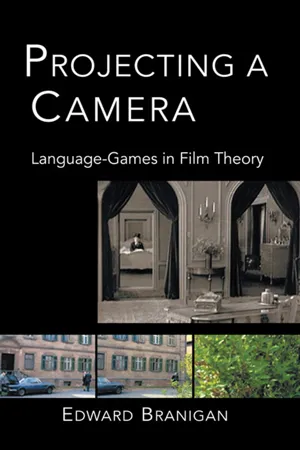
In Projecting a Camera, film theorist Edward Branigan offers a groundbreaking approach to understanding film theory. Why, for example, does a camera move? What does a camera "know"? (And when does it know it?) What is the camera's relation to the subject during long static shots? What happens when the screen is blank? Through a wide-ranging engagement with Wittgenstein and theorists of film, he offers one of the most fully developed understandings of the ways in which the camera operates in film.
With its thorough grounding in the philosophy of spectatorship and narrative, Projecting aCamera takes the study of film to a new level. With the care and precision that he brought to NarrativeComprehension and Film, Edward Branigan maps the ways in which we must understand the role of the camera, the meaning of the frame, the role of the spectator, and other key components of film-viewing. By analyzing how we think, discuss, and marvel about the films we see, Projecting a Camera, offers insights rich in implications for our understanding of film and film studies.
- 456 pages
- English
- ePUB (mobile friendly)
- Available on iOS & Android
eBook - ePub
About this book
Information
Chapter 1: The Life of a Camera
“I think of [my] book [Ways of Worldmaking] as belonging in that mainstream of modern philosophy that began when Kant exchanged the structure of the world for the structure of the mind, continued when C. I. Lewis exchanged the structure of the mind for the structure of concepts, and that now proceeds to exchange the structure of concepts for the structure of the several symbol systems of the sciences, philosophy, the arts, perception, and everyday discourse. The movement is from unique truth and a world fixed and found to a diversity of right and even conflicting versions or worlds in the making.”1
— Nelson Goodman
“When the film close-up strips the veil of our imperceptiveness and insensitivity from the hidden little things and shows us the face of objects, it still shows us man, for what makes objects expressive are the human expressions projected on to them. The objects only reflect our own selves. … ”2
— Béla Balázs
“The concept of a ‘cinematographic grammar’ is very much out of favor today; one has the impression, indeed, that such a thing cannot exist. But that is only because it has not been looked for in the right place. Students have always implicitly referred themselves to the normative grammar of particular languages …, but the linguistic and grammatical phenomenon is much vaster than any single language and is concerned with the great and fundamental figures of the transmission of all information. Only a general linguistics and a general semiotics … can provide the study of cinematographic language with the appropriate methodological ‘models.’”3
— Christian Metz
“[I]t is language which speaks, not the author; to write is, through a prerequisite impersonality (not at all to be confused with the … objectivity of the realist novelist), to reach that point where only language acts, ‘performs,’ and not ‘me.’ … We know now that a text is not a line of words releasing a single ‘theological’ meaning (the ‘message’ of the Author-God) but a multi-dimensional space in which a variety of writings, none of them original, blend and clash. The text is a tissue of quotations drawn from the innumerable centres of culture.”4
— Roland Barthes
“Gott im Himmel, it has spoken!”
— John Kruesi, assistant to Thomas Edison, on first hearing
Edison’s voice coming from the “Talking-Machine”
Edison’s voice coming from the “Talking-Machine”
“Essence is expressed by grammar. … Grammar tells what kind of object anything is.”5
— Ludwig Wittgenstein
The Death of the Author
Roland Barthes famously announced the passing away of the literary author. What was lost was the sense of an identifiable Agent, an origin (an original) — the One who had infused sense into a work, creating meanings and unity. Critics used to have “the important task of discovering the Author (or its hypostases: society, history, psyché, liberty) beneath the work: when the Author has been found, the text is ‘explained’. … ”6 Barthes refers to this task of peering into the depths of a text’s meaning to search for the Author as an effort of “decipherment.” The aim was to trace back along the causal chain from the surface of a text to its hidden point-source.
For Barthes, the Author’s death heralded “the birth of the reader,” which meant an empowerment of a common language and way of thinking, a recognition that writing was actually a meshwork of “quotations” from a community rather than the private and unique utterance of an Author.7 The newly born reader, however, was not conceived as a private individual:
“[A] text’s unity lies not in its origin but in its destination. Yet this destination cannot any longer be personal: the reader is without history, biography, psychology; he is simply that someone who holds together in a single field all the traces by which the written text is constituted.”8
It is important that for Barthes the reader has simply evolved into a “someone” — that is, someone who is impersonal. In fact, the same thing has happened to the author: the state of being-an-Author for Barthes did not dissolve into nothing but instead found a new place within a life of letters in the form of an “impersonality,”9 a kind of “Talking-Machine.” As we shall see, however, a general form of impersonality is not a ‘universal’ form (every one) but instead is relative to ‘a set of readings’ produced through the discourse of a particular community, that is, relative to the dimensions of a specialized use of language.
Film, too, may be thought to have an Author, or its hypostasis behind the image: the Camera. This is true even if the Camera is said to be merely a thing that objectifies the world. The reason is that, for Barthes, “objectivity” is just a pretext or ruse that conceals the Author (or its hypostases: society, history, psyché, liberty).10 For Barthes, the Author’s death was also the death of “objectivity.” The Author, and now presumably the Camera, have been replaced by a simple impersonality. But what is “impersonality”? Barthes seems to interpret the impersonal as a form of indefiniteness, so that rather than one Author, there will be many authors, not all of whom can be identified. A text, whether composed of words or pictures, would be thought of as a vast imbrication of quotations, allusions, beliefs, and values arising from a community or communities. A particular “image,” then, would actually be a composite or summation of many possible images, stereotypes, and verbal descriptions.11
An indefinite mode of speaking may be illustrated by the utterance, “it rains.” I believe that the indefinite subject of this utterance (the “it” of raining) may also be applied to an image of rain. What is being said through it (the image) is that “it rains.” The relationship of “rains” to “it” is the same as “it rains” to a camera-it that precipitates the meaning “rain.” There is a subtle distinction to be made here. Even though a film may show rain, one should resist saying that the film depicts literally that “it is raining” or that “it was raining.” This is because the “is” or “was” progressive tenses are appropriate only when one is thinking fictionally (e.g., “the character looks out the window and sees that it is raining”) or else when one is tracing back along the causal chain from an image on the screen to its hidden point-source (e.g., “it was raining when the camera filmed the scene in the script”). The progressive tenses apply when the artifact is assumed to be transparent (i.e., when one thinks about what is happening “inside” the fiction) or the artifact is taken to be opaque (i.e., when one thinks about its manufacture as an object with an outside and an inside). By contrast, the “is” and “was” progressive tenses are not appropriate, I believe, when one is thinking about a novel or film as a product from which a thing (“rain”) is being identified (“I understand there is rain” or “I see it is rain”). An indefinite mode of address emerges when we confront the sheer “flatness” of a text and discover that no privileged focus (beneath or above) authorizes our descriptions: the only focus for our language is hypothetical or potential, a product of our ability to speak — or, more exactly, a product of how we and others have typically spoken about a thing. Or else, how we have made a thing recognizable by recalling how we have spoken about “similar” things.12
For Barthes, a ‘fact’ in a text is not attributable to an author’s unique vision, which supposedly bubbles upward through force of will and is often filtered through a character. Barthes is more concerned with the way that a ‘fact’ comes into being when put under descriptions in the act of interpretation. A ‘text,’ then, is not so much ‘out there’ as it is a mental process intimately connected with creating and assessing resemblances, metaphors, and projections deemed appropriate within or against the norms of a community. The purpose in searching for ‘resemblances’ (i.e., in searching for how a fact is simplified and sorted into one or many categories) is not to discover which individual or author is making a given interpretation, or to measure the truth of an interpretation, but rather to juxtapose an interpretation with the conditions that make it possible. Writing is an experiment in reading; to write is to be the first reader. Filming is an experiment in seeing; to film is to be the first spectator. Writing and filming are alike in that each depends on a common set of mental operations by which knowledge is being represented, retrieved, manipulated, and revised. Thus, a text’s ‘impersonality,’ finally, has to do with the commonness and intelligibility of the knowledge being expressed. What is expressed is not due to an Author or Camera, but is the result of a person speaking about his or her knowledge and feelings on an occasion of reading or seeing.
Let me put the idea of ‘commonness’ and ‘intelligibility’ in a different light. In order to make sense, one must use a grammar; that is, one must communicate by following or bending the rules of a linguistic grammar. For Wittgenstein, however, there are still ‘larger grammars’ at work when we speak. These larger grammars select and shape local linguistic rules into special sets of rules that create patterned ways of speaking and thinking. Each of these special grammars possesses a rich ‘vocabulary.’ In turn, the vocabulary (usually composed of ordinary words employed in a special way) corresponds to a manner of acting in the world — to making the world seem. For Wittgenstein, each grammar is a kind of map created to help solve a set of closely related problems. In fact, for Wittgenstein we make a world by accumulating a large number of these sets of problems and their associated grammars. That is, we fashion a significant world out of problems and grammars into which our various desires and acts may be fitted and made significant. Wittgenstein proposes that these many grammars should be understood as a series of “language-games” where each game requires one to learn specific rules in order to be able to make a significant “move” (i.e., to play, or act in, the “game”). Playing a game is a practice, though we may also practice playing a game.
What counts in making a particular “move,” according to John Ellis, is the “relation to other possible moves in that game rather than to the mental states of the speakers or to ideas or independent ‘facts’ that exist outside the structure of the game.”13 A language-game specifies the moves that can be made by us as well as by the objects in the game. A language-game specifies what can be meaningfully said about an object (and its range of movements) and hence determines what kind of object something is — its nature or essence.14 To inquire about essence is to ask what a particular grammar allows one to do with an object or to see the object do. A language-game thus functions as a kind of frame for an object by creating a standard of rationality believed to be appropriate to the object. In chapters 4 and 5 we will look more closely at the notions of “frame” and “radial meaning,” which result from a certain multiplicity of frames. (Radial meaning is a type of ambiguity that arises when the same word appears in different language-games, including the word “frame” itself.15) We will also examine how particular language-games are played out in film theory: for example, games concerning fictiveness, mobility, causation, subjectivity, and what will count as “concrete reality.” Indeed, we will need to revise substantially some traditional ideas about the nature of “film theory” as individual film theories are seen to be an imbrication of games.
In the chapters to follow, I will seek to build on Barthes’s argument that the personal Author has been replaced by impersonality. I will seek to demonstrate that this “impersonal,” or ‘indefinite,’ mode of speaking in a text should be understood in terms of moves in one or more “language-games” that we are being invited to play. (See figure 1.1.) Indeed, the personal Author and the (gregarious) Narrator were themselves created through a language-game. The traditional way of describing the qualities of texts was often based on the notion that a text was a conversation with an Author or at least a condensed sort of message from the Author, even though this message was incomplete and contained exculpatory ambiguities.

FIGURE 1.1 A Reader-Author
A reader-author makes a move (as conceived by five-year-old Nicholas Branigan).
A reader-author makes a move (as conceived by five-year-old Nicholas Branigan).
Just as Barthes’s notion of “the birth of the reader” means a new freedom for reading, where responses and criticisms are no longer limited to the rules of a conversation or to the rules of reading a kind of ‘telegram,’ so one may imagine that the death of the Author means that an author no longer needs to impersonate a narrator, a character, or a ‘nobody’ (i.e., appear in the guise of a disembodied “objectivity”), in order to be able to speak. After death, the author becomes simply another reader, occupying the same ground as any reader, including readers not yet born. Being an impersonal voice permits an author to work close up to a reader — in a place where language-games are being lived.
A Camera as Impersonal Subject
This book is about a camera in its impersonal mode. A camera is most evident during its movements and long-held shots, so we will examine these events closely (in chapters 2 and 5). The impersonal mode, however, seems ever-present even when the screen is blank or black, and so we will need to examine theories about the general nature of the film medium (chapters 3 and 4). To complicate matters further, an “impersonal utterance” must still be an utterance about something and in this book the “something” will be taken to be an element of narrative discourse. Thus, we will need to consider a variety of general issues bearing on storytelling techniques in relation to camera movement and the long take (chapters 2 and 4). Narrative discourse, however, cannot be analyzed apart from a particular choice of a theory of narrative. Thus, we will be led to consider various narrative theories and the relationship each establishes with a “camera” (chapters 2 and 3). Ultimately, we will be led to weigh various theories of film, each of which seeks to identify a unique place for a camera to occupy in the medium of film with the result that — by virtue of a particular film theory and narrative theory — a person will be able to talk confidently, and even boldly, about a camera as being the camera (chapter 3).
One may also say that because a camera occupies a “point” in space and “points” at things, it has a “point of view.” But, of course, questions soon arise about the nature of the “space” in which a camera exists and about the nature of the pointing that produces a “point of view.” One will need to ask, for example, how literal the “pointing” must be for a camera to have a point of view, which amounts to asking how literal a “camera” must be for it to have a point of view (chapter 2). For example, it is often said that an image appears onscreen for some (particular) reason and therefore must have a “point,” must represent an attitude or viewpoint. Another issue is ...
Table of contents
- Cover
- Title
- Copyright
- Dedication
- Contents
- Cover and Frontispiece Illustrations
- Figures
- Preface
- Acknowledgments
- Terminological Note
- 1 THE LIFE OF A CAMERA
- 2 A CAMERA-IN-THE-TEXT
- 3 WHAT IS A CAMERA?
- 4 HOW FRAME LINES (AND FILM THEORY) FIGURE
- 5 WHEN IS A CAMERA?
- Notes
- Works Cited
- Index
Trusted by 375,005 students
Access to over 1.5 million titles for a fair monthly price.
Study more efficiently using our study tools.
Frequently asked questions
Yes, you can cancel anytime from the Subscription tab in your account settings on the Perlego website. Your subscription will stay active until the end of your current billing period. Learn how to cancel your subscription
No, books cannot be downloaded as external files, such as PDFs, for use outside of Perlego. However, you can download books within the Perlego app for offline reading on mobile or tablet. Learn how to download books offline
Perlego offers two plans: Essential and Complete
- Essential is ideal for learners and professionals who enjoy exploring a wide range of subjects. Access the Essential Library with 800,000+ trusted titles and best-sellers across business, personal growth, and the humanities. Includes unlimited reading time and Standard Read Aloud voice.
- Complete: Perfect for advanced learners and researchers needing full, unrestricted access. Unlock 1.5M+ books across hundreds of subjects, including academic and specialized titles. The Complete Plan also includes advanced features like Premium Read Aloud and Research Assistant.
We are an online textbook subscription service, where you can get access to an entire online library for less than the price of a single book per month. With over 1.5 million books across 990+ topics, we’ve got you covered! Learn about our mission
Look out for the read-aloud symbol on your next book to see if you can listen to it. The read-aloud tool reads text aloud for you, highlighting the text as it is being read. You can pause it, speed it up and slow it down. Learn more about Read Aloud
Yes! You can use the Perlego app on both iOS and Android devices to read anytime, anywhere — even offline. Perfect for commutes or when you’re on the go.
Please note we cannot support devices running on iOS 13 and Android 7 or earlier. Learn more about using the app
Please note we cannot support devices running on iOS 13 and Android 7 or earlier. Learn more about using the app
Yes, you can access Projecting a Camera by Edward Branigan in PDF and/or ePUB format, as well as other popular books in Media & Performing Arts & Film History & Criticism. We have over 1.5 million books available in our catalogue for you to explore.