On the face of it, the very idea of artistic citizenship looks like an oxymoron. From ancient times to the present, artists have been asked to pay tribute to and have been viewed with suspicion by all manner of officialdom. Plato, who fancied himself a philosopher–king, thought the right music could promote social harmony but wanted to kick playwrights out of his ideal Republic. China’s self-proclaimed first emperor, Qin Shi Huangdi (221–209 BC) built extensive public works, including 7,000 terra cotta sculptured soldiers for his mausoleum, but also burned books and banished music. Why would artists seek more of such freighted attentions?
In perhaps the most typical incarnation, the artist epitomizes unsullied individualism, an inner-directed free spirit who answers to the muse, not to the state. Citizenship, by contrast, entails group membership with common privileges and obligations conferred from without and regulated by a national government. Yet in the hurly-burly of experience, where the private realm of the individual leaves off and the public domain of civic life takes up is neither so simple nor clear cut. The realm of the commons where civic engagements are joined provides an arena where personal voice takes flight. Strong perspectives are forged in dialogue with others. Artists themselves may sense a tension between what can be attributed to talent as a kind of self-possessed natural right and what they seek through training with others as an achieved status—one that is increasingly acquired by means of a college degree.
In practice, art-making is an intricate journey where public and private are at once the vehicle, the route, and the destination. Similarly, the question of what art is for (of its attachments, interests, passions, and commitments) has become inseparable from the matter of how it is brought into the world—from the rigor of training and technical formation to support for production and access to audiences. The keys to artistic citizenship lie in understanding how art and artists are brought into the world. Today, artists’ paths to realize creative opportunity most commonly run through professional school, and the lessons as to what the world makes of their endeavors is legible in the swirl of controversies around what can be called public art. No less than artistic citizenship itself, public art and the professional school also could appear to be contradictions in terms. Art in, as, or for the public chafes against the conviction that art exists for its own sake. The professional school—including the arts either as free-standing institutions or as colleges or divisions within a university—similarly rubs against the liberal arts ideal of education as an end in itself, which is devoted not to specialization but to the cultivation of the whole person. The seemingly incompatible terms that compose public–art and professional–school speak to the complexity of the often controversial manner in which art makes its appearance in the world. That, at least, is what I would like to venture here: namely, an exploration of the artist’s civic capacities as made legible by mapping what can be learned from the intricacies and tensions evident in public art and the art school.
Public Art
Public art can be understood in a variety of ways. Among them, it can be seen as a site or physical place, as a representation of civic ideas, or as an occasion for people to gather to engage in critical reflection—in short, a way of seeing, a way of knowing, and a way of gathering. These ways of understanding are not necessarily mutually exclusive; they can be evident in the same works of art. Rather, the differences matter for our thinking about art’s worldly effects. Sculptures, monuments, and other installations in town squares, parks, and on or around major civic buildings have been in evidence in any number of cultures for millennia. The Sphinx of Egypt, the ornate pyramids of Chichen Itza, the Greek Parthenon, and the twelfth-century Temple of Angkor Wat in Cambodia, site of the Aspara dance, are but a few examples.
Civic monuments have been present since the Republic’s inception, and heroic memorials reached their apex under the influence of nineteenth-century beaux-arts traditions. The modern paradigm of public art in the United States can be seen as a response to the urban strife of the 1960s. Tom Finkel pearl pointed out that artists then were called on in a rather unrealistic fashion to right the ills of the city fabric by using public art to engender a sense of a more intimate, premodern community.1 Policy initiatives meant to use art as a balm to social unrest and to stimulate urban redevelopment were promulgated at all levels of government, whether through commissions from the federal Government Services Organization or, later, the municipally administered 1 percent for the arts programs. The National Endowment for the Arts, launched in 1965, offered initiatives such as its Art in Public Places Program, whose first commission was a sculpture by Alexander Calder called La Grande Vitesse (1969) for the Grand Rapids, Michigan, Civic Center. Miwon Kwon, who has written perceptively on public art, observed of such works that the basis of their identification as public “was quite simply their sitings outdoors or in locations deemed to be public primarily because of their ‘openness’ and unrestricted access.…” The specific attributes of the site “mattered only to the extent that they posed formal compositional challenges.”2
Public art thus becomes a type of art — one that uses its immediate environment as part of its formal, aesthetic idea. This is art without a frame in the conventional sense. The immediate physical world around the work—city, square, building, park, airport, university campus—becomes its frame. The viewer is invited to consider ordinary surroundings in aesthetic terms; the form of the work extends attention to what is around it. Light and shadow; the extensions of the sculptural lines in the patterns of the urban habitat; and the intensity of color of the sky, street, or shrubbery set against the sculptural form all invest the eye with a heightened attention to the experience of living in a particular environment. What is done with this attention is an open question, and so, too, is how seeing the world aesthetically relates to how one attends to it socially—to the people around us and the concerns that issue from them.
The second understanding of public art is as a form of representation. Here, art can be considered a particular kind of social good that serves as a means to bring forth ideas about our lives together. In this, public art performs a civic function. It seeks to make explicit linkages among the formal properties of a work, its ability to get us to pay attention to our surroundings, and how we value what we perceive. In this, the form and content of public art is fundamentally about how we live together with those around us. Such work rests on a conviction that art is not simply aesthetically enlivening of everyday surroundings but that it is civically ennobling. The representational aspect runs as a thread through the history of public art. The monuments of old, “the hero on the horse,” exalted great historical figures around which a nation might be unified that characterized the explosion of nineteenth-century civic sculpture. The populist turn, epitomized by the murals of Diego Rivera in the 1930s, rendered everyday life and ordinary people worthy of artistic memorialization. Community-based works like those of John Ahearn in the mid-1980s and early ’90s explored a yet more intimate relation between the artist and certain residents he selected to be the models for his sculptures. In each of these examples, art is treated as the embodiment of shared values—of the nation, public, or community—and serves to integrate through its own legible forms those who might otherwise remain strangers to one another.
The heroic or quotidian figures stand in for what is commonly shared; they evoke sentiments of patriotism, the value of hard work, and the attachment to a location that encourages people to feel they belong together. This sense of mutual belonging, expressed through exemplary figures, lends the artist credibility as providing a social good and not simply a personal statement or private service. Government support of artistic endeavors is justified by treating art as an exceptional type of good, one whose sole purpose is civic engagement and enlightenment. The immediate difficulty lies in separating good intentions from tangible value—an issue that calls forth both the evaluative criteria for judgment and the question of who is entitled to judge.3 If art is a highly specialized activity that artists know best, it is challenging to assuage doubts from skeptical politicians, individuals, or organizations that commissions are following highly particularized tastes rather than a general interest. Even if no tax dollars are involved, which is frequently the case for contemporary art like the installation of Jeanne Claude and Christo’s The Gates in New York City’s Central Park, the scrutiny and curiosity over how art comes to represent a common interest remain persistent features of any work that considers itself public. Whether art enjoys government sponsorship or merely tax-exempt status, or whether it requires an official permit for its installation or only police protection as private property, public art rubs up against the state, and some part of the state’s function to speak on behalf of the people rubs off on the art. Beyond the particular attributes of a work, public art occupies a space that can confound what constitutes the clear boundary between government authority and private discretion. Controversy issues from this ambiguous border.
The third sense of public art treats it neither as an exceptional type of art nor as an exceptional type of good, for its publicness is not about access or interest; rather, it is treated as a special occasion. Public art hence becomes a vehicle of connection, a means to realize and recognize the commons, a medium for people to gather together to reflect on the very idea of being together. In a world where privacy is typically bound up with a sense of security and where going out in public is conventionally oriented toward commerce, art would treat civic activity, the desire to be critically engaged, as an end in itself. Art-as-occasion is not exempt from expectations of formal aesthetic accomplishment or ideational clarity. The public is, after all, an idea in need of representation as much as it is a tangible ground where folks can gather.
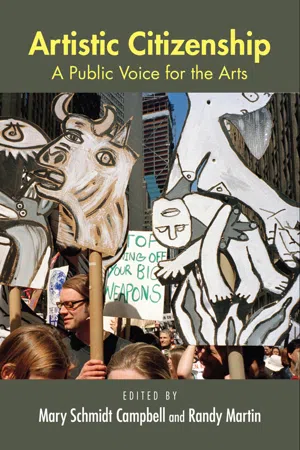
South Cove (1988), Mary Miss’s serene harbor within the harbor at Battery Park in downtown Manhattan, or her sublime installation Framing Union Square (1998) in the labyrinthine subway station at Union Square, certainly sacralize otherwise mundane places. Art that affiliates with protests and demonstrations operates in a variety of ways, whether as the gigantic figures of Bread and Puppet Theater, which has continued to be active since the Sixties, or as the savvy theatrics of Act-Up, the 1980s activist AIDS Coalition to Unleash Power, or as the ironic protests against the 2004 Republican National Convention in New York City enhanced by initiatives such as Bikes Against Bush and the text messaging system-based Spectropolis. This art helped engage people as part of a civic operation of mobilization for purposes of dissent, it gave voice and comment to a crowd, it captured media attention so that the protest could affect other lives, and it introduced a range of voices—ironic, humorous, outraged, parodic, utopian—into a political gathering usually measured in exclusively strident tones. Public making, calling the people together, is one of the operations of art, whether in the ancient Greek amphitheater where polis m...