- 167 pages
- English
- ePUB (mobile friendly)
- Available on iOS & Android
eBook - ePub
Textual Practice 10.3
About this book
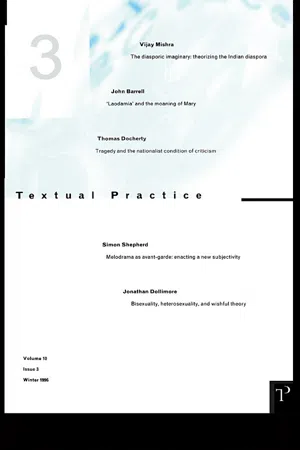
Volume 10, Issue 3- Papers include: Tragedy and the nationalist condition of criticism "Thomas Doucherty"--Descartes, Baudrillard, Dryden and a consideration of cultural relations between England and France in the late seventeenth century.ILaodamia and the moaning of Mary "John" "Barrell"--changing critical responses to Wordsworth's "heroic version of masculinity." Melodrama as Avant-garde: enacting a new subjectivity "Simon Shepherd"--nineteenth-century English radicals and translations of French melodrama. The diasporic imaginary: theorizing the Indian diaspora "Vijay Mishra;" Bisexuality, heterosexuality and wishful theory "Jonathan Dollimore. Reviews, index. Holcroft ""IA Tale of Mystery, --a melo-drame" and ICaleb Williams.
Information
‘Laodamia’ and the moaning of Mary
John Barrell
I
Wordsworth’s ‘Laodamia’ was written in late October 1814 and first published the following year. As soon as the poem appeared, Charles Lamb wrote to Wordsworth to tell him how ‘original’ he had found it: ‘original,’ he explained, ‘with reference to your own manner. You have nothing like it. I should have seen it in a strange place, and greatly admired it, but not suspected its derivation.?1 It is probably because ‘Laodamia’ is, as Lamb points out, so apparently unWordsworthian that the poem has not seemed of much importance to twentieth-century critics. To a number of his early admirers, however, the poem was one of Wordsworth’s greatest achievements. Henry Crabb Robinson described it as one ‘in which men rejoice on account of the sympathies and sensibilities it excites in them’, and he was surprised to find that Wordsworth himself did not value it so highly.2 De Quincey found ‘Laodamia’ ‘exquisite’, and arguably the more so for not being written in ‘the idiomatic language of life’ that had characterized Wordsworth’s earlier poems.3 Haydon thought it one of Wordsworth’s ‘finest things’, and Hazlitt seems to have admired the poem more as he came to like Wordsworth less.4
In recent years, ‘Laodamia’ has come to be thought of, in particular by Jean Hagstrum, Lawrence Lipking, Donald Reiman, and Judith Page, as a poem which invites us to think about Wordsworth and masculinity, and it is in those terms that I want to talk about it too.5 But my account of it differs, I hope, from theirs, in attempting to describe the version of masculinity it offers as, precisely, a version, a historically specific account of what it was to be a man. I shall be arguing that in ‘Laodamia’ Wordsworth articulated a heroic version of masculinity and of the attitudes towards male and female sexuality it involved which has its roots in a classical republican account of heroism and which came increasingly to be questioned in the early decades of the nineteenth century. I will be suggesting how Wordsworth responds to the gathering doubts about the value of this notion of masculinity in his revisions of the poem, and I will try to show how the poem could be used by early Victorian readers to express an account of masculinity which was directly critical of the account developed in ‘Laodamia’. As part of this enquiry, I want to use the poem to set up the terms in which to talk about how Wordsworth’s own masculinity was constructed by two, in particular, of his younger admirers, Benjamin Robert Haydon and Thomas De Quincey— remarks that would have been added, had space permitted, to recent attempts I have made to write about the anxieties of gender in the work of both men. I will attempt to describe the deep anxiety of Haydon and De Quincey about their own masculinity, the way Wordsworth figures in that anxiety, and the suggestions implicit in their writing about how notions of masculinity may have been changing in the period between the writing of the poem and the years around 1840, when the passages by Haydon and De Quincey I will mainly be referring to were written.
| Textual Practice 10(3), 1996, 449–477 | © 1996 Routledge 0950–236X |
II
Laodamia was the wife of Protesilaus, the ruler of a small kingdom in Thessaly. Shortly after their marriage, Protesilaus left his wife to join the expeditionary force assembled at Aulis in preparation for the siege of Troy. When finally, by the sacrifice of Iphigenia, the Greek fleet was able to sail, it did so under the shadow of a prophecy that the first man to disembark on the Trojan shore would be killed. Protesilaus, worried that the other Greek captains would hang back from the shore, determined to be the first to leap on to the beach. He was first, and Hector killed him. There are different versions of what follows; but in the version of the myth followed by Wordsworth, when Laodamia heard of his death, she pleaded with the gods to be allowed to see her dead husband once more. Protesilaus was duly conducted from the underworld by Mercury, and was allowed to stay with his wife for three hours. When the time was up, and Protesilaus died again, Laodamia, unable to support the prospect of a life without him, also died. She was believed to have died of love, and passed into classical and medieval literature as the type of the devoted and loving wife. According to Pliny the Elder, the grave of Protesilaus was planted with trees which when Pliny was writing were still alive, despite the fact that every time they grew tall enough to see across the Hellespont to Troy, they withered away, and had to grow all over again. According to Wordsworth, it was ‘the incident of the trees growing and withering again’ which had prompted his own poem.6
Wordsworth’s account of this myth begins from the assumption that Laodamia’s motive in desiring Protesilaus’s return was primarily sexual. As soon as Protesilaus appears she tries to embrace him; her hands get no purchase on his now insubstantial form, but still she attempts to persuade him to lie down with her on their marriage bed for one final ‘nuptial kiss’.7 Protesilaus at first responds to his wife’s flagrant sexuality with stern disapproval. He advises her to govern her passion, and to accept the exigencies of fate. Laodamia threatens that if the consummation she desires is denied her, she will die and follow him to Elysium; and Protesilaus, though he repeats his condemnation of her ungovernable passion, then teaches her that its fervour is the very means by which she may attain the spiritual love and peace enjoyed in Elysium. The strength of desire, Protesilaus explains (lines 145–50), is so far in excess of its capacity to be satisfied on earth that it can be fulfilled only by spiritual pleasures; sexual passion, though apparently a purely selfish emotion, may become so powerful as to annihilate the self, and prepare us for the truly selfless love enjoyed by spiritual beings. He no longer advises her to reconcile herself to life on earth, but to look forward to their reunion in Elysium.
This exchange has entirely filled the three hours allowed for the interview. Mercury reappears, leads Protesilaus away, and Laodamia herself expires in a trance of passion. Protesilaus’s account of the uses of desire is apparently validated when Laodamia is translated herself to Elysium; at least, she is in the first version of the poem, but, as we shall see, in later versions of the poem she is punished for the very passions which at first appear to have earned her spiritual reward.
There is no classical precedent for this version of the myth whereby Laodamia is consumed by a desire to make love with the shade of her dead husband, and Protesilaus is represented as having transcended sexual in favour of spiritual love. To Ovid in the Epistles from Pontus, Laodamia is simply the type of the perfectly faithful wife. To Ovid in the Heroides, and to Catullus, Laodamia is an ardent lover, but in both texts she is represented at the period between Protesilaus’s departure and the discovery of his death—the question of her nourishing impious desires towards her dead husband never arises.8 But for a number of other classical authors, it is Protesilaus who cannot reconcile himself to the loss of Laodamia and the pleasures of sexual love. According to Eustathius, Protesilaus initiates the lovers’ brief reunion, because, having angered Aphrodite, he cannot rid himself of his desire for Laodamia even though he is dead. For Lucian too it is Protesilaus who prays for the reunion, by which he hopes to persuade his wife to join him in death. In Propertius, Protesilaus is represented as yearning to embrace his wife once more; and whereas in Wordsworth’s poem Laodamia’s embraces fail because insubstantial form cannot be embraced by substance, in Propertius’s elegy it is the insubstantial embrace of Protesilaus that cannot get a grip on his wife’s body.9
The nearest classical precedent for Laodamia’s impious desire occurs in book VI of the Aeneid, where she is briefly glimpsed not in Elysium, as in the first version of Wordsworth’s poem, but in the Mourning Fields, a region on the outer margins of Orcus, among women who have died for love, who cannot reconcile themselves to death, and whose yearnings do not leave them even in death.10 Virgil’s mention of Laodamia—it is three words long—was to become increasingly influential on Wordsworth’s poem as it was revised over the thirty years following its first publication, but there are some intriguing allusions to this book of the Aeneid even in the version of 1815. The moment, for example, where Laodamia is shown by Wordsworth attempting to embrace her husband’s shade probably derives not from Protesilaus’s attempt to embrace Laodamia in Propertius, but from the futile attempts of Aeneas to embrace the shade of his dead father: what is in Virgil a sign of the filial piety of his epic hero becomes for Wordsworth the behaviour of a woman unhinged by desire.11 Wordsworth’s account in his second stanza of the transformation of Laodamia’s body as she eagerly awaits the answer to her prayer is derived from Virgil’s account of the transformation of the terrifying Sybilline priestess Deiphobe, the prophetess who helps Aeneas to gain entry to the underworld, and who is driven to frenzy as she attempts to resist the inspiration of Apollo. ‘Suddenly,’ writes Virgil, ‘neither her face nor her complexion was the same as it had been, nor was her hair braided; but her bosom heaves, her heart swells with savage frenzy, and she seems taller than before’; but more of this in a moment.12
III
We have seen that at the end of the poem, as it stood in the 1815 version, Laodamia (lines 158–63) is ‘delivered’ by death from ‘the galling yoke of time’, and translated to Elysium. Her love, we are told, was ‘in reason’s spite’, but not criminal; the very depth of her love appears to redeem its unreasonableness. By dying of love, indeed, Laodamia seems to have followed Protesilaus’s doctrine to the letter; she has transcended desire by the very intensity of desire. This deliberate exculpation of Laodamia, however, bears all the marks of what Freud described as negation. The very terms of the assurance that she was without crime seem to speak of an anxiety that she is indeed somehow a criminal. On the one hand we are invited to judge Laodamia gently, presumably because the intensity of her passion is a mark of her wifely devotion. On the other hand we are still invited to judge her, apparently because she has acted out of passion and in spite of reason. This insistence that Laodamia is up for some kind of judgement can rest only on the notion that the question of her criminality arises out of her sexuality. It is for this that Protesilaus has reproved her earlier in the poem, and nothing she does thereafter, and no attempt to re-present passion as a part of the divine purpose, can quite wash away the crime of a woman who has so openly acknowledged her sexual desire.
That the sexuality of women is a threat to masculine virtue is of course a commonplace of heroic art in general, and of heroic poetry in particular. It is in these terms that Ovid represented Laodamia’s love for Protesilaus in the Heroides, and that Virgil represented Aeneas’s rejection of Dido.13 The founding text of English heroic or history painting, Shaftesbury’s essay on the choice of Hercules, represents masculine virtue as similarly founded on the renunciation of sexual pleasure, and the story of how Hercules chose virtue in preference to pleasure had been endlessly repeated throughout the eighteenth century. It was an especially appropriate topic in wartime, and ‘Laodamia’ was written in the year of uncertain peace between the abdication of Napoleon and the ‘Hundred Days’. From the 1790s onwards the heroic decision to embrace one’s public duty rather than one’s wife or lover was attributed to heroes on both sides of the revolutionary conflict.
Wordsworth himself had already offered such an account of heroism in his poem ‘Character of the Happy Warrior’, which when it was published in 1807 he represented as inspired by the death of Nelson. The poem, written in one of the nearest approximations Wordsworth ever attempted to the heroic couplet, attributes to the true hero, along with the usu...
Table of contents
- Cover Page
- Copyright Page
- The Diasporic Imaginary: Theorizing the Indian Diaspora
- ‘Laodamia’ and the Moaning of Mary
- Tragedy and the Nationalist Condition of Criticism
- Melodrama As Avant-Garde: Enacting a New Subjectivity
- Bisexuality, Heterosexuality, and Wishful Theory
- Reviews
Trusted by 375,005 students
Access to over 1.5 million titles for a fair monthly price.
Study more efficiently using our study tools.
Frequently asked questions
Yes, you can cancel anytime from the Subscription tab in your account settings on the Perlego website. Your subscription will stay active until the end of your current billing period. Learn how to cancel your subscription
No, books cannot be downloaded as external files, such as PDFs, for use outside of Perlego. However, you can download books within the Perlego app for offline reading on mobile or tablet. Learn how to download books offline
Perlego offers two plans: Essential and Complete
- Essential is ideal for learners and professionals who enjoy exploring a wide range of subjects. Access the Essential Library with 800,000+ trusted titles and best-sellers across business, personal growth, and the humanities. Includes unlimited reading time and Standard Read Aloud voice.
- Complete: Perfect for advanced learners and researchers needing full, unrestricted access. Unlock 1.5M+ books across hundreds of subjects, including academic and specialized titles. The Complete Plan also includes advanced features like Premium Read Aloud and Research Assistant.
We are an online textbook subscription service, where you can get access to an entire online library for less than the price of a single book per month. With over 1.5 million books across 990+ topics, we’ve got you covered! Learn about our mission
Look out for the read-aloud symbol on your next book to see if you can listen to it. The read-aloud tool reads text aloud for you, highlighting the text as it is being read. You can pause it, speed it up and slow it down. Learn more about Read Aloud
Yes! You can use the Perlego app on both iOS and Android devices to read anytime, anywhere — even offline. Perfect for commutes or when you’re on the go.
Please note we cannot support devices running on iOS 13 and Android 7 or earlier. Learn more about using the app
Please note we cannot support devices running on iOS 13 and Android 7 or earlier. Learn more about using the app
Yes, you can access Textual Practice 10.3 by Alan Sinfield in PDF and/or ePUB format, as well as other popular books in Literature & English Literary Criticism. We have over 1.5 million books available in our catalogue for you to explore.