- 224 pages
- English
- ePUB (mobile friendly)
- Available on iOS & Android
eBook - ePub
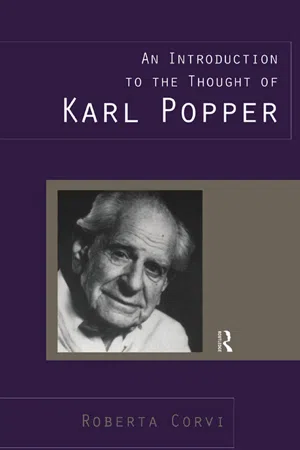
An Introduction to the Thought of Karl Popper
About this book
This is a comprehensive introduction to the philosophical and political thought of Karl Popper, now available in English. It is divided into three parts; the first part provides a biography of Popper; the second part looks at his works and recurrent themes, and the third part assesses his critics. It was approved of by Popper himself as a sympathetic and comprehensive study, and will be ideal to meet the increasing demand for a summary introduction to his work.
Information
Part I
1: THE LIFE
Karl Popper was born at Himmelhof, in the district of Vienna, on 28 July 1902, the last of three children after two sisters. His family was of Jewish origin, and the atmosphere in which he grew up was, as he put it, ‘decidedly bookish’ (UQ: 10): his father, Simon, was a lawyer and his mother, Jenny Schiff, came from a family in which music was enthusiastically cultivated. The personalities of both parents made their mark on the child’s development. The father, ‘more of a scholar than a lawyer’ (UQ: 11), translated the classics, greatly appreciated philosophy, and took a keen interest in social problems. He gave the young Karl numerous opportunities to channel his precocious intelligence: for example, the portraits of Schopenhauer and Darwin hanging in his father’s studio aroused in him a questioning curiosity, ‘even before [he] had learned to read’ (NSEM: 339). His mother, on the other hand, passed on to him such a passion for music that between 1920 and 1922 he seriously thought of taking it up as a career. Even after this idea was abandoned, his love for music did not diminish and indeed was fundamental in the development of his philosophical thinking.
This stimulating climate favoured a spontaneous interest in books, but also in the political events that marked his early adolescence and culminated in the First World War and the ensuing collapse of the Austro-Hungarian Empire. Meanwhile Karl attended the Realgymnasium, but he was not satisfied with the instruction he received there. After a long illness that kept him at home for more than two months, he became convinced that his class no longer offered any scope for significant progress. He therefore left in late 1918 and enrolled at the University of Vienna, but it was only in 1922 that he finally sat the entrance examination (the Matura) and became a properly matriculated student. He later recalled that he wanted to study not in order to start a career, but for the pleasure of learning and for the opportunity it gave him of exchanging political views with his friends. He had in fact joined a Socialist association, and for a few months in 1919 considered himself a Communist. But soon a clash between demonstrators and police in the Hörlgasse led him to think more critically about Marxism, which could justify the spilling of blood for the sake of the revolution on the grounds that one day of capitalism took a heavier toll of lives than the whole social revolution would do (OGOU: 9). Karl felt sure that when it came to sacrificing human lives, it was necessary to act with extreme prudence. Disillusioned with the dogmatic character of Marxism, he moved away from it but continued to call himself a socialist for a number of years. Socialism was then for him no more than ‘an ethical postulate: nothing other than the idea of justice’ (RR: 10). Only later did he realize that state socialism was merely oppression and could not be reconciled with freedom; that ‘freedom is more important than equality’ because ‘if freedom is lost, there will not even be equality among the unfree’ (UQ: 36).
Of minor importance, though still crucial, was the young Karl’s discovery—also in 1919—of Freud’s psychoanalysis and Alfred Adler’s ‘individual psychology’. As we shall see, he thought of these as lacking scientific status, unlike Einstein’s theories that made such a strong impression on him during that critical year. He managed to attend a lecture in Vienna at which Einstein unfolded before a ‘dazed’ Popper (UQ: 37) a new cosmology which challenged Newtonian mechanics and Maxwellian electrodynamics, both hitherto accepted as true beyond all doubt.
This decisive encounter revealed to the young physics student the difference between the positions of Marx, Freud and Adler, on the one hand, and those of Einstein on the other: the former were dogmatic attitudes that went looking for verifications, whereas the latter constituted a critical approach seeking not confirmation but crucial tests. By late 1919, then, Popper was convinced that what distinguished the scientist was the critical attitude (UQ: 38). Though showing some interest in philosophy, which led him to read Kant’s Critique of Pure Reason and Prolegomena, he was mainly captivated by mathematics and theoretical physics. In the winter of 1919–20, when he left the parental home to live in modest student accommodation, he tried to become independent by doing various kinds of work, so as not to burden a family whose economic situation was anything but flourishing in the runaway post-war inflation. Besides, he was eager to do some manual activity and avoid becoming an isolated intellectual remote from the social reality he was supposed to interpret and influence (OGOU: 10). His first jobs were irregular, but later he served an apprenticeship as a cabinetmaker and did social work with neglected children. Meanwhile he obtained a qualification to teach mathematics, physics and chemistry in secondary schools, and above all developed his own ideas on the demarcation between science and pseudo-science (UQ: 41). (As he later admitted, however, the first stimulus here came from his interest in political philosophy, which subsequently broadened out into a more general conception of philosophy (OGOU: 24))
The 1920s were thus a watershed in Popper’s formation, enriching it not only with intellectual discoveries but also with experience of life that wove together varied human and cultural interests. In 1925 he started to attend the Pedagogic Institute, where he met, among others, the woman who would become his wife in 1930 and always be close to him in his work (UQ: 73). To this period, too, belong his first unofficial academic experiments in the holding of seminars to help other students prepare for their exams. Although he had not yet published anything, he read and wrote a great deal, identified problems and outlined the solutions that would later be fleshed out in his most famous works. In particular, he was very keen on the ideas of Karl Bühler, a Gestalt psychologist who, as his professor, taught him that language was capable of serving different functions—to which Popper later added the argumentative function, as the basis of all critical thought (UQ: 74).
Around this time Popper got to know Heinrich Gomperz, son of the Hellenist Theodor Gomperz, with whom he often discussed problems of the psychology of knowledge and discovery. But then it became clear that what really interested Popper was the logic of discovery, and that his belief in a real world to be discovered and known made it impossible for him to accept Gomperz’s very different ‘psychological’ approach. This option in favour of realism, one of the cornerstones of Popper’s epistemology, would become stronger in later years and eventually lead to his theory of three worlds in which the realism applies even to creations of the human mind. If knowledge has an objective dimension beyond the subjective one, there is for Popper no choice but to reject the associationist psychology of the English empiricists; the study of logic—that is, of the objective aspects of knowledge— takes priority over the study of subjective thought processes. This view shows an affinity with the ideas of the Würzburg School, according to which human beings think not in pictures but in terms of problems (UQ: 76). It is not surprising, then, that Popper’s PhD thesis, ‘On the Problem of Method in the Psychology of Thinking’, marked his final move away from psychology and towards philosophy or, to be more precise, a consideration of methodology.
It was in 1928, in the city where Popper had so far lived and studied, that the Vienna Circle was officially born with its ‘scientific conception of the world’ better known as logical positivism. Previously called the Verein Ernst Mach, the Circle had already been meeting for some time around the figure of Moritz Schlick, and its main exponents included Rudolf Carnap, Otto Neurath (who first brought the group to Popper’s attention through an article and a lecture), Hans Hahn (his former mathematics professor), Viktor Kraft and Herbert Feigl (both of whom Popper knew personally). It was Feigl who, after a ‘nightlong’ discussion, had a major influence on Popper’s philosophical future by encouraging him to write up his ideas in book form (UQ: 82).
Early in 1932, after a couple of years’ work, Popper finished what he considered at the time to be the first volume of The Two Fundamental Problems of the Theory of Knowledge. It was read first by Feigl and then by other members of the Circle, including Carnap and Schlick, who thought highly of it despite its open criticism of the theories held by the logical positivists. The Springer publishing house, however, insisted that it had to be ‘radically shortened’ (UQ: 85) to no more than 240 pages. The version that finally appeared in 1934, under the title Logik der Forschung, was widely reviewed in the press, including by Circle members— Carnap and Hempel were quite favourable, while Reichenbach and Neurath were more critical.
Popper was certainly inclined to be polemical in relation to the Wiener Kreis, but he shared its members’ Enlightenment attitude and critical view of philosophy (UQ: 89), so much so that many people identified him with the Circle. In fact, although Popper maintained contact with many of its leading members, he was never invited to the meetings organized by Schlick (OGOU: 39–41). Later he claimed that the objections contained in his first work actually killed off logical positivism (UQ: 88), but that it was at most a question of manslaughter rather than premeditated murder (OGOU: 39). Whatever the author’s responsibilities, it certainly had a greater success than he had expected, and this brought him numerous invitations to lecture abroad. Because of the new commitments, he took a period of leave from the secondary school teaching in which he had been employed since 1930. Then, apart from a brief spell back in Austria, he spent almost nine months in England between 1935 and 1936, having the opportunity to put forward his anti-inductionist theory in a discussion following a lecture by Russell. (According to Popper, those present ‘took this for a joke…and laughed’ (UQ: 110).) Altogether the time Popper spent in England was very profitable, both scientifically and in personal terms, because he was able to make new contacts with representatives of British culture that would prove invaluable during the difficult years of Nazi dictatorship and war.
Popper’s interests soon extended to the quantum theory formulated by Heisenberg in 1925, whose interpretation he saw as closely bound up with the calculus of probability (UQ: 92). He had the chance to go more deeply into the problem at a congress in Copenhagen in 1936, where he discussed with Bohr some aspects of the theory that struck him as less than convincing—especially the Danish physicist’s view that quantum mechanics, unlike classical physics, could not really be understood. This encounter led Popper to investigate the idea of understanding, not in terms of pictures but by focusing on the logical force of a theory. This problem, together with that of corroboration and truth, kept him busy immediately after the publication of the Logik. In fact, between 1934 and 1935 he had met Tarski successively in Prague, Vienna and Paris and realized that ‘he had finally rehabilitated the much maligned correspondence theory of truth which, I suggest, is and always has been the commonsense idea of truth’ (UQ: 98). Popper attached so much importance to this that in the autumn of 1935 his first two lectures at Bedford College, London were devoted to Tarski, at that time unknown in England.
Europe was meanwhile passing through difficult years as a result of the totalitarian regimes that had been imposed in various countries. Austria itself was the object of Hitler’s barely concealed appetites, as well as having many Nazi sympathizers among its own citizens. Members of the Vienna Circle were moving to Britain or the United States, and Schlick was assassinated in 1936 by a Nazi student. Given his Jewish origins, Popper also finally decided to leave the country and applied for a position teaching philosophy at the University of Canterbury in New Zealand. in New Zealand. Towards the end of 1936 Cambridge University offered him its hospitality, but as he had meanwhile obtained the post in New Zealand he declined the offer in favour of Fritz Waismann, a follower of Schlick’s, who was also seeking a secure refuge from racial and political persecution.
And so Popper and his wife left for their new destination and arrived in March 1937. They spent the whole of the war there in a climate of exceptional calm, though at the price of a certain isolation from the rest of the world; Britain, with which they had the easiest and most frequent contact, was five weeks away by sea. Nevertheless, and despite his heavy teaching load, Popper found the time and concentration to immerse himself in study: he resumed his reflections on probability theory and quantum physics, and investigated more systematically the methodology of the social sciences which had begun to interest him at the time of his break from Marxism. Already in England he had given a lecture The Poverty of Historicism’ in which he tried to apply the ideas of the Logik to the social sciences. In 1938 Hitler’s annexation of Austria induced the philosopher to collect and publish his political reflections that had been maturing since 1919. He naturally had difficulty in writing in a language which, however much practised, was not his own. But during his time in New Zealand he completed two works of a political character: The Poverty of Historicism (which argues that historicism inspired both Marxism and fascism), and The Open Society and Its Enemies, which started as a spin-off from the historicism essay but soon acquired a dimension of its own. The problems of composition were followed by still more wearisome ones of publication: the journal Mind turned down The Poverty of Historicism, and The Open Society was judged too irreverent towards Aristotle (not Plato, as it would be more logical to think in view of the book’s contents) (UQ: 119). Thus, the acquaintances to whom Popper had turned in America did not even submit the book for consideration by publishers, and it was only a year later, thanks to the intervention of Gombrich and Hayek, that an edition finally appeared. Soon afterwards, it was Hayek who ‘saved [Popper’s] life once more’ (UQ: 120) by offering him a readership at the London School of Economics and so enabled him to leave New Zealand for Europe.
Popper returned to London with his wife at the beginning of 1946 and began to teach at the LSE. Among his many students was a former Navy officer, John Watkins, who later succeeded him at the LSE. Popper did not conceal his preference for the natural sciences, but he adjusted to his new academic environment by concentrating more on problems of method in the social sciences, though trying at the same time to compare and contrast the two fields. Nor did this prevent him from composing articles between 1946 and 1948 on formal logic or—as he preferred to call it—metalogic.
The Open Society had been well received in England, and so Popper was invited to attend various symposia and to deliver a number of lectures. Especially worthy of note was the one he gave at Cambridge in October 1946 in the presence of Wittgenstein, when he posed the question ‘Are There Philosophical Problems?’ His somewhat provocative tone of argument soon angered Wittgenstein, who walked out of the room and slammed the door (UQ: 123). But less stormy minds were also present, including Bertrand Russell, and he moved on to argue that there are genuinely philosophical problems which cannot all be reduced to language mistakes. Popper’s relations with Wittgenstein were always rather argumentative—indeed, one writer has seen in his work an attempt to refute the thought of his fellow-Austrian. But according to Sir Karl himself, he had formulated all his major problems by the fateful year of 1919, long before he became acquainted with Wittgenstein and his doctrines around 1925 (OGOU: 37–38). On the other hand, he was quite willing to recognize the influence exerted on him not only by members of the Vienna Circle, but also by leading figures of the previous generation: he even regarded Boltzmann as an intellectual father because of his clash with Mach over the question of realism (OGOU: 64). Despite this admiration for two ‘Titans’ of Viennese philosophy, we shall see that Popper distanced himself from both to keep faith with his own realist commitment (OGOU: 45–47, 51– 54).
In 1949 Popper became professor of logic and scientific method in the University of London. The next year he stopped living in the capital, of which he was never very fond, and moved to Penn, Buckinghamshire where he lived until his wife’s death in 1985. Also in 1950 he made his first trip to the United States, where he met a number of old friends, such as Kurt Gödel, whom he had not seen since 1936. America made a good impression on him for the ‘feeling of freedom, of personal independence, which did not exist in Europe; (UQ: 128), but the real highlight was at Princeton where Einstein attended one of his lectures together with Bohr. He had three meetings with the great scientist, all mainly focused on Popper’s theory of indeterminism. Against Einstein’s view that ‘the world was a four-dimensional Parmenidean block universe in which change was a human illusion, or very nearly so’ (UQ: 129), Popper argued that if it was possible to experience change and temporal succession, they could not be just an illusion. (In the years to come he would never give up his realism even when it meant quarrels not only with Einstein or Gödel but also with his friend Schrödinger, with whom he regularly corresponded after they met again in England in the late 1940s.) Thomas Kuhn also attended Popper’s lectures in America, and not long afterwards he went to visit him in England. Subsequently, of course, Kuhn became famous for his critique of Popper’s methodology, in his book published in 1962, The Structure of Scientific Revolutions.
From 1951 to 1956 Popper worked on revisions ‘to correct, expand and develop the ideas of his first published book’ (P1: xi). Little by little, however, what were supposed to be mere appendices became autonomous of the whole and acquired the dimensions of a single, homogeneous work, much longer than the original Logik der Forschung. It was therefore decided to publish it as a kind of companion volume to the first English translation of the Logic, with the title Postscript: After Twenty Years. But early in 1957, when the galleys were ready for correction, a serious eye complaint forced the author to postpone the proofreading and to undergo a difficult operation on both retinas that kept him from working for a considerable time. In the end The Logic of Scientific Discovery only came out in 1959; and by the time his eyes had returned to normal, other projects had become more pressing and the Postscript was set aside.
In 1963 a collection of Popper’s major articles and lectures from a dazzling fifteen-year period appeared under the title Conjectures and Refutations. The next decade or so then saw the publication of Objective Knowledge (1972), an intellectual autobiography Unended Quest (1974) and a joint work with Sir John Eccles, The Self and Its Brain (1977). In the late sixties and early 1970s, Popper developed and refined his theory of objective mind, according to which three real and distinct worlds coexist within the single world perceived and accepted by common sense. It thus strayed into cosmological and ontological questions that were the province of metaphysics, in Popper’s use of the term: that is, such theories were not open to empirical refutation yet made it possible to provide arguments, and without them it would be difficult to see science as having the significance that is normally attributed to it.
From 1950 on, as he once confessed during a lecture (ISBW: 223), Popper led quite a secluded life in the Chiltern Hills, completely absorbed in his work. From time to time, however, it took him to America, Australia or Japan, as well as his own country of birth and various European cities, to give the kind of lecture series that was in ever greater demand as his fame as a philosopher continued to grow. After his wife’s death, he preferred to leave the home they had shared for so many years and moved to Kenley, near London, where he was assisted by his loyal secretary Melitta Mew up to his death on 17 September 1994.
Popper’s intellectual activity continued, at least as strongly as before, even after his retirement in 1969. And as old age crept up on him, he went on contributing interviews and articles to the press and television, especially in connection with the burning issues of the day. Although his health worsened with the passing years, he never abandoned his struggle against irrationalism and his faith in science, even as an antidote, for example, to environmental disasters. Indeed, he thought that such problems could only be solved through scientific and technological effort, and not—as the ecologists maintained—by renouncing science and industry.1 He also insisted that it would be impossible to protect the environment if the demographic explosion was not brought under control: 5 billion human beings with a tendency to double themselves had become a dangerous species, and Popper argued in favour of birth control by all non-authoritarian means.
These were not, in his view, the only reasons for humanity to feel anxious about the contemporary world. Popper was also very concerned about the mass media, especially television, which exercised ‘unlimited power without responsibility’.2 Indeed, the last text he published before his death was a pamphlet called Una patente per fare TV (A Licence to Make TV), which, far from being just a sterile denunciation, proposed a solution for the safeguarding of democracy and, above all, for the protection of young children and those least able to defend themselves from the aggressiveness of images and messages appearing on the small screen. What he suggested was to establish an organization similar to a professional body, which would train its members in certain values and have the power to issue reprimands for breaches of the rules.
Popper also saw a continuing threat from the Russian nuclear arsenal, which Yeltsin promised to dismant...
Table of contents
- COVER PAGE
- TITLE PAGE
- COPYRIGHT PAGE
- AN INTRODUCTION TO THE THOUGHT OF KARL POPPER
- FOREWORD TO THE ENGLISH EDITION
- ABBREVIATIONS OF POPPER’S WORKS
- A CHRONOLOGY OF POPPER’S LIFE
- PART I
- PART II
- PART III
- NOTES
- BIBLIOGRAPHY
- CRITICAL LITERATURE
Trusted by 375,005 students
Access to over 1.5 million titles for a fair monthly price.
Study more efficiently using our study tools.
Frequently asked questions
Yes, you can cancel anytime from the Subscription tab in your account settings on the Perlego website. Your subscription will stay active until the end of your current billing period. Learn how to cancel your subscription
No, books cannot be downloaded as external files, such as PDFs, for use outside of Perlego. However, you can download books within the Perlego app for offline reading on mobile or tablet. Learn how to download books offline
Perlego offers two plans: Essential and Complete
- Essential is ideal for learners and professionals who enjoy exploring a wide range of subjects. Access the Essential Library with 800,000+ trusted titles and best-sellers across business, personal growth, and the humanities. Includes unlimited reading time and Standard Read Aloud voice.
- Complete: Perfect for advanced learners and researchers needing full, unrestricted access. Unlock 1.5M+ books across hundreds of subjects, including academic and specialized titles. The Complete Plan also includes advanced features like Premium Read Aloud and Research Assistant.
We are an online textbook subscription service, where you can get access to an entire online library for less than the price of a single book per month. With over 1.5 million books across 990+ topics, we’ve got you covered! Learn about our mission
Look out for the read-aloud symbol on your next book to see if you can listen to it. The read-aloud tool reads text aloud for you, highlighting the text as it is being read. You can pause it, speed it up and slow it down. Learn more about Read Aloud
Yes! You can use the Perlego app on both iOS and Android devices to read anytime, anywhere — even offline. Perfect for commutes or when you’re on the go.
Please note we cannot support devices running on iOS 13 and Android 7 or earlier. Learn more about using the app
Please note we cannot support devices running on iOS 13 and Android 7 or earlier. Learn more about using the app
Yes, you can access An Introduction to the Thought of Karl Popper by Roberta Corvi, Patrick Camiller in PDF and/or ePUB format, as well as other popular books in Philosophy & Epistemology in Philosophy. We have over 1.5 million books available in our catalogue for you to explore.