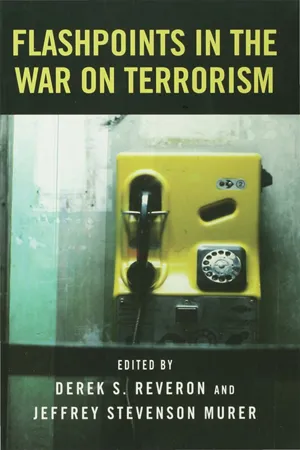
This volume offers a comprehensive overview of international political violence by bringing together foreign policy experts on several regions who examine conflicts in the Fertile Crescent, the Balkans, the Post-Soviet Region, the Himalayas, Southeast Asia, and sub-Saharan Africa. With cogent assessments of civil conflicts that threaten to be part of a 'global jihad', each chapter both dissects the historical roots and socio-economic causes that catalyze terrorism in those areas, as well as posits ways for the United States to meet the myriad of foreign policy challenges posed by the growing threat of contemporary international terrorism.
- 400 pages
- English
- ePUB (mobile friendly)
- Available on iOS & Android
eBook - ePub
Flashpoints in the War on Terrorism
About this book
Information
III
Asia
Thailand

7
THAILAND
NATURE OF THE FLASHPOINT
Since January 2004 the insurgency in the southern Thai provinces of Narathiwat, Pattani, and Yala has taken a violent turn and is now at its bloodiest stage in the entire history of the Kingdom with about 1,000 people being killed in the simmering violence. Insurgents in southern Thailand have targeted almost everyone: the security forces, government officials, civilians, and especially Buddhists. Thailand’s security forces have also responded in kind, killing insurgents in significant numbers. On one notable occasion, Thai authorities were perceived to have taken a particularly heavy hand; during the October 25, 2004, riot in Tak Bai, 78 Muslim protesters were taken into custody and later died from suffocation. That incident brought a new dimension to the conflict.
Some separatist groups now threaten to bring the violence to other parts of the kingdom, which thus far has been localized to the south. A period of relative calm followed the February 2005 elections, during which the government adopted a series of measures for a lasting solution to the problems in the south. Most notable was the creation of the National Reconciliation Commission, headed by former Prime Minister Anand Panyarachun. Yet even as the National Reconciliation Commission was to submit its reports and recommendations, near simultaneous and coordinated bombings in Yala on July 14, 2005, brought the specter of violence, fear, and intimidation once again to the fore. These multiple bombings in Yala preceded a spate of brutal killings, including the beheadings of numerous members of the Buddhist community. In response, Prime Minister Thaksin Shinawatra moved swiftly, declaring a state of emergency in the southern provinces, vesting the responsibility for security matters and the power to deal with insurgent violence directly in the office of the Prime Minister.1 There is, however, a perception that the emergency measures would be counterproductive, which further exacerbates the conflict.
Unrest and violence have never been alien to Thailand’s southern provinces. Muslim separatism in that region has been present to some degree or another since the 1940s, which was transformed into insurgent violence in the 1960s. However, in the late 1990s, insurgency and violence abated somewhat. The current phase of insurgent violence, especially since January 2004, and Bangkok’s response mark a departure from the previous separatist movements in the south.
HISTORICAL CONTEXT
The unified Thai kingdom dates back to the mid-fourteenth century. In 1782, King Rama I founded the Chakri dynasty with Bangkok as its capital, which continues to the present. The southern Thai provinces of Narathiwat, Yala, and Pattani, together with Songkhla, Satun, and the northern Malay states of Kelantan, Terengganu, and northern Kedah, were all part of what was known as Patani Raya (Greater Patani2), a domain of the earlier Sultanate of Pattani. It was in the mid-thirteenth century that the kingdom adopted the name “Pattani” under the rule of Sultan Ismail Shah. After the fall of Malacca in 1511, the kingdom’s stature as a major trading center grew with Indian-Muslim traders competing vigorously with the kingdom of Sumatra in Aceh.
In 1786, the forces of Rama I invaded Pattani. Its ruler, Sultan Muhammad, was killed and the city was destroyed. Many Malays were taken to Bangkok as slaves. Thai rule over the southern provinces continued since then, with intermittent periods of rebellion and unrest. In the later part of the nineteenth century, Thai rulers responded more vigorously to these periodic rebellions, thereby weakening the Pattani Sultanate.3 In May 1897, the Thai Provincial Administration Act (Phraratchabanyat Laksana Pakkhrong Thongthi) was enacted with the goal to integrate the southern provinces within Thailand.
In 1902, Siam formally annexed Pattani. The seven provinces of Pattani—Pattani, Nong Chik, Saiburi, Yala, Yaring, Ra-ngae, and Reman—came under the Area of the Seven Provinces, which in turn was placed under a centralized administrative structure governed by Siamese-appointed bureaucrats.4 In 1906, the seven Malay provinces were brought even closer together under a single administrative unit called Monthon Pattani. Following the Anglo-Siamese Treaty of 1909, which drew a border between Patani and the Malay states of Kelantan, Perak, Kedah, and Perlis, Siam’s absolute suzerainty over Pattani was formally established.5 Since then, there have been systematic attempts to develop a mono-ethnic Buddhist Thai character in the entire kingdom, which was seen by southern Muslims to be at odds with the Islamic identity in the provinces of the Pattani.6
At present, the Thai population is predominantly Buddhist (95 percent), with Muslims comprising 4.6 percent of the population. The majority of the Muslim population is Sunni with a miniscule Shiite minority. Geographically, the Muslim population has been concentrated in southern Thailand, particularly in Narathiwat, Yala, and Pattani, now collectively known as the Southern Border Provinces. These provinces now constitute the restive segments in Thailand.
Islam in Thailand
Southeast Asia’s initial contact with Islam was through Arab traders in the region as early as the eighth century CE. Between the twelfth and fifteenth centuries, Islam spread extensively, with large numbers of people converting, including the king of Pattani, who declared an “Islamic kingdom” in 1457.7 Islam in Southeast Asia drew heavily from the beliefs and practices of Hinduism and animism. In Thailand, Islam had been largely inclusive, as elsewhere in Southeast Asia. Like Buddhism, it integrated many beliefs and practices, which were not central to the Islamic faith.8 However, since the seventeenth century, Islamic scholars educated in Saudi Arabia and Egypt introduced more orthodox and scripture-based interpretation of the faith.9 The insistence on ethnic and religious solidarity was reinforced by the status of Islam as a pillar of the Malay identity.10
The Pattani Kingdom was at that time considered the “cradle of Islam” in Southeast Asia,11 due to its status as a major center for Islamic learning, comparable to the prestigious Sultanate of Aceh in Indonesia.12 The Islamic teachings affirmed the traditional virtues and greatness of the kingdom of Pattani (Patani Darussalam), the identification with the Malay race, and a religious orientation toward Islam.13 The centralization of the Thai state since the eighteenth century sought to bring the Pattani Kingdom under Buddhist influence, with controls exerted in taxation, education, and through the Thaification of the local culture, language, and religion. Measures were introduced to abolish “backward” customs and dialects and to enforce uniformity in social behavior as part of strategies to integrate the southern Muslims into mainstream Buddhist Thai society. The Education Act of 1921 forced Muslims to attend Siamese schools to receive a secular education. State-run schools were forced to impart teachings in Buddhist ethics, with monks often serving as teachers.14 Under the Act’s provisions, the Koran was translated in the Thai language. This was considered an insult to Muslims, as it is not permissible in Islam to reproduce the Koran in any other language except its original Arabic.
One of the primary reasons why Bangkok attempted to integrate the southern provinces into Thai culture has been a sense of vulnerability rising out of its proximity to the northern Malay border states of Kelantan, Trengganu, and Kedah. Despite administrative separation, people on both sides share the same language, political culture, social structures, customs, and values, with a high level of cross-border contact15 This has reinforced the ethnic affinity of the Malay Muslims with their Muslim brethren in southern Thailand.16
Origins of the Southern Insurgency
Discontent against what the southern Muslims call “Thai imperial dominance” began to manifest as early as 1903 when Tengku Abdul Kadir Qamaruddin, the last sultan of Patani, revolted against Bangkok. He was defeated and imprisoned. In 1910, two Sufi preachers—To’tae and Haji Bula—led protests against the Thai government, which the military put down and arrested the leaders.17 After another failed attempt in 1915, Tengku Abdul Kadir fled to Kelantan and regrouped his forces with the help of Sultan Muhammad IV, launching one of the biggest campaigns against Bangkok in response to the Education Act of 1921. The education reform was seen as an attempt to erase Pattani-Malay identity through coerced conversions to Buddhism18 It also undermined the influence of Islamic religious teachers who mobilized the community against the reforms. This rebellion, like so many before, failed when many key leaders were either captured or killed.
In 1939, Bangkok introduced the Thai Customs Decree (Thai Ratthaniyom) which forced all Thai citizens—including the minority groups—to conform to a set of common cultural norms19 Muslims were prevented from adopting Muslim names or using the Malay dialect. Thai Buddhist laws on marriage and inheritance replaced Shari‘a.20 In some cases, Muslims were even forced to participate in the public worship of Buddhist idols, and men were required to wear Western-style trousers.21 This process challenged the ethno-cultural identity of the Muslims and led them to rebel against the central government; the resulting rebellion was harshly quelled with Pattani leaders killed, arrested, or exiled to Malaysia.
During World War II, the Malay Muslims fought alongside the British with an assurance that after the war, Pattani would be granted independence. When the war ended in 1945, Bangkok allowed the sultanates of Kelantan, Trengganu, Kedah, and Perlis to rejoin Malaya. Muslim leaders under Tengku Abdul Jalal petitioned the British to grant independence to four southern provinces from Thailand. However, the British reneged on their “gentlemen’s agreement.” For the British, a unified Thai state was a strategic counterweight to the communist insurgency in China, Indochina, and Malaya. This marked the beginning of militant separatism in 1946.
From the 1960s to the 1980s, there was a massive transmigration of Thai-Buddhists from other parts of Thailand to the south to “balance up” the racial and religious demography of the southern provinces.22 Though there was an attempt by the central Thai administration to be more conciliatory in the post-war period, centuries of marginalization, suppression, state penetration of Muslim civil society, and the absence of political participation stood in the way of any meaningful cultural assimilation of the southern provinces with the rest of Thailand. The process of social and cultural assimilation was very much resented by ethnic Malays, who saw it as cultural colonization by the Bangkok government.23
This led to the development of radical Islamist movements in southern Thailand. One of the earliest groups to engage in armed rebellion was Barisan Nasional Pembebasan Patani or the Patani National Liberation Front (BNPP) formed by Adun Na Saiburi from among the remnants of Gabungam Melayu Pattani Raya (GAMPAR, the Greater Pattani Malayu Association). GAMPAR was established in Madrasah Muhammadiyyah, Kota Baru, Kelantan (now in Malaysia) in March 1948, with the avowed objective of uniting the four provinces of Pattani, Yala, Narathiwat, and Satun as a Malay Islamic state.24 Other groups subsequently emerged, such as the Barisan Revolusi Nasional (BRN) or the National Revolutionary Front, and the Pattani United Liberation Front (PULO). The objectives of these groups were to establish an independent Islamic state in the three provinces of Pattani, Yala, ...
Table of contents
- Cover
- Halftitle
- Dedication
- Title
- Copyright
- Contents
- Preface
- Acknowledgments
- Introduction: Flashpoints in the War on Terrorism
- Section I: The Near East
- Section II: Europe and the Post-Soviet Region
- Section III: Asia
- Section IV: Africa
- Contributors
- Index
Trusted by 375,005 students
Access to over 1.5 million titles for a fair monthly price.
Study more efficiently using our study tools.
Frequently asked questions
Yes, you can cancel anytime from the Subscription tab in your account settings on the Perlego website. Your subscription will stay active until the end of your current billing period. Learn how to cancel your subscription
No, books cannot be downloaded as external files, such as PDFs, for use outside of Perlego. However, you can download books within the Perlego app for offline reading on mobile or tablet. Learn how to download books offline
Perlego offers two plans: Essential and Complete
- Essential is ideal for learners and professionals who enjoy exploring a wide range of subjects. Access the Essential Library with 800,000+ trusted titles and best-sellers across business, personal growth, and the humanities. Includes unlimited reading time and Standard Read Aloud voice.
- Complete: Perfect for advanced learners and researchers needing full, unrestricted access. Unlock 1.5M+ books across hundreds of subjects, including academic and specialized titles. The Complete Plan also includes advanced features like Premium Read Aloud and Research Assistant.
We are an online textbook subscription service, where you can get access to an entire online library for less than the price of a single book per month. With over 1.5 million books across 990+ topics, we’ve got you covered! Learn about our mission
Look out for the read-aloud symbol on your next book to see if you can listen to it. The read-aloud tool reads text aloud for you, highlighting the text as it is being read. You can pause it, speed it up and slow it down. Learn more about Read Aloud
Yes! You can use the Perlego app on both iOS and Android devices to read anytime, anywhere — even offline. Perfect for commutes or when you’re on the go.
Please note we cannot support devices running on iOS 13 and Android 7 or earlier. Learn more about using the app
Please note we cannot support devices running on iOS 13 and Android 7 or earlier. Learn more about using the app
Yes, you can access Flashpoints in the War on Terrorism by Derek S. Reveron,Jeffrey Stevenson Murer in PDF and/or ePUB format, as well as other popular books in Politics & International Relations & International Relations. We have over 1.5 million books available in our catalogue for you to explore.