eBook - ePub
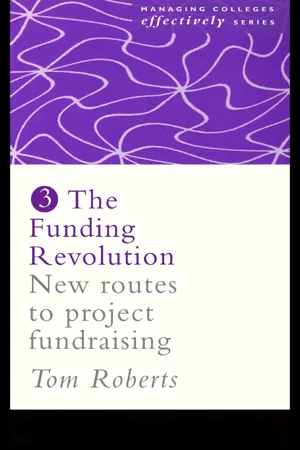
The Funding Revolution
New Routes to Project Fundraising
- 150 pages
- English
- ePUB (mobile friendly)
- Available on iOS & Android
eBook - ePub
About this book
At a time when traditional funding is diminishing and costs increasing, the need to look to new external sources of money is now central to survival for many organizations. New avenues of funding often demand a new outlook, and old ways of thinking can prove to be barriers to success. This book looks not only at methods for raising funds, providing practical steps in preparing for new funding initiatives, but also at the attitudes and mind-sets that form part of the whole picture. The volume is concise and accessible, with plans of action, bullet lists and diagrams for ease of consultation.
Information
Chapter 1
The New Outlook
In determining what funds to allocate to the college, the Council shall have regard to the desirability of not discouraging the college from maintaining and developing its funding from other sources.
(The Further Education Funding Council, 5 August 1993)
In the past, income tended to come from one source. This is no longer the case. Some colleges tend to see new income sources as a cherry on the cake, whilst others are already beginning to see them as the route to survival. The simple fact is that FEFC funding is likely to diminish in the future and alternative funding sources will become increasingly vital.
The difficulty for colleges is that in most cases the new funding distributors have their own agendas and the core educational provision which colleges currently see themselves as committed to tend not to figure very highly on these new agendas. New distributors are coming from a wholly different direction and are not in business to top up diminishing funds of Colleges of Further Education. If a college feels that these new sources are a quick way to achieve extra funding, it is in for a very very rude awakening.
The new funding sources are external to the environment and ethos of traditional college life, and so the first thing one needs to do is to put oneself into the shoes of these external funders. This might well be a good thing, for there is great danger in remaining insular in a world which is becoming increasingly dependent upon networking, partnerships, collaboration, and the breaking down of barriers. Well before the formulating of individual project funding bids, colleges should be making that extra effort to get to know and empathize with the key players in their region—the local authorities; the Training and Enterprise Councils; Business Links; the private sector; the Health Authority; Probation Service; economic development organizations; the voluntary and community sector; and so on. This needs to go beyond polite lunchtime meetings by really delving into the issues which are dominating the outlook of other groups. Once these issues are identified, one can begin to look at one’s own college as a major resource and begin to see how this resource can be put to greater use within the community.
New funding organizations such as the lottery distribution boards, the Government Offices, and European Community funding agencies usually award innovative concepts transgressing traditional boundaries, and involving a partnership of organizations, of at least demonstrating strategic awareness of issues stretching beyond the bounds of an individual organization’s territory. It is no use saying ‘I’m all for partnerships’ if the unspoken point is ‘providing I get my own way’.
This may all sound rather daunting, and it is if you realize the situation half way through making a project bid, but if it has already become a way of life, a way of looking at things, then you are half way there before you start thinking of specific projects.
One approach to implementation is to set up a structure, within or running parallel to a college, which plugs into the new ethos, and links back into the internal activities of the college. Such an example is the formation of a college charity which enables a college to enhance its contribution to the well-being, prosperity and quality of life of its region. The charity would not raise funds directly for the college, but would address broader educational needs in the community including special needs. Outreach activity could fit neatly into this. A good illustration of this may be seen in Bournemouth and Poole College of Further Education’s College Foundation, which is described in detail in Chapter 6. The College set up the charity as a way of distancing itself from the fundraising process (including accessing lottery funds). ‘We looked for ways in which we could put something back into our local community,’ explains Gary Bentham, Manager of the foundation. The foundation has two staff—Foundation Manager and Foundation Secretary—ten Directors, some of which are College Governors (the organization is a company limited by guarantee with full charitable status), and there are three Foundation Patrons. It was formally launched in October 1996 and in the period between August 1996 and July 1997 an income of approximately £100,000 was raised, plus £63,000 of Gifts in Kind. Much of this money was in turn used as partnership funding to lever further funding from the lottery. In the new world of interactive match funding packages, the actual funding generated by fundraising can be many times this value; for example, Arts Council lottery funding can amount to three times initial match funding.
Projects undertaken by the College Foundation have varied from a contemporary art gallery to a pilot project to provide sailing opportunities for those who would normally be excluded by disability. The College provides tutors and transport for the sailing programme, whilst the Foundation provides the funding needed by the college infrastructure in order for this community project to be delivered.
Another example of a discreet structure is the creation of an Enterprise Faculty. Having one foot within the day-to-day operation of the college and another in the outside world of business contacts, community issues, partnership participation and fundraising, it is possible to establish a new focus within the community. The objective is to use the college strength in addressing community needs whilst feeding back a new community awareness into the life of the college. Oxford College of Further Education launched an Enterprise Faculty in the summer of 1997 and, whilst it is early days yet, they are already benefiting from the fresh perspective generated by the Faculty. The Faculty is operated by a Faculty Manager who is supported by a group of managers responsible for company services, community services, adult learning, tendering, sponsorship and international services.
In principle the Faculty has been created from the regrouping of elements of the College which had previously been housed in other Faculties and Service Departments, but in practice there is a growing awareness of a new ethos emerging from the interaction between the previously separate business elements. The whole is far greater than the parts, and the existence of the Faculty is producing a new innovative and entrepreneurial outlook which is influencing the values of the whole College and its standing in the community. The pros and cons of setting up an Enterprise Faculty are looked at in detail in Chapter 9.
So, what sort of skills does the new outlook demand? Administrative skills, obviously; but, in addition, considerable vision, realism, negotiation skills, team-building skills, flexibility of attitude, community awareness, political awareness, business sense, marketing skills, great commitment, and endless patience. The time involved tends to be far greater than anticipated. There is a danger in isolating this work into the hands of a few staff who appear to thrive on the new ethos. There needs to be total awareness and commitment from top to bottom of the organization—and that includes the governors. The message needs to come firmly from the top so that no-one is in any doubt. The work must be right at the heart of the strategic direction of the college— working on the sidelines is both fruitless, potentially embarrassing, and damaging.
This all sounds time consuming and high risk. It is, but the rewards are also high. It makes colleges more relevant because it generates activity which focuses upon local needs, takes on board national strategy, and on occasions reflects international strategy—via a high-quality project. The new funding approach is about promoting good practice, innovation, participation; promoting new ways of working, networking between groups, maximizing the benefits of one’s own resources, and has its roots firmly in society. At a time when colleges are buried by the intensity of keeping their heads above water day by day, the new funding sources provide scope for vision like never before. But will they make money? Many of these initiatives are not about making money, they are about integrating the college much more closely into the community. However, an integrated approach will prove the finest way to survive—not just socially, but financially.
One important factor to bear in mind is that individual funding organizations will come and go, but the competitive, cross boundary, outward looking, local yet strategic world represented by the new funding sources is irreversible. Never again will we see the total funding pot divided equally between all. Whether we like it or not, there will be very clear winners and losers and the winners will be those who best understand the new systems and produce the most innovative solutions.
Chapter 2
National Lottery Funding
Background
In 1993, the National Lottery Act was passed by Parliament enabling a National Lottery to be set up in the UK. Camelot Group plc was awarded a seven year licence to operate the lottery (i.e. until 2001). Five Good Causes were nominated to benefit from lottery money: the Arts Councils, the Sports Councils, the National Lottery Charities Board, the National Heritage Memorial Fund and the Millennium Commission. They collectively receive 28 per cent of the money raised by the National Lottery. The Lottery is the responsibility of the Government’s Department of National Heritage. In its first three years, the National Lottery raised over £4 billion for the Good Causes, which has been distributed over 28,000 projects. By the end of the seven year licence period around £9 billion is expected to be raised for Good Causes. A sixth Good Cause, the New Opportunities Fund, comes on stream in mid-1998.
Criteria
Each of the Lottery Distribution Bodies are independent and operate on a slightly different basis.
- The main aim of the National Lottery Charities Board is to help meet the needs of those at greatest disadvantage in society, and to improve the quality of life in the community. It aims to achieve this by giving grants to charities and voluntary groups throughout England, Wales, Scotland and Northern Ireland. Grant awards relate to a changing programme of themes. Past and present examples include: poverty; youth issues and low income; health, disability and care; new opportunities and choices; improving people’s living environment; and community involvement and voluntary sector development. There is no requirement for partnership funding. Check with the Charities Board to find current and impending themes.
- There are separate Arts Councils for England, Scotland, Wales and Northern Ireland. Each distributes lottery funds according to its own programmes. The Arts Council of England currently runs five programmes:
- A Capital Programme, which provides grants for building projects, equipment, musical instruments, public art, vehicles and other capital items. Publications and recordings are to be introduced on a pilot basis.
- Film Production Programme, covering artists’ film and video, film production, and arts programmes.
- Stabilization Programme. A pilot scheme to test how arts organizations can put themselves on a more secure creative and financial footing.
- Arts for Everyone (A4E), which provides grants for time-limited projects which develop interest and participation in the arts, especially among young people, and support new work.
- A Dance and Drama Students Programme, which helps students to pay for their fees for certain accredited courses.
The minimum partnership funding to be found by the applicant from non-lottery sources is:
- Feasibility studies: 25 per cent of the cost of the study;
- Project development work: 25 per cent of the project development costs;
- Building and fit-out work: 25 per cent of the total costs for applications for more than £100,000; 10 per cent for applications for £100,000 or less.
Partnership funding can take the form of financial commitment, in-kind support, or money raised for the project in question (which may or may not have been spent) within the three years prior to the lottery application being made.
3 The Lottery Sports Fund is distributed by the English Sports Council, Scottish Sports Council, and the Sports Councils for Wales and Northern Ireland. The recently established United Kingdom Sports Council will advise on the allocation of lottery grants to projects with a UK wide dimension. The Lottery Sports Fund can be used to:
- acquire new buildings, finance new building construction projects, and upgrade existing facilities;
- provide support to individual talented sportsmen and women;
- develop sports coaching and talent-identification projects at both grass-roots and elite levels;
- fund one-off major international sporting events.
The Lottery Sports Fund requires that all applicants normally contribute between 35 and 50 per cent of the total cost of the project.Exceptions to this rule are projects accepted under the School Community Sports Initiative (for schools which have tried without success to get partnership funding) which can achieve up to 80 per cent lottery funding, and the Priority Areas Initiative (relating to specified geographical areas of deprivation) which can receive 90 per cent lottery funding, and even more in exceptional circumstances.
Regarding funding for the development of talented individuals, all sports governing body applicants are expected to contribute at least 10 per cent of the project cost. Athletes are not expected to make a contribution towards a subsistence award.
4 The Heritage Lottery Fund is administered by the National Heritage Memorial Fund, a body set up to safeguard land, buildings, objects, and collections of outstanding interest to the national heritage. The purpose of the Heritage Lottery Fund is to provide financial assistance for clearly defined capital projects which safeguard and enhance public access to land, buildings, items, and collections considered of interest to local, regional and national heritage of the UK. Capital projects are eligible when they relate to ancient monuments and historic buildings; land of scenic, scientific or historic importance; special library collections, man...
Table of contents
- Cover Page
- Title Page
- Copyright Page
- List of Figures and Tables
- Acknowledgments
- Preface
- Chapter 1: The New Outlook
- Chapter 2: National Lottery Funding
- Chapter 3: Regional Regeneration Funding
- Chapter 4: The Welfare to Work Initiative
- Chapter 5: The Private Finance Initiative
- Chapter 6: Setting Up a College Charity
- Chapter 7: Seeking Funding from the European Community
- Chapter 8: Securing Match Funding
- Chapter 9: Managing Enterprise
- Chapter 10: The Future Starts Here
- Bibliography
Trusted by 375,005 students
Access to over 1.5 million titles for a fair monthly price.
Study more efficiently using our study tools.
Frequently asked questions
Yes, you can cancel anytime from the Subscription tab in your account settings on the Perlego website. Your subscription will stay active until the end of your current billing period. Learn how to cancel your subscription
No, books cannot be downloaded as external files, such as PDFs, for use outside of Perlego. However, you can download books within the Perlego app for offline reading on mobile or tablet. Learn how to download books offline
Perlego offers two plans: Essential and Complete
- Essential is ideal for learners and professionals who enjoy exploring a wide range of subjects. Access the Essential Library with 800,000+ trusted titles and best-sellers across business, personal growth, and the humanities. Includes unlimited reading time and Standard Read Aloud voice.
- Complete: Perfect for advanced learners and researchers needing full, unrestricted access. Unlock 1.5M+ books across hundreds of subjects, including academic and specialized titles. The Complete Plan also includes advanced features like Premium Read Aloud and Research Assistant.
We are an online textbook subscription service, where you can get access to an entire online library for less than the price of a single book per month. With over 1.5 million books across 990+ topics, we’ve got you covered! Learn about our mission
Look out for the read-aloud symbol on your next book to see if you can listen to it. The read-aloud tool reads text aloud for you, highlighting the text as it is being read. You can pause it, speed it up and slow it down. Learn more about Read Aloud
Yes! You can use the Perlego app on both iOS and Android devices to read anytime, anywhere — even offline. Perfect for commutes or when you’re on the go.
Please note we cannot support devices running on iOS 13 and Android 7 or earlier. Learn more about using the app
Please note we cannot support devices running on iOS 13 and Android 7 or earlier. Learn more about using the app
Yes, you can access The Funding Revolution by Tom Roberts,Mr Tom Roberts*****Nfa***** in PDF and/or ePUB format, as well as other popular books in Pedagogía & Educación general. We have over 1.5 million books available in our catalogue for you to explore.