- 292 pages
- English
- ePUB (mobile friendly)
- Available on iOS & Android
eBook - ePub
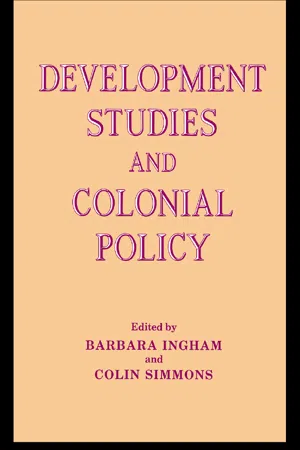
Development Studies and Colonial Policy
About this book
First Published in 1987. This volume is the product of a number of meetings held by the Third World History and Development Study Group, which is one of several study groups sponsored by the Development Studies Association. The Group was formed in 1978 at the Development Studies Association Conference held at the University of Strathclyde, Glasgow. It comprises people who for one reason or another wish to raise the status of historical work within development studies, seeking to redefine the scope and enlarge upon its role. The present collection of essays represents research which has been done both on procedures and methodology in development studies, and on colonialism as a historical process relevant to the study of underdevelopment.
Information
PART ONE
1: Economic Development and Economic History
COLIN SIMMONS
INTRODUCTION
In the aftermath of the Second World War and within the general context of de-colonisation the modern discipline of Development Economics and its offshoot—the rather wider inter-disciplinary field of Development Studies—became established. During their first quarter century or so both subjects expanded at a very rapid rate and first in the West and then subsequently in many parts of the emergent ‘Third World’, a Liberal-Orthodox development tradition came into being. The rise of this tradition is briefly examined in the first part of this paper, and although I make no claim to provide a comprehensive review of its many component parts, I do seek to highlight what I take to be its basic ethos. Now partly as a result of a whole series of perceived development failures, over the last decade a growing sense of disillusionment and questioning has characterised the orthodox development profession. Both from within as well as from without the tradition there has been a growing challenge to the earlier consenses, and these pressures are explored in Part II. I argue that the current state of the art is highly unsatisfactory on many counts and in particular there is now a great deal of confused thinking about the meaning, relevance and measurement of many of the key concepts—especially the central notion of economic development itself. Finally, in Part III I suggest how it might be possible to clarify the major issues, reconcile some of the different approaches and point a way forward out of the impasse. The burden of the argument rests upon the proposition that a long-run perspective is required if we are to understand the underlying causes of ‘late-’, ‘less-’ or ‘under-’ development and then go on to identify its manifestations. Although the injunction of an explicit historical dimension inclines us more towards explanation and development education than the current preoccupations with prescription would seem to allow, far from being a source of weakness or even withdrawal, it is contended that without it the very basis upon which various policy strategies and pronouncements are made, is both inadequate and unsound.
I: FAITH, HOPE AND CHARITY: DEVELOPMENT ECONOMICS, c. 1945–1975
The emergence of the modern discipline of Development Economics and its offshoot, the somewhat broader field of Development Studies, can be proximately dated to the decade following the end of the Second World War. Irrespective of whether we can meaningfully trace back its theoretical antecedents to the writings of the Classical Political Economists1 (or, with François Quesnay's Tableau in mind, perhaps even earlier),2 relevant sections of the work of Marx and Schumpeter,3 the efforts of those civil servants involved with the promotion of ‘development’ during the late colonial period,4 the reports of various international economic agencies responding to the Great Depression,5 or the seminal articles by Paul Rosenstein-Rodan on the industrialisation of Eastern Europe published over 1943/4,6 it was really not until the late 1940s and early 1950s that the subject we recognise today became established. The basic condition for its birth and subsequent growth was, of course, the dismantling of the major colonial empires (a process which, when we bear in mind the experience of the full-range of erstwhile possessions, has been highly uneven over space and time), and the creation of a still rising number of formally autonomous states throughout Asia, the Pacific, Africa, the Middle East, the Caribbean and parts of South and Central America.
The most obvious common characteristic of these countries was the poverty, absolute as well as relative, of the great majority of their inhabitants, and the energies of the local political leaders were soon directed —at least on paper in a whole panoply of five-year plans-towards ‘developing’ the respective economies. Now depending upon the prevailing ideological persuasion of the particular ruling elite—which, more often than not, was the direct outcome of the way in which independence was achieved —the preferred choice of development route was generally a variant of either the perceived Western or Soviet models (or, in some notable instances such as Pandit Nehru's India and Kwame Nkrumah's Ghana, some sort of combination of the two laced with ‘relevant’ doses of indigenous values and re-vamped institutions).7 Since such strategies were in some fundamental sense replicatory, and given the fact that the pool of appropriate development ‘knowledge’ was thin on the ground, it was but natural that financial assistance, technical advice and even expert guidance should be sought from without—though for understandable reasons of national honour this latter point, if not handled sensitively, was something of a touchy issue in the early days.
As it happens, a ready and welcoming reception was accorded to such overtures—indeed it was frequently the case that these services were offered well in advance of their being solicited—by governments and academics in Western and Eastern hemispheres alike. A fortunate conjunction of circumstances—political, economic, strategic and scholarly—had paved the way for the appearance of a Development Establishment keen to attain official or quasi-official status and become professional.8 In the Western democracies the opportunity to expunge some of the feelings of guilt which had begun to build up as a result of past imperial activity was too good to be missed, and the apparent success of the Marshall Aid Programme9 in revitalising the war-ravaged European economies, offered plenty of scope (in association with the theoretical implications stemming from the Harrod-Domar formulations) for thinking that a similar disbursement of funds would perform the same sort of task for the capital-scarce societies of the ‘less developed’ world. Further, the triumph of Keynesian Economics among other things legitimised a degree of purposeful state intervention, and this was consistent with the stated intention of many, if not most, Third World’10 governments to perform much more than a purely night-watchman role.
There was also the question of competition with the Soviet bloc for influence amongst the emergent nations because they too were extremely anxious to ply their own version of development: once ‘Socialism in One Country’ had perforce been buried by virtue of the acquisition of Eastern Europe, the Kremlin became highly receptive to the need to court the governments and people of what they insisted on referring to as the ‘victims of capitalist imperialism’.11 After all, it was alleged, only two decades of national planning had had a dramatic effect in propelling the USSR from a state of abject backwardness into an advanced industrial power—and this was precisely what articulate voices in the Third World were demanding. They were not prepared to accept a gradualistic unfolding of a laissez-faire style of development: no, in view of the urgency of the domestic poverty problem and the not-unconnected issue of ‘national strength’, there seemed to be a patent need to telescope farreaching change to the fabric of society and economy in as short a span of time as possible. Of course once the revelations about the human costs of the Soviet crash development programmes became widely disseminated following Stalin's death, even those governments overtly sympathetic to the USSR were quick to distance themselves from these ‘negative’ aspects. But as Stephen Clarkson and others have shown,12 disillusionment was not total and the feeling lingered that somehow it was possible to abstract selective parts of the package and that, with the design of appropriate safeguards, important lessons could still be learnt and hence the uncontested material benefits emanating from such a policy framework would be unsullied. The onset of the Cold War heightened the rather unsavoury spectacle of both sides attempting to score points of f each other in terms of who held the ‘key’ to development, and this tended to bid up promises of aid, all manner of assistance and, of course, military hardware. Both sides, too, became ever firmer in the conviction that they alone could provide the ideological and intellectual answer to the question of how best to bring about development, and both were prepared to back their respective cases with increasing allocations of resources.
In this way, through an untidy admixture of humanitarian idealism, the pragmatic quest for strategic hegemony and spheres of influence, and frank self-interest,13 Development Economics received the necessary motivation, justification and essential wherewithal to flourish. If the impetus initially derived from national considerations, it was not long before a cadre of experts emerged to fill an expanding number of positions in the international agencies: the various arms of the UN and the array of financial institutions born at Bretton Woods began to recruit suitable (i.e., predominantly Western) staff, and so cause a second tier of professional developmentalists to come into existence.14 Finally, and to complete the picture, after a comparatively short time-lag, the Third World began producing a homespun supply of personnel. At first recourse was made to acquiring development education and training abroad (again mainly in the West), but soon universities and other specialist centres (frequently manned by expatriates in the early phases) appeared, and hence by the late 1950s the discipline had put down roots all over the world.
For the first 25 years or so of its existence, Development Economics enjoyed a tremendous spurt of growth and prestige. A heady atmosphere of hope and optimism was built up. There was widespread consensus upon underlying values, fundamental principles and a whole series of composite issues including the derivation of a general explanation for the state of ‘less’ or ‘late’ development, the evolution of suitable analytical tools and techniques for studying its incidence, forms and manifestations, the identification of the most promising directions of research activity, the laying out of policy options, and the refinement of procedures to monitor and evaluate particular development projects. In the West, and shortly afterwards in many of the ‘client’ Third World countries, this basic agreement permitted the formation of a Development Orthodoxy—one which was essentially Liberal in outlook.15 By this I mean that it (a) rejected the brand of Marxist-Leninism currently being peddled by the Soviet Bloc and its Western apologists as ‘sterile’ and ‘outdated’; (b) was highly selective in its appropriation of neo-Classical theory—indeed after a sequence of ‘litmus tests’ the bulk of such theory was considered to be lacking in relevance, realism and significance: the economics of the ‘special case’ (i.e. the contemporary Western societies) as Dudley Seers once put it,16 was too far removed from the Third World to be of much consequence; (c) positively encouraged the promotion of a mixed private and public enterprise economy in the Third World, placing a considerably greater emphasis upon state planning17 and ‘gap-filling’ entrepreneurship18 than was currently being advocated for the West.
Thus safely distanced from both Left and Right, and riding upon the crest of a new wave of interest in the social sciences (flush with infusions of real cash), the Liberal-Orthodox ‘developmentalists’ were able to construct a substantial institutional edifice and inspire a great deal of academic work—work which was highly respected (perhaps even envied in some quarters) and apparently taken very seriously at the highest levels of government and administration.19
From the myriad of development centres, specialist institutes and departments of universities and other higher educational establishments, came a veritable flood of text-books, monographs, edited readings, journals, periodicals, manuals, guides and commissioned reports.20 New packages of courses were designed to cater for increasing numbers of overseas and domestic students, and curriculum experimentation proceeded apace. The media were naturally not slow to become (selectively) involved, and in the wake of dramatic presentations (particularly if they were vividly pictorial) of disaster and distress, many charitable organisations were either freshly founded or suitably reconstituted. Home governments responsible f or aid disbursement began to play one sort of role, and private consultancies—then at the other end of the spectrum— commenced to set up shop. ‘Development decades’ were declared, and at frequent intervals impressive-sounding international conferences and symposia were convened. An environment characterised by genuine intellectual excitement and real advance prevailed, and those whom one commentator has rather unkindly dubbed ‘the jetset proletariat’21 roved the Third World to and fro carrying around a baggage that could well have been labelled ‘faith’ (in development progress), ‘hope’ (that the advice would be implemented) and ‘charity’ (promises of aid, grants and low-interest credits).
Although it would be quite absurd to attempt to convey the variegate nature of development thinking over these halcyon years in a few sentences—to do that adequately one would require a great deal of space, and certainly much more considered thought than recent exercises conducted in this vein would suggest22—I believe that it is possible to capture its essential thrust. Shorn of the details, and without engaging in too much parody and caricature, we can reduce the Liberal-Orthodox position to the following basic elements.
First, economic development came to mean a process of structural change resulting from a sustained rise in per capita incomes. An acceleration of the growth rate would lead to a declining share of the primary sector (usually excluding extractive mining activity) in N.D.P. and labour resources, and a substantial enhancement of the secondary sector (especially manufacturing)—with the tertiary sector remaining roughly neutral in the ‘first phase’ and then rising quite rapidly thereafter. The method of measuring growth and development derived from national income accounting, and extens...
Table of contents
- Cover Page
- Title Page
- Copyright Page
- Notes on Contributors
- Preface
- Part One
- Part Two
Trusted by 375,005 students
Access to over 1.5 million titles for a fair monthly price.
Study more efficiently using our study tools.
Frequently asked questions
Yes, you can cancel anytime from the Subscription tab in your account settings on the Perlego website. Your subscription will stay active until the end of your current billing period. Learn how to cancel your subscription
No, books cannot be downloaded as external files, such as PDFs, for use outside of Perlego. However, you can download books within the Perlego app for offline reading on mobile or tablet. Learn how to download books offline
Perlego offers two plans: Essential and Complete
- Essential is ideal for learners and professionals who enjoy exploring a wide range of subjects. Access the Essential Library with 800,000+ trusted titles and best-sellers across business, personal growth, and the humanities. Includes unlimited reading time and Standard Read Aloud voice.
- Complete: Perfect for advanced learners and researchers needing full, unrestricted access. Unlock 1.5M+ books across hundreds of subjects, including academic and specialized titles. The Complete Plan also includes advanced features like Premium Read Aloud and Research Assistant.
We are an online textbook subscription service, where you can get access to an entire online library for less than the price of a single book per month. With over 1.5 million books across 990+ topics, we’ve got you covered! Learn about our mission
Look out for the read-aloud symbol on your next book to see if you can listen to it. The read-aloud tool reads text aloud for you, highlighting the text as it is being read. You can pause it, speed it up and slow it down. Learn more about Read Aloud
Yes! You can use the Perlego app on both iOS and Android devices to read anytime, anywhere — even offline. Perfect for commutes or when you’re on the go.
Please note we cannot support devices running on iOS 13 and Android 7 or earlier. Learn more about using the app
Please note we cannot support devices running on iOS 13 and Android 7 or earlier. Learn more about using the app
Yes, you can access Development Studies and Colonial Policy by Barbara Ingham,Colin Simmons in PDF and/or ePUB format, as well as other popular books in Economia & Economia dello sviluppo. We have over 1.5 million books available in our catalogue for you to explore.