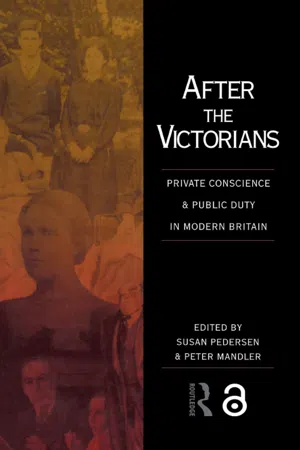
Written by a team of eminent historians, these essays explore how ten twentieth-century intellectuals and social reformers sought to adapt such familiar Victorian values as `civilisation', `domesticity', `conscience' and `improvement' to modern conditions of democracy, feminism and mass culture. Covering such figures as J.M. Keynes, E.M. Forster and Lord Reith of the BBC, these interdisciplinary studies scrutinize the children of the Victorians at a time when their private assumptions and public positions were under increasing strain in a rapidly changing world.
After the Victorians is written in honour of the late Professor John Clive of Harvard, and uses, as he did, the method of biography to connnect the public and private lives of the generations who came after the Victorians.
eBook - ePub
After the Victorians
Private Conscience and Public Duty in Modern Britain
- 268 pages
- English
- ePUB (mobile friendly)
- Available on iOS & Android
eBook - ePub
After the Victorians
Private Conscience and Public Duty in Modern Britain
About this book
1 Henrietta Barnett 1851–1936: The (auto)biography of a late Victorian marriage
Seth Koven
On 4 February 1872, the “pretty, witty and well-to-do”1 Henrietta Octavia Rowland received a letter that “surprised [her] very much.”2 It was a marriage proposal from a singularly unattractive older clergyman named Samuel Barnett. He conspicuously lacked those qualities that a fashionable young woman was taught to cherish in her suitors: wealth, social standing and personal ambition. It was not, however, the unsuitability of this particular match that shocked Miss Rowland. She was troubled by different matters. She had heretofore interpreted his interest in her as entirely dependent on their common work to improve the lives of the London poor in Marylebone. What place could there be for private passion and sexual desire among men and women joined together in the “passionless”3 comradeship of social reform? Was matrimony compatible with female independence of thought and action?
Henrietta Rowland Barnett’s life, and the way in which she chose to depict it in her monumental two-volume biography of her husband, Canon Barnett, His Life, Work and Friends (hereafter referred to as the Life), offer one set of answers to these questions and form the subject of this essay. Born in the year of the Great Exhibition of 1851, she died a much honored (CBE, 1917; DBE, 1924) and still “wonderful old lady”4 in 1936. By dint of sheer longevity alone, her life forms an unbroken bridge between the moral certitudes and convictions of the late Victorian urban gentry and the growing intellectual, political and cultural doubts that engulfed this class on the eve of the Second World War.
Henrietta’s public activities were wide ranging and influential. She was a respected architect of state policies for Poor Law children; her husband’s partner in the development of the famous university settlement in Whitechapel, Toynbee Hall; an early advocate of women’s suffrage and a life-long critic of war; initiator and organizer of the Hampstead Garden Suburb, a suburban housing development committed to cross-class communitarian ideals; and founder, honorary secretary and president of many organizations and institutions to improve the lives of working-class girls and women. The City and East London Observer declared in 1932 that she occupied a “place all to herself” among “those notable women of the first quarter of the twentieth century” “who rendered most distinguished public and social service.”5
In a brief essay, it is difficult to do justice to a career in public service that spanned more than sixty years. And this task is even more difficult because not a single scholarly essay—much less a full-scale biography—treating Henrietta’s ideas and accomplishments has ever been written, despite considerable academic interest in her husband and in Toynbee Hall.6 I have long been puzzled by this gap in scholarship, especially since women’s historians for the past three decades have examined the lives and ideas of many of her less influential peers.7
In attempting to explain why posterity has ignored Henrietta, I found myself returning to her own ideas about singleness and marriage, to her partnership with Samuel Barnett, and to her biography of him. Despite the fact that she wrote or edited eight books and numerous pamphlets and articles, only the biography is read today. The Life remains the most important source of information about both its ostensible subject, Samuel Barnett, and its author, Henrietta Barnett. It is an autobiography manqué. Any attempt to write a biographical essay about Henrietta Barnett must reckon with her strategies as biographer, as well as with how posterity has interpreted her deliberate blurring of autobiography and biography in the Life. This essay thus examines how Henrietta Barnett sought to construct for herself a life of social action first as a spinster and then as a married woman, while paying close attention to how she chose to represent spinsterdom and marriage in the Life.
HENRIETTA ROWLAND: SPINSTERDOM AS VOCATION
It is easy to forget that men and women who later married were not necessarily destined for matrimony, or bachelors and spinsters for an unmarried life. It seems inconceivable to us, for example, that the spinster “heroine of [Henrietta’s] life,” Octavia Hill, hoped to become Mrs Edward Bond as she approached the mature age of forty.8 Similarly, in light of the fact that Henrietta Rowland married at twenty-one, there initially seems to be something faintly absurd about calling her a spinster at the time she met Samuel Barnett. Nonetheless, despite her youth, beauty and social position, Henrietta Rowland saw herself as committed to spinsterdom as a social vocation during the short interval between leaving her home in 1869 and her marriage to Samuel Barnett in 1873. Many factors, some political, others personal, contributed to Henrietta Rowland’s identity as a spinster in 1872.
Single women were better positioned than their married counterparts in the 1860s and 1870s to take advantage of expanding work, educational and political opportunities for women.9 In the years that Rowland came into young womanhood—the late 1860s and early 1870s—the disabilities of married women were widely discussed in middle-class circles. Groups like the extra-parliamentary lobby, the Married Women’s Property Committee, sought to establish a measure of legal equality within marriage, but with only limited success. Only single women retained unambiguous control over their purses and their persons, and, with the passage of the Municipal Corporations Act of 1869, some spinsters and widows gained a local franchise as well. As historians have recently recognized, local government was the linchpin of the Victorian state and the key arena for the design and provision of social welfare. Possessing the right to vote and hold local office gave single women rate payers access to precisely the political venues that were most vital to the education and welfare of the poor.10 Henrietta Rowland was well aware of spinsters’ legal and electoral privileges in local government. In 1870, she canvassed on behalf of the pioneering medical woman, Elizabeth Garrett (later Anderson), who was elected to the first London School Board.11
A broadening of political opportunities for single women was accompanied by the construction of a new voice. The archly polemical but playful writings of Frances Power Cobbe in particular revealed unmarried women as happy and useful members of society for whom singleness was a choice, not an unfortunate accident.12 To be sure, many spinsters’ lives were dogged by financial insecurity and social isolation, but Henrietta Rowland, like Cobbe, had ample money to support herself in comfort. Orphaned by the death of her indulgent father in 1869, she was free to make choices about her future unfettered by financial worries or parental social ambitions. For Henrietta Rowland, spinsterdom offered freedoms that most marriages could not.
While the wider political climate made the single life especially attractive for women seeking independent and useful lives, Henrietta’s conventional upbringing seems scarcely to have prepared this high-spirited young girl for a life of social action. No bluestocking intellectual, she was raised by her father and a maiden aunt—her mother died giving birth to her—who “did not agree with girls being educated.” While the battles to establish the first women’s colleges were waged in Cambridge in the late 1860s, her formal education consisted of only “three glorious terms” at a boarding school at Dover kept by three ladies, the Haddon sisters.13 Why she decided to leave the pampered luxury of her pet dogs and horses to embark on a single life devoted to helping the poor remains something of a mystery. The only clue Henrietta offered about her social awakening consisted of a short vignette from her school days with the Haddons. A school visit to the boy inmates from the Dover Workhouse stimulated her “ignorant mind” to revolt “against the social injustices made evident by boys, odorous of institutionalism, dulled to inanity.”14
As is so often the case, Henrietta’s omissions are at least as revealing as her statements. Henrietta must have been aware of the extremely close ties of marriage and intellectual discipleship binding her beloved teachers to James Hinton, the controversial moral and social philosopher and aural surgeon. Hinton had been married to Margaret Haddon and, after his death, Caroline Haddon edited and elucidated his writings. Henrietta must have been exposed to Hinton’s radical views about women and his passionate belief that personal service to humanity was necessarily linked to pleasure, not asceticism. Hinton anticipated Henrietta’s own path: he longed to live among the poor of Whitechapel and loaned his collection of fine art for exhibition there in 1870. Perhaps scandalous rumors about Hinton’s private life which circulated in the 1880s after his death explain Henrietta’s distancing silence.15 We cannot know this for certain.
Grieving but perhaps also liberated by her father’s death, and under the influence of the Haddons, she sought to give purpose to her life by joining ranks with that selfless paragon of spinsterly civic duty, Octavia Hill. Henrietta believed that her short apprenticeship with Hill marked a formative epoch in her life and that her later achievements could not be properly understood apart from it. Hill and her band of mostly female and unmarried workers were in the vanguard of the experiments in housing and charitable relief in London associated with the newly established, mixed-sex voluntary organization, the Charity Organisation Society (COS). The COS aimed to promote thrift and self-help through scientific investigation of the circumstances of each applicant for relief. The work of visiting the poor was, in Hill’s eyes, preeminently though not exclusively suited to women. The more strictly the COS applied its parsimonious principles, Hill explained, “the more tenderly gentle, the more patiently watchful should be the messenger and interpreters of those decisions.”16 Samuel Barnett was a founding member of the COS, and it was through Octavia Hill that he and Henrietta met in 1870.
These were the political and personal circumstances surrounding Henrietta’s receipt of Barnett’s unanticipated marriage proposal. In her biography of her husband, she offered her own account of her feelings about the proposal. It is a noteworthy passage, not the least because it recaptures her ambivalence toward Samuel and the uncertainty of the outcome of his suit.
He [Samuel Barnett] dressed very badly, generally obtaining his clothes by employing out-of-work tailors in the district. He always wore a tall silk hat which, as he had purchased by post, never fitted, and so was usually tilted over his forehead or rammed on at the back of his head. His umbrella was a byword, and he always bought his black cotton gloves two or three sizes too large…he was often at the same time both shy and aggressive, defects which he covered by a frequent nervous laugh…. Insignificant as were these externals, they happened to be peculiarly unattractive to a girl who had been reared in a luxurious home, accustomed to lavish living and entertaining, who revelled in hunting and gardening and outdoor life…. He was entirely different from any of the men I had known, and in the plans I had formed for spending my life in Bethnal Green [in the East London slums] I could see no place for marriage with its obedience and its ties. My inclination was to give a decisive ‘No’ to his beautiful letter, but I knew that, if I did so, either he or I would have to give up Miss Octavia’s work; and to injure her schemes at that juncture was an impossible conception, worth the demand of any sacrifice on the part of either of us. I therefore wrote to tell him that my feeling for him was only that of respect, and suggested that we should go on with our work for six months and not refer to the matter during that period.17
The courtship narrative frames the entire Life and explicitly connects questions about spinsterdom, marriage and social action with strategies of (auto) biographical representation. It highlights Henrietta’s role as the vehicle by which Samuel’s manliness and powers can be realized. It sets up Samuel’s wife, who also happens to be the author of the biography, as the central figure in the courtship and its representation. It thus raises the question of who is the actual subject of the biography, Samuel or Henrietta. As the reviewer for the Morning Post approvingly observed in 1918, the book was a “commingling of biography and autobiography.”18
The passage also performs the vital task of establishing Henrietta’s credibility as biographer. It anticipates and deflects readers’ doubts about her ability, as the grieving widow and (auto)biographer, to present us with a truthful portrait. By so often finding imperfections in her husband, Henrietta precludes the need for her readers to do so. Contemporary reviewers consistently noticed and applauded the unbiased candor of her criticisms of her husband and the veracity of the biography.19 The trappings of biographical objectivity and critical distance coexist with autobiographical subjectivity and intimacy in the text.
Finally, Henrietta Barnett’s desire in 1918 (the year she completed the Life) to represent Henrietta Rowland in 1872 as an independent spinster allowed her to develop a central but unstated thesis of the Life about marriage. Henrietta Barnett believed that marriage could be a partner ship of equal-but-different beings because she believed so strongly that it was possible to live a purposeful and happy life as a spinster. Thus, Henrietta Rowland’s independence before marriage is a precondition for the unfolding of Henrietta Barnett’s interdependent marital relationship with Samuel. Similarly, Samuel’s lack of distinction as a bachelor curate sets the stage for his growth to greatness as her husband. The intertwined trajectories of their lives illustrate the ways in which each perfected his or her individuality within a partnership that made it virtually impossible to distinguish the impulse and activity of the one from the other.
The generic elision of biography and autobiography is thus not only a literary conceit, but also an expression of Henrietta’s true subject in the Life: the expansive possibilities of marriage for women and men. She assures her readers that it has cost her dearly to share the intimate and private story of the love letters she has published. But share she must, for the story of their marriage is at once private and political, a matter rooted in the particularities of their lives and a tale of love and duty to guide readers in the social and sexual confusion of the postwar world.
MRS SAMUEL BARNETT: MARRIAGE AND SOCIAL REFORM
Overburdened with cares for her voluntary work and anxious to distance herself from her ardent ...
Table of contents
- Cover Page
- Title Page
- Copyright Page
- Contributors
- Preface
- Introduction: The British intelligentsia after the Victorians
- 1 Henrietta Barnett 1851–1936: The (auto)biography of a late Victorian marriage
- 2 George Alfred Lefroy 1854–1919: A bishop in search of a church
- 3 Raymond Unwin 1863–1940: Designing for democracy in Edwardian England
- 4 Eleanor Rathbone 1872–1946: The Victorian family under the daughter’s eye
- 5 E.M.Forster 1879–1970: Connecting the prose and the passion in 1910
- 6 Leonard Woolf 1880–1969: The conscience of a Bloomsbury socialist
- 7 J.M.Keynes 1883–1946: “The best of both worlds”
- 8 John Reith 1889–1971: Entrepreneur of collectivism
- 9 J.B.Priestley 1894–1984: Englishness and the politics of nostalgia
- 10 John Summerson 1904–1992: The architectural critic and the quest for the Modern
- 11 John Clive 1924–1990: TBM and John
Trusted by 375,005 students
Access to over 1.5 million titles for a fair monthly price.
Study more efficiently using our study tools.
Frequently asked questions
Yes, you can cancel anytime from the Subscription tab in your account settings on the Perlego website. Your subscription will stay active until the end of your current billing period. Learn how to cancel your subscription
No, books cannot be downloaded as external files, such as PDFs, for use outside of Perlego. However, you can download books within the Perlego app for offline reading on mobile or tablet. Learn how to download books offline
Perlego offers two plans: Essential and Complete
- Essential is ideal for learners and professionals who enjoy exploring a wide range of subjects. Access the Essential Library with 800,000+ trusted titles and best-sellers across business, personal growth, and the humanities. Includes unlimited reading time and Standard Read Aloud voice.
- Complete: Perfect for advanced learners and researchers needing full, unrestricted access. Unlock 1.5M+ books across hundreds of subjects, including academic and specialized titles. The Complete Plan also includes advanced features like Premium Read Aloud and Research Assistant.
We are an online textbook subscription service, where you can get access to an entire online library for less than the price of a single book per month. With over 1.5 million books across 990+ topics, we’ve got you covered! Learn about our mission
Look out for the read-aloud symbol on your next book to see if you can listen to it. The read-aloud tool reads text aloud for you, highlighting the text as it is being read. You can pause it, speed it up and slow it down. Learn more about Read Aloud
Yes! You can use the Perlego app on both iOS and Android devices to read anytime, anywhere — even offline. Perfect for commutes or when you’re on the go.
Please note we cannot support devices running on iOS 13 and Android 7 or earlier. Learn more about using the app
Please note we cannot support devices running on iOS 13 and Android 7 or earlier. Learn more about using the app
Yes, you can access After the Victorians by Peter Mandler, Susan Pedersen, Peter Mandler,Susan Pedersen in PDF and/or ePUB format, as well as other popular books in History & World History. We have over 1.5 million books available in our catalogue for you to explore.