eBook - ePub
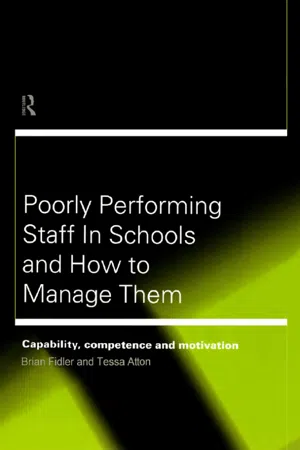
Poorly Performing Staff in Schools and How to Manage Them
Capability, competence and motivation
- 232 pages
- English
- ePUB (mobile friendly)
- Available on iOS & Android
eBook - ePub
Poorly Performing Staff in Schools and How to Manage Them
Capability, competence and motivation
About this book
This book will help headteachers, managers and governors diagnose and tackle poor performance where it has arisen and help them to prevent poor performance in the future.
The book investigates a whole range of solutions and issues and includes detailed case-studies on:
* remedial action
* disciplinary action
* legal and moral issues
* employment law
* dismissals and appeals.
Information
Chapter 1
Introduction
There have always been teachers who, for whatever reason, have not carried out their role to a satisfactory standard. It has long been assumed that schools exist in order to enable pupils to learn and develop to the limit of their potential but it is only fairly recently that this has been articulated in terms of schools’ aims and objectives. Once articulated, the next step is to interpret these aims through action: staff training and development, appraisal, evaluation of performance, formal inspection and so on, to the current scene with league tables and target setting. The intention of these procedures is to ensure a consistency of quality educational experience for pupils wherever they are and whatever their ability.
There have always been teachers who, for whatever reason, have not carried out their role to a satisfactory standard. It has long been assumed that schools exist in order to enable pupils to learn and develop to the limit of their potential but it is only fairly recently that this has been articulated in terms of schools’ aims and objectives. Once articulated, the next step is to interpret these aims through action: staff training and development, appraisal, evaluation of performance, formal inspection and so on, to the current scene with league tables and target setting. The intention of these procedures is to ensure a consistency of quality educational experience for pupils wherever they are and whatever their ability.
Inconsistency in the quality of staff performance can be the result of a whole range of factors. An unexpectedly poor examination result is not necessarily the direct result of poor teaching. It could be because of resourcing decisions made two or three years previously. It could be pupil grouping arrangements dictated by timetabling constraints. It could be the result of external pressures on either the teacher or the pupil. Once detected, the determination of the reasons for poor staff performance is a complex exercise.
It is the aim of this book to explore what poor performance is and how it can be identified, to look at the range of factors causing performance to drop below the standard required and, most importantly, to look at ways that senior managers, governors and LEAs can and have worked to remediate such problems.
Definition
‘Poor performers’ is the euphemism which this book uses for those employees who are not performing satisfactorily. ‘Poor performers’ have major failings in a number of critical aspects of their work. They fall below a threshold of satisfactory performance on a number of criteria: they are not just unsatisfactory in one small aspect of the job.
This introduces the concept of a benchmark which can be used to identify the minimum satisfactory performance. Where this exists, and is generally agreed, then the suspected poor performer can be assessed against the criteria to gauge the extent to which he or she falls short. Where such a benchmark does not exist, even notionally, then such a benchmark needs to be set up so that everyone is aware of the expectations of satisfactory performance. Inevitably, there will be employees performing at a variety of levels of performance. Unless there are clear expectations of performance, some very good but nervous employees will suspect that their performance is in question because they set themselves exacting levels of performance. It is important that such groups are reassured that their levels of performance are not in question.
What is an appropriate benchmark will depend upon the situation. The context of the school and its history will influence what are appropriate benchmarks. Thus it is ‘criteria in context’ which are important for defining the expectations of a satisfactory teacher or other worker. For a teacher, this is the ‘professionally acceptable standard’ referred to for teachers in the Revised Outline Capability Procedure for Teachers produced in November 1997 (DfEE 1997b). We think this is best laid down at school level. Such a benchmark should lay down standard operating procedures, such as marking and assessment policies, attendance at meetings, required deadlines for paperwork and so on, in addition to more general expectations of teaching competency.
Recency of effect
We have categorised poor performance as either:
a of long standing, or
b having just appeared.
In our experience, it is likely that different managers will be taking action in each of these two cases. In case (a) it is likely to be a new manager, while in case (b) it is likely to be an existing manager. Existing managers are most likely to be taking action on poor performance which has only just appeared. It will have come to their notice as being out of the ordinary for this member of staff and they will expect that its causes can be located and a solution found. On the other hand, existing managers are unlikely to have such expectations about long-standing poor performance. They are likely to have become accustomed to this level of performance as the norm, and have come to accept that this is tolerable. They are likely to try to ameliorate and work round such poor performance. They are unlikely to do anything about it unless they are under particular pressure to do so or feel themselves under such pressure. Financial pressures and regular school inspections have provided some new incentives to tackle difficult problems of this type.
We find that it is most likely to be a new manager who comes into a school who notices performance which is out of the ordinary and unacceptable to him or her. He or she is likely to be the one to tackle long-standing poor performance. In many ways this is easier because there are no long-standing relationships, nor is there the need to justify why no action has been taken in the past. A new person also means that it is a fresh and unprejudiced eye which looks at the situation. The new manager will need to collect evidence to ascertain that there really is a problem.
A further situation which has come into existence recently is a combination of the above. Here, an existing manager is dealing with long-standing poor performance, either with the prospect of a school inspection by OFSTED inspectors or after such an inspection. In this case, the manager feels under renewed pressure to tackle a problem which has been neglected. The options are rather greater before inspection than afterwards. However, the option before inspection, of trying to cover up poor performance, may rebound on the school. In the case of one small infants’ school, a poor teacher who was also the English co-ordinator was helped to show evidence of satisfactory teaching during the inspection week, but it was the lack of progress in English which was then picked up by the inspection report. This teacher was not able to provide such leadership, and indeed after the inspection her teaching performance also began to decline.
While dealing with poor performance is never easy or pleasant, we have recognised an increasing level of difficulty in the cases identified above, as shown in Table 1.1 below.
Teaching and non-teaching staff
Although a good deal of the book deals with varying kinds of examples of teaching staff who are poor performers, there is also some consideration of other staff in schools who may be poor performers. Although there are separate capability and disciplinary procedures for teachers, generally there are only disciplinary procedures for other employees. It is our contention that each school should have a policy and procedures to deal with poor performance for all staff. There should be the equivalent of capability procedures for non-teaching staff to cover the cases where they do not have a clear under-standing of the requirements of their job or do not have appropriate skills.
Table 1.1 Degree of difficulty of dealing with poor performance
Recent changes
This book examines the causes of poor performance and suggests both how to prevent poor performance and how to deal with it. It illustrates these theoretical ideas with a wealth of examples. These are closely based on real examples which have mainly occurred in the 1990s. In some cases, inessential details have been changed to preserve the anonymity of the informants and the characters. Later sections of the book contain more detailed case studies which can be used for discussion purposes. All the examples here need to be analysed for any changes which might be necessary in present circumstances due to:
- revised outline capability procedures introduced in November 1997
- changes to regulations on early retirement
- lower tolerance of poor performance
Following concern at the sometimes protracted timescale which existing procedures took for dealing with poor performance, the Revised Outline Capability Procedure for Teachers was agreed by the DfEE and teachers’ unions in November 1997 (DfEE 1997b). These provide for accelerated procedures ‘in extreme cases where the education of pupils is jeopardised’ within four weeks and a normal procedure which should be completed in two terms.
One feature of a number of the examples of solutions to poor performance in the past included in this book is the possibility of early retirement. This has generally meant retirement after the age of 50 but before normal retirement age. In September 1997, the government made changes to the pension regulations which required employers (LEAs and schools) to fund any costs arising from early retirement. Previously, such costs had been borne by the pension fund itself. Such a financial commitment for either LEAs or schools is likely to be prohibitive and so it is generally assumed that early retirements in future are likely to be less frequent. This has severe implications for dealing with poor performance. As many of the examples given here show, although early retirement is not without its problems, it has provided an ‘honourable way out’ for many poor performers. The implications of the withdrawal of this facility may necessitate alternatives to a number of the examples in this book.
Finally, a further change which has taken place over the last few years is a decreasing tolerance of poor performance by teachers and others. A number of the examples contained here have involved protracted and sometimes intermittent periods of active work dealing with poor performance, often with excessive consideration of any consequences for the poor performer. Many cases which were treated as cases of capability might alternatively have been treated as cases of discipline and brought to a more speedy conclusion. While we hope that the case studies provide a reality to the ideas presented here, we are aware that they are a product of their time and that much useful discussion could result from reconsidering how they might be treated in the different circumstances, which we believe to exist now for the reasons cited above.
Interests of children
Although the climate may have changed, we believe that the essential justification for tackling poor performance has not. The reason we believe that poorly performing staff in schools cannot be ignored is that, directly or indirectly, these staff adversely affect the education of children and young people. Schools exist, first and foremost, to educate children, and that is why teachers and others are employed in schools.
Not only may poor performers directly affect the education of children, but they may also have an indirect effect. Poor performance may prevent other staff from teaching well, in addition to affecting staff morale where other staff can see that they are continually being let down by one or two staff who are not performing satisfactorily.
Few senior staff can approach dealing with poor performance with anything but great trepidation. It is not an enjoyable task. However, many headteachers have been sustained through the process by a conviction that what they are doing is necessary if they are to serve the interests of children, and that they would be letting down the children in their care if they did not take action. As one headteacher put it, ‘keep your eye on the children’. She offered this advice both to assess the effects of classroom performance and also as a reminder to ensure that the interests of the children are upheld within the school.
Determination and open-mindedness
This brings us to what we believe to be an essential attitude to the management of poor performers. We are convinced that the only guarantee of ultimate success comes if the prospect is approached with an absolute determination that the poor performance will not be allowed to continue. This means that if all else fails, the poor performer will be dismissed. This may seem unduly pessimistic in view of our experience that most poor performance can be corrected, if it is tackled appropriately and tackled early, but it is an attitude of mind which we believe to be indispensable. This is because it is this conviction which ensures that some progress is made when conditions appear to be at their toughest. The alternative is to make progress when possible and accept defeat when the first obstacles appear.
We believe that this absolute determination is more likely to be in the poor performer’s ultimate best interest too. Such determination is likely to lead to a more positive outcome because it is clear that the relentless driving force is spurred on by a need to defend the interests of children and that they cannot be let down. The alternative is for the process to stall when obstacles appear. However, it is our experience that in this case, the same issue will come up again in the future when the problem is more entrenched and the prospects of a positive outcome from the poor performer’s point of view are much reduced.
We have produced this book to sustain headteachers and others in tack-ling poor performers, and also to ensure that they are aware of and follow good ethical practice in dealing with poor performers. We defend neither poor performance nor the unscrupulous hounding of poor performers, or even worse, the indulgence of personal prejudices by headteachers. We believe that the hallmarks of good practice are:
- the assessment of performance based on evidence, not hearsay;
- an approach combining support with a determination to secure acceptable improvement;
- the seeking of innovative solutions, rather than an unbending obduracy which only seeks improved performance in an unchanged job;
- giving consideration to the dignity of the poor performer, and honourable solutions are sought rather than punitive ones;
- learning lessons about the prevention of future poor performance, rather than accepting poor performance as inevitable;
- ensuring the interests of children are paramount.
The structure of the book
The book is written for all who have to deal with poor performers—heads and senior staff in schools, governors and LEA advisors and inspectors. It aims to treat the problem of poor performance in a comprehensive way both as regards the types of staff covered—heads and other teaching staff and also teaching support staff—and also as regards the reasons for poor performance and possible solutions.
Part I begins with a chapter that outlines the ways in which the poor management of staff can contribute to poor performance and makes the case for good staff management as the best preventive measure. It deals with selection, induction, motivation and monitoring, appraisal and development.
Five further chapters follow in this section. The first two present a theoretical framework for analysing and solving problems of poor performance. The next chapter outlines the evolving legal framework within which schools operate employment law. The final two chapters in this section examine the part which the governing body of a school plays, and concludes that it is in identifying and dealing with poorly performing headteachers that governors make their most important contribution.
Part II looks in detail at particular issues—recently discovered poor performance—and at particular groups of staff—temporary problems, new staff, established staff, management positions and teaching support staff. A number of actual examples are presented and their implications analysed.
Part III consists of twelve further detailed case studies. This gives a more full picture of a number of cases of poor performance. These convey the progress of issues over time so that a better understanding of the complexity of the issues can be gained. These case studies are intended to be sufficiently detailed so that they can be discussed by groups of staff. We envisage that small groups of staff who may be dealing with poor performance or who are being prepared to deal with poor performance could discuss these examples and in particular examine how they might be treated differently now when the prospect of early retirement a...
Table of contents
- Cover Page
- Title Page
- Copyright Page
- Illustrations
- Notes on the authors
- Preface
- Chapter 1
- Part I
- Part II
- Part III
- Part IV
- References and further reading
Trusted by 375,005 students
Access to over 1.5 million titles for a fair monthly price.
Study more efficiently using our study tools.
Frequently asked questions
Yes, you can cancel anytime from the Subscription tab in your account settings on the Perlego website. Your subscription will stay active until the end of your current billing period. Learn how to cancel your subscription
No, books cannot be downloaded as external files, such as PDFs, for use outside of Perlego. However, you can download books within the Perlego app for offline reading on mobile or tablet. Learn how to download books offline
Perlego offers two plans: Essential and Complete
- Essential is ideal for learners and professionals who enjoy exploring a wide range of subjects. Access the Essential Library with 800,000+ trusted titles and best-sellers across business, personal growth, and the humanities. Includes unlimited reading time and Standard Read Aloud voice.
- Complete: Perfect for advanced learners and researchers needing full, unrestricted access. Unlock 1.5M+ books across hundreds of subjects, including academic and specialized titles. The Complete Plan also includes advanced features like Premium Read Aloud and Research Assistant.
We are an online textbook subscription service, where you can get access to an entire online library for less than the price of a single book per month. With over 1.5 million books across 990+ topics, we’ve got you covered! Learn about our mission
Look out for the read-aloud symbol on your next book to see if you can listen to it. The read-aloud tool reads text aloud for you, highlighting the text as it is being read. You can pause it, speed it up and slow it down. Learn more about Read Aloud
Yes! You can use the Perlego app on both iOS and Android devices to read anytime, anywhere — even offline. Perfect for commutes or when you’re on the go.
Please note we cannot support devices running on iOS 13 and Android 7 or earlier. Learn more about using the app
Please note we cannot support devices running on iOS 13 and Android 7 or earlier. Learn more about using the app
Yes, you can access Poorly Performing Staff in Schools and How to Manage Them by Tessa Atton,Brian Fidler in PDF and/or ePUB format, as well as other popular books in Education & Education General. We have over 1.5 million books available in our catalogue for you to explore.