In The Morality of Gay Rights, Ball presents a comprehensive exploration of the connection between gay rights and political philosophy. He discusses the writing of contemporary political and legal philosophers-including Rawls, Walzer, Nussbaum, Sandel, Rorty and Dworkin-to evaluate how their theoretical frameworks fit the specific gay rights controversies, such as same-sex marriage and parenting by lesbians and gay men, that are part of our nation's political and legal debates.
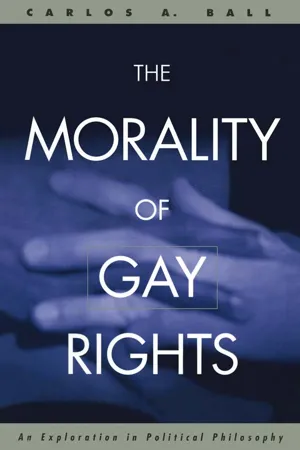
- 288 pages
- English
- ePUB (mobile friendly)
- Available on iOS & Android
eBook - ePub
About this book
Information
NOTES |
INTRODUCTION—WHY MORALITY?
1. See William N. Eskridge Jr., Gay law: Challenging the Apartheid of the Closet (Cambridge: Harvard University Press, 1999), p. 60.
2. See The Wolf enden Report: Report of the Committee on Homosexual Offenses and Prostitution (American edition, New York: Stein & Day, 1963).
3. Ibid., 161.
4. Ibid.
5. John D’Emilio, Sexual Politics, Sexual Communities: The Making of a Homosexual Minority in the United States, 1940–1970 (Chicago: University of Chicago Press, 1983), p. 112.
6. See Richard D. Mohr, Gays/Justice: A Study of Ethics, Society, and Law (New York: Columbia University Press, 1988), chs. 5–7.
7. 478 U.S. 186, 196 (1986).
8. Brief for Respondent, pp. 26–27, Bowers v. Hardwick, 478 U.S. 186 (1986), quoting Poe v. Ullman, 367 U.S. 497, 545 (1961) (Harlan, J., dissenting). Twelve years later, the Georgia Supreme Court, in a case involving a heterosexual defendant, struck down on state constitutional grounds the same statute that was at issue in Bowers. See Powell v. State, 510 S.E.2d 18 (Ga. 1998).
9. Chai Feldblum suggests that there may be benefits to raising issues of morality even when advocating for legislation that would protect lesbians and gay men from employment discrimination. See Chai R. Feldblum, “Sexual Orientation, Morality, and the Law: Devlin Revisited,” 57 University of Pittsburgh Law Review 237, 300–12 (1996).
10. Michael J. Sandel, “Political Liberalism,” 107 Harvard Law Review 1765, 1788 n.52 (1994).
11. See William J. Bennett, The Book of Virtues: A Treasury of Great Moral Stories (New York: Simon & Schuster, 1993).
12. Face the Nation (CBS television broadcast, Dec. 8, 1996).
13. Sen. Burns, 142 Cong. Ree. S10117 (Sept. 10, 1996).
14. See John Finnis, “Law, Morality, and ‘Sexual Orientation,’ ” 69 Notre Dame Law Review 1049, 1049–1053 (1994). There are also a growing number of Americans who believe that lesbians and gay men should be provided with the kind of protection against discrimination in employment and housing that is afforded to other minorities. When President William Clinton issued an order banning discrimination against lesbians and gay men by federal civilian agencies, for example, surveys showed that 70 percent of Americans supported his decision. See Richard L. Berke, “Chasing the Polls on Gay Rights,“ New Tork Times, Aug. 2, 1998, §4, p. 3. In 1996, a bill that would have prohibited discrimination on the basis of sexual orientation failed in the United States Senate by only one vote. See John E. Yang, ”Senate Passes Bill Against Same-Sex Marriage; In First Test on Hill, Measure to Prohibit Employment Discrimination is Defeated 50–49,“ Washington Post, Sept. 11, 1996, p. Al. Surveys continue to show, however, that a substantial majority of Americans (around two thirds) are opposed to the recognition of same-sex marriage. See Hanna Rosin and Richard Morin, ”In One Area, Americans Still Draw a Line on Acceptability,“ Washington Post, January 11, 1999, p. 8 (national edition); ”More Folks Say Gay is OK, But Most Oppose Marriages,“ USA Today, March 19, 1996, p. 3A.
15. Finnis, “Law, Morality, and ‘Sexual Orientation,’ ” p. 1076. The conservative philosopher Robert George also believes that society has a legitimate interest in enforcing public morality in many instances, including through the prohibition of same-sex marriage. See Robert P. George and Gerard V. Bradley, “Marriage and the Liberal Imagination,” 84 Georgetown Law Journal 301 (1995). George nonetheless recognizes the importance of an enforceable and meaningful right to privacy. See Robert P. George, Making Men Moral: Civil Liberties and Public Morality (New York: Oxford University Press, 1995), pp. 210–17. See also Harry M. Clor, Public Morality and Liberal Society: Essays on Decency, Law, and Pornography (Notre Dame: Notre Dame Press, 1996), p. 83 (recognizing “limiting criteria” in the otherwise valid regulation of public morality that would counsel against the enforcement of “criminal statutes against homosexual conduct among consenting adults in private”).
16. I will not in this book discuss the normative foundations of a right to privacy. For thoughtful elaborations on such foundations with particular attention to constitutional issues, see Möhr, Gays/Justice, chs. 2–4; David A. J. Richards, Sex, Drugs, and the Law: An Essay on Human Rights and Over criminalization (Totowa, NJ: Rowman & Littlefield, 1982); Vincent J. Samar, The Right to Privacy: Gays, Lesbians, and the Constitution (Philadelphia: Temple University Press, 1991).
17. Most of the issues, priorities, and concerns that I will raise in this book in relation to lesbians and gay men are also applicable to bisexual and transgen-dered individuals. Adding “bisexuals and trangendered” to the dozens of times that I will refer to “lesbians and gay men” in this book, however, would be cumbersome. I also prefer not to use acronyms—such as LGBT—to refer to people. The least dissatisfactory option, then, is to use “lesbians and gay men” accompanied by this early caveat that I wish to include bisexual and transgendered individuals within the ambit of my arguments.
18. See e.g., Posner, SR.
19. See e.g., David M. Halperin, One Hundred Tears of Homosexuality (New York: Routledge, 1990).
20. See e.g., Judith P. Butler, Bodies that Matter: On the Discursive Limits of “Sex” (New York: Routledge, 1993).
21. 1 For ways of dividing social constructionists in matters of sexuality into categories that are somewhat different from the ones that I have used here, see Edward Stein, “Conclusion: The Essentials of Constructionism and the Construction of Essentialism,” in Forms of Desire: Sexual Orientation and the Social Constructionist Controversy, ed. Edward Stein (New York: Routledge, 1992), pp. 325, 338–4; Carole S. Vance, “Social Construction Theory: Problems in the History of Sexuality,” in Homosexuality, Which HomosexualityP, eds. Anja van Kooten Niekerk and Theo van der Meer (London: GMP Publishers, 1989), pp. 13, 18–23.
22. 1 Peter M. Cicchino, “Building on Foundational Myths: Feminism and the Recovery of’Human Nature’: A Response to Martha Fineman,” 8 American University Journal of Gender; Social Policy and the Law 73, 84 (1999).
23. 1 For an eloquent defense of this view, see Michael Warner, The Trouble with Normal: Sex, Politics, and the Ethics of Queer Life (New York: Free Press, 1999).
24. 1 The connection between Mill and Warner’s ideas is noted by Martha Nussbaum in “Experiments in Living,” The New Republic, Jan. 3, 2000, pp. 31, 32.
25. 1 The sections on Dworkin are organized slightly differently. I divide the discussion of Dworkin into his earlier and later works. Both sections have a descriptive and an evaluative component to them, unlike the discussions of Rawls, Rorty, Posner, Sandel, Walzer, and Foucault that try, as much as possible, to separate description from evaluation.
CHAPTER ONE—NEUTRAL LIBERALISM
1. Another important proponent of neutral liberalism is Bruce Ackerman. See Bruce A. Ackerma...
Table of contents
- Cover
- Half Title
- Title Page
- Copyright Page
- Dedication
- Table of Contents
- Preface
- Acknowledgments
- Citation Abbreviations
- Introduction Why Morality?
- One Neutral Liberalism
- Two Pragmatic Liberalism
- Three Moral Liberalism
- Four Communitarianism
- Five Postmodernism
- Notes
- Index
Trusted by 375,005 students
Access to over 1.5 million titles for a fair monthly price.
Study more efficiently using our study tools.
Frequently asked questions
Yes, you can cancel anytime from the Subscription tab in your account settings on the Perlego website. Your subscription will stay active until the end of your current billing period. Learn how to cancel your subscription
No, books cannot be downloaded as external files, such as PDFs, for use outside of Perlego. However, you can download books within the Perlego app for offline reading on mobile or tablet. Learn how to download books offline
Perlego offers two plans: Essential and Complete
- Essential is ideal for learners and professionals who enjoy exploring a wide range of subjects. Access the Essential Library with 800,000+ trusted titles and best-sellers across business, personal growth, and the humanities. Includes unlimited reading time and Standard Read Aloud voice.
- Complete: Perfect for advanced learners and researchers needing full, unrestricted access. Unlock 1.5M+ books across hundreds of subjects, including academic and specialized titles. The Complete Plan also includes advanced features like Premium Read Aloud and Research Assistant.
We are an online textbook subscription service, where you can get access to an entire online library for less than the price of a single book per month. With over 1.5 million books across 990+ topics, we’ve got you covered! Learn about our mission
Look out for the read-aloud symbol on your next book to see if you can listen to it. The read-aloud tool reads text aloud for you, highlighting the text as it is being read. You can pause it, speed it up and slow it down. Learn more about Read Aloud
Yes! You can use the Perlego app on both iOS and Android devices to read anytime, anywhere — even offline. Perfect for commutes or when you’re on the go.
Please note we cannot support devices running on iOS 13 and Android 7 or earlier. Learn more about using the app
Please note we cannot support devices running on iOS 13 and Android 7 or earlier. Learn more about using the app
Yes, you can access The Morality of Gay Rights by Carlos Ball in PDF and/or ePUB format, as well as other popular books in Philosophy & Ethics & Moral Philosophy. We have over 1.5 million books available in our catalogue for you to explore.