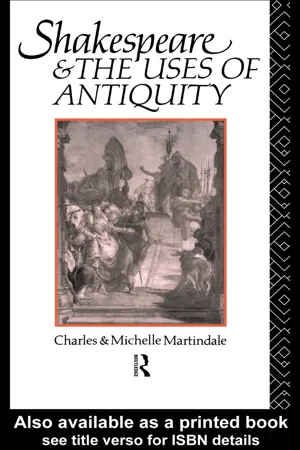
Although a third of his plays are set in the ancient world and he constantly used classical mythology, history, and ideas, Shakespeare received a simple grammar school education and did not have a scholar's knowledge of the classics.
The critical implications of this are the subject of Shakespeare and the Uses of Antiquity. Against a recent academic tendency to exaggerate Shakespeare's learning, the authors investigate how he used his comparatively restricted knowledge to create, for example, an unusually convincing picture of Rome, and analyse, by presenting us with careful readings of specific passages, the styles Shakespeare employed under the influence of classical writers, especially Ovid, Seneca, and (in translation) Homer and Plutarch.
- 240 pages
- English
- ePUB (mobile friendly)
- Available on iOS & Android
eBook - ePub
About this book
Information
1
INTRODUCTION
SMALL LATIN
It is customary to begin discussion of the extent of Shakespeare’s classical knowledge with the opinions of Ben Jonson. So, for the sake of variety, let us open with some well-known lines by Milton, a devotee of Shakespeare but one who had no reason for partiality over the issue:
Then to the well-trod stage anon,
If Jonson’s learned sock be on,
Or sweetest Shakespeare, Fancy’s child,
Warble his native wood-notes wild.
(L’Allegro, 131–34)
A careless reading of these lines, together with an anachronistic understanding of their key terms, has encouraged the picturing of Shakespeare as a purely spontaneous genius. In fact the distinction, which is not polemical, is between Jonson’s ‘learning’, that is his assiduous imitation of classical models and insistence on their superiority, and Shakespeare’s delight in a general ambience of English language and inspiration. The dominant contrast is not between Art and Nature, but between the classical and the ‘native’; and that contrast involves a pastiche of the characteristic styles of the two authors, not surprising in a poem devoted to literary parody and allusion. In the lines on Jonson, where the vocabulary has a plain, hard-edged, concrete quality, ‘sock’ Englishes a Latin metonymy (soccus, the slipper worn by comic actors, for comedy), and there may be a punning jest by which the ‘sock’ could be either on stage or on Jonson’s foot (cf. Jonson’s ‘Ode to Himself: On The New Inn’, 37; Horace, Ars Poetica, 80). The lines on Shakespeare use suggestive but somewhat unfocused metaphorical writing, with a distinct shift midway, as Shakespeare, first the child of a semi-personified Fancy, becomes a bird or rustic singer of the forest. ‘Sweetest’ hints at the Shakespearean style, described in his own time as ‘sugared’ and ‘sweet’; it was the Shakespeare of plays like A Midsummer Night’s Dream whom Milton especially favoured, and Shakespeare is anyway treated here as a writer of comedy only. Since these complimentary lines are couched in Shakespearean terms, we should take the key words in something of their Shakespearean sense. In particular, ‘fancy’ means imagination, and is not equivalent to ‘nature’, to which indeed it is sometimes opposed: for example in Antony and Cleopatra II.ii.200f. (‘O’er-picturing that Venus where we see/The fancy outwork nature’) fancy, man’s creative faculty, amounts almost to art, or at least to an aspect of art. That Shakespeare is ‘Fancy’s child’ does not mean that he is Nature’s child, untutored and artless, but that he is a great exponent of the powers of the imagination. The passage thus has no bearing on the question of how much ancient literature Shakespeare had read, even if Milton is nodding, with some wit, at the tradition already established by Jonson. Milton is certainly not trying to score points for Jonson against Shakespeare, or vice versa.
Let us return to Jonson and his celebrated tribute from the First Folio ‘To the Memory of My Beloved, The Author, Mr. William Shakespeare, And What He Hath Left Us’ (1623). Dryden—who should have known better—called it ‘an insolent, sparing, and invidious panegyric’, apparently supposing that Jonson was criticizing his rival.1 However, the hesitations of the opening lines testify not to genuine dubieties but to a conventional awareness of the dangers inherent in eulogy, while in the body of the poem the ‘Swan of Avon’ is presented as the ideal poet combining Nature and Art in his ‘well-turned and true-filed lines’ (68). (Admittedly Jonson, in combative mood, expressed a different opinion to the Scottish poet William Drummond: ‘Shakespeare wanted art’.2) Despite his lack of classical knowledge—‘And though thou hadst small Latin, and less Greek’ (31)—Shakespeare surpassed not only all previous English poets, but also all the classical writers both of tragedy and of comedy—from Jonson a remarkable compliment. The tone is judicious—Jonson will not deny what is known to all—but whatever reservations the private man may have had about Shakespeare’s ‘art’, the public poet shows none. If Jonson had made his well-known comment privately, he might have meant by it ‘virtually no Latin and no Greek at all’, but in this wholly eulogistic context the words should be taken without irony. In consequence ‘less Greek’ ought to imply that Shakespeare had some Greek, perhaps enough to struggle through easy texts like the New Testament. According to Nicholas Rowe’s Life (1709), Shakespeare went to ‘free-school’ ‘for some time’, but was withdrawn because of his father’s straitened circumstances;3 so it was at ‘free-school’, probably Stratford Grammar School, that he learned his small Latin. There is also a story reported by John Aubrey, deriving from William Beeston, the son of one of Shakespeare’s fellow actors, that Shakespeare had been a schoolmaster in the country, which showed that ‘he understood Latin pretty well’. Whether true or false, it has little bearing on the question of Shakespeare’s Latinity; a country schoolmaster could pass muster with very small Latin indeed.
The argument about the extent of Shakespeare’s classical knowledge thus started in his own day and has continued until ours. Contributors to it are often arguing at cross purposes. For example, Housman contrasts the disciplined Milton, ‘steeped through and through with classical literature’, with the unlearned Shakespeare, who constantly descends into what (in Housman’s view) is atrocious Elizabethanism.4 Chesterton by contrast argues that ‘Shakespeare was every bit as classical as Milton’, citing some famous lines from Othello’s speech before he kills Desdemona:
If I quench thee, thou flaming minister,
I can again thy former light restore
Should I repent me; but once put out thine,
Thou cunning’st pattern of excelling nature,
I know not where is that Promethean heat
That can thy light relume. (V.ii.8–13)5
In one version of the Prometheus myth he is the giver of fire, in another the instigator of human life itself. Shakespeare’s allusion possibly fuses these two ideas, so that ‘Promethean heat’ comes to mean something like ‘vital spark’ or ‘flame of life’; or it may simply give a sense of ‘original fire’, a fire that kindles where no fire exists. The striking reference is embedded in a smoothly-rolling classicizing period, culminating in a fine Latinism ‘relume’. Chesterton comments:
the classical spirit is no matter of names or allusions…this profound resonance, striking such echoes out of such hollows and abysses, could not thus be achieved without a very deep understanding of classical diction. It could not be done without the word ‘Promethean’;…without those rolling polysyllables that are the power of Homer and Virgil. In one practical and prosaic sense, of course, a man might say what Othello says. He might say, ‘If I kill this woman, how the devil am I to bring her to life again’; but hardly with majesty; hardly with mystery; not precisely with all those meanings and echoes of meanings which belong to a great line of verse.
(Chesterton on Shakespeare, 1971, pp. 17–18)
Granted their differences of taste and a shared tendency to exaggerate, Housman and Chesterton are not so much at odds as might appear. Housman was right to claim that Shakespeare did not imitate—and probably could not have imitated—‘the dignity…the unfaltering elevation of style, the just subordination of detail’ of Virgil in Milton’s way. But Chesterton was right to argue that Shakespeare was part of the general culture of Western Europe descending from Rome (unlike, say, Langland). As Chesterton puts it, ‘the classical tradition…was the popular thing, the common thing; even the vulgar thing’.
The argument is seldom conducted in a neutral or disinterested spirit. All too often one can hear the sound of the grinding of axes. To some readers, particularly in the eighteenth century, it seemed that the honour of England required the demonstration of Shakespeare’s classical learning. To others Shakespeare’s very lack of it was testimony to his greatness. Often the matter became entangled in the question of the rival merits of Shakespeare and Jonson and of the superiority of original genius to stale imitation. For example, Leonard Digges wrote in 1640:
Next Nature only helped him, for look through
This whole book, thou shalt find he doth not borrow
One phrase from Greeks, nor Latins imitate,
Nor once from vulgar languages translate…
So have I seen when Caesar would appear… how the audience
Were ravished, with what wonder they went thence,
When some new day they would not brook a line
Of tedious, though well-laboured, Catiline…
(Thomson, p. 25)
Passages like Prospero’s renunciation speech show that Digges’ first point is simply incorrect, and remind us of the tendentiousness of this whole tribute. In similar vein Rowe reports a conversation of the poets Suckling, Davenant, Endymion Porter, Jonson and John Hales, a Fellow of Eton College, at which Hales, in answer to Jonson’s criticisms of Shakespeare, pointedly told him that ‘if Mr. Shakespeare had not read the ancients, he had likewise not stolen anything from them’ (Baldwin, vol. 1, p. 19). Dryden, in Of Dra matic Poesy (1668), enlisted Shakespeare in an antithetical division of poets, when he wrote that Shakespeare ‘was naturally learned; he needed not the spectacles of books to read nature; he looked inwards, and found her there’.6 Pope praised the supposedly untutored Homer in just these terms. Echoing Dryden he contrasted Homer’s ‘invention’ with Virgil’s ‘judgement’.7 Historical credibility is seldom reached in quite this way. Our own century is not free of such confusions. For example, the Leavisite school’s determination to establish English as a separate discipline, wholly independent of Classics from which it had arisen, involved a perverse privileging of the supposedly ‘native’ over any foreign influences. For this ‘Little Englandism’ Shakespeare, clearly our supreme poet, had to be pressed into service and the undeniably classical Milton ‘dislodged’. Today the position is reversed: within universities the institutional pressures to publish promote an endless search for fresh sources, and make belief in a learned Shakespeare advantageous to academics avid for job security.
A milestone in the history of the debate is Richard Farmer’s Essay on the Learning of Shakespeare (1767), a brilliant intellectual achievement.8 Farmer, who argues that Shakespeare had little knowledge of Latin works, was wrong in some of his conclusions but right in many of his methods; he was the first to address the problem as one of historical scholarship. He established the principle—still too often ignored—that it is not enough to point to an apparent similarity between a passage in Shakespeare and one in a classical writer.9 It is necessary to know about Elizabethan and Jacobean literature (in which Farmer was remarkably well versed for the period), possible intermediate vernacular sources, the availability of translations and so forth. Farmer made one incorrect assumption; that if Shakespeare used a translation he cannot also have used the original. But, despite the defects and the maliciously triumphal tone, nothing better was written on the subject until Paul Stapfer’s book Shakespeare et L’Antiquité, translated into English in 1880. Many thought that Farmer had settled the matter. In the circumstances Dr. Johnson’s conclusion was eminently reasonable (particularly if by ‘easy perusal’ he meant the sort of perusal of ancient texts which he himself could make):
Jonson, his friend…besides that he had no imaginable temptation to falsehood, wrote at a time when the character and acquisitions of Shakespeare were known to multitudes. His evidence ought therefore to decide the controversy, unless some testimony of equal force could be opposed…It is...
Table of contents
- Cover
- Title
- Copyright
- Dedication
- Contents
- Preface
- Acknowledgements
- 1 Introduction
- 2 Shakespeare’s Ovid
- 3 Shakespeare’s Troy
- 4 Shakespeare’s Rome
- 5 Shakespeare’s Stoicism
- Abbreviations used in notes
- Notes
- Selected Bibliography
- Index
- Index of Passages
Trusted by 375,005 students
Access to over 1.5 million titles for a fair monthly price.
Study more efficiently using our study tools.
Frequently asked questions
Yes, you can cancel anytime from the Subscription tab in your account settings on the Perlego website. Your subscription will stay active until the end of your current billing period. Learn how to cancel your subscription
No, books cannot be downloaded as external files, such as PDFs, for use outside of Perlego. However, you can download books within the Perlego app for offline reading on mobile or tablet. Learn how to download books offline
Perlego offers two plans: Essential and Complete
- Essential is ideal for learners and professionals who enjoy exploring a wide range of subjects. Access the Essential Library with 800,000+ trusted titles and best-sellers across business, personal growth, and the humanities. Includes unlimited reading time and Standard Read Aloud voice.
- Complete: Perfect for advanced learners and researchers needing full, unrestricted access. Unlock 1.5M+ books across hundreds of subjects, including academic and specialized titles. The Complete Plan also includes advanced features like Premium Read Aloud and Research Assistant.
We are an online textbook subscription service, where you can get access to an entire online library for less than the price of a single book per month. With over 1.5 million books across 990+ topics, we’ve got you covered! Learn about our mission
Look out for the read-aloud symbol on your next book to see if you can listen to it. The read-aloud tool reads text aloud for you, highlighting the text as it is being read. You can pause it, speed it up and slow it down. Learn more about Read Aloud
Yes! You can use the Perlego app on both iOS and Android devices to read anytime, anywhere — even offline. Perfect for commutes or when you’re on the go.
Please note we cannot support devices running on iOS 13 and Android 7 or earlier. Learn more about using the app
Please note we cannot support devices running on iOS 13 and Android 7 or earlier. Learn more about using the app
Yes, you can access Shakespeare and the Uses of Antiquity by Michelle Martindale in PDF and/or ePUB format, as well as other popular books in Literature & Ancient & Classical Literary Criticism. We have over 1.5 million books available in our catalogue for you to explore.