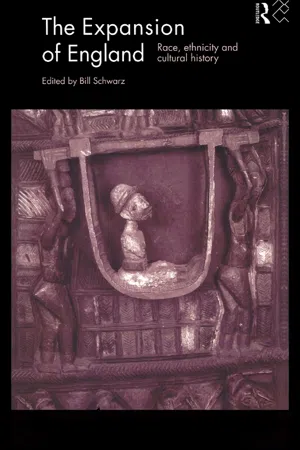
The organized study of history began in Britain when the Empire was at its height. Belief in the destiny of imperial England profoundly shaped the imagination of the first generation of professional historians. But with the Empire ended, do these mental habits still haunt historical explanation?
Drawing on postcolonial theory in a lively mix of historical and theoretical chapters, The Expansion of England explores the history of the British Empire and the practice of historical enquiry itself. There are essays on Asia, Australasia, the West Indies, South Africa and Britain. Examining the sexual, racial and ethnic identities shaping the experiences of English men and women in the nineteenth century, the authors argue that habits of thought forged in the Empire still give meaning to English identities today.
- 272 pages
- English
- ePUB (mobile friendly)
- Available on iOS & Android
eBook - ePub
About this book
1 INTRODUCTION The Expansion and Contraction of England
DOI: 10.4324/9780203993187-1
As the empire dies and England’s decline continues apace, the inner forms of English culture are thrown into sharper relief. As we argue in the chapters which follow, that elusive, displaced notion of Englishness, apparently so insular and self-contained, cannot be grasped without seeing its intimate and complex connections to the wider imperial world. It is above all the external determinations which have been most vital. ‘England alone’ is a myth: potent, but false.
The historic connection between England and its colonial empire—and the separate but overlapping relations between white English men and women and their ethnic and racial Others—ineluctably lies at the very heart of the matter even, or perhaps especially, when it remains unspoken.
In the recent past these questions have assumed public prominence in many different arenas. Of particular significance were the debates about the appropriate forms of (national) history to be taught to school-children. What began broadly as another Thatcherite offensive—the imposition of a national curriculum—was quickly transformed into an issue of serious public debate. Some critics deplored the very idea of a national history. Though much can be said for this, the most commonly articulated objections fell for an easy cosmopolitanism, in which the story of the world’s oppressed through the ages would define the historiographical project. In eschewing this, others argued for a national focus out of recognition of the global location of the British nations in modern history. 1 To justify the study of national history in this way has the advantage of appreciating that the empire has been, and inescapably still is, constitutive of English identity. 2 This indicates the need to relocate the formations of English culture within the larger compass of an imperial and global map.
But what these interventions miss is the degree to which there already exist valuable precedents. In the classics of colonial historiography one can find powerful reconstructions of England in which the imperial determinations are primary and in which the idea of the nation is formed, immediately, by the spatial dimensions of territorial expansion and contraction. After the spate of microscopic, internal studies of the proclivities of the English, where the domestic frame determines and where an unnerving complicity between critic and object in the end always seems to prevail, to confront these older studies— their dogmatic conviction in their nation’s destiny notwithstanding—is a relief, unfolding a larger map from which new routes may yet be charted.
One such text (amongst many) is Sir John Seeley’s The Expansion of England. The book combines discussion of contending versions of historical inquiry, reflections on the relations between nation and empire, and an unembarrassed political purpose. Seeley himself, on the basis of bewildering credentials (his only substantial publication being an anonymous life of Christ), found himself appointed Regius Professor of History at Cambridge in 1869. He soon came to be influential in the professionalization of historical study both in the university (the historical tripos was introduced four years after his appointment) and more widely through the medium of working men’s colleges. In 1881 he began to work systematically on colonial history most likely, it seems, lecturing in the first instance to would-be members of the Indian Civil Service. Initially determined that his lectures should remain unpublished he was persuaded otherwise in May 1882 by Florence Nightingale. His book appeared later that year, coinciding with the British occupation of Egypt; by 1885 some 80,000 copies had been sold. Thereafter it remained in print, its reputation as an imperial primer established, until 1956—when Britain once more was bombarding Egypt, though on this occasion to less effect. Now it is hardly read at all. 3
Seeley’s lectures were delivered at a moment when it appeared as if the colonial frontiers could expand no further—or more accurately, when indigenous peoples were finally being quelled as a military threat. In this respect Seeley should be read alongside Frederick Jackson Turner whose more memorable lecture, ‘The significance of the frontier in American history’, was delivered to the American Historical Association in July 1893. In the American north it was only in 1890 that the native armies were finally defeated, in North Dakota; while at the other end of the continent, the Europeans of Buenos Aires and Santiago had put an end to regular indigenous attacks only as late as the 1880s, due largely to the arrival of the Remington rifle. 4 Global frontiers were closing in.
The expansion of the United States westwards, consolidating its power over the Pacific coastline, and the commensurate drive of Russia to the east, to its Pacific coast, posed the greatest threat, in Seeley’s view, to the British empire. The political question was simple. England, as he saw it, had lost its first empire in the 1770s. A century later he identified four great groupings of territories: the Dominion of Canada; the West Indian islands; the South African possessions; and the Australian colonies. To these he added India, ‘subject to the Crown’, ‘ruled by English officials’, but ‘inhabited by a completely foreign race .. .bound to us only by the tie of conquest’. Before long, he surmised, the colonial (that is, the white) population of the empire would be greater than that of England. Was the second empire to be lost too? Or was it possible to unify the empire sufficiently to compete with the USA and Russia? In fact, unusually for one of this temperament, Seeley was not overly swayed by a belief in an inherent national or racial destiny: it was for him a matter of contingency and politics—in sum, of history. 5
In order to communicate what he saw as the political urgency of the imperial situation he organized his account of the nation in terms of its external dynamics: or better, he attempted to dismantle the dualism of ‘internal’ and ‘external’ altogether by insisting on the necessary unity of the two. ‘It seems to be assumed that affairs which are remote from England cannot deserve a leading place in a history of England…’, he noted, complaining of a historiography ‘much too exclusively European’. For Seeley the central issue of early imperial Europe was the presence of the New World, which ‘does not lie outside Europe but exists inside it as a principle of unlimited political change’. Or as he put it more pithily: in the eighteenth century ‘the history of England is not in England but in America and Asia’. 6
In setting up the problem in this way he was able to avoid some of the more common, and the more arcane, hyper-idealizations of England. Of course, the idealizations are not absent: he contrasted the empire of the English to previous colonial projects precisely in terms of England’s lack of ‘violent military character’ and he didn’t—or couldn’t—countenance anything other than a white empire. But by placing the colonial dynamic at the centre of his history he side-steps the usual story of England as the true home of well-regulated liberty. This is a history of England which pays scant attention to its monarchs, its parliaments, or the peculiar grace of its people. It is rather the authority of the English state which functions as the prime mover, an authority active as much in the colonies as in the metropolis. His own hopes were clear: that metropolitan rule would prove sufficiently benign, and colonialists sufficiently accommodating, for there to emerge throughout the empire a consensual unity founded upon a shared recognition of English ethnicity. ‘If Greater Britain in the full sense of the phrase really existed, Canada and Australia would be to us as Kent and Cornwall’. 7
To the degree that this had already occurred, it confirmed in Seeley’s mind that strictly England possessed no empire, the colonies merely operating as an organic extension of the home-nation. 8 But this approach entailed a scepticism about the eternities of England which imperialists of his ilk, and at that time, generally were not keen to pursue. Seeley deplored an ‘unhistorical way of thinking’ which assumed England always to have been the same. ‘That we might have been other than we are, nay that we once were other, is to us so inconceivable that we try to explain why we were always the same before ascertaining by any inquiry whether the fact is so’. ‘The expansion of England’, he continued, ‘involves its transformation’. To be English promises no ‘natural vocation, founded upon inherent aptitudes’. And it is for this reason that he could foresee a future for England akin to Holland or Sweden, its history, as he conceived it, ‘wound up’. 9
Seeley was also concerned that his lectures should stand as an essay in the practice of history. He drew a fine distinction between history and politics—both, as he saw it, principally concerned themselves with the examination and organization of the state—believing history should ‘modify his (the reader’s) view of the present’. His lectures on empire developed from his classes to young men who were about to administer the colonies, and the lectures themselves serve to fuse the categories of masculine and imperial authority. 10 He railed against a historiography which peddled only ‘common sense’ and worked by ‘the drowsy spell of narrative’. He looked forward to a history based less on ethics and more on causes, which was analytical, rational and true. History bereft of these qualities, and bereft of a properly masculine concern with politics, became merely ‘foppish…aiming only at literary display, which produces delightful books hovering between poetry and prose’. A feminized history without politics could only alight upon such frivolities as ‘the ladies thronging to the toy-shops’. Should history ‘cease studying what sort of government our ancestors had and inquire rather what they had for dinner?’ He had a number of malefactors in his sights. Scott was one, Macaulay another. 11 But Thackeray he condemned most of all precisely because it was he who proclaimed that fiction could be historically truthful and history fiction, denying the possibility (in Seeley’s words) that ‘history can establish any solid or important truths’. History in this scheme becomes only rhetoric. Thackeray, according to Seeley, ‘does not deny that history might be important if it were true, but he says it is not true’. To this Seeley could only respond—one can imagine the tone— ‘Make it true and trustworthy’. 12
Seeley conceptualized England as constituted by its overseas possessions, and he was prepared to push this hard enough that the very differentiation between England and colony, internal and external, came to be questioned. But he did this in a cause palpably imperialist and racist It is little wonder that subsequent liberal, radical and socialist historiographies ignored historians like Seeley, horrified that they constructed an England indistinguishable from its colonies. As a consequence, the chosen historiographical starting-point for an entire tradition of radical, popular history, far from being Seeley, came to fall on J.R.Green’s Short History of the English People, first published eight years earlier in 1874; though a deal more generous in political sensibility than Seeley could ever imagine, it deployed an analysis of English history solidly internal, a forceful encoding of English ethnicity functioning both as object and means of study. The most famous passage reads as follows:
The aim of the following work is defined by its title; it is not of English kings or English conquests, but of the English people …I have preferred to pass lightly and briefly over the details of foreign wars and diplomacies, the personal adventures of kings and nobles, the pomp of courts, or the intrigues of favourites, and to dwell at length on the incidents of that constitutional, intellectual and social advance in which we read the history of the nation itself. It is with this purpose that I have devoted more space to Chaucer than to Creasy, to Caxton than to the petty strife of Yorkist and Lancastrian, to the Poor Law of Elizabeth than to her victory at Cadiz, to the Methodist revival than to the escape of the Young Pretender. 13
While one can applaud the populism of this project, and see why it came about, the problems are palpable. The ‘people’ of England are treated as if they had no place in the sequence of ‘English conquests’, or as if they remained untouched by ‘foreign wars and diplomacies’. As the historiographical emphasis on the people intensified, even as the nation’s history was democratized, the emphasis on colonialism weakened: the two became incompatible approaches. The creation of a popular, democratic history in England brought with it a historiography parochial in texture, its frequent draughts from the cup of liberty inducing a deeper myopia.
For by underplaying the colonial dimensions, and by overplaying the long march of the freeborn Englishman, it could appear as if the two operated in distinct worlds, as if the full, complex constructs of English liberty did not carry inside them powerful exclusions which—amongst other things—were connected by an intimate set of relations to the workings of colonial rule. This conceptual separation of metropolis from colony incubated a belief common amongst radical political circles that once the shell of empire fell away there would remain the kernel of a benign England, untouched by its imperial past. 14 As a result the traditions of radical historiography could—invariably did—carry alongside them a passionate anti-colonialism. The problem was whether the silent codes of English ethnicity, in which the radical temper of the people could be pronounced, did not conceal more than they revealed.
As England contracts these things become clearer to see from within the old metropolis itself. The chapters which follow explore the effects of the expansion of England on the ‘internal’ constitution of English ethnicities, paying careful attention to different locales.
But there is a second issue which runs just as powerfully through this book. This is the question of history: the practices of historical inquiry, the appropriate forms of historical narrative and the central issue of historical truth are all raised by Seeley. Indeed, he may suggest to us that the theoretical dilemmas of our own times are not so new. He was determined to establish a boundary between a hard (masculine) positivist truth and a more disconcerting (feminized) form of historical consciousness in which truth is less the issue than rhetoric and the imagination.
Very broadly, the collapse of historical positivism in conjunction with the arrival of many varieties of poststructuralism might suggest that today it is Thackeray rather than Seeley who is the more appropriate model. After all, it’s easy enough to show the intimate connections between Seeley’s conception of history and his conceptions of race and masculinity. With good reason, those who have now become dubbed postcolonial theorists expend great effort in showing how some of the most basic philosophical assumptions of ‘Western’ historical practice are part and parcel of the founding master-categories of race and nation, culture and sexuality.
As we show in the next chapter some of the more spirited renditions of postcolonial theory—in a burst of early enthusiasm—appeared to allow for no conception of history, of conceptualizing, past, present and future, which wasn’t...
Table of contents
- Cover
- Half Title Page
- Title Page
- Copyright Page
- Contents
- Notes on contributors
- 1 Introduction: the expansion and contraction of England
- 2 Conquerors of truth: reflections on postcolonial theory
- 3 History lessons: formation of subjects, (post)colonialism, and an Other project
- 4 History and poststructuralism: Hayden White and Fredric Jameson
- 5 Walter Scott: a new historical paradigm
- 6 Imperial man: Edward Eyre in Australasia and the West Indies, 1833–66
- 7 ‘Under the hatches’: English Parliamentary Commissioners’ views of the people and language of mid-nineteenth-century Wales
- 8 Fertile land, romantic spaces, uncivilized peoples: English travelwriting about the Cape of Good Hope, 1800–50
- 9 Foreign devils and moral panics: Britain, Asia and the opium trade
- Index
Trusted by 375,005 students
Access to over 1.5 million titles for a fair monthly price.
Study more efficiently using our study tools.
Frequently asked questions
Yes, you can cancel anytime from the Subscription tab in your account settings on the Perlego website. Your subscription will stay active until the end of your current billing period. Learn how to cancel your subscription
No, books cannot be downloaded as external files, such as PDFs, for use outside of Perlego. However, you can download books within the Perlego app for offline reading on mobile or tablet. Learn how to download books offline
Perlego offers two plans: Essential and Complete
- Essential is ideal for learners and professionals who enjoy exploring a wide range of subjects. Access the Essential Library with 800,000+ trusted titles and best-sellers across business, personal growth, and the humanities. Includes unlimited reading time and Standard Read Aloud voice.
- Complete: Perfect for advanced learners and researchers needing full, unrestricted access. Unlock 1.5M+ books across hundreds of subjects, including academic and specialized titles. The Complete Plan also includes advanced features like Premium Read Aloud and Research Assistant.
We are an online textbook subscription service, where you can get access to an entire online library for less than the price of a single book per month. With over 1.5 million books across 990+ topics, we’ve got you covered! Learn about our mission
Look out for the read-aloud symbol on your next book to see if you can listen to it. The read-aloud tool reads text aloud for you, highlighting the text as it is being read. You can pause it, speed it up and slow it down. Learn more about Read Aloud
Yes! You can use the Perlego app on both iOS and Android devices to read anytime, anywhere — even offline. Perfect for commutes or when you’re on the go.
Please note we cannot support devices running on iOS 13 and Android 7 or earlier. Learn more about using the app
Please note we cannot support devices running on iOS 13 and Android 7 or earlier. Learn more about using the app
Yes, you can access The Expansion of England by Bill Schwarz in PDF and/or ePUB format, as well as other popular books in History & Early American History. We have over 1.5 million books available in our catalogue for you to explore.