eBook - ePub
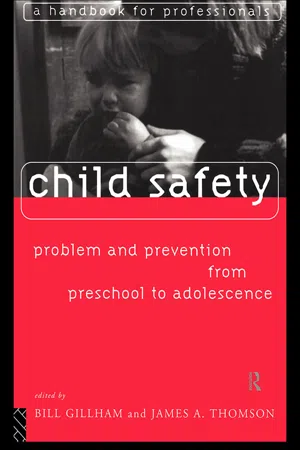
Child Safety: Problem and Prevention from Pre-School to Adolescence
A Handbook for Professionals
- 228 pages
- English
- ePUB (mobile friendly)
- Available on iOS & Android
eBook - ePub
Child Safety: Problem and Prevention from Pre-School to Adolescence
A Handbook for Professionals
About this book
Child safety is everybody's concern, but much professional activity is misinformed or based on a misrepresentation of the facts, and preventative action is rarely adequately evaluated. Written and edited by leading researchers with an active role in social policy, this new book challenges both our understanding of the problem of child safety and points to the impotence of "educational" approaches based on "knowledge enhancement". The strong message is that improving children's knowledge has little or no effect on their behaviour. From the physical abuse of young children to drug abuse in adolescence, this book presents a radical new perspective on a key social issue.
Information
Chapter 1
The challenge of child safety research
Bill Gillham and James A.Thomson
Child safety is everyone’s concern. The severe abuse, injury or death of a child brings about a public response of anger and outrage directed, not least, at those seen as responsible for protecting children. Why weren’t the police, social workers, teachers, etc. doing something about it? This hindsight response to extreme cases implies that preventive action was obvious.
Indeed, when taken at face value, problems of child safety can seem largely a matter of common sense. But if so, why isn’t it applied? The answer is that common sense at best over-simplifies the situation and is sometimes entirely wrong: and that if preventive measures are unsuccessful it is because the problem is complex and difficult to engage with. Professional workers often respond creatively but have to deal with a plethora of immediate demands that make it difficult to get beyond the current situation. The extra dimension provided by the research process is the time and space needed to reflect on issues, to get beyond immediacy, and to explore and evaluate new ways of dealing with the persistent problems of child safety.
DEFINING THE PROBLEM
Research can also help achieve a more balanced perspective. Because personal and even professional experience is restricted, it can often be biased. The picture gained from such experience is real, but it may not be representative. At one time, for example, it was thought that the sexual abuse of boys was much less common than the sexual abuse of girls—for the simple reason that most cases seen by doctors and social workers were of girls. Similarly, police officers may have good experience of road accidents involving child pedestrians but miss out on accidents that nearly happened, which may be an important part of the picture.
You cannot devise effective intervention and prevention procedures without an accurate view of the problem, a statement which may seem obvious until you start to examine the issues in depth. As we shall see, there is no entirely agreed view of the problem in relation to any of the topics discussed in this book. Contrary to what the cliché tells us, facts do not speak for themselves: they require qualification and interpretation. For example, it is in fact the case that as many mothers as fathers physically abuse children (at least according to the main UK study: Creighton, 1992). But in this study, it was found that children were twice as likely to be living with their mother as their father and therefore had far more contact with them. In other words, because the exposure was not equivalent, neither was the risk: fathers were more likely to abuse children when they were in contact with them.
The simple counting of numbers is not enough. To take another example, fewer children under five are killed on our roads than children over five. The risk is, nonetheless, greater for the younger children, but they are less exposed to risk in the first place. Another weakness of accident statistics is that they only reflect what happened—not what could have happened or nearly happened. In her chapters on accidents in the home Helen Roberts makes the important point that accident statistics tell us nothing about the strategies most parents use to keep their children safe most of the time. Without knowledge of ‘near-misses’ or the safety strategies that parents routinely adopt to protect their children, we may well see a distorted picture of what the problem is and how to solve it.
Most people, however, don’t get their understanding of child safety issues from professional experience or from reading and studying the research literature which is, in any case, both extensive and diverse. For all of us, knowledge of those areas where we are not specialist comes largely through news reports and other media representations. News reports are written by journalists not by those with specialist experience, and it is not difficult to appreciate that correct facts may not be properly qualified or explained. But the problem is more than that. Media reports of child abuse and accidents are dominated by exceptional and dramatic cases: that is what makes them newsworthy. Such cases have an undeniable validity—they are terrible and they happened. But they do not adequately represent the problem: their extreme character is not characteristic.
News reports are one form of bias. Others are political, professional, and ideological. Bias from these sources is a complex issue and is considered more fully later under the heading ‘Research and social policy’. Politicians’ willingness to accept or consider research findings depends to some extent on whether the findings are likely to be acceptable to the electorate when translated into social policy; whether they are consistent with the beliefs of the relevant political party; and whether they would be troublesome to implement.
Something analogous happens in the reaction of relevant professionals. In the current climate, all professions are sensitive to evaluative research which might be seen to suggest their role is less crucial or effective than they would like. Professions too, have their ideologies. Whilst everyone wants to do the ‘right thing’ especially in relation to children and other vulnerable groups, what is seen as the right thing is going to be affected by its implications for professional practice, for social and political action, and to the extent that it aligns with beliefs or ‘theories’ that people hold. Systems don’t change easily or quickly: it would be an unstable world if they did. Nor is there an implication here that the views of researchers should necessarily hold sway. They too have their preferred theories, though they approach them in a different way.
Professional (and other) ‘resistance’ to change is probably not the major problem. More problematic is that too much is almost certainly expected of practitioner professions—particularly social work and education. When evidence of greater social problems emerges, a common response from the public and politicians alike is to expect more of these overloaded professional groups or, indeed, to imply blame for their inaction. In relation to most social problems affecting school-age children, a common response is to impose further expectations on teachers. It is difficult to escape the inference that society shrugs off many of its responsibilities on to the teaching profession.
An assumption, usually tacit, is that an ‘educational’ response is what is needed to tackle the problem—be it sexual abuse, racial discrimination and harassment, or drug abuse. A great deal of money and energy is expended on developing programmes of this kind. But does a curriculumbased approach emphasising greater knowledge and changes in attitudes constitute effective intervention or prevention?
KNOWLEDGE ENHANCEMENT
A powerful and largely unquestioned assumption underlying almost all preventive approaches is that ‘knowledge enhancement’ is the way to deal with problems of personal safety. If children know what the risks are and are told what they should do to deal with them, then surely that will make them more safe? Unfortunately, a consistent finding is that such approaches do not work: increasing or improving children’s knowledge certainly makes them better able to discuss the problems in the classroom and to give the ‘right’ answers when questioned by adults. But this increased knowledge does not generalise to their behaviour.
It is a paradox that at first seems surprising. After all, it is common sense that the difference between a novice and an expert is that the one knows more than the other. This view is naive, however, because expertise involves much more than ‘knowing things’: it implies being able to put that knowledge into practice. The difference between the master cabinet-maker and his apprentice is not that the master knows the steps to go through in cutting a dovetail joint, whereas the apprentice doesn’t.
The difference is that the master can do it, whereas the apprentice can’t (or does it much less well). The difference lies not so much in their knowledge as in their skill.
While probably much less apparent, the distinction between knowledge and skill holds true for the very different topics discussed in this book. In some cases, the analogy with the apprentice cabinet-maker may not seem too remote. For instance, learning how to cross the road safely involves specific skills like estimating vehicle distances and speeds. It is obvious that novice pedestrians, like novice cabinetmakers, would benefit from practical experience. But in the case of the more ‘social’ problems discussed in the book, the analogy may seem inappropriate.
However, such a view would be mistaken. For example, a major knowledge enhancement approach in trying to persuade young people not to dabble in drugs has been to inform them of how dangerous drugs are. There are several drawbacks to this approach. In the first place, it is not obvious that teenagers are particularly interested in avoiding dangerous activities: in fact, to be seen to do dangerous things can attract a great deal of esteem and kudos. For this reason, it may be much harder for the individual to refuse to participate than to join in. If the teenagers do intend to refuse, they may have to find a way of doing so without attracting the scorn of their peers. Just like cabinet-making this requires skill: in this case it is social skills that are required rather than physical ones. The same social skills are required in dealing with many of the situations discussed in this book: knowing how to reject unwelcome sexual advances, avoiding becoming the victim of bullying, all involve skill in dealing with the situations that arise in social contexts. There is thus little point in simply telling children and young people ‘not to talk to strangers’ or ‘to say no to drugs’: they need to learn how to deal with the concrete social encounters that arise in these contexts in an effective and skilled manner.
THE IMPORTANCE OF PRACTICAL TRAINING FOR CHILDREN
Knowledge enhancement, then, insofar as it simply informs children of risks or tells them verbally the general principles of how to cope, is of little help to them in dealing with a complex and sophisticated social and physical world. To do so effectively, they do not just need knowledge: they need ‘know-how’.
By far the best way of getting know-how is through practical experience of dealing with appropriate situations, whether real or simulated. Obviously, these have to be modified so that no harm comes to children if they make errors. In learning how to deal with traffic situations, for instance, one can hardly set up training for children where they will make their mistakes crossing real roads. However, it is perfectly possible to contrive surrogates of real-life situations and use these as a tool for training. Just as apprentice pilots spend many hours in simulators developing their flying skills to the point at which they can begin to transfer them to real aircraft, so children would benefit from simulations that allow practical experience under equally controlled conditions. Later in the book we discuss how various simulations of the road environment can help to improve children’s traffic judgements, sometimes quite dramatically. Similarly, role playing or other practical exercises might help children learn how to deal with some of the social situations that arise in the context of bullying, sexual advances from strangers and so on. The development of practical training methods to tackle such problems is very much in its infancy. For example, there is only one adequately evaluated sexual abuse prevention programme which has demonstrated behavioural generalisation (Fryer et al., 1987); all others have judged success in terms of children’s greater knowledge of what they should do. We argue that practical approaches aimed at improving children’s behaviour rather than their knowledge deserve far greater emphasis than they have received up till now.
THE IMPORTANCE OF EVALUATION
It will be obvious, then, that not all preventive activities actually work in making children safer. Whether a particular programme does so is an empirical matter and requires demonstration. However, rigorous evaluation has seldom received a high priority in child safety research. As Thomson argues in his chapters on pedestrian safety, the attitude seems to be that if the material deals with child safety at all, then it is more or less bound to have a beneficial effect.
Most child safety programmes have enough ‘face validity’ to make evaluation appear almost unnecessary. The programme seems to make sense and is at least ‘doing something about the problem’, so what is there to complain about? However, quite a lot of things which at first sight seem to ‘make sense’ in fact don’t work. Increasing children’s knowledge may seem a good idea but if it doesn’t lead to changes in how children behave in threatening situations, how much good has it actually done? Indeed, inappropriately formulated programmes may be positively harmful: for example, if parents feel that their children are now better equipped to deal with dangerous situations (e.g., the road environment) then they may allow them more access to roads in the mistaken belief that they are capable of handling them. In such a case, far from increasing the child’s safety, the programme would positively increase the threat. It is therefore essential that programmes aimed at increasing children’s safety should be evaluated with respect to their effectiveness, and realistic conclusions drawn as to what children can now do as a result of having undergone the programme (and, even more importantly, what they can’t).
THE LIMITATIONS OF PREVENTIVE APPROACHES TARGETED ON CHILDREN
Helping children to behave more safely follows from the fact that adults cannot always be around to protect them. Eventually children must acquire the skills necessary to deal with life situations themselves. The question is whether they learn how to do so in a structured way through education, or whether they simply pick the skills up for themselves. Thomson argues in his chapters on road safety that this is precisely how most children learn to deal with traffic. If they survive they become quite good at it. Unfortunately, some become victims in the process. Nevertheless, it is important to assess as realistically as possible just what can be achieved through educational intervention and what can not. Many safety problems are intrinsically difficult for children and teaching them to cope with such situations may be a considerable challenge. For example, it is unlikely that any four-year-old could be taught road safety skills to a level that would enable them to become independent pedestrians. Road safety education for four-year- olds is essential, but the child is not being trained to become an independent pedestrian next week: they are being prepared for future independent travel. It is therefore incumbent on us to continue to protect the child for some years during which their training continues. Similarly, studies of child sexual abuse cases show that their predators are usually relatively sophisticated adults. Child molesters’ accounts of how they identify and approach their victims make chilling reading (Budin and Johnson, 1989). Although children must learn to recognise and deal with such situations, there is a limit to their ability to do so. Two conclusions follow from this. Firstly, we need to know much more about what children of different ages are and are not capable of mastering in the context of child safety. Without such information, we cannot have a satisfactory basis for deciding what to teach to a particular age group or how to build on this as the child’s experience changes. Secondly, educational initiatives must be matched by strenuous efforts to lower the risks posed by the physical and social environment in the first place.
Some approaches aimed at creating an intrinsically safer environment are elaborate and expensive, and cannot easily be introduced. An example would be the woonerven established in many Dutch cities. These are a sort of ‘safe haven’ in which pedestrians have (legally enforced) priority over vehicles and where the latter may travel only at very low speeds. In addition, such areas—which usually correspond to residential districts—are detached from main arterial roads so that there is no reason for vehicles to enter unless the driver lives in the area or is deliver...
Table of contents
- Cover Page
- Title Page
- Copyright Page
- Figures
- Tables
- Contributors
- Preface
- Acknowledgements
- Chapter 1 The challenge of child safety research
- Chapter 2 Physical abuse: the problem
- Chapter 3 The prevention of child abuse
- Chapter 4 Child accidents at home, school and play
- Chapter 5 Intervening to prevent accidents
- Chapter 6 Child pedestrian accidents: what makes children vulnerable?
- Chapter 7 Increasing traffic competence in young children
- Chapter 8 Child sexual abuse: myth and reality
- Chapter 9 The prevention of child sexual abuse
- Chapter 10 Bullying as a social problem in schools
- Chapter 11 The management and prevention of bullying
- Chapter 12 Drug abuse: what’s your poison?
- Chapter 13 Drug abuse: the issue of prevention
Trusted by 375,005 students
Access to over 1.5 million titles for a fair monthly price.
Study more efficiently using our study tools.
Frequently asked questions
Yes, you can cancel anytime from the Subscription tab in your account settings on the Perlego website. Your subscription will stay active until the end of your current billing period. Learn how to cancel your subscription
No, books cannot be downloaded as external files, such as PDFs, for use outside of Perlego. However, you can download books within the Perlego app for offline reading on mobile or tablet. Learn how to download books offline
Perlego offers two plans: Essential and Complete
- Essential is ideal for learners and professionals who enjoy exploring a wide range of subjects. Access the Essential Library with 800,000+ trusted titles and best-sellers across business, personal growth, and the humanities. Includes unlimited reading time and Standard Read Aloud voice.
- Complete: Perfect for advanced learners and researchers needing full, unrestricted access. Unlock 1.5M+ books across hundreds of subjects, including academic and specialized titles. The Complete Plan also includes advanced features like Premium Read Aloud and Research Assistant.
We are an online textbook subscription service, where you can get access to an entire online library for less than the price of a single book per month. With over 1.5 million books across 990+ topics, we’ve got you covered! Learn about our mission
Look out for the read-aloud symbol on your next book to see if you can listen to it. The read-aloud tool reads text aloud for you, highlighting the text as it is being read. You can pause it, speed it up and slow it down. Learn more about Read Aloud
Yes! You can use the Perlego app on both iOS and Android devices to read anytime, anywhere — even offline. Perfect for commutes or when you’re on the go.
Please note we cannot support devices running on iOS 13 and Android 7 or earlier. Learn more about using the app
Please note we cannot support devices running on iOS 13 and Android 7 or earlier. Learn more about using the app
Yes, you can access Child Safety: Problem and Prevention from Pre-School to Adolescence by Bill Gillham,James Thompson in PDF and/or ePUB format, as well as other popular books in Social Sciences & Education General. We have over 1.5 million books available in our catalogue for you to explore.