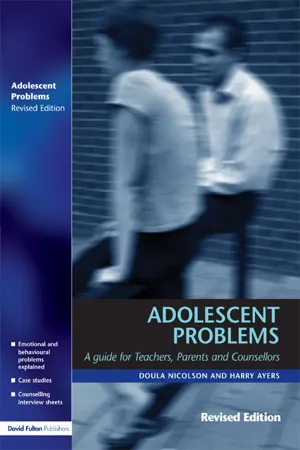
First published in 1997, this book has been updated and revised to bring it in line with new legislation and current concerns. It is an eclectic reference book on adolescent emotional and behavioural problems, covering a range of psychological theories and approaches in a readable style. The theory presented is tied in with practical application using illustrative case studies and there are time-saving interview sheets and other material for teachers/counsellors to use.
- 144 pages
- English
- ePUB (mobile friendly)
- Available on iOS & Android
eBook - ePub
Adolescent Problems
About this book
Information
Subtopic
Education GeneralIndex
PsychologyCHAPTER 1
Adolescent problems
This introductory book is intended to be a concise, structured, readable and eclectic reference guide to theory and practice with respect to adolescent emotional and behavioural problems. It should prove most useful for teachers, parents and all those who deal with and study adolescent problems, and also for adolescents themselves.
This guide includes theories of adolescent development, theoretical and practical approaches to adolescent problems, detailed sections on common adolescent problems, counselling interview sheets and addresses and phone numbers of organisations that can help with adolescent problems.
The main approaches included in the guide are behavioural, cognitive, social learning, psychodynamic, person-centred and ecosystemic, chosen because they are quite frequently used by practitioners.
The biological approach is also mentioned but not in any detail as this approach involves drug therapy which is the province of physicians and psychiatrists. It is worth stating that emotional and behavioural problems can result from physical conditions and the side-effects of drugs. Where this is suspected, it is advisable to consult a GP. It can also be the case that emotional and behavioural problems are symptomatic of a psychiatric disorder or the onset of such a disorder, and again, it is advisable to consult a GP.
Certain issues and controversies that fall outside the remit of this book do arise from time to time and need to be considered. For example:
• the influence of heredity and the environment on emotional and behavioural problems, i.e. how far there is a biological and genetic basis for such problems;
• whether a problem should be seen as categorical, i.e. a distinct, discrete category or dimensional, i.e. as lying along a continuum;
• how far these problems are the results of traits or states or an interaction between the two, e.g. temperament and situations;
• the validity and the reliability of the assessment of emotional and behavioural problems and the prevalence of such problems;
• the influence of culture and ethnicity on how problems are perceived and assessed;
• the relative effectiveness of the different approaches with respect to such problems.
The concept of adolescence
Adolescence is a transitional stage between childhood and adulthood. It is a period of biological, social, emotional and cognitive development which, if not negotiated satisfactorily, can lead to emotional and behavioural problems in adult life. It is customarily defined as beginning at approximately 10 to 13 years of age and ending between 18 and 22 years of age. It is usually subdivided into early and late adolescence.
Particular psychological and psychiatric problems can have their onset in adolescence or become more prevalent or noticeable during adolescence, e.g. phobias, anxiety, depression, suicide and attempted suicide, attention-deficit disorders, anorexia and bulimia, conduct disorders, schizophrenia and substance abuse.
Adolescence is also a time when adolescents strive to create their own personal identities and sense of autonomy which may at times lead to major or minor, temporary or permanent disagreements with their parents, carers or teachers. Most adolescents negotiate this phase satisfactorily and enjoy positive relationships with their parents and other adults.
Adolescence can be viewed from different developmental perspectives. It can be seen as being influenced by a variety of factors: genetic, temperamental and environmental. Puberty begins during adolescence, a period of hormonal and bodily changes which in turn are associated with psychological changes. Adolescents can become preoccupied with bodily image and physical attractiveness, particularly in relation to their peers or in relation to media models or ideals. They may be early or late maturers and as one or the other may experience particular problems, e.g. fears and doubts about what is normal development for their age. Additionally, they may engage in risky behaviour and be catapulted into early adulthood.
Cognitively, adolescence is a time when, in Piagetian terms, adolescents should reach the formal operational stage which means that they should be able to reason logically and abstractly, consider hypothetical possibilities and engage in problem-solving activities. They should also be able to engage in meta-cognition, i.e. reflecting on their own cognitive processes. There is also a tendency to compare themselves with their peers and to what they perceive as ideal standards; this may lead them to become self-conscious and this can adversely affect their self-esteem, particularly with regard to their own perceived lack of physical attractiveness. Low self-esteem may contribute to particular problems, e.g. loneliness, depression, suicide, anorexia and conduct disorders. They may try out different roles on their way to forming a sense of personal identity. Adolescents also have fantasies about themselves and their futures.
In terms of social cognition, adolescence is a time when adolescents reason about themselves and their social world. This means that adolescents become egocentric, thinking others, either imaginary or real, are as interested in them as they are in themselves. There is an emphasis on how others see them and a desire to be noticed and recognised. Adolescents also develop perspective-taking and, if successful, come to understand the thoughts and feelings of others.
They may become idealistic and interested in religious, philosophical and political ideas and movements. As a result, the adult world may appear to them to be hypocritical and immoral.
Psychodynamically, adolescence is a time when adolescents strive to develop independence and to distance themselves from their parents. They begin to form a personal and sexual identity of their own. It is also a period when childhood trauma may surface and when adolescents become aware of unconscious conflicts.
The significance of adolescence lies in the fact that, along with childhood, it provides the foundation for adulthood.
CHAPTER 2
Theories of adolescent development
Erikson
His analysis of the period of adolescence focuses on the concept of identity. He defines identity as being composed of a genetic inheritance together with a particular way of organising experience that is in turn structured by a given cultural context. Personal identity is therefore partly determined by the individual’s psychological make-up but also by the community of which that individual is a part. That identity is one that is both conscious and unconscious, providing a sense of continuity. It is rooted in a past that helps shape the future.
Identity evolves throughout childhood by the processes of introjection (internalising the persona of significant others) and identification (assimilating the roles and values of others). Personal identity also depends on the way society responds. Identity formation occurs when the adolescent chooses from a variety of introjections and identifications and achieves a new synthesis. This identity formation continues throughout the life of the individual.
Erikson believes that human development adheres to the principle of epigenesis which means that everything emerges from a basic ‘ground plan’ in parts, with each part experiencing a period of ascendancy, finally forming an integrated whole. He outlines eight stages of development, each stage being conflictual and having the possibility of two opposing, bipolar outcomes. Individuals experience conflicting possibilities and if they resolve these conflicts, a positive self-concept is formed. But if the conflict persists or is unresolved, then a negative or dystonic element is incorporated into a person’s identity, leading to a negative self-concept and psychological problems. However, he states that both syntonic (positive) and dystonic are necessary for there to be satisfactory personal adaptation. Identity issues are never finally resolved and may be affected by role changes and major life events, depending on changing needs and circumstances. Optimal identity formation should include a commitment to roles, values and sexual orientation that reflect an individual’s particular abilities and needs.
Erikson states that the fifth stage is the one that characterises the period of adolescence. It is the stage of identity versus role confusion. The individual is faced with achieving a synthesis through transcending childhood identifications and undertaking expected social roles. The adolescent should achieve a balance between the bipolar outcomes, thus enabling the individual to adapt to his or her environment. Prior to this fifth stage the adolescent will have passed through four other necessary stages:
• trust versus mistrust;
• autonomy versus shame and doubt;
• initiative versus guilt;
• industry versus inferiority.
Erikson believes it is necessary for the infant to develop a balance of trust and mistrust in order to navigate the world securely. Mutual recognition and mutual trustworthiness form the bases for a future sense of personal identity. Mistrust alone is dystonic and may result in identity confusion in adolescence and thereby lead to a sense of alienation from others.
Autonomy means acquiring a sense of self-control; this self-control may be achieved through conflict manifested in disobedience. Successful resolution of this stage will lead the child to develop a desire to be him- or herself which becomes a necessary precondition for attaining personal identity in adolescence. The dystonic result could be self-doubt and dependency leading to the avoidance of difficult situations or, alternatively, defiance of parents and authority in general.
If the child develops initiative at this stage, this sets the scene for experimenting with different social and sexual roles in adolescence. If children are constrained by parents in their exploration and initiative-taking, then they may be inhibited by guilt and fear, thus restricting themselves to fixed roles and over-dependency on adults.
The stage between starting secondary school and puberty is referred to as the apprenticeship for life, where a positive attitude to work is acquired through identification with role models who possess and display knowledge and skills. Work is the stage where the child builds a desire for achievement and feelings of competence. If this stage is not satisfactorily negotiated, the child will feel incompetent, inferior and experience work paralysis and futility.
For Erikson, adolescence is the period when individuals must form a personal identity and avoid role diffusion and identity confusion. The adolescent must address a number of identity questions: ‘Where do I originate from?’, ‘Who am I?’ and ‘What do I want to be?’ The goal is to achieve an integrated synthesis of past, present and future which together contribute to an adolescent’s identity. This identity is also the product of reciprocal interaction between the individual and significant others, i.e. peer group and role models. The adolescent also needs to come to terms with physical changes and sexual desire. If personal identity is poorly formed, the risks of delinquency and psychological problems can arise. These problems can emerge due to past difficulties with mistrust, shame, doubt, guilt and feelings of inferiority.
Adolescent love is seen by Erikson as primarily a means by which adolescents test out their evolving identity through redefinition and revision of their self-concept. The adolescent is also concerned to establish vocational goals and initially aims to achieve often unrealistic and idealised occupational roles, particularly ones that ‘heroes’ possess. Adolescent identification is often with such ‘heroes’ in preference to their parents whom they rebel against. Erikson sees such rebellion as the adolescent striving to achieve autonomy and independence and thereby form a separate identity. The adolescent pursues fidelity which is the quest for something to identify with and be identified by: a step on the way to attaining autonomy.
The atta...
Table of contents
- Cover
- Halftitle
- Title
- Copyright
- Contents
- Chapter 1 Adolescent Problems
- Chapter 2 Theories of Adolescent Development
- Chapter 3 Theoretical Approaches to Adolescent Problems
- Chapter 4 Practice
- Chapter 5 Detailed Topics
- Chapter 6 Case Studies
- Student Counselling Interview Sheets
- Glossary
- Useful Addresses
- References and Further Reading
Trusted by 375,005 students
Access to over 1.5 million titles for a fair monthly price.
Study more efficiently using our study tools.
Frequently asked questions
Yes, you can cancel anytime from the Subscription tab in your account settings on the Perlego website. Your subscription will stay active until the end of your current billing period. Learn how to cancel your subscription
No, books cannot be downloaded as external files, such as PDFs, for use outside of Perlego. However, you can download books within the Perlego app for offline reading on mobile or tablet. Learn how to download books offline
Perlego offers two plans: Essential and Complete
- Essential is ideal for learners and professionals who enjoy exploring a wide range of subjects. Access the Essential Library with 800,000+ trusted titles and best-sellers across business, personal growth, and the humanities. Includes unlimited reading time and Standard Read Aloud voice.
- Complete: Perfect for advanced learners and researchers needing full, unrestricted access. Unlock 1.5M+ books across hundreds of subjects, including academic and specialized titles. The Complete Plan also includes advanced features like Premium Read Aloud and Research Assistant.
We are an online textbook subscription service, where you can get access to an entire online library for less than the price of a single book per month. With over 1.5 million books across 990+ topics, we’ve got you covered! Learn about our mission
Look out for the read-aloud symbol on your next book to see if you can listen to it. The read-aloud tool reads text aloud for you, highlighting the text as it is being read. You can pause it, speed it up and slow it down. Learn more about Read Aloud
Yes! You can use the Perlego app on both iOS and Android devices to read anytime, anywhere — even offline. Perfect for commutes or when you’re on the go.
Please note we cannot support devices running on iOS 13 and Android 7 or earlier. Learn more about using the app
Please note we cannot support devices running on iOS 13 and Android 7 or earlier. Learn more about using the app
Yes, you can access Adolescent Problems by Doula Nicolson,Harry Ayers in PDF and/or ePUB format, as well as other popular books in Psychology & Education General. We have over 1.5 million books available in our catalogue for you to explore.