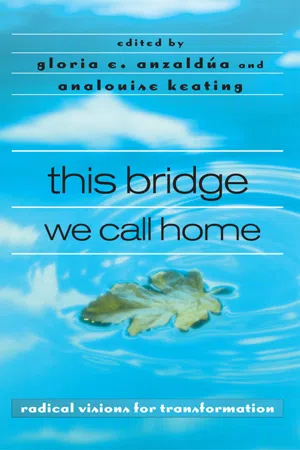
More than twenty years after the ground-breaking anthology This Bridge Called My Back called upon feminists to envision new forms of communities and practices, Gloria E. Anzaldúa and AnaLouise Keating have painstakingly assembled a new collection of over eighty original writings that offers a bold new vision of women-of-color consciousness for the twenty-first century. Written by women and men--both "of color" and "white"--this bridgewe call home will challenge readers to rethink existing categories and invent new individual and collective identities.
eBook - ePub
this bridge we call home
radical visions for transformation
- 624 pages
- English
- ePUB (mobile friendly)
- Available on iOS & Android
eBook - ePub
this bridge we call home
radical visions for transformation
About this book
Information
Open the Door
Nova Gutierrez
DOI: 10.4324/9780203952962-1

Chameleon
Lobel Andemicael
DOI: 10.4324/9780203952962-2
Someone was screaming in the hallway. You could hear the screech of sneakers on the polished floor followed by a slamming of doors that shook An’s reflection in the mirror of the medicine cabinet. With her open palm she steadied the glass and started again on the red outline of her mouth. Lips pursed and face leaning close to her reflection in the stark bathroom light, she tried—as she had since she could remember—to see herself as others did. Very dark eyebrows, lashes and eyes, skin somewhere between yellow ochre and olive brown, and pigment discoloration—splotches of white like dry salt lakes on an amber plain—at the temples and jaw. She knew the details minutely, each birthmark and imperfection, but still failed—as she had since she could remember—to perceive the whole face as a stranger might and ascertain the identity, ethnicity, culture, and race of the woman before her. Was she beautiful? Was her complexion sallow or seductive? Was she black? Was she so pale and soft-featured as to be mistaken for white? Was she dark enough to be Latina? Discernibly Colombian? Or did she simply look mixed—too indefinable to be seen as anything authentic at all?
Doing her childhood dance with her reflection she turned away then swung back suddenly to catch herself unaware. Nothing. She turned off the lights and tried to clear her mind, then flicked them on again and stood blinking; nothing. Who did people see?
Frustrated yet resigned, she shrugged at her reflection. She should be feeling better: her grades were strong enough to keep her pre-med, and she was learning how to step carefully between friends like a hiker crossing over water on stones; yet she was more apprehensive than ever, and acutely felt she still did not fit in. She wasn’t invisible, just unseen; familiarity, rather than helping people understand her better, allowed them to impose their expectations more. She still cringed when asked what she was, “ethnically,” by people gauging her allegiances. Like the last student left in a classroom at the end of a math exam, she sat paralyzed: even with all the variables she needed listed on the blackboard before her, she was stymied and unable to compute the solution.
With a last quick glance at her flushed reflection, An opened the bathroom door. Kate was pulling her fair hair back into a ballerina-style bun and surveying herself in the full-length mirror on the back of their door. “You promised me you’d go to the movies with us,” she said quietly.
“I just found out there was a meeting before the party.” An sat awkwardly on Kate’s desk chair.
“What’ll you miss? Come on,” Kate cajoled, “come with us. Everyone’s coming over for tequila after the movie and you can go to the party late.” Her voice was gentle, with less of the edge that had set in when An had announced she was joining the Black Students’ Center a month before. Still anxious to mollify her, An gave in.
“Good choice.” Kate moved to stand behind An and examined An’s black curls, arranging and rearranging the hair in different positions. “It’s so curly and long,” she said warmly, snagging her fingers as she tried to straighten the thick strands.
There was a clamor outside the door and after a perfunctory knock, Kate’s girlfriends—their friends—pushed into the room in a wave of herbal shampoo and flowery perfume.
“I knew they wouldn’t be ready,” Emily said over her shoulder to Christie as they crowded into the room, sitting where they could and picking up random objects within their reach. As An was painfully self-contained—as much as she could, she kept everything crammed into her trunk, dresser, desk, and bookshelf—most of the things were Kate’s. But Christie was opening a red notebook that An recognized with a sickening jolt.
“Whose poems are these? Or notes anyway.”
As nonchalantly as she could, An reached a hand out for her notebook. “It’s for an English class.”
“Oh, have you finally caught up?” Emily asked.
“No, she’s still blocked,” Kate said with a melodramatic flourish, her hands deep in An’s hair. “She has a semester’s worth of poems to turn in to pass the class,” she told Christie, “and we have one-on-one tutorials with the professor tomorrow. But An’s pre-med—she’s too pragmatic to write poetry.”
“I think she’d just rather fail the class and wreck her precious GPA than open up about herself.” Emily avoided An’s eyes.
“What’s the assignment?”
“Poems based on Sartre’s ‘words are actions’ or ‘acts’ or something. And identity. We have to turn in a portfolio with one poem per week for the entire semester. That’s our whole grade for the class.” Emily turned to An. “At least you’re interesting. You should have a lot to say.” With a smile she approved each hairdo that Kate tangled together on An’s head.
“I’m blank,” An said. “I don’t know what to say.”
“Just speak your mind,” Kate said. “Or else you could just cook some of your plantains and do a show-and-tell,” she added, laughing knowingly with Emily.
“I like plantains.” Christie smiled at An.
“These aren’t normal plantains, they’re plátanos maduros. They look like pieces of shit on a plate.” The room reverberated with barely repressed laughter. “The place smells for weeks.”
“And she plays her music when she cooks,” Emily added, mimicking a little salsa step. Then seeing An’s taut expression, she went over and put her arms around her. “You know we love you. That’s why we tease you.”
“Where’re you from?” Christie asked politely.
“Colombia.”
“Her mother’s Colombian. Her father’s white,” Kate corrected in a proprietary tone.
“Afro-Colombian,” An added.
“I’d love to meet your family.” Christie was animated. “I’d love to see what produced you.”
“They’re very eccentric,” An said, awkwardly clasping her hands together. “Colombian with big doses of immigrant suspicion and single motherhood thrown in.”
“Movie’s starting in five. We’ve got to go,” Emily jumped up and the group mobilized.
Passing the mirror, An was shocked to see her hair, straightened to an electric frizz, tangled and matted around her head like unspun wool.
“Kate, wait,” she gasped, “I can’t go out like this! Why didn’t you tell me?”
Turning back Kate guffawed and grabbed for Emily. “Look what I did—oh An, I’m so sorry.” She laughed again and tried unsuccessfully to press the frizzy mass down with her hands. “It’s not so bad.”
“Wait. I’ll put something in it.” An hurried to the bathroom.
“Not that smelly shit, please. You look fine.”
“Go ahead,” An said, rubbing gel in her hands.
“Isn’t that for black hair?” Emily asked, peering over An’s shoulder and grimacing.
“Look, just go ahead.”
“Hurry up,” Kate sighed.
With An’s hair finally twisted into a knot and stuffed under a crocheted tam, they ran to the auditorium, which was overflowing for the Saturday-night showing of Scarface. As Tony Montana burst into the Colombians’ hotel room and was greeted by a whorish, vicious-looking, heavily made-up woman with mannish features reclining on the bed, An watched her friends’ expressions carefully. Their faces were absorbed—not indignant or surprised but not amused or disgusted either. Uneasy, An gripped the arms of her chair as the eruptions of cocaine grew into mountains and Michelle Pfeiffer suffered the excesses of her Latin man in white-hot silence. Confused and disembodied, she puzzled out her discomfort. On the one hand she felt dirty, vulgar and un-American, like a creeping, insidious, sinister, enemy “other”; on the other she felt violated, like someone had spit or urinated on her from an apartment above as she walked alone, minding her own business. She felt violated as a Colombian and guilty for the violation as an American.
As the women gathered together in the bathroom after the film, chatting about weekend events and scrutinizing themselves and each other, An relaxed a little. The frown softened on her reflection, but her face looked distorted, crooked somehow. Her complexion—not pink or translucent, freckled or rouged like her neighbors’—seemed muddy, blemished, discolored. Like turgid water churned up at the edge of a pond, or slush shoveled unceremoniously on freshly fallen snow.
“You should wear red,” Emily was saying to her, drawing her in from the margin. You have the coloring for it. Like a Carmen.” All the women in a row paused to examine An and nod, almost in unison.
“Guys like that exotic thing.”
The women laughed. An smiled tentatively, trying to gauge the feelings percolating around her in the bathroom.
“Don’t mess with her,” Kate said, grinning at An. “Colombians’ll fock jou op.”
Back at the dorm, people crowded into their room as Kate pulled tequila and limes from her mini-fridge. Listening to the laughter from the bathroom, An meticulously kohl-lined her eyes and fought her hair with gel until it lay still and gleamed. She smoothed gloss over her lips instead of lipstick and pinched her sallow cheeks until they glowed and she was satisfied with the boldness of her reflection. Then she joined the others in pounding tequila shots, licking salt from their hands, and pushing limes into their mouths, laughing as the juice ran down their chins. But afterwards, she and Kate were silent as they weaved across the campus, An heading to the BSC party and Kate on an off-campus food run with the others. As they reached the heaving basement party room, she and Kate squeezed hands and went their separate ways.
An pushed inside and made her way immediately to the BSC contingent knotted in the center of the room. Shyly sliding into a rhythm, An sidled up to the group, willing the ranks to part a little for her yet trying to look unconcerned if they didn’t. An arm stretched out and pulled her into orbit at the periphery like a comet or moon held by a planet’s gravitational pull. James, his hand still on her wrist, seamlessly moved out of the center of the group and joined her.
“Are you okay?” he asked, leaning into her ear and squeezing her shoulder. “You look messed up.”
She nodded, leaning her weight into him. “Been a long night.”
“Well come home and relax, baby.” He opened his arms and she was absorbed into his rhythm until the end of the song.
“We missed you at the meeting tonight,” he said when they stepped outside to cool off.
“I know. I promised Kate I’d go to the movies with her.”
“You went to the movies with 90210 instead of coming to a meeting? You have to get your priorities straight. No wonder you’ve been having a rough time.”
They sat companionably together, enjoying the cool air.
“There’s no rule that says you have to pledge to your roommate’s friends when you come to college. You need to be where you’re most comfortable. In fact, you’re welcome to move over to the BSC house if you want. There’s a room free since Alice moved off campus.”
“I don’t know. I don’t want to hurt my roommate. She’d take it personally.”
“And that’s your problem—how, exactly?”
“We’re friends, in our own way.”
James shrugged. “It’s your call. Just be sure the decision’s for you and not for other people.”
An closed her eyes and tried to ease the spins by breathing slowly and deeply. “I’ll think about it.” She stood up. “I think I’m going to head out.”
“I’ll walk you.”
The air from the underbrush was cloying and sweet as they walked along the campus’s nature trail, each one synchronizing their footsteps to the other’s.
“You finish your poem portfolio?” An asked as they stopped under a streetlamp in front of her dorm.
“Are you kidding? Weeks ago. But poetry’s what I do. I’ve got a lot to say about—well, most things.” Seeing her doleful expression he pulled her into a hug. “Try not ...
Table of contents
- Cover Page
- Half Title Page
- Title Page
- Copyright Page
- Contents
- Giving Thanks
- Preface (Un)natural bridges, (Un)safe spaces
- Charting Pathways, Marking Thresholds . . . A Warning, An Introduction
- Foreword AfterBridge: Technologies of Crossing
- i. “Looking for my own bridge to get over” … exploring the impact
- 1. Open the Door
- 2. Chameleon
- 3. Del puente al arco iris: transformando de guerrera a mujer de la paz—From Bridge to Rainbow: Transforming from Warrior to Woman of Peace
- 4. Nacido en un Puente/Born on a Bridge
- 5. Engaging Contradictions, Creating Home …Three Letters
- 6. Bridges/Backs/Books: A Love Letter to the Editors
- 7. Bridging Different Views: Australian and Asia-Pacific Engagements with This Bridge Called My Back
- 8. Thinking Again: This Bridge Called My Back and the Challenge to Whiteness
- 9. The Spirit of This Bridge
- 10. Remembering This Bridge, Remembering Ourselves: Yearning, Memory, and Desire
- 11. Seventh Fire
- ii. “Still struggling with the boxes people try to put me in” … resisting the labels
- 12. Interracial
- 13. Los Intersticios: Recasting Moving Selves
- 14. Gallina Ciega: Turning the Game on Itself
- 15. Que Onda Mother Goose: The Real Nursery Rhyme From El Barrio
- 16. The Hipness of Mediation: A Hyphenated German Existence
- 17. Living Fearlessly With and Within Differences: My Search for Identity Beyond Categories and Contradictions
- 18. A Letter to a Mother, from Her Son
- 19. Young Man Popkin: A Queer Dystopia
- 20. Transchildren, Changelings, and Fairies: Living the Dream and Surviving the Nightmare in Contemporary America
- 21. The Real Americana
- 22. Shades of a Bridge's Breath
- 23. Nomadic Existence: Exile, Gender, and Palestine (an E-mail Conversation between Sisters)
- 24. (Re)Writing Home: A Daughter's Letter to Her Mother
- 25. In the End (Al Fin) we are all Chicanas (Somos Todos Chicanas) Pivotal positions for change
- iii. “Locking arms in the master's house” … omissions, revisions, new issues
- 26. Burning House
- 27. “What's Wrong with a Little Fantasy?” Storytelling from the (Still) Ivory Tower
- 28. Footnoting Heresy: E-mail Dialogues
- 29. Memory and the New-Born: The Maternal Imagination in Diaspora
- 30. The “White” Sheep of the Family: But Bleaching Is like Starvation
- 31. Lesbianism, 2000
- 32. “Now That You're a White Man”: Changing Sex in a Postmodern World—Being, Becoming, and Borders
- 33. Poets, Lovers, and the Master's Tools: A Conversation with Audre Lorde
- 34. “All I Can Cook Is Crack on a Spoon”: A Sign for a New Generation of Feminists
- 35. Don't Touch: Recuerdos (Self-Destruction)
- 36. Premature
- 37. The Reckoning
- iv. “A place at the table” … Surviving the battles, shaping our worlds
- 38. Puente del Fuego
- 39. Vanish Is a Toilet Bowl Cleaner
- 40. Yo' Done Bridge Is Fallin' Down
- 41. Council Meeting
- 42. For My Sister: Smashing the Walls of Pretense and Shame
- 43. Resisting the Shore
- 44. Standing on This Bridge
- 45. Stolen Beauty
- 46. Looking for Warrior Woman (Beyond Pocahontas)
- 47. So Far from the Bridge
- 48. The Ricky Ricardo Syndrome: Looking for Leaders, Finding Celebrities
- 49. Survival
- 50. Imagining Differently: The Politics of Listening in a Feminist Classroom
- v. “Shouldering more identity than we can bear” … seeking allies in academe
- 51. Nurturance
- 52. Aliens and Others in Search of the Tribe in Academe
- 53. The Fire in My Heart1
- 54. Notes from a Welfare Queen in the Ivory Tower
- 55. Being the Bridge: A Solitary Black Woman's Position in the Women's Studies Classroom as a Feminist Student and Professor
- 56. This World Is My Place
- 57. Missing Ellen and Finding the Inner Life: Reflections of a Latina Lesbian Feminist on the Politics of the Academic Closet
- 58. The Cry-Smile Mask: A Korean-American Woman's System of Resistance
- 59. Andrea's Third Shift: The Invisible Work of African-American Women in Higher Education
- 60. Recollecting This Bridge in an Anti–Affirmative Action Era: Literary Anthologies, Academic Memoir, and Institutional Autobiography
- 61. Healing Sueños for Academia
- vi. “Yo soy tu otro yo—i am your other i” … forging common ground
- 62. My Tears are Wings
- 63. The Colors Beneath Our Skin
- 64. Connection: The Bridge Finds Its Voice
- 65. The Body Politic—Meditations on Identity
- 66. Speaking of Privilege
- 67. The Latin American and Caribbean Feminist/Lesbian Encuentros: Crossing the Bridge of Our Diverse Identities
- 68. Sitting in the Waiting Room of Adult and Family Services at SE 122nd in Portland, Oregon, with My Sister and My Mother Two Hours Before I Return to School (April 1995)
- 69. Tenuous Alliance
- 70. Chamizal
- 71. Linkages: A Personal-Political Journey with Feminist-of-Color Politics
- vii. “I am the pivot for transformation” … enacting the vision
- 72. Girl and Snake
- 73. Thawing Hearts, Opening a Path in the Woods, Founding a New Lineage
- 74. Still Crazy After All These Tears
- 75. “And Revolution Is Possible”: Re-Membering the Vision of This Bridge
- 76. Witch Museum
- 77. Forging El Mundo Zurdo: Changing Ourselves, Changing the World
- 78. In the Presence of Spirit(s): A Meditation on the Politics of Solidarity and Transformation
- 79. Continents
- 80. Now let us shift … the path of conocimiento … inner work, public acts1
- Works Cited
- Contributors’ Biographies
- Editors’ Biographies
- Index
Trusted by 375,005 students
Access to over 1.5 million titles for a fair monthly price.
Study more efficiently using our study tools.
Frequently asked questions
Yes, you can cancel anytime from the Subscription tab in your account settings on the Perlego website. Your subscription will stay active until the end of your current billing period. Learn how to cancel your subscription
No, books cannot be downloaded as external files, such as PDFs, for use outside of Perlego. However, you can download books within the Perlego app for offline reading on mobile or tablet. Learn how to download books offline
Perlego offers two plans: Essential and Complete
- Essential is ideal for learners and professionals who enjoy exploring a wide range of subjects. Access the Essential Library with 800,000+ trusted titles and best-sellers across business, personal growth, and the humanities. Includes unlimited reading time and Standard Read Aloud voice.
- Complete: Perfect for advanced learners and researchers needing full, unrestricted access. Unlock 1.5M+ books across hundreds of subjects, including academic and specialized titles. The Complete Plan also includes advanced features like Premium Read Aloud and Research Assistant.
We are an online textbook subscription service, where you can get access to an entire online library for less than the price of a single book per month. With over 1.5 million books across 990+ topics, we’ve got you covered! Learn about our mission
Look out for the read-aloud symbol on your next book to see if you can listen to it. The read-aloud tool reads text aloud for you, highlighting the text as it is being read. You can pause it, speed it up and slow it down. Learn more about Read Aloud
Yes! You can use the Perlego app on both iOS and Android devices to read anytime, anywhere — even offline. Perfect for commutes or when you’re on the go.
Please note we cannot support devices running on iOS 13 and Android 7 or earlier. Learn more about using the app
Please note we cannot support devices running on iOS 13 and Android 7 or earlier. Learn more about using the app
Yes, you can access this bridge we call home by Gloria Anzaldúa, AnaLouise Keating, Gloria Anzaldúa,AnaLouise Keating in PDF and/or ePUB format, as well as other popular books in Social Sciences & Feminism & Feminist Theory. We have over 1.5 million books available in our catalogue for you to explore.