Prevention: What Works with Children and Adolescents? deals with the prevention of psychological problems which are of central concern to those who fund and develop health, social and educational services for children, adolescents and their families. Problems addressed in this book include developmental delay in low birth weight infants and socially disadvantaged children; adjustment problems in children with sensory and additional disabilities and autism; challenging behaviour in children with intellectual disabilities; physical and sexual abuse; bullying; adjustment problems in children with asthma and diabetes; teenage smoking; alcohol use and drug abuse; teenage pregnancy, STDs and HIV infection; post-traumatic adjustment problems and adolescent suicide. Conclusions drawn in this book are based on the results of over 200 rigorously conducted studies of more than 70,000 children.
eBook - ePub
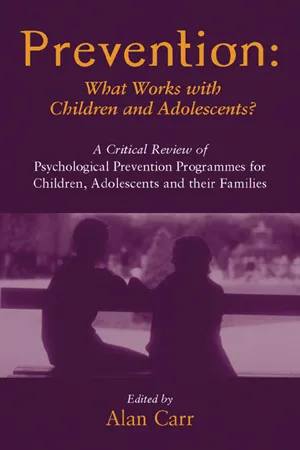
Prevention: What Works with Children and Adolescents?
A Critical Review of Psychological Prevention Programmes for Children, Adolescents and their Families
- 432 pages
- English
- ePUB (mobile friendly)
- Available on iOS & Android
eBook - ePub
Prevention: What Works with Children and Adolescents?
A Critical Review of Psychological Prevention Programmes for Children, Adolescents and their Families
About this book
Information
1 Introduction
Between 10% and 20% of youngsters suffer from psychological problems serious enough to warrant psychological treatment (Carr, 1999). There is now an impressive body of research which shows that psychological interventions for many of these problems are highly effective (Carr, 2000). However, for all who work in child and adolescent health, education, and social services a central concern is how these psychological problems might be prevented in the first place. Our book aims to answer this question. Our answer is based on a thorough, critical review of rigorously conducted prevention programme evaluation research.
Selection of areas for review
In structuring the review process, we decided to focus on groups of children who, because of biological or psychosocial adversity, are vulnerable to developing adjustment problems which entail particularly negative outcomes. For example, children with diabetes, because of biological adversity, are vulnerable to a range of serious medical complications if they do not strictly adhere to their illness management regime. Socially disadvantaged youngsters, because of environmental adversity, are vulnerable to cognitive and language developmental delays and school-based attainment difficulties. We also decided to focus on problems which may affect all youngsters and which can lead to particularly negative outcomes, for example sexual risk-taking which can lead to teenage pregnancy and infection with sexually transmitted diseases including HIV. Our selection of areas for review was limited by the availability of methodologically robust prevention programme evaluation studies. Finally, for the most part, we excluded populations and problems considered in our recent critical review of the child and adolescent psychological treatment outcome literature: What Works with Children and Adolescents? (Carr, 2000). So, for example, because behavioural parent training for youngsters with oppositional defiant disorder was covered in What Works with Children and Adolescents?, the same literature is not reviewed here in a chapter on the prevention of conduct disorder. Using these inclusion and exclusion criteria the following problem areas were selected and a chapter is devoted to each in this volume:
• developmental delay in low birth weight infants
• cognitive delays in environmentally disadvantaged children
• adjustment problems in children with cerebral palsy
• adjustment problems in children with sensory disabilities
• adjustment problems in children with autism
• challenging behaviour in children with intellectual disabilities
• physical abuse
• sexual abuse
• bullying
• adjustment problems in children with asthma
• adjustment problems in children with diabetes
• teenage smoking, alcohol use and drug abuse
• teenage pregnancy, sexually transmitted diseases and HIV infection
• post-traumatic adjustment problems in children and adolescents
• suicide in adolescence
While the empirical literature on the effectiveness of intervention programmes for some of these problems has been reviewed previously, all of these areas have never been considered in a single volume in a uniform way (Ammerman & Hersen, 1997; Guralnick & Bennet, 1987; Guralnick, 1997; Di Clemente et al., 1996). In this sense the present volume is unique.
Overall review strategy
For each of the 15 problem areas listed in the previous section, the following review strategy was used for the period 1977–2000. First, a PsychLit search of English language journals and book chapters was conducted using the core problem term and variations of it combined with terms such as prevention, intervention, evaluation and related phrases to identify potential programme evaluation studies. Second, a PsychLit search was conducted using the core problem term combined with the term review, to identify review papers. Third, the bibliographies of review papers, treatment outcome studies and relevant journals were manually searched. Fourth, in certain instances investigators were contacted directly to solicit copies of recent articles, although only in exceptional circumstances where very few high quality published studies were available were unpublished studies included in reviews. Fifth, with a couple of exceptions mentioned below, studies were selected for inclusion if they met the following stringent methodological criteria: a randomized or matched comparative group outcome design was used; cases were diagnostically homogeneous; at least five cases were included in each group; reliable and valid pre- and post-programme measures were used. Sixth, if these stringent methodological criteria yielded a particularly small pool of studies, the criteria were relaxed and less methodologically robust studies were included for review. These procedures ensured that for each problem area, a pool of the most methodologically robust available studies containing at least 50 treated cases was reviewed. Seventh, for each group of studies wherever possible at least four types of tables were drawn up to summarize key features. These tables covered (1) general characteristics; (2) methodological features; (3) effect sizes and outcome rates; and (4) key findings. The structure of these tables and definitions of the terms included in them are given below. Eighth, narrative accounts were written summarizing the main trends in each of the tables, with one section giving an overview of the characteristics of the studies; a further section commenting on their methodological features; and the third section summarizing the substantive findings. Ninth, in constructing tables and writing sections on substantive findings, studies were grouped by problem subtype (e.g. deaf children, blind children, deaf-blind children) and type of intervention programme (e.g. psychoeducation only; psychoeducation and communication skills training only; psychoeducation, communication and behavioural skills training). In outlining substantive findings reference was made to the results of each study or group of studies on a range of relevant outcome measures which varied from study to study. For example, in studies of low birth weight children, cognitive functioning was one of the widely used outcome measures whereas for adolescent sexual risk-taking frequency of condom use was one of the outcome measures commonly reported. Tenth, a summary of the main conclusions and the confidence with which these were drawn was outlined before highlighting the implications for future policy, practice and research. Finally, for each problem area resources for assessment, intervention, and informing clients about the area or problem were listed.
There were a number of exceptions to this overall strategy. All of the empirical studies of the impact of psychological interventions to prevent challenging behaviour in children with intellectual disabilities which were identified were experimental single case designs. Rather than omit this important area, we selected and reviewed a representative group of these experimental single case design studies. In most of the studies of bullying prevention programmes there were no control groups and conclusions about programme effectiveness were based on time-lagged contrasts between age-equivalent groups, i.e. data from Time 1 were used as a baseline against which data from Time 2, and in some instances Time 3, could be compared. In the area of sensory disabilities a number of studies lacked control groups and statistical procedures were used to control for matur-ational processes. We therefore included these types of studies in our review.
To orient readers at the outset of each chapter definitions of core problems addressed within the chapter are given along with epidemiological information, a summary of the main aetiological theories and the principal conclusions of previous reviews. In instances where the programme evaluation literature was very large, and where previous reviews clearly indicated that certain types of intervention programmes were particularly effective, while others were clearly ineffective, we confined our review to studies of intervention programmes that previous reviewers identified as being particularly effective. For example, within the substance use prevention literature we confined our review to resistance skills training, life skills training and multisystemic, multimodal programmes, since there is some consensus within the literature that these can be effective. However, we did not review the voluminous literature on psychoeducational and affectively oriented programmes, which have been shown repeatedly to be ineffective. In instances where very large numbers of methodologically robust studies of effective programmes were identified, we confined our review to a representative group of 10–20 studies.
Strategy for tabulating general characteristics of studies
To provide an overview of the general characteristics of studies reviewed, a table containing the following headings was constructed for problems addressed in each chapter.
• Authors.
• Year: The year of publication is given under this heading.
• N per group: The number of cases in each group is given under this heading.
• Age: The mean age and age range of participants are given under this heading.
• Gender: The number of males and females is given under this heading.
• Family characteristics: Descriptions of the structure, socioeconomic status (SES) and ethnicity are given under this heading.
• Programme setting: Distinctions are made between hospital inpatient settings, community outpatient and day programme settings, preschools, primary schools and secondary school.
• Programme duration: The average number of sessions or hours of intervention and the time period over which this occurred are given under this heading, e.g. 20 hourly sessions over 1 year.
Where all studies shared a particular characteristic or where information on a particular characteristic was unavailable for most studies, then a column for categorizing that characteristic was eliminated from the table so as to simplify the overall presentation of information. Additional column headings were added if all studies in a particular group provided important information on that variable.
Strategy for tabulating methodological features
Different strategies were used for tabulating methodological features for comparative group outcome designs and single case designs, so each will be addressed in separate sections below.
Methodological features of comparative group outcome studies
To provide an overview of the methodological features of comparative group outcome studies, a table containing categories listed below was constructed in each chapter and the presence or absence of each methodological feature for each study was noted. These categories collectively constitute a checklist for assessing methodological robustness. The checklist represents a synthesis of other similar checklists (Carr, 2000). In interpreting tables based on this checklist, attention was paid to both profiles and total scores. Examination of each study’s profile on this checklist threw light on its methodological strengths and weaknesses. Greater confidence was placed in ...
Table of contents
- Cover
- Halftitle
- Title
- Copyright
- Contents
- List of contributors
- Foreword
- Preface
- 1 Introduction
- 2 Prevention of developmental delay in low birth weight infants
- 3 Prevention of cognitive delay in socially disadvantaged children
- 4 Prevention of adjustment problems in children with cerebral palsy
- 5 Prevention of adjustment difficulties in children with sensory impairments
- 6 Prevention of adjustment problems in children with autism
- 7 Prevention of challenging behaviour in children with intellectual disabilities
- 8 Prevention of physical abuse
- 9 Prevention of child sexual abuse
- 10 Prevention of bullying
- 11 Prevention of adjustment problems in children with asthma
- 12 Prevention of adjustment problems in children with diabetes
- 13 Prevention of teenage smoking, alcohol use and drug abuse
- 14 Prevention of teenage pregnancy, STDs and HIV infection
- 15 Prevention of post-traumatic adjustment problems in children and adolescents
- 16 Prevention of suicide in adolescence
- 17 Conclusions
- Bibliography
- Index
Trusted by 375,005 students
Access to over 1.5 million titles for a fair monthly price.
Study more efficiently using our study tools.
Frequently asked questions
Yes, you can cancel anytime from the Subscription tab in your account settings on the Perlego website. Your subscription will stay active until the end of your current billing period. Learn how to cancel your subscription
No, books cannot be downloaded as external files, such as PDFs, for use outside of Perlego. However, you can download books within the Perlego app for offline reading on mobile or tablet. Learn how to download books offline
We are an online textbook subscription service, where you can get access to an entire online library for less than the price of a single book per month. With over 1.5 million books across 990+ topics, we’ve got you covered! Learn about our mission
Look out for the read-aloud symbol on your next book to see if you can listen to it. The read-aloud tool reads text aloud for you, highlighting the text as it is being read. You can pause it, speed it up and slow it down. Learn more about Read Aloud
Yes! You can use the Perlego app on both iOS and Android devices to read anytime, anywhere — even offline. Perfect for commutes or when you’re on the go.
Please note we cannot support devices running on iOS 13 and Android 7 or earlier. Learn more about using the app
Please note we cannot support devices running on iOS 13 and Android 7 or earlier. Learn more about using the app
Yes, you can access Prevention: What Works with Children and Adolescents? by Alan Carr in PDF and/or ePUB format, as well as other popular books in Psychology & Clinical Psychology. We have over 1.5 million books available in our catalogue for you to explore.