The author of this book has identified the seven key emerging Internet-related technologies: Internet of things, smart everything, big data, cloud computing, cybersecurity, software-defined networking, and online education. Together these technologies are transformational and disruptive. This book provides researchers, students, and professionals a comprehensive introduction, applications, benefits, and challenges for each technology. It presents the impact of these cutting-edge technologies on our global economy and its future. The word "technology" refers to "collection of techniques, skills, methods, and processes used in the production of goods or services."
- 129 pages
- English
- ePUB (mobile friendly)
- Available on iOS & Android
eBook - ePub
Emerging Internet-Based Technologies
About this book
Information
1
Internet of Things
The best way to predict the future is to invent it.
Alan Kay
1.1 Introduction
The Industrial Revolution changed the dynamics of a society through rapid urbanization and rise of cities, working women, rise of the middle class, and creation of job opportunities. The Internet Revolution predominately brought with it changes that were not only technological but societal and pervasive in scope. The Internet is regarded by many as the greatest technological disruption of all time. Access to information combined with global ecommerce reshaped established conventions. The next revolution that will disrupt our lifestyle, technology, and business is the Internet of Things (IoT) [1].
Most of the devices we use today support communication technology. Such devices include cell phones, sensors, smart grid, and laptops. These devices can interact among themselves through the Internet. Such a paradigm is called the “Internet of Things” or “Internet of Objects,” where the devices are referred to as the things. It is the Internet of relating to things. A thing in the IoT environment is always connected with the external and interacting with other things, such as objects, humans, animals, or plants.
The IoT is a link between objects in the real world with the virtual world, thereby enabling anytime, anywhere connectivity for anything. The goal of IoT is to integrate and automate everything from home appliances to plants on factory floors. Experts predict that the IoT will consist of about 50 billion objects by 2020. Thus, the number of things connected to the Internet now exceeds the number of people on the planet. IoT is the next step in the evolution of the Internet, since it takes into consideration all devices connected to it. It allows all types of elements (sensors, actuators, personal electronic devices, laptops, tablets, digital cameras, smart phones, alarm systems, home appliances, industrial machines, etc.) to autonomously interact with each other. Today, big players from a wide range of industries are adopting IoT and basing their future business and growth prospects on it.
This chapter begins by presenting the basic characteristics of IoT. Then it presents the technologies enabling IoT and some popular applications of IoT. It gives the current trends in IoT: industrial IoT, Internet of Vehicles (IoV), and social IoT. It addresses some challenges facing IoT and some organizations working on some of these challenges. Finally, the last section provides the conclusions.
1.2 IoT Basics
The term, IoT, was first coined by Kevin Ashton, a British entrepreneur in 1999. He meant to represent the concept of computers and machines with sensors, which are connected to the Internet to report status and accept control commands [2].
IoT (also known as sensor network or Industrial Internet) is a global network infrastructure of interconnected devices (such as sensors, actuators, personal electronic devices, laptops, tablets, digital cameras, smart phones, alarm systems, home appliances, or industrial machines, and other smart devices) that are enabled with technology of interacting and communicating with each other. It mainly enables the interconnection of Thing to Thing (T2T), Human to Thing (H2T), and Human to Human (H2H). By collecting and combining data from various IoT devices and using big data analytics, decision-makers can take appropriate actions with important economic, social, and environmental implications.
As shown in Figure 1.1 [3], the IoT can be divided into three layers: perception (or sensing) layer, network layer and application layer:
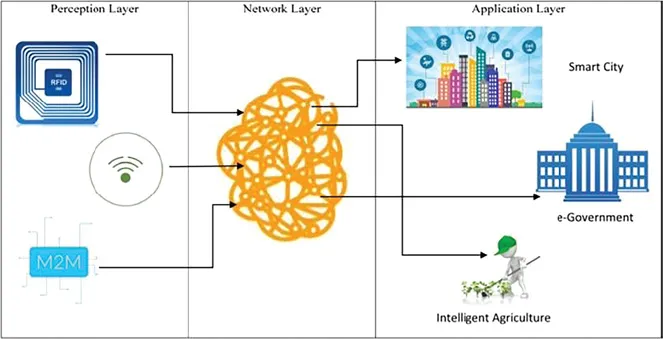
FIGURE 1.1
The IoT layers [3].
The IoT layers [3].
- The perception layer collects from devices such radio-frequency identification (RFID) tags and readers, camera, GPS, and sensors. In this layer, the wireless smart systems with sensors can automatically sense and exchange information among different devices and remotely control them.
- The network layer is mainly messaging and processing information. The role of this layer is to connect all things together and allow them to share the information with each other.
- The application layer is the IoT and the application systems.
The fundamental characteristics of IoT include interconnectivity, things-related services, scalability, heterogeneity, and dynamic changes.
1.3 Enabling Technologies
Translating the IoT concept into the real world requires integration of several enabling technologies. Technologies that enable IoT are shown in Figure 1.2 [4]. These IoT technologies are widely used for the deployment of successful IoT-based products and services. These include RFID, wireless sensor networks (WSN), middleware, cloud computing, artificial intelligence, IoT application software, and Micro-Electro-Mechanical Systems (MEMS) [5, 6 and 7].
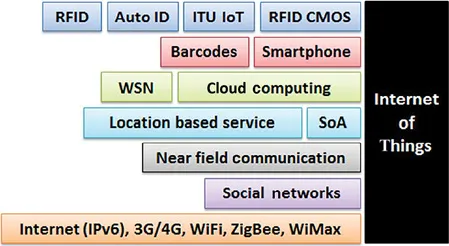
FIGURE 1.2
Technologies associated with IoT [4].
Technologies associated with IoT [4].
- Networking technologies. These can be wired or wireless. The choice depends on the geographical range to be covered. Ethernet and fiber optics are examples of wired technologies, while Wi-Fi is a typical wireless technology. Bluetooth was introduced in 1999 as a wireless technology for transferring data over short distances. Newly released smart phones have Bluetooth Low Energy (BLE) hardware in them. ZigBee is a low-power LAN protocol based on the IEEE 802.15.4 standard. It is specifically designed for low-rate sensors.
- WSN. This is perhaps the most important integral part of IoT. Sensors are usually connected as WSNs to monitor physical properties in specific environments. The purpose of a sensor is to convert a non-electric signal to an electrical signal that can be transmitted through an electric circuit. An actuator complements a sensor; it converts an electrical signal into physical action. IoT may be regarded as a things-connected network, where things are wirelessly connected via smart sensors. These sensors collaborate with each other to provide information of their physical surroundings. They collect data that may enable the business make a good decision. TinyOS serves as operating systems for sensor networks due to limited resources, flexibility, and low power.
- RFID. RFID is an emerging noncontact identification technology which is designed to enhance the bar code technology. It refers to technologies that use radio waves to identify objects, animals, or people. It enables the design of microchips for wireless communication that can identify anything they are attached to automatically just as an electronic barcode. It is now widely used for tracking objects, humans, or animals. A typical RFID system consists of three main components: tags, readers, and controller [8]. Optical tags are used for low-cost tagging.
- Near-field communication (NFC). NFC is a subset within the family of RFID. As the name implies, NFC is a set of short-range wireless technologies that enable two electronic devices to communicate full-duplex and typically require a separation of 10 cm or less between them. NFC employs electromagnetic induction between two antennas and operates within the globally available unlicensed radio-frequency ISM band of 13.56 MHz. It allows a device, usually a mobile phone, to collect data from another device at close range without the need for an Internet connection. Virtually every mobile operating system maker has their own apps that offer unique NFC functionality.
- MEMS. This field, which encompasses all aspects of science and technology, is involved with things on a smaller scale. MEMS technology gives scientists and engineers the tools to build things that have been impossible or prohibitively expensive with other technologies. It is a manufacturing technology; a new way of making complex electromechanical systems using batch fabrication techniques similar to the way integrated circuits (ICs) are made and making these electromechanical elements along with electronics [9]. This is an enabling technology for IoT because MEMS manufacturing produces small, low-cost sensors and actuators. MEMS technology has already taken root firmly in today’s world. It is destined to become a hallmark 21st century manufacturing technology with numerous and diverse applications.
These technologies have helped capture of and access to real-time information. IoT is the convergence of the Internet with RFID, sensors, and smart objects. IoT has potential for societal as well as economic impact. Potential applications are the major force driving the future of the IoT. Some see IoT as a vehicle for economic growth.
1.4 Applications
The main advantage of the IoT concept is the high impact it will have on various aspects of everyday-life of potential users. The US government and government of other nations such as UK, China, and India are taking drastic measures to incorporate IoT into many industries. This action will have impact on various government projects such as smart cities, smart manufacturing (SM), smart materials, smart transportation, smart power grids, smart agriculture, etc. The IoT is applied in health care, automotive industries, smart power grid, manufacturing, transportation, agriculture, logistics, pharmaceutics, surveillance, etc. Some of these applications are illustrated in Figure 1.3 [10]. Here we will consider some typical applications of IoT [11,12].
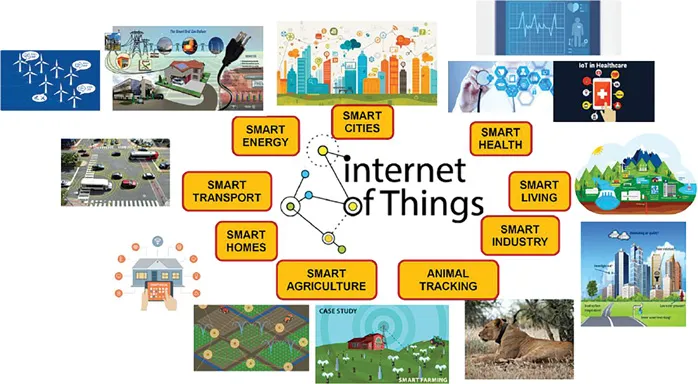
FIGURE 1.3
Typical IoT applications [10].
Typical IoT applications [10].
- Manufacturing. This is the largest industry from an IoT spending (software, hardware, connectivity, and services) perspective. Manufacturing is among the industrial sectors that will be directly impacted by the disruption springing from industrial IoT. By collecting information from IoT sensors and analyzing it, SM increases production efficiency in factories. IoT is posed to automate, monitor, and analyze information from machinery and equipment in exciting new business ventures. Thus, IoT provides numerous great opportunities to advance manufacturing in achieving better system performances in globalized and distributed environments.
- Transportation. This represents the second largest IoT market. Today’s transportation infrastructure is stressed to the breaking point. Many cities have begun smart transportation initiatives to optimize their public transportation routes, create safer roads, reduce infrastructure costs, and alleviate traffic congestion. Airlines, rail companies, and public transit agencies can aggregate huge quantities of data to optimize operations.
- Energy management. Energy costs account for major production and monitoring. IoT can be put to use in this regard. Sensors connected to IoT can be used to monitor energy consumption, help control costs, and ensure compliance. IoT simplifies the process of energy monitoring and management while maintain low cost and high precision.
- Cybersecurity. Since industrial plants may be potential targets for terrorist attacks, cybersecurity should be a top priority. Companies must consider physical security, industrial systems security, and data security. Using IoT, companies can bring data together easily, enabling them to quickly identify unauthorized access and prevent further intrusion. This way they can prevent hackers from gaining access to their sensitive data.
- Technologies. The IoT provides big opportunities for using technologies at affordable cost. It is helping to simplify business processes and provide more insight that can help improve quality, reduce downtime, decrease the costs of maintenance, and increase on-time delivery. Using the technologies to connect devices, plants, assets, people, products, and processes is helping industries to make data-driven ...
Table of contents
- Cover
- Half Title
- Title Page
- Copyright Page
- Dedication Page
- Table of Contents
- Preface
- Acronyms
- Author
- 1. Internet of Things
- 2. Smart Everything
- 3. Big Data
- 4. Cloud Computing
- 5. Cybersecurity
- 6. Software-Defined Networking
- 7. Online Education
- Index
Trusted by 375,005 students
Access to over 1.5 million titles for a fair monthly price.
Study more efficiently using our study tools.
Frequently asked questions
Yes, you can cancel anytime from the Subscription tab in your account settings on the Perlego website. Your subscription will stay active until the end of your current billing period. Learn how to cancel your subscription
No, books cannot be downloaded as external files, such as PDFs, for use outside of Perlego. However, you can download books within the Perlego app for offline reading on mobile or tablet. Learn how to download books offline
Perlego offers two plans: Essential and Complete
- Essential is ideal for learners and professionals who enjoy exploring a wide range of subjects. Access the Essential Library with 800,000+ trusted titles and best-sellers across business, personal growth, and the humanities. Includes unlimited reading time and Standard Read Aloud voice.
- Complete: Perfect for advanced learners and researchers needing full, unrestricted access. Unlock 1.5M+ books across hundreds of subjects, including academic and specialized titles. The Complete Plan also includes advanced features like Premium Read Aloud and Research Assistant.
We are an online textbook subscription service, where you can get access to an entire online library for less than the price of a single book per month. With over 1.5 million books across 990+ topics, we’ve got you covered! Learn about our mission
Look out for the read-aloud symbol on your next book to see if you can listen to it. The read-aloud tool reads text aloud for you, highlighting the text as it is being read. You can pause it, speed it up and slow it down. Learn more about Read Aloud
Yes! You can use the Perlego app on both iOS and Android devices to read anytime, anywhere — even offline. Perfect for commutes or when you’re on the go.
Please note we cannot support devices running on iOS 13 and Android 7 or earlier. Learn more about using the app
Please note we cannot support devices running on iOS 13 and Android 7 or earlier. Learn more about using the app
Yes, you can access Emerging Internet-Based Technologies by Matthew N. O. Sadiku in PDF and/or ePUB format, as well as other popular books in Computer Science & Cloud Computing. We have over 1.5 million books available in our catalogue for you to explore.