- 258 pages
- English
- ePUB (mobile friendly)
- Available on iOS & Android
eBook - ePub
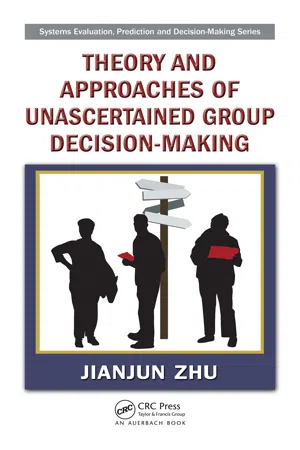
Theory and Approaches of Unascertained Group Decision-Making
About this book
Tackling the question of how to effectively aggregate uncertain preference information in multiple structures given by decision-making groups, Theory and Approaches of Unascertained Group Decision-Making focuses on group aggregation methods based on uncertainty preference information. It expresses the complexity existing in each group decision-maki
Information
Publisher
Auerbach PublicationsYear
2012Print ISBN
9781138198982
9781420087505
Edition
1eBook ISBN
9781466575981
1
INTRODUCTION
1.1 Background and Purpose
The key processes of decision making include the evaluation and selection of people. Related theoretical methods are based on the subject’s cognitive activities, which reflect a speculative analysis and treatment process. Therefore, decision making often depends on decision makers’ subjective preferences; common preference structures are judgment matrix, utility value, preference ordering value, linguistic value, and so on. Because of the uncertainty of the decision-making environment, decision makers tend to express in the form of preference, such as interval numbers, fuzzy numbers, and linguistic variables. This book studies mainly group decision-making methods and group aggregation methods based on uncertainty preference information. The famous economist H. A. Simon [1], one of the founders of scientific management, said that “management is decision making,” and decision making is a conscious and optional action process to achieve some purpose or to accomplish a task. With the development of society, science, and technology, the amount of knowledge and information has greatly increased, wherein more and more decision-making problems involve a number of decision makers. Decision making encompasses the three following aspects of complexity:
1. Uncertain property of the preference structure: uncertainty is absolute, whereas certainty is relative. Decision-making groups always cognize, predict, and judge things in complex and dynamic decision space. Even if the preference is deterministic, there are inevitably some uncertainties. In many cases, the uncertain preference is more relevant for decision making and is usually adopted by decision makers.
2. Multiform property of the preference structure: Extensive application of internet technology makes it possible for many decision makers to be involved in complex decision-making problems. Because of differences in social and cultural backgrounds, life experience, work experience, psychological quality, judging level, the external environment, personal preferences, and so on, different forms of preference information may be given on the same decision by different decision makers to solve the same problem, even in the same space-time. At the same time, due to the incompleteness and asymmetry of decision-making information, and the complexity of the decision-making object structure, decision makers often supply multiple uncertain preferences.
3. Properties of dynamic and multiple stages in the decision-making process: Decision makers’ awareness of objective things follows the law of progressive approach wherein conditions are changing and in constant development, so a comprehensive, contacted, dynamic perspective is needed in the decision-making process. In addition, decision makers often need to pay attention to the characteristics of multiple stages in the decision-making process for comprehensive assessment; for example, postevaluation requires a combination of prefeasibility study, feasibility study, design, engineering development, and other stages with which those stages interact, and different forms of preference may be given by decision makers in different stages. A score form involves a numerical evaluation (e.g., a score of 98 points). A voting form requests a qualitative evaluation (e.g., yes or no, qualified or unqualified).
Due to the legion of assessment factors involved in complex decision-making problems, and the difference between decision makers’ awareness of things, and the impact of internal and external environment in the decision-making process, it is often difficult to effectively gather group preference information in the group decision-making process, which leads to decentralized decision-making advice and even contrary evaluation findings and seriously affects the decision-making process, thereby adversely affecting the “fighters.” In addition, with the development of an intelligent decision support system in the combination of communications and computer technology, the open comprehensive integrated discussion system needs to improve the practical applicability and flexibility of group decision-making technology. Therefore, it is necessary to determine how to effectively aggregate uncertain preference with different structures supplied by decision makers. The background above is the basis of this book.
1.2 Review of the Research
1.2.1 Review of the Uncertain Decision-Making and Group Decision-Making Method
Decision making became the universally accepted expert research in the academic field, which can be traced back to statistical decision theory in the 1950s, and L. J. Savage, Abraham Wald, R. A. Fisher, and other scholars are representative. H. Raiffa and R. O. Schlaifer developed the Bayesian statistical theory, and Harvard Business School researchers represented by H. Raiffa have applied this theory to practical business problems, which contributed to the application of statistical decision theory. In 1966, Howard first proposed the “decision analysis” concept at the 4th International Operations Conference, which has become synonymous with scientific research on decision making.
With increasingly complex human social activities, research on practical problems involves larger and more complex systems that are characterized by more prominent uncertainty, and deterministic description of classical methods becomes powerless. After many years of research, fuzzy math, gray systems, unascertained mathematics, rough sets, and other mathematical theories of uncertainty have been developed, and the application in decision-making also contributed to decision theory being perfected. Probability theory and mathematical statistics can deal with random information. Zhou [1a] and Hu [2] discussed decision-making questions based on random preference. Hahn [3] proposed a random multiple attribute decision-making method based on Bayesian theory. Sabbudin [4] proposed a new algorithm to solve multistage decision-making problem application of Markov. Hryniewicz [5] studied the testing problem of random decision making. L. A. Zadeh [5a, 5b] proposed that fuzzy set–based fuzzy mathematics can express fuzzy information. Gu and Zhu [6] proposed a fuzzy multiattribute decision-making method based on feature vector space. Tang et al. [7] studied the applications of the fuzzy theory in aggregate production planning decision making. Walk and Rutkowski [8] proposed an application model of the fuzzy decision support system. Because fuzzy decision making comes down to comparing fuzzy sets, many papers have been published that proposed ranking methods of fuzzy sets [9–11]. Deng [12] and Liu et al. [13] proposed gray system theory and a mathematical approach to deal with the gray information. Liu [14] reviewed the research progress of the gray system theory. Wang [15] proposed an unascertained information-processing method. Liu et al. [16] summarized the theoretical method and application areas of unascertained mathematics. Other typical findings include: Parkan and Wang [17] and Parkan et al. [18] determined an effective strategy making use of incomplete probability information. Researchers [19, 20, 21] have studied uncertain multiattribute group decision making and information assembly problems making use of evidence theory. Qiu [22] and Chang et al. [23] used information entropy to deal with uncertain decision-making problems. Zhau [24] described uncertainty making use of set pair analysis. Pawlak [25] proposed a rough-set theory to deal with the imprecise problem. Wang et al. [26] proposed a universal gray-set theory. Liu et al. [27] described the application approach of prospect theory. Uncertain decision-making theory grows in its association with uncertainty mathematics. In recent years, some new uncertainty mathematical theories have been introduced to the decision domain, and comprehensive integration application of a variety of uncertainty mathematical theories in complex decision-making environments will become a research hotspot.
The uncertainty and complexity of decision-making problems lead to extensive use of group decision making, and the earliest group decision-making studies date back to medieval social choice theory. K. J. Arrow [28], a Nobel Laureate in Economics, proposed the Arrow impossibility theorem, which led to modern social choice theory and became a classic conclusion of group decision making. In 1975, group decision making was proposed as a clear concept by Bacharach [29] and Keeney and Kirkwood [30], followed by a wide range of academic attention. Since 2002, more than 50 researchers have chosen group decision theory as the direction of their Ph.D. theses and achieved progress in preference theory, group utility theory, social choice theory, negotiation method theory, voting theory, game theory generally, expert evaluation and analysis, quantitative factor assembly, random and fuzzy group decision theory, economic equilibrium theory, group decision support systems, etc. [31–37]. Though research on group decision theory and methods has not formed a unified and rigorous system [38, 39], the next focus of research can be summarized in the following ways:
1. Dynamic process of group decision making: the existing research is still very weak.
2. Organization theory of group decision making: The organization process of group decision making plays an important role in the decision results, and it is an inevitable requirement for scientific group decision making to strengthen research on organization processes. In addition, organizational structure and management are complex in decision-making groups.
3. Communications and impacts among group members: Ex- change of information can enhance the judging ability of group members but also easily lead to correlation among group members and the convergence effect. Especially in complex decision environments, uncertain preference may affect correlation and convergence effect among members and complicate decision making.
4. Selecting preference aggregation rules and building an aggregation model: specific decision problems, decision-making groups, and spatial and temporal characteristics often lead to different assembly standards.
5. Strategic behavior in group decision making: Decision makers often represent their own interest groups in various degrees; to a certain degree conflict of interest and interest relevance exist among group organizations, inevitably involving decision-making rivalry and games.
6. The development and application of a group decision support system platform: At present, enterprises and organizations are increasingly demanding for application software of decision making, but a truly effective software is rare [40, 41]. In particular, software platforms that respond to the complicated decision-making environment is in severe shortage.
1.2.2 Review of the Complexity of Group Decision-Making and Related Studies
Many new features presented in group decision making are due to the complexity of the decision-making process. The above-mentioned research related to the complexity of the group decision-making processes. Following Arrow’s impossibility theorem, breakthroughs in group decision theory have been rare. As a result, people still recognize the complexity in group decision making insufficiently and lack effective solution strategies. The complexity of the group decision-making process abounds in areas such as multilayer, multifactor, changeable, nonlinear interaction, complexity of time and space evolution, randomness, and other characteristics [42, 43]. The causes can be summarized as follows: things run irregularly, which is completely random; things run regularly, but people still have not found the objective law or have erroneous cognition; things run regularly, but people still cannot accurately grasp and handle the framework of the existing system of theoretical knowledge.
Over the years, research on the complex problem has been a hot issue for scholars who have described the complexity from the entropy, information, fractal dimension, thermodynamic depth, and time and space [43]. The U.S. National Science Foundation published “2006–2011 Strategic Plan,” whose key research areas are also involved in the modeling of complex systems and other new cross-disciplines. Early research on Marca Loch and Pitt Heights’s neural networks, Neumann’s cellular automata, and Wiener’s cybernetics made a substantive contribution on the complexity research. In 1980s, the Santa Fe Institute made outstanding contributions to complexity research, and Eisenstein summed up recent progress in complexity research, such as multiscale approaches in the understanding of the complex behavior, nonlinear mechanics and dynamics of the network, agent-based modeling, economic and social complex systems modeling, and so on. Since the 1990s, a comprehensive integration method based on the combination of people’s wisdom and high-performance computers, qualitative and quantitative, came into being [44–46]. In the case of complex situations, experts gave judgments and assumptions (and various data and information), and then sublimed the qualitative understandings to quantitative, conclusions through the computer’s process; but the modeling method of interactions among main subjects of the system and interactions has still not been effectively addressed, as there is no literature discussing the algorithms of information integration processing over the computer.
1.2.3 Review of Preference Aggregation for Group Decision Making
Decision makers’s preferences play an important role in the decision-making process. Based on complex scenarios, according to their own knowledge structure, the speculative process of analyzing and dealing with alternatives of decision makers directly affects the group decision-making process. Furthermore, their preferences also affect the alternative selection. How to effectively gather various types of preference information needs to be addressed urgently. According to the structure categories of preference information given by group decision makers in the decision-making process, the aggregation methods of individual preferences can be generally divided into the same structural preference assembly and different structural preference assembly. The assembly methods of the same structural preference are abundant [47–53], and the aggregation methods of certainty preference with different preference structure have also attracted academic attention. Chiclana and Herrera [54] studied an aggregation method of three forms of preference including utility value, order value, and the complementary judgment matrix in group decision making. Delgado et al. [55] studied an aggregation method of two forms of preference including linguistic judgment matrices and value judgment matrices. Fan and Jiang [56] and Xiao et al. [57] studied an aggregation method of four forms of preference including complementary judgment matrices, reciprocal judgment matrices, utility value, and order value. But in the group preference aggregation studies of the existing literature, the impact of complexity in group decision-making processes was not great. In fact, due to the presence of external disturbances, the complexity of objective issues, the ambiguity of the human mind, and the uncertain environment, using deterministic preference to characterize complex decision problems is unrealistic. Research [58–62] has summarized the uncertain decision-making progress, focusing on problems with single decision-making preference and data structure. In group decision-making processes, aggregation of the uncertain pluralistic structural preference has the following five aspects of difficulties:
1. There is very little research on the complexity of group decision making. There is no effective characterization for the complex structural relationship among decision-making groups (or decision-making alternatives) and no models and methods for the effects internal and external environments effects of on decision-making groups and alternatives. These complex factors will directly affect the assembly model selection and parameter settings.
2. Research on the internal decision-making mechanism of uncertain preference information is not perfect. The traditional decision-making mechanism of the uncertain preference information (such as the interval number reciprocal judgment matrix) has been researched to some extent [63–65] but the weight calculation method of uncertain preference is not perfect. In particulars research on uncertain preference consistency value is lacking, while some new decision-making mechanism of the uncertain preferences is rare [66].
3. Research on the consistent conversion mechanism of various types of uncertain preference information is lacking. The multiple uncertain preference aggregation method can be summarized after aggregating the different structural preferences into the same structure, directly aggregating various forms of preference information without consistent conversion, aggregating based on prioritizing various types of preference information, etc. Information distortion is inevitably produced in the process of aggregating the different structural preferences into the same structure. Mikhailov [67] studied a consistent conversion method of various types of certain preference information, and in Wu [68] Xu [69] several kinds of consistent conversion formulas for various types of uncertain preference information are given. Zhu and Liu [70] studied the changing process of information based on complementary judgment matrices into reciprocal judgment matrices. But there exists no literature researching equivalence and the validity of information in the consistent conversion process of various types of uncertain preference, which will thus affect the quality and reliability of group preferences aggregation.
4. An optimization model of a variety of uncertain preference aggregation is lacking. Zhu [71] proposed an assembly method for two types of uncertain preferences—interval number complementary judgment matrices and interval number reciprocal judgment matrices. Zhu et al. [72] proposed a measurement of preference information of decision makers utilizing a three-point interval number and studied two aggregating methods of two kinds about the three-point interval number judgment matrices. But there have been no measures to determine experts’ weights based on uncertain preference information, how to measure the satisfaction degrees of decision-making groups, how to build an aggregating model with the maximum reflection of decision-making group preferences, and how to aggregate more types of uncertain preferences.
5. An aggregation method of uncertain preference information with timing characteristics is lacking. Researches [73–78] have studied an aggregation method of certain preference data information with timing characteristics, but there has been no literature considering aggregation methods of multiple stages of uncertain group preference information, whose challenges are weighting of decision makers and stages based on uncertain preference information. The challenges are the weight solution of decision makers and stages based on uncertain preference information. It is also important to forecast development trends before making rational decisions.
1.3 Brief Introduction of Content and Chapter
1.3.1 Decision-Making Mechanism...
Table of contents
- Cover
- Title Page
- Copyright
- Contents
- PREFACE
- ABOUT THE AUTHOR
- ACKNOWLEDGMENTS
- ABSTRACT
- CHAPTER 1 INTRODUCTION
- CHAPTER 2 DECISION-MAKING METHOD OF INTERVAL NUMBER RECIPROCAL AND COMPLEMENTARY COMPARISON MATRIX
- CHAPTER 3 DECISION-MAKING METHOD OF UNASCERTAINED NUMBER COMPARISON MATRIX
- CHAPTER 4 DECISION-MAKING METHOD OF THREE-POINT INTERVAL NUMBER COMPARISON MATRIX
- CHAPTER 5 DECISION-MAKING METHOD OF THE LINGUISTIC COMPARISON MATRIX
- CHAPTER 6 AGGREGATION METHOD ON MULTIPLE STYLE PREFERENCE FOR GROUP DECISION MAKING
- CHAPTER 7 AGGREGATION METHOD OF MULTIPLE STAGES FOR GROUP DECISION MAKING
- CHAPTER 8 AN EXTENSION OF TOPSIS WITH MULTIPLE-STAGES FUZZY LINGUISTIC EVALUATION FOR GROUP DECISION MAKING
- CONCLUSION AND SUMMARY
- REFERENCES
- INDEX
Trusted by 375,005 students
Access to over 1.5 million titles for a fair monthly price.
Study more efficiently using our study tools.
Frequently asked questions
Yes, you can cancel anytime from the Subscription tab in your account settings on the Perlego website. Your subscription will stay active until the end of your current billing period. Learn how to cancel your subscription
No, books cannot be downloaded as external files, such as PDFs, for use outside of Perlego. However, you can download books within the Perlego app for offline reading on mobile or tablet. Learn how to download books offline
Perlego offers two plans: Essential and Complete
- Essential is ideal for learners and professionals who enjoy exploring a wide range of subjects. Access the Essential Library with 800,000+ trusted titles and best-sellers across business, personal growth, and the humanities. Includes unlimited reading time and Standard Read Aloud voice.
- Complete: Perfect for advanced learners and researchers needing full, unrestricted access. Unlock 1.5M+ books across hundreds of subjects, including academic and specialized titles. The Complete Plan also includes advanced features like Premium Read Aloud and Research Assistant.
We are an online textbook subscription service, where you can get access to an entire online library for less than the price of a single book per month. With over 1.5 million books across 990+ topics, we’ve got you covered! Learn about our mission
Look out for the read-aloud symbol on your next book to see if you can listen to it. The read-aloud tool reads text aloud for you, highlighting the text as it is being read. You can pause it, speed it up and slow it down. Learn more about Read Aloud
Yes! You can use the Perlego app on both iOS and Android devices to read anytime, anywhere — even offline. Perfect for commutes or when you’re on the go.
Please note we cannot support devices running on iOS 13 and Android 7 or earlier. Learn more about using the app
Please note we cannot support devices running on iOS 13 and Android 7 or earlier. Learn more about using the app
Yes, you can access Theory and Approaches of Unascertained Group Decision-Making by Jianjun Zhu in PDF and/or ePUB format, as well as other popular books in Business & Decision Making. We have over 1.5 million books available in our catalogue for you to explore.