eBook - ePub
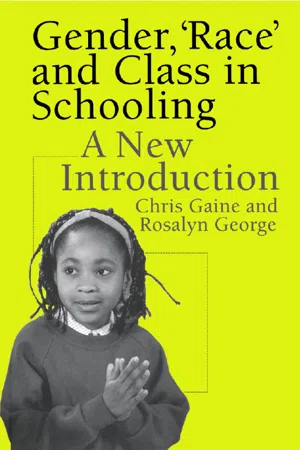
Gender, 'Race' and Class in Schooling
A New Introduction
- 224 pages
- English
- ePUB (mobile friendly)
- Available on iOS & Android
eBook - ePub
Gender, 'Race' and Class in Schooling
A New Introduction
About this book
With education and social inequalities under scrutiny, this timely book provides an up-to-date summary of research into the key issues, as well as practical strategies for educators, including strategies for staff development, working with children and school policy. The facts have changed significantly, and much received wisdom cannot be relied upon: girls' performance is rising faster than boys and surpasses them in almost all respects up to the age of 18; unequal opportunity faced by those of different race is becoming more fractured along class, gender, ethnic and religious lines; class divisions are increased with the reintroduction of selection and has become a matter of concern for government and school policy makers. This title makes good the lack of literature on inequality, and brings teachers, and those training to be teachers, the latest information.
Information
1
Key Ideas and Concepts
In this book we want to explore the current situation in schools with regard to three central inequalities in education: gender, ‘race’ and social class. All three have been high on both teachers’ and politicians’ agendas in the careers of most practising teachers, and all three have been the focus of significant and recent changes.
There has been a long history in the UK of addressing educational inequalities resulting from social class—from the advent of free secondary education for all in 1944, to the intended phasing out of grammar schools beginning in 1965, and to the expansion of free higher education in 1966. All of these have had the explicit aim (among others) of increasing the lower levels of educational participation and success of the children of poorer people and those in unskilled work. By the 1970s some social and political attention was also focused on the educational performance of girls and young women in line with the advent of the Sex Discrimination Act in 1975. ‘Race’ came later than class to national attention and policy, though special measures were introduced via the Local Government Act of 1967 to address what were seen as particular disadvantages of immigrant pupils. It was not really until the late 1970s that the issue was firmly established on the national policy agenda and, since the 1980s, it has had a very high profile.
A good deal has happened in policy terms since 1980, some of it seemingly paradoxical. In the early years of the Thatcher governments, which began in 1979, the movement towards comprehensive secondary education continued. At the same time, the intervention of LEAs in how schools dealt with racial (and to an extent gender) inequality increased, so the early 1980s saw an expansion of explicit and official attempts to tackle inequality. We call this ‘paradoxical’ because in time it became increasingly clear that this was incompatible with important elements of Conservative Party philosophy. There are several strands to this: it is not that in any simplistic way Tories believe in inequality.
As regards class, they believe that people have the right to be unequal. That is to say, differences in ability and effort will naturally lead to differences in education and differences in life, so this kind of inequality is not inherently unjust. With certain exceptions they believe that on the whole there are fair chances for those who want to ‘get on in life’ to do so. As regards ‘race’ they believe that there should not be unjust or unfair barriers to success on the basis of ‘race’. They also believe that the state should interfere as little as possible with individuals’ actions, including discriminatory ones,1 preferring the checks and balances of the market and having a fairly sceptical view of what they would call ‘social engineering’. At the same time, they also believe that there are several things about Britain best left alone—their party title itself signals this, so there is a strong assimilationist current within the party which argues that equal treatment is conditional upon ‘following British ways’. This strand does believe in state intervention (or at least involvement) where particular aspects of British life are involved, such as requiring ‘Christian’ school assemblies. As regards gender, the Conservatives believe in evolutionary rather than revolutionary change. Their strong attachment to tradition and to ‘tried and tested’ aspects of British society means they have some suspicion of a large scale change from women as wives and mothers to women as equal partners in the workforce.
In accordance with these different currents in Conservative thought Margaret Thatcher declared in the early 1980s that ‘the pursuit of equality is dead’. The involvement of LEAs in the pursuit of educational equality was reduced in the late 1980s and 1990s, largely as a result of drastically limiting the LEAs’ spending power beyond what they had to allocate to schools. At the same time, central power was taken over the curriculum as an important definer of how a society sees itself and passes on messages to its next generation. Whatever specific emphasis on equality which there had been in the curriculum was given less prominence. In 1980 most secondary age pupils went to comprehensive schools maintained by LEAs with a notional shared perspective and goal of providing a common (or at least similar) curriculum in broadly similar schools. This has now changed to a situation where schools may reintroduce selection in certain circumstances and where selection is allowed to flourish in a more covert way by parental choice of school. While the relationship is more complex than it would have been two decades ago because of a more fragmented social class structure, this ‘choice’ is nevertheless related to social class (these points are explored in later chapters).
At the same time, and perhaps for different reasons, patterns of inequality have changed. We have already referred to an increasingly fragmented class structure and something similar has happened with regard to ‘race’. In the 1980s there was a broad pattern of relative under-achievement by the children of all post-war migrants. This is no longer true. Some groups continue to be less successful than the majority white population and others have become more successful. The situation here is again more fractured and complex, and much harder to generalize about.
If anything the situation with regard to gender has changed the most. In 1980 (and for much of the time since) all the literature about gender and school performance concentrated on the poorer performance of girls. While there were areas of greater success than boys (particularly in primary school and in language-based subjects) the overall pattern was of lower results as girls got older and a much lower take-up of A-level and higher education places. This is now entirely reversed, so that while both boys’ and girls’ results have steadily improved over the intervening years, girls’ results have done so at a much faster rate. By 1996 they outperformed boys in every subject at both GCSE and Alevel (these general statements are critically analysed in Chapter 6).
Thus the forces and processes generating inequality, and the fine detail of how they operate, may have changed from the past. It is these series of changes which have placed teachers in a new position. There are new sets of practices and official policies within which teachers have to work, and there are new sets of priorities for those seeking to engage critically with the educational world in which they work. Making sense of what has happened, and is happening, is, we believe, critical if all young people are to receive their entitlement. While the Conservative Party is not likely to see political power again until some years into the twenty-first century, their influence on the educational world we now inhabit has been profound. They have changed the landscape in which anyone concerned with educational inequality has to operate.
Our own view is the comparatively modest one that more equality is possible. In particular we believe there are aspects of language (Chapter 3), curriculum (Chapter 4) and pupils’ experience (Chapter 5) which at the ideological and practical level promote inequality. We also believe that in material ways current policies will increase social class differences in education and that these will interact in intricate but reinforcing ways with gender and ‘race’ (Chapter 7). Our main aim for this book, therefore, is to provide an accessible summary of recent history and developments in order to promote an understanding of future trends and possibilities.
Clarifying our Terms
In view of what Ball called the ‘discourse of derision’ to which concern with equality has been subjected in the past two decades, there are certain key terms and ideas which need defining.
The first of these is the most obvious: inequality, which we have begun to discuss already. A distinction that needs to be made is between inequality of access and inequality of outcome. If there are barriers which ought to be irrelevant but which prevent particular children getting into a school or receiving its benefits (barriers such as skin colour, sex or social background) then, on the face of it, this constitutes unequal access. If it can be justified (for there are equally good alternatives: there is different but not unequal provision; and the same desirable goals are attainable by different routes) then there is not necessarily injustice present. The inequality we are concerned with therefore is different and unequal treatment based on irrelevant criteria resulting in injustice. This kind of unequal access can be quite subtle, it is much more than a crude (and usually unlawful) exclusion from an entire school and can operate through the curriculum that is offered, the style of interaction in classrooms and the atmosphere in corridors—all aspects of schooling which will be discussed in the ensuing chapters.
Unequal outcomes, as such, do not necessarily present a problem for educationalists. No group of people learning netball or nuclear physics will become equally proficient in the necessary skills, and no school is likely to produce a group of pupils entirely undifferentiated in their achievements. The unequal outcomes we are concerned about are those resulting from the un-equal access described above.
Equality of opportunity, therefore, means opportunities without unfair barriers or irrelevant criteria getting in the way. It does not mean every pupil’s results will be the same.
Discrimination we shall take to mean more than its literal sense of simply choosing and use it in its usual sense of unjust choosing, that is to say treating people differently on the basis of irrelevant criteria. It is unlawful in Britain in some respects but not others. For instance, it is against the law for schools to set quotas for the number of black (or white) pupils or for them to demand a higher pass mark for girls in entrance exams in order to keep the sex ratio even. It is also unlawful to have measures or procedures which indirectly disadvantage some ethnic groups compared to others or one sex against the other. It is not unlawful to indirectly, covertly or even virtually explicitly advantage one social class compared to another. Legislation was passed in 1996 making most forms of discrimination against disabled people unlawful in employment, but there remain areas of unequal access. Another high profile issue is sexual orientation, where at the moment no general law requires equal treatment and some explicitly prevent it, i.e. recognition of marriage and service in the armed forces. The Race Relations Acts are less draconian than bar-room wisdom usually has it. The first law was introduced in 1965, prohibiting discrimination in restaurants, theatres and cinemas; in 1968, this was widened to key areas of employment and housing, and in rather more general terms to the provision of education and health care.2 The more nebulous provision against ‘promoting racial hatred’ is almost never used, and has no connection with the mythical ‘bans’ on books and words which have been the subject of some media hysteria.
Positive discrimination is one of a group of ideas which are easily misunderstood and perceived negatively. There is not the space here to explore the idea fully, but in relation to pupils in schools it is indicated above where discrimination is against the law, whatever the motive, hence positive discrimination is also against the law. Positive action, however, can be used to ensure irrelevant barriers are not preventing someone or a particular group achieving access. Taking particular steps to undermine the ‘unmacho’ image of learning French, or learning to type, even though the steps require extra staff resources, is positive action and is not unlawful. When viewed in this way it is clear that, in practice, many features of school life involve positive action.
Sex and gender The usual distinction here is that sex encompasses those features which are biologically determined and gender those which are socially determined. Thus the fact that women are on average shorter and lighter than men is mostly due to sex, i.e. it is biologically determined. The fact that in western societies women often wear skirts and men almost never do is entirely social. Even the pattern on the skirt matters, since in the UK it is acceptable for some men to wear skirts if they carry a tartan pattern.
Sexism refers to actions or circumstances where one sex displays prejudiced attitudes, or more especially, actions towards the other. For sexism to have any effect it must operate from a position of power, and, as will be discussed in Chapter 2, in practice the opportunity to act in ways which disadvantage the other sex has historically been more open to males.
‘Race’ This term is always put in quotes in this book because it does not mean what people think it means, but it would require many pages to explain why not (for a slightly fuller discussion see Gaine, 1995). The key point is that what are often thought of as ‘races’— Africans, Europeans, Chinese etc.—are only superficially different from each other. Groups which appear different from others generally have more differences within the group than some of their members do with outsiders. ‘Race’ is a crude and superficial classification which began in the last century, it has no biological significance to scientists today. Perhaps a useful working definition is ‘a group of people who may share some physical characteristic to which social importance is attached’. Thus, the important facet of ‘race’ is not the skin colour, facial features or type of hair people have but the social significance which is placed upon these.
Ethnicity and ethnic group Ethnicity is a far more preferable term because it unambiguously refers to culture. An ethnic group is simply a group which shares certain cultural features such as language, religion, various customs, perhaps food and clothing preferences. It usually depends on a sense of shared peoplehood— that is to say that if a group believe themselves to be an ethnic group based on one or more of the above features then they probably are. Where one draws the line between different ‘ethnic groups’ depends on who is drawing the line and for what purpose. It might make sense sometimes to speak of ‘Asians’ as an ethnic group in Britain, but at others it will be more appropriate to speak of specific sub-divisions.
Racism is, analogously to sexism, the belief that one ‘race’ (in practice often an ethnic group) is superior to others coupled with the power to put this belief into practice. This last point allows for the importance of media control, force of numbers, institutional assumptions and power over employment and housing. Racism in this sense is more than name-calling or simple dislike of another ethnic group.
Left wing has traditionally been associated with the Labour Party a...
Table of contents
- Cover Page
- Title Page
- Copyright Page
- List of Figures and Tables
- Acknowledgments
- 1 Key Ideas and Concepts
- 2 Facts and Representations
- 3 Language
- 4 Curriculum
- 5 The Experience of School
- 6 Achievement
- 7 Policy: Separatism by Default, Design or Exclusion
- Bibliography
Trusted by 375,005 students
Access to over 1.5 million titles for a fair monthly price.
Study more efficiently using our study tools.
Frequently asked questions
Yes, you can cancel anytime from the Subscription tab in your account settings on the Perlego website. Your subscription will stay active until the end of your current billing period. Learn how to cancel your subscription
No, books cannot be downloaded as external files, such as PDFs, for use outside of Perlego. However, you can download books within the Perlego app for offline reading on mobile or tablet. Learn how to download books offline
Perlego offers two plans: Essential and Complete
- Essential is ideal for learners and professionals who enjoy exploring a wide range of subjects. Access the Essential Library with 800,000+ trusted titles and best-sellers across business, personal growth, and the humanities. Includes unlimited reading time and Standard Read Aloud voice.
- Complete: Perfect for advanced learners and researchers needing full, unrestricted access. Unlock 1.5M+ books across hundreds of subjects, including academic and specialized titles. The Complete Plan also includes advanced features like Premium Read Aloud and Research Assistant.
We are an online textbook subscription service, where you can get access to an entire online library for less than the price of a single book per month. With over 1.5 million books across 990+ topics, we’ve got you covered! Learn about our mission
Look out for the read-aloud symbol on your next book to see if you can listen to it. The read-aloud tool reads text aloud for you, highlighting the text as it is being read. You can pause it, speed it up and slow it down. Learn more about Read Aloud
Yes! You can use the Perlego app on both iOS and Android devices to read anytime, anywhere — even offline. Perfect for commutes or when you’re on the go.
Please note we cannot support devices running on iOS 13 and Android 7 or earlier. Learn more about using the app
Please note we cannot support devices running on iOS 13 and Android 7 or earlier. Learn more about using the app
Yes, you can access Gender, 'Race' and Class in Schooling by Chris Gaine,Rosalyn George,Dr Chris Gaine,Ms Rosalyn George in PDF and/or ePUB format, as well as other popular books in Didattica & Didattica generale. We have over 1.5 million books available in our catalogue for you to explore.