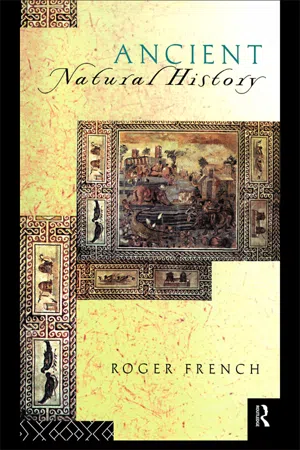
Ancient Natural History surveys the ways in which people in the ancient world thought about nature. The writings of Aristotle, Theophrastus, Strabo, Pliny are examined, as well as the popular beliefs of their contemporaries. Roger French finds that the same natural-historical material was used to serve the purposes of both the Greek philosopher and the Christian allegorist, or of a taxonomist like Theophrastus and a collector of curiosa like Pliny. He argues convincingly that the motives of ancient writers on nature were rarely `scientific' and, indeed, that there was not really any science at all in the ancient world.
This book will make fascinating reading for students, academics and anyone who is interested in the history of science, or in the ancient history of ideas.
- 384 pages
- English
- ePUB (mobile friendly)
- Available on iOS & Android
eBook - ePub
About this book
1
ARISTOTLE AND THE NATURES OF THINGS
THE GREEKS AND ANIMALS
Histories of science customarily begin with Greek philosophy, and Greek philosophy conventionally starts with Thales of Miletus. The Greeks themselves counted Thales as among the seven sages at the foundation of their culture, and among the philosophers of ancient Greece there were those who deliberately tried to explain how natural events occurred: they looked at nature, physis, and gave natural, physical explanations. A physikos was a recognised kind of person in ancient Greece.1
In offering such explanations these physical philosophers of the period before Socrates are generally credited with doing away with explanations based on the actions of the gods. This has been seen as a good thing, sometimes as the origin of science itself, sometimes as the triumph of rationality over superstition and myth, and often as part of the intellectual ferment of the ‘Greek miracle’ of the sixth century.
To a certain extent these historical views are based on the Greeks’ own traditional view of their past. It was, naturally, a very special past for them, because it was Greek. It was also naturally an intellectual past because when the Greeks began to talk about their philosophy, uppermost in their minds was the superiority of thinking over action. It was also useful for the philosophers to have a history of their subject, not only to give it the dignity of age, reaching back to the roots of Greek society, but to show how the particular form of it practised by particular philosophers was an improvement of what had gone before. We shall see later in this chapter how Aristotle profited on both counts.
But when we look closer at how the Greeks wrote about the productions of nature—the subject matter of natural history—we see a little how the conventional history of Greek philosophy was constructed for their own purposes by the Greeks themselves. Let us begin our closer—and alternative— look with a slave, Aesop. He had a fund of entertaining and instructive stories, about animals, which are still common currency. We all know about the fox who, failing to secure a bunch of grapes from the vine, tried to convince himself that they were anyway sour. The dog in the manger who kept out the cattle when he could not eat their food himself is equally familiar. Aesop’s fables became well known and he was freed by his master. He even gave political advice to the Athenians, who were contriving to rid themselves of Peisistratus in exchange for another ruler, with a fable perhaps less well known: the frogs wanted a leader and called upon Zeus to send them one. Zeus sent a block of wood. The frogs were pleased; but in due course became dissatisfied and asked for another. Zeus sent a water snake. The moral of the parable is clear: do not change what you have, for fear of something worse. Generally the moral hangs on the nature of the animal, for foxes are sly to the point of deceiving themselves, dogs can be aggressive without deriving benefit, frogs are unwise. Such a view of animals remained part of Greek culture as much as that of other nations and races. It is present in Aristotle perhaps less than any other author we shall look at, but it nevertheless remained a common attitude. We shall see that right at the end of our period it returned strongly, in a new form.
Aesop, who died in about 560 BC, was a contemporary of Thales. As a slave he was naturally not included by the Greeks among the founders of their philosophy. But his fables became part of Greek literature and in later biographies he is given the dignity of dining with the seven wise men—another example of how history is constructed for later purposes. While the natural philosophers, the people whom Aristotle called his predecessors, were marking themselves off from others as men who were seeking to find godless explanations of natural things, other Greeks pursued a philosophyless kind of wisdom, of which the wisdom of Aesop’s fables is an example.2 Aristotle’s predecessors were the men we call the pre-Socratics because in our history of Greek philosophy a great turning point came when the young Socrates turned away from the study of nature and towards that of man and his life. The work of the pre-Socratics has survived only in fragments and we cannot really identify the kind of enterprise they were engaged in. Aristotle pictures them as (in removing the gods) being entirely materialist; but that is because he is trying to put some non-material causality into natural change. Later historians have seen the fragments as seminal, providing insights into what Greek philosophy was thought to be when it was apparently at the beginnings of Western culture.
But contemporary Greeks did not always see the natural philosophers as cultural heroes. A refreshing view of them from the nonphilosophy side of Greek life is that of Aristophanes. He seized the essential Aesopian message that the behaviour of animals can carry a moral for man, and that conversely men can behave like animals. The Wasps parodies the stinging litigiousness of the Athenians. The birds in the comedy of that name construct a city in the sky which acts as a barrier between the gods and men. The men who persuade them to do so first flatter the birds by reminding them that according to Aesop the lark was born before other creatures, indeed, even before the earth itself. (When its father died, the lark therefore had nowhere to bury him and had to entomb him in his own head.) The birds hesitate over collaboration, bearing in mind Aesop’s fable of the fox and the eagle; but finally convinced, the foundations of the city are laid by thirty thousand cranes flying from Libya with stones. The birds and the frogs form the chorus respectively here and in The Frogs. But it is in The Clouds that we see the non-philosophical wisdom of the Greeks looking sideways at the natural philosophers. The object of ridicule is Socrates. It is the young Socrates, still deep into a study of nature and representing natural philosophers as a kind. He also teaches rhetoric, and it is for his reputation of being able to prove that the false is true that he is sought out by a father troubled by debt on account of his son’s extravagance. The father wishes to be able to prove that he has in fact made no pledges nor borrowed any money.
He accordingly goes to see Socrates. He is reproved by the servant for making so much noise beating on Socrates’ door lest he cause a miscarriage in the birth of an idea. It sometimes happens, said the servant; an idea successfully born was the realisation that gnats buzz not through their proboscises but through their trumpet-shaped backsides. But a sublime idea was lost when a lizard in the roof defecated on Socrates as he gazed open-mouthed at the revolutions of the moon. Passing animals whose lowered heads were studying what went on below ground and whose elevated rumps were studying astronomy, the father finds Socrates suspended from the roof in a basket the better to mingle with the rarefied air and learn about the heavens. He is, Aristophanes makes plain, a vulgar little fellow, not too careful about his personal hygiene, and making a great show of his atheism and natural reasons. In place of Zeus are the clouds of the title: they are the Chorus, and the source of all naturalphilosophical ideas. They personally produce all the meteorological events that were to be of enduring interest in the ‘natural-history’ part of natural philosophy throughout the ancient period: lightning, thunder, rain, the rising of the Nile, snow and frost (the clouds also supply Socrates with his easy and false arguments and they support all idle poets who mention clouds). Socrates’ physikos allows no other divine being except the clouds and has a natural explanation for the meteorological events that frightened people who throught they were the vengeance of the gods.
Strepsiades (the father): But by the Earth! is our Father, Zeus, the Olympian, not a god?
Socrates: Zeus! What Zeus? Are you mad? There is no Zeus.
Strepsiades: What are you saying now? Who causes the rain to fall? Answer me that!
Socrates: Why, ’tis these and I will prove it. Have you ever seen it raining without clouds? Let Zeus cause rain with a clear sky and without their presence!
Strepsiades: By Apollo, that is powerfully argued! For my own part I always thought it was Zeus pissing into a sieve. But tell me, who is it makes the thunder, which I so much dread?
Socrates explains that it is not Zeus but the Celestial Whirlwind that makes the clouds bump into each other, making thunder; and that it is not Zeus who hurls lightning at perjurers (for it often strikes oak trees—unlikely perjurers—and temples dedicated to Zeus himself) but a dry wind that had accumulated in the clouds and which emerges explosively.
For Aristophanes these natural explanations were simply inadequate and shallow accounts of great mysteries, as he indicates in the play by having Strepsiades likening the thunder to his own rumbling indigestion after eating too much stew at the Panathenaea, and lightning to the explosion of a sow’s belly he was cooking and had forgotten to prick.3 Strepsiades, too old to learn from the brash young Socrates, sends his son instead. He proves an apt pupil and returns to thrash his father for a wholly rational and natural reason. Strepsiades ends the play by destroying Socrates’ house with an axe and fire (‘What am I up to? Why, I am entering upon a subtle argument with the beams of the house.’). Of course, in getting the most from his parody Aristophanes is hardly giving us a historical narrative, but for a satire to be effective there must be enough truth for the audience to recognise the people and their actions that are being satirised. No restraint was made from the outside on the Old Comedy, and Aristophanes could be as direct and as savage as he wished to the fashions of intellectualism, naturalism and atheism.4 The play was performed in 423 BC, nearly a quarter of a century before the death of Socrates, and perhaps indeed he was better known at the time as a natural philosopher. The direction of Aristophanes’ satire seems to be well aimed given that the charges on which Socrates was tried, abandonment of the gods and the corruption of youth, were the themes of The Clouds.5
ARISTOTLE AS NATURAL HISTORIAN
The natural philosophers in turn distanced themselves from the poets and tellers of fables. Aristotle, for example, trying to reach a physical explanation of the saltiness of the sea, dismisses the claim of his predecessor, Empedocles, that the seas were the sweat of the earth. Such might be satisfactory for a poet, says Aristotle, but it is not our method.6 In a similar way he dismissed the argument of Democritus, who thought that the seas were diminishing, being sucked down by the whirlpool Charybdis. As an explanation Aristotle thought that this was no better than the fables of Aesop,7 whom he clearly saw as belonging to another department of Greek life.
For later ages, Aristotle was far and away the greatest philosopher of antiquity as far as the natural world was concerned. Indeed, it was he who turned philosophical attention back to the natural world after Socrates had despaired of finding physical truth. For a long period he was a pupil of Plato in the Academy and for another long period he taught in his own school in Athens, the Lyceum. He was, then, wholly immersed in the business of philosophy. But it was not philosophy in our sense, which is much more limited in its subject area than that of Aristotle. For philosophising Greeks philosophy was ‘love of knowledge’, whether ethical, natural or any other kind. To love knowledge included ways of finding it, as well as having the knowledge itself, and Aristotle gave a lot of attention to this.
But to understand what kind of knowledge it was and how Aristotle set about finding it, we should know a little of his purposes and circumstances. He was a teacher. He taught the sons of Athenians who had a degree of wealth and a political share in the polis. Among the subjects he taught were ethics and rhetoric, which we might suppose to have been useful to those who were to argue about the best way of running the city. But it was quite typical of his teaching that he taught nothing that was directly useful, like a trade or a craft. Such things were done and taught by people who were obliged to do so for a living and did not therefore have the leisure to embrace all knowledge, the range of philosophy. Aristotle was providing, then, what we would call a liberal education. What came to be known in the later West as the seven liberal arts had indeed its origin in the Greek world,8 but this was not what Aristotle was teaching. Three of the liberal arts were concerned with language and argument, and four of them with quantity, being aspects of mathematics; Aristotle did not think that mathematics described the realities of things.
But although Aristotle did not teach the liberal arts, there is a similarity between these and what Aristotle did teach. Language and argument, like Aristotle’s dialectic and rhetoric, were useful to the free man (for whom the ‘liberal ‘arts were appropriate) and were almost the trade or craft knowledge of the class of citizens who helped to run the state. For the rest, it was politically important that this class of citizens should not be seen to be tied down to the technical knowledge of other classes of society: theirs had to be the broadest of concerns, and part of their status must have been derived from the nature of their education and knowledge. Plato taught moral philosophy and thought that the leaders of the state should be philosophers. In other words what Aristotle taught was determined not solely by its intrinsic interest to the enquiring mind, nor only by Aristotle’s philosophical acumen, but by the nature of the city-state. Education was important for the state not only for the information it provided but for the social cohesion it imparted. Greek education was learning how to be Greek. Its first concern was with the language and it was based on Homer, the national poet. Greeks were Greeks not only by language, but by their political institutions, and Greeks were taught too about these. Historians of philosophy have commonly given most of their attention to the intellectual component of Greek philosophy and have produced as a result internal accounts of pure enquiry. But we shall find in this book that philosophy was a very practical business. Many people practised it to avoid fear and to bring order to life, both their own and other people’s. Often this needed access to political power, and philosophers were rarely shy both of teaching about how society should be run and of taking part in running it. The Academy took an active interest in politics,9 teaching legislators and politicians, and in 367, the year in which Aristotle arrived in Athens, Plato went to Syracuse to advise Dionysius II, its ruler. He was there again six years later; and when he died in 347 Aristotle went with Xenocrates to Assos, across the Aegean, to join other Platonists who had attracted the attention of Hermias, its ruler. They advised him to rule with less ...
Table of contents
- COVER PAGE
- TITLE PAGE
- COPYRIGHT PAGE
- SCIENCES OF ANTIQUITY
- PLATES
- GENERAL SERIES INTRODUCTION
- INTRODUCTION
- 1: ARISTOTLE AND THE NATURES OF THINGS
- 2: THEOPHRASTUS, PLANTS AND ELEPHANTS
- 3: GEOGRAPHY AND NATURAL HISTORY
- 4: GREECE AND ROME
- 5: THE NATURAL HISTORY OF PLINY
- 6: ANIMALS AND PARABLES
- NOTES
Trusted by 375,005 students
Access to over 1.5 million titles for a fair monthly price.
Study more efficiently using our study tools.
Frequently asked questions
Yes, you can cancel anytime from the Subscription tab in your account settings on the Perlego website. Your subscription will stay active until the end of your current billing period. Learn how to cancel your subscription
No, books cannot be downloaded as external files, such as PDFs, for use outside of Perlego. However, you can download books within the Perlego app for offline reading on mobile or tablet. Learn how to download books offline
Perlego offers two plans: Essential and Complete
- Essential is ideal for learners and professionals who enjoy exploring a wide range of subjects. Access the Essential Library with 800,000+ trusted titles and best-sellers across business, personal growth, and the humanities. Includes unlimited reading time and Standard Read Aloud voice.
- Complete: Perfect for advanced learners and researchers needing full, unrestricted access. Unlock 1.5M+ books across hundreds of subjects, including academic and specialized titles. The Complete Plan also includes advanced features like Premium Read Aloud and Research Assistant.
We are an online textbook subscription service, where you can get access to an entire online library for less than the price of a single book per month. With over 1.5 million books across 990+ topics, we’ve got you covered! Learn about our mission
Look out for the read-aloud symbol on your next book to see if you can listen to it. The read-aloud tool reads text aloud for you, highlighting the text as it is being read. You can pause it, speed it up and slow it down. Learn more about Read Aloud
Yes! You can use the Perlego app on both iOS and Android devices to read anytime, anywhere — even offline. Perfect for commutes or when you’re on the go.
Please note we cannot support devices running on iOS 13 and Android 7 or earlier. Learn more about using the app
Please note we cannot support devices running on iOS 13 and Android 7 or earlier. Learn more about using the app
Yes, you can access Ancient Natural History by Roger French in PDF and/or ePUB format, as well as other popular books in History & Ancient History. We have over 1.5 million books available in our catalogue for you to explore.