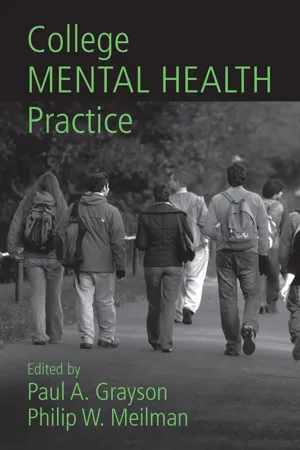
Paul Grayson, a co-editor of the successful 1989 book College Psychotherapy, has teamed up with Phil Meilman, a seasoned veteran of college counseling and psychological services, to compile this needed comprehensive up-to-date treatment guide. After an opening discussion of the campus environment and student mentality, the book provides an overview of the state of college mental health at the start of the 21st century, touching on the issues faced by students of every generation, as well as those concerns unique to this day and age. With an emphasis on practice, and not theory, this easily referenced treatment guide will be of use to anyone working in the mental health fields in and around a college environment.
eBook - ePub
College Mental Health Practice
- 356 pages
- English
- ePUB (mobile friendly)
- Available on iOS & Android
eBook - ePub
College Mental Health Practice
About this book
Information
1
Overview
PAUL A. GRAYSON
Any clinician who comes to work at a college clinic soon discovers that college mental health is a world unto itself. To understand students, you need to become acquainted with the developmental issues of their stage of life, and also the quite specific stresses of living and studying at college. You have to understand indi- viduals who are remarkably diverse, and not only in culture, race, sexual ori- entation, and age, but also in their presenting concerns, psychological health, psychological mindedness, and readiness for treatment. Outsiders sometimes wonder if it gets repetitive listening to the same old student complaints all day long. The truth is, you never quite know what to expect when a new college patient enters the office.
Clinicians new to college services must also learn to practice in fresh and flexible ways. “Therapist” feels too narrow and pure to capture the scope of the work. In addition to their more conventional role as counselors or psychother- apists, college clinicians are variously called on to do triage; manage referrals; provide reassurance, feedback, and information; serve as long-term supports and patient advocates; conduct consultations; and handle crises. “Sometimes,” one clinician wearily remarked after seeing a string of high-maintenance cases, “this feels more like case management than therapy.”
As if all this weren’t enough to absorb, would-be college clinicians also have to adjust to a very particular clinical setting. Treating a college student on campus is quite different from seeing the same student in a private practice or community clinic. College clinicians must handle tricky phone calls from parents and deans, balance patients’ needs against the community welfare, and judge when to make exceptions to therapeutic neutrality and confidenti- ality. Political acumen is an asset when one works on campus. Clinicians must ally themselves with various constituencies who don’t always understand their methods or share their goals.
This chapter takes a bird’s-eye view of college students, aspects of treat- ment, and the college context. Here, in brief, are distinguishing themes of our ever more complicated clinical specialty.
Students
Development
The traditional starting point for understanding students is their stage of life. College students are at a pivotal transitional point, leaving behind adolescence (and childhood) on the tortuous road to adulthood. Their in-between status makes confusion and missteps inevitable. Each student must find his or her way based on the contradictory guidance of parental role models, peer influ- ences, media messages, school teachings, online sources, inner promptings, and trial and error. Seen from this perspective, students’ upsets are, in part, normal growing pains. Adjustment problems are what you get during times of rapid developmental change (Grayson & Cauley, 1989).
Although academic psychologists have churned out elaborate lists of specific developmental challenges for college students, three overlapping tasks have traditionally stood out in importance. The first is separating from family (Blos, 1979), the final stage of the separation-individuation struggles that originate in toddlerhood. Now in college, students must further pull away from parents to be autonomous and engage in campus life. When they’re not ready to let go, or parents won’t let them, the unhappy result is dependency, detachment from college, and a general posture of helplessness.
Does the traditional separation narrative still apply today? Certainly, many students still struggle to break away from parents and stand on their own two feet. But many others aren’t struggling at all these days, proudly calling their parents “my best friends” and keeping in constant cell phone contact. Some observers worry that such close ties are creating an entitled, pampered “nation of wimps” (Marano, 2004). Yet it is also arguable that ongoing closeness with parents is for some students a benign developmental variant; indeed, in some cultures it is normative. At any rate, not everyone is so lucky or unlucky as to be tied to so-called helicopter parents. Many undergraduates have been raised by emotionally distant, narcissistic, abusive, or erratic caretakers, or handed off from one parent figure to another. For these damaged souls, the task of separating from parents is complicated because they’ve never been healthily attached. Some of these students are all too practiced at pushing others away. Others do reach out, but in a clinging or clumsy fashion, or perhaps by stag- ing suicide attempts or starving themselves, forcing their oblivious parents to take notice at last.
The second traditional developmental challenge for both adolescents (Erikson, 1968) and college students (Arnstein, 1984) is identity formation. Forming an identity is an enormous and rather nebulous project, partly a matter of forging a confident, accepting, inclusive, cohesive, resilient, and accurate idea of self, and partly making choices and commitments in regard to academics, career, socializing, sex, political and religious values, and cultural affiliations. Plainly, all this is a tall order, today more so than ever. The difficulty of forming a coherent and confident sense of self seems magnified when society itself seems so unsta- ble and unsure, fragmented by a bewilderment of lifestyle and value choices. Identity problems are easy to spot with students who are markedly indecisive or rigid, self-critical or self-aggrandizing, self-involved or self-effacing. To some extent, however, no undergraduate is immune. Scratch the surface of a bulimic or binge drinker or suicidal student—or any student—and the same gnawing insecurities tend to appear: “Am I good enough?” “Am I lovable?” “Am I normal?” “Where do I belong?”
The third traditional developmental task is intimacy—achieving mature and satisfying intimate relationships (Group for the Advancement of Psychia- try, 1990). As with separation and identity, these days there seems to be less agreement on what the goal is. Plenty of students still pair off romantically and sexually, and plenty more wish they could. Yet many others seem fine without a steady boyfriend or girlfriend, preferring group socializing and “hooking up” to the old mating rituals of dating and relationships, or simply putting love and sex on hold while they tend to their educations. It’s hazard- ous to speculate about which path is healthiest without knowing the indi- vidual student’s motives and experiences. Intimacy problems come in many forms: shyness and loneliness, inability to commit, sexual concerns, couples’ problems, romantic breakups, stalking, obsessive relationships, and abusive relationships. Indeed, if we count friendships as well as love relationships, intimacy issues are implicated in most students’ treatments, whether or not they’re a presenting problem.
Developmental issues underlie students’ adjustment problems and inform our understanding of them. When we listen to students’ accounts, it helps to remember that so much in their thinking is still new and tentative, and their relationships with parents and peers and their sense of themselves are still in flux. Developmental issues also inevitably affect students’ reactions within the therapeutic relationship. Some college students are wary of starting treatment because it threatens their fledgling autonomy. Others are afraid to terminate, feeling emotionally unequipped to go it alone. Some dependently lean on ther- apists for all the answers, while others counterdependently reject everything they hear, as if the slightest agreement would compromise their autonomy. Students also may use sessions for identity building and relationship-testing purposes—trying out new ideas for size, showing off their vocabularies, ask- ing for reassurance and feedback, or experimenting with assertive or angry or flirtatious or trusting manners of relating.
As for therapists’ best response in light of students’ developmental needs, there’s no foolproof way to react to persons who are partly still adolescents, partly young adults. When possible it’s therapeutic to treat them like adults, and so reinforce their autonomy. But not every student is developmentally ready (or culturally appropriate) for such treatment. Sometimes one has to be a guidance-giving, nurturing, limit-setting parent. One sign of progress is when a patient who formerly was pulled by parental responses begins inviting a more egalitarian therapy relationship.
The College Experience
In addition to the challenges their stage of life poses, students are also exposed to immediate stressors from the college experience. In certain respects under- graduate conditions may foster psychological development, in others they may postpone adult responsibilities, but either way the daily hassles of being a student are another source of our patients’ distress.
Academics When students perform badly in their studies, family conflicts and psychological insecurities are often to blame. Thus, poor grades may be a mute protest against intrusive parents’ interference, an academic collapse during senior year may stem from anxiety about graduating, and procrastina- tion may be linked to perfectionism or low self-esteem.
But not all academic problems are psychological conflicts in disguise (Grayson & Cauley, 1989). The volume of work and level of competition at a given college may simply be too much for some students to handle. And just as emotional problems can sabotage studies, study problems can roil the emo- tions. Resolving a student’s emotional crisis sometimes calls for an academic intervention—reducing the course load, getting an extension, or transferring to a less competitive institution where it’s possible to be a “big fish in a little pond” (Marsh & Hau, 2003).
Social Life With the possible exception of themselves, no subject fascinates students more than other students. From a developmental and educational standpoint, this is as it should be. Students arguably learn more about them- selves and the world from peer interactions than from all their courses.
But campus social conditions are not always benign. For residential stu- dents, it can be torture to share a cell-like dormitory room with a noisy, bul- lying, or drug-taking roommate, and even good roommate relationships can feel suffocating. The situation is especially oppressive for those who don’t fit in socially or who feel economically or culturally out of place, the surround- ing laughter and activity constantly reminding them of their outsider status. Commuting students, too, often feel excluded, shortchanged on the full col- lege experience. Students who study abroad face not only the usual under- graduate pressures but also the challenge of coping with a foreign culture and perhaps foreign language.
Campus society also heightens pressures to conform. Young people are natu- rally susceptible to peer influence anyway, but insular “youth ghettos” (Pavela, 2003)—dormitories, Greek houses, student apartments—aggravate the con- tagiousness. Not that peer influence is necessarily bad. On the contrary, peer influence can help students separate from families and pave the way to take their place in adult society. But peer pressures do push vulnerable stu- dents in dangerous directions—drinking games, pill popping, unwanted sex, restricted eating, purging, self-cutting, and suicidal attempts. More insidiously, competition with peers can reinforce vulnerable students’ tendencies toward perfectionism and self-dissatisfaction. Sometimes the treatment of choice for self-destructive or perfectionist students is to separate them from their equally self-destructive or perfectionist friends.
A new, far-reaching influence on campus is the explosion of cell phones and text messages, e-mail and instant messaging, web logs (“blogs”), virtual com- munities, multiplayer computer games, and the like. On the plus side, these developments do helpfully bring together unacquainted students and keep physically separated friends and relatives connected, and for isolated students chat rooms provide at least an attenuated form of socializing. But electronic tools can reinforce social avoidance. Obsessed with computer games, virtual communities, or, most ominously, online pornography, some students hole up in their rooms at the expense of face-to-face socializing or real accomplishment. Also, students often relate on the Internet through aliases or false identities. While trying out different personas may be freeing and identity building, such posing is, again, no substitute for genuine relating and makes it easy for indi- viduals to misrepresent themselves and deceive others. In addition, solitude and reflection are compromised with cell phones incessantly ringing (even in therapy sessions!), privacy is often violated by tell-all web logs, and dam- aging messages—hate mail, slander, threats of suicide or violence, electronic stalking—are as easy as clicking on a keyboard.
All in all, the contemporary revolution in communications, like the advent of television a half century earlier, would seem to be a mixed blessing for stu- dents’ relationships and emotional development.
Self-Care Many students trip up in their courses because there are no par- ents on the scene to monitor and nag. Now it’s up to them to turn off the TV or video game and get to work. Likewise, it’s the student’s job to plan meals, manage finances, clean the bathroom, make the bed, do laundry, get exercise, take showers, arrange transportation, and get a good night’s sleep. For young scholars used to being told what to do, self-care may be more demanding than taking French or calculus.
Unfortunately, the college environment isn’t conducive to acquiring self- care skills. Regular sleep habits are hard to establish with slamming doors, late-night parties, and midterm exams. Healthy eating is complicated thanks to all-you-can-eat cafeterias and crazy-quilt class schedules, and financial budgets can fall prey to credit card temptations and cell phone excesses. Loss of control in any of these areas—academics, sleep, eating, finances, exercise, cleanliness—can be the first domino toppling other areas of functioning.
Self-care may also fall apart because of stress. Many students today juggle full-time jobs and full-time course schedules, or pile on course credits, cam- pus activities, and internships. Their overloaded schedules are often neces- sary; perhaps they can’t afford college without working 40 hours per week. Sometimes, however, stressed-out students do it to themselves. These are the undergraduates who can’t, or won’t, let themselves rest, whose sense of self depends on relentless self-driving. No wonder they can’t sleep or eat well or that at some point they stop in their tracks like an exhausted marathoner.
Change One of the most striking features of college students’ lives is that nothing stands still for long. Every year brings new roommates and rooms, classes and teachers, friends and lovers. The span of a single semester ushers in a transition to school and a transition out of school, with academic peaks and valleys in between. So, if students are emotionally labile and impulsive, perhaps partly it’s due to their fluid circumstances.
Students’ lives change, but are the changes orderly? Past writings by vari- ous observers, including this one (Grayson, 1989), tied developmental chal- lenges to certain pressure points over the 4-year college life cycle. Freshman year was said to feature separation struggles; sophomore year emphasized the identity concerns of self-examination and choice; junior year stressed differ- ent identity concerns—achievements and disappointments; and senior year again roused separation anxieties because of graduation. Aside from being tidy, this stage theory was appealing due to its explanatory power. Class year provided a key to students’ underlying difficulties.
The trouble with this neat schema is that today’s students no longer spend four straight years at a single institution. Instead, they often transfer colleges or even “swirl” among several different schools (Bailey, 2003), study abroad, drop down to part-time status, and take time off to move back home before return- ing to college later. Starting and ending college are still reliable milestones, but in the intervening college years we can no longer be quite so precise about when developmental struggles unfold.
Diversities Along with their developmental status as late adolescents/young adults and the college pressures they face, a third defining feature of students is their heterogeneity. Many students are, in one way or another, members of a minority.
Recent years have seen dramatic increases in diversity on campus in terms of race, ethnicity, and country of origin, inclu...
Table of contents
- Front Cover
- Title
- Copyright
- Contents
- Introduction
- 1 Overview
- 2 Developmental Considerations
- 3 Legal and Ethical Issues
- 4 Medications
- 5 Family Problems
- 6 Relationships
- 7 Depression and Anxiety
- 8 Stress
- 9 Diversity Issues
- 10 Academic Difficulties
- 11 Alcohol, Drugs, and Other Addictions
- 12 Sexual Concerns
- 13 Sexual Victimization
- 14 Eating Disorders
- 15 Personality Disorders
- 16 Suicide and Suicidal Behaviors
- Contributors
- Index
Trusted by 375,005 students
Access to over 1.5 million titles for a fair monthly price.
Study more efficiently using our study tools.
Frequently asked questions
Yes, you can cancel anytime from the Subscription tab in your account settings on the Perlego website. Your subscription will stay active until the end of your current billing period. Learn how to cancel your subscription
No, books cannot be downloaded as external files, such as PDFs, for use outside of Perlego. However, you can download books within the Perlego app for offline reading on mobile or tablet. Learn how to download books offline
Perlego offers two plans: Essential and Complete
- Essential is ideal for learners and professionals who enjoy exploring a wide range of subjects. Access the Essential Library with 800,000+ trusted titles and best-sellers across business, personal growth, and the humanities. Includes unlimited reading time and Standard Read Aloud voice.
- Complete: Perfect for advanced learners and researchers needing full, unrestricted access. Unlock 1.5M+ books across hundreds of subjects, including academic and specialized titles. The Complete Plan also includes advanced features like Premium Read Aloud and Research Assistant.
We are an online textbook subscription service, where you can get access to an entire online library for less than the price of a single book per month. With over 1.5 million books across 990+ topics, we’ve got you covered! Learn about our mission
Look out for the read-aloud symbol on your next book to see if you can listen to it. The read-aloud tool reads text aloud for you, highlighting the text as it is being read. You can pause it, speed it up and slow it down. Learn more about Read Aloud
Yes! You can use the Perlego app on both iOS and Android devices to read anytime, anywhere — even offline. Perfect for commutes or when you’re on the go.
Please note we cannot support devices running on iOS 13 and Android 7 or earlier. Learn more about using the app
Please note we cannot support devices running on iOS 13 and Android 7 or earlier. Learn more about using the app
Yes, you can access College Mental Health Practice by Paul A. Grayson, Philip W. Meilman, Paul A. Grayson,Philip W. Meilman in PDF and/or ePUB format, as well as other popular books in Psychology & Education Counseling. We have over 1.5 million books available in our catalogue for you to explore.