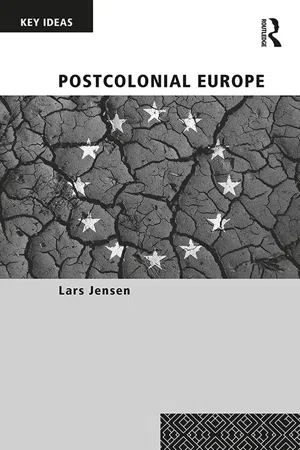
This book presents an overview of the direct and indirect ways in which Europe continues to be influenced by its entrenched postcolonial condition. Exploring the notion of postcolonial Europe as it characterises a Europe caught at a number of crossroads, it considers the distinctly European features of a range of global crises by which Europe is beset, relating to migration, nationalism, internationalism, climate change and inequality. Linking these to the legacy of European hegemony during the era of high imperialism and the inability to come to terms with the region's increasingly provincialised status, the reversal of migrant flows following the implosion of European empires, and the dismantling of welfare societies initially made possible by the accumulation of wealth during colonialism, the author examines the gradual disintegration of the idea of the European collectivity and the erosion of the idea that Europe is a dispenser of privileged status. A wide-ranging study of Europe's crisis in its postcolonial era, this volume will appeal to scholars of critical sociology, political geography, cultural studies, anthropology, political science and history with interests in colonialism and postcolonialism.
- 176 pages
- English
- ePUB (mobile friendly)
- Available on iOS & Android
eBook - ePub
Postcolonial Europe
About this book
Information
1
HISTORICISING POSTCOLONIAL EUROPE
This chapter is dedicated to the role history plays in conceptualising postcolonial Europe. There have been few attempts to write nation-empire histories into a broader European imperial history. In fact there are few nation-empire histories, as the colonial histories of various European nation-empires have been regarded as a separate terrain with only sporadic links to national historiography (Raben 2013). At a broader continental level there are comprehensible reasons for the absence of nation-empire historiography. The difficulty in writing continental nation-empire history should not be underestimated given the enormity of the task in acquiring sufficient knowledge about the various empires. A task further challenged by the fact national(-imperial/-colonial) archives contain documents written in a number of different languages that probably no single scholar masters (see Buettner 2016 whose inclusion of France, Britain, Belgium, Portugal and the Netherlands makes it the most comprehensive endeavour). The lack of national nation-empire historiographies is less easily explained. Why would national historical scholarship not seek to make sense of the specific nation-empires as part of the respective national historiography? After all, the nation-imperial phase provided those countries with a global influence unmatched in each of the nations since the demise of their colonial rule. Yet European national historiographies have consistently downplayed, when not outright ignored, the role of empire in the nation’s history.
Colonial historiography
Colonial historians might object to the observation on nation-imperial-colonial neglect arguing they have or are already undertaking this work. However, imperial-colonial history is not placed under national historiography, which continues to ignore the work of colonial historians, at least as far as their work having any wider implications on the formation and development of national identity is concerned. Colonial historians may also have remained complacent to see their work as either an addendum or at best partially related to national historiography (see Buettner 2016: 7, 13), partly because of the extremely contentious terrain critiques of nationhood open up. If this suggests a critical colonial historiography holding back, it is important to note that although critical colonial historiographical work has emerged in former European nation-empires, it coexists uneasily with a long established colonial historiographical tradition of understanding European colonial rule as intrinsically benevolent. This tradition may have come under fire, but the criticism has not stemmed the flow of nostalgia-driven accounts permeated by a sense of loss of historical privilege and status, and belonging. Thus the emergence of critical colonial historiography does not represent a moment of broadly accepted critique of colonial rule, and the national culture that enabled this, or a contemporary moment of reckoning with the misconceptions driving long held views of colonialism by the former nation-empire. For such a moment to arrive a great deal of work would need to be done by historians to emancipate colonial history from its compartmentalisation and still prevalently nostalgia-infused narratives. The process would include a long overdue, far more developed articulation of the correlation between colonial and national historiography. To produce a postcolonial historiography nationally or continentally could begin with the recognition of the significance and consequences of blocking out the imperial-colonial past.
This chapter, however, is not about correcting historical records or debating historiographical accountability. The point of historicising postcolonial Europe here is to draw attention to how history is produced and used, not to stake claims on how it was. In this broader perusal of how history is produced and used, the domain of conventional historical research is abandoned in favour of far broader primarily non-academic manifestations in the public domain that can be loosely referred to as politics of memory (Maurantonio 2014). Politics of memory in the context of colonialism may involve representations of colonial life in the archives, and more broadly in historiography, but can also simply reflect the multiple ways in which a national culture makes sense of its colonial past. When memory politics is coupled with postcolonial Europe, however, the colonial past ceases to be the primary object of historical enquiry and instead becomes a reflection of contemporary society’s concerns with the present. Asking many Danes how poor social conditions in parts of Greenlandic society might be ameliorated or how to make “integration” work better for “non-European migrants” in Denmark is likely to elicit answers based on a largely instinctual answer to an enormous complexity. Yet, “instinctual” does not mean a full range of answers spanning from “it is all ‘their’ fault” to “it is all ‘our’ fault”. Thus it is unlikely to find many Danes coupling Greenland’s social problems to Danish colonial rule in Greenland or answers coupling the presence of Global South migrants in Denmark to the country’s historical and contemporary role in contributing to the crises producing flows of refugees and migrants from the Global South. Yet, the historical roots of the social problems in Greenland do go back to the time of Danish colonial rule, including the now widely discredited “modernisation plan”, ironically implemented when Greenland’s status was changed from colony to an annexed part of Denmark. And the crises in the Global South leading to migration have in recent decades emerged as a consequence of a neoliberal global (and when required, military) governmentality that Denmark has participated in actively promoting and economically benefitting from (Jensen 2018), such as the American-led invasion of Iraq that in turn sowed the seeds of the civil war in Syria and resulted in the exodus of refugees. Thus one dimension of “instinctual” refers to the processes of governmentality in colonial and neoliberal times illustrating the connections between intuition and internalisation of normative discourses.
The key between intuition and discourse stems from the cultural domain. The simplistic answer given by an average Dane to the above mentioned complex issues may be seen to merely reflect a lack of Danish knowledge about Greenland (Andersen 2016), and a parallel lack of Danish knowledge about Global Southerners living in Denmark (Anker et al. 2011). After all, resident Danes living in Greenland and Danes in Denmark typically live segregated from Greenlanders and Global Southerners. The facts underpinning the Danish ignorance on both fronts are thus easily established, but do not explain the readiness to provide answers to something one does not have an informed opinion about let alone feel a need to find out about. Something else thus informs the instinctual answer, namely the idea that you should know the other, or it betrays an embarrassing ignorance about people living within your national space. But also that you can know the other, without knowing the other, because of a sense of prerogative to “know”. And this discourse of “privileged information” translated into entitlement is rooted in the long history of Danish colonial rule in Greenland and the five decades of “managing” if not “mastering” migrants. Danes may be ignorant or they may be well-versed in social problems in Greenland and the “integration problem” surrounding Global Southerners. Either way the position as “Dane” grants an automatic right to pronounce what needs to be done and to ignore the opinions of Greenlanders and migrants. A discourse that is further entrenched by the establishment (mainstream political and media discourse) isolating the problems in Greenland as Greenlandic and the “integration problem” as an intrinsic feature of Global Southerners, protected by a mainstream discourse asserting “Danes” are not racists. In both cases the position of the paradoxically omniscient-ignorant Dane (see also Jensen et al. 2017) is supported by a sense of entitlement to identify as rulers, based on their long history of handling – not mishandling – Greenlanders and of fairness – not unfairness – in the treatment of Global Southerners living in Denmark. This is not unique to Denmark, or Danes – the phenomenon is European (Maeso and Araújo 2017) and is becoming entrenched. The nation, while always based on notions of patrolled inclusion and exclusion (Bhabha 1994), has become in the era of vigilantism and militant nationalism an authoritarian space patrolled by state and zealous citizens.
As should be clear by now, while historicising postcolonial Europe focuses on history it is not primarily about historical records. Rather, it is about how the present is produced through retrospective projection with a view to monoculturalising the nation’s future. Thus grasping Europe’s position in the long shadow cast by the colonial era requires understanding how Europe narrates and renarrates its colonial past in response to contemporary challenges associated with the resurfacing of the colonial past and the arrival of postcolonial subjects in Europe. In some cases renarration is a proactive strategy of containment (see Jensen 2018 and Chapter 3 for a discussion of colonial restaging), where nostalgia and future directed ideas of commonality are driven by a desire for reconciliation inevitably with a view to create a postcolonial relation as a comfort zone. Such narratives may include a circumscribed recognition of elements of colonial repression, where what is included is patrolled by the former nation-empire typically casting itself in the role of donor, “compensation philanthropist” or apologiser. What is not included is accepting the particular nation-empire as a wholesale system of repression (I will return to this point at the end of the chapter).
In other instances, renarration has been forced into the open typically by postcolonial subjects’ discontent with nostalgic nation-empire accounts of colonial interactions. Hence Belgians have in recent years been confronted with their record of atrocities in the Congo, complicity in Patrice Lumumba’s murder and complicity in the Rwandan genocide (Bentley 2015). Yet, as this chapter will discuss, replacing colonial nostalgia-driven narratives with accounts reflecting the silenced repressiveness of colonialism is extremely difficult, as revealed by the arduous process surrounding the overhaul of the recently reopened (2018) Belgian Africa Museum, originally built as a glorifying monument to King Leopold’s Congo Free State (see Hoenig 2014 for a discussion of the old museum).
Apologetics of colonialism
Renarrating colonialism can take the form of appealing to its critics by stressing European colonialists were just struggling settlers with little power, as evidenced by the discourses surrounding for example Pied-Noirs (Algeria), Caldoche (New Caledonia), Luso-Angolano (Portuguese settlers in Angola) and Dutch administrators in Indonesia. Or that colonial times were different and people had a different mentality. The urge not to reduce history to a continuity of flat sameness has merits, but is premised on the distinction between national and colonial historiography. National historiography does not reject the merits of “great minds” by reference to their historical entrapment. They are seen as an intrinsic part of a national tradition and pivotal to the notion of the nation as evolutionary, transcendent and modern. The modernity of the nation is reflected in the “great minds” implied ability to transcend their own historicity, but also understood as linear. It is only when their language betrays the racialised Eurocentricity that this part of their work ceases to be drawn upon. Examples include Kant’s lectures of anthropology (see Bernasconi 2001; Mills 2014, and contrast with Cohen’s 2014 astonishing dismissal of race (along with gender) as worthy of specific treatment in a whole volume dedicated to Kant’s lectures; for Kant as part of a German genealogy see Raphael-Hernandez and Wiegmink 2017), and Dickens’s indignant rejection of evidence that members of the fatal Franklin expedition searching for the Northwest Passage had resorted to cannibalism is but an instance of a deeper racism in his outlook (see Peters 2013). Or, using the principle of neglectful omission, the lack of Danish public intellectual condemnation of enslavement, during the rise of nationalism.
The moment of national awakening is indisputably central to virtually all contemporary understandings of Europe’s national selves, including humanitarian and altruistic national characteristics, yet its deeply racialised cultural underpinnings are virtually absent from discussions of the period. The ensuing period of high imperialism (1870–1914), representing the most pervasive-invasive European presence in the colonial world, is similarly largely ignored in national historiography. Consequently, one of the most central historical points in thinking through postcolonial Europe is how it points towards a huge silence in national historiography surrounding high imperialism’s impact on nation formation in Europe. This neglect is matched by an amnesia regarding the impact of the loss of the colonial world on the shrinking nation-empires’ conceptualisations of national selfhood. As I pointed out earlier, there is a danger in exaggerating the influence of academics on the broader society. However, the absence of national historiographical interest in the colonial world, that is, as integral to state and hence nation formation, at least partially explains the lack of interest in colonial history and its legacy as well as a general absence of knowledge in the public domain. It also promotes its absence in school curriculum tasked with forming the perception of the nation’s future citizens. The relative absence of colonial critique in turn enables the continued accounts of uncontested narratives based on colonial nostalgia.
Other aspects that might help explain the lack of public interest in colonial affairs would be the reluctance to look for material that would compromise positive accounts of national selfhood. Thus unsurprisingly, when colonialism does emerge into the public domain as critical discourse, in the form of a history and a legacy that Europeans have failed to deal with, it is prompted by postcolonial subjects, either in the former colonies or from the former colonies resident in or visiting Europe, who insist on bringing it into the public domain (see Buettner 2016; see also Henneberg 2004). Their intervention is typically not welcomed, but met with shock (over the discovery, often repeated, of colonialism), anger (over the insubordinate postcolonial subject daring to question the nation’s account) and betrayal (over the recalibrated history, including the exposure of racist children’s stories and paraphernalia). The postcolonial subject intervention has taken many different forms over the last two decades in particular, but is happening across Europe, and I am now turning to some of its manifestations. While often taking the form of individual expressions addressing postcolonial Europe’s ignorance and amnesia, collectively they amount to a broader process rolling across Europe. The interventions are not exclusively performed by postcolonial subjects, yet it is worth reflecting on why so often they are. What prevents critical self-reflection in the majoritarian society?
Approaches to postcolonial memory politics
The relationship between contemporary Europe and the memory of its colonial past can be strategically separated into public and popular memory, even if they also intersect. Public memory ranges from the erection of statues and monuments to the organisation of public displays in museums and galleries (for an extensive argument about memory politics in a postcolonial context (France) see Aldrich 2005), while popular memory represents the various ways in which knowledge about the colonial past enters and is produced by people. A public display, for example a colonial exhibition, may have an impact in the wider public domain since it is typically perceived as an official/publicly endorsed way of representing the past with considerable investment of funds and other resources. The contestations encountered by the few but rising number of museums, monuments and public displays in Europe dedicated to renarrating Europe’s colonial past, are evidenc...
Table of contents
- Cover
- Half Title
- Series Page
- Title Page
- Copyright Page
- Table of Contents
- Acknowledgements
- Introduction
- 1. Historicising postcolonial Europe
- 2. Postcolonial Europe regionalised
- 3. The nation-empires and their legacy
- 4. Postcolonial Europe in the time of crisis
- Index
Trusted by 375,005 students
Access to over 1.5 million titles for a fair monthly price.
Study more efficiently using our study tools.
Frequently asked questions
Yes, you can cancel anytime from the Subscription tab in your account settings on the Perlego website. Your subscription will stay active until the end of your current billing period. Learn how to cancel your subscription
No, books cannot be downloaded as external files, such as PDFs, for use outside of Perlego. However, you can download books within the Perlego app for offline reading on mobile or tablet. Learn how to download books offline
Perlego offers two plans: Essential and Complete
- Essential is ideal for learners and professionals who enjoy exploring a wide range of subjects. Access the Essential Library with 800,000+ trusted titles and best-sellers across business, personal growth, and the humanities. Includes unlimited reading time and Standard Read Aloud voice.
- Complete: Perfect for advanced learners and researchers needing full, unrestricted access. Unlock 1.5M+ books across hundreds of subjects, including academic and specialized titles. The Complete Plan also includes advanced features like Premium Read Aloud and Research Assistant.
We are an online textbook subscription service, where you can get access to an entire online library for less than the price of a single book per month. With over 1.5 million books across 990+ topics, we’ve got you covered! Learn about our mission
Look out for the read-aloud symbol on your next book to see if you can listen to it. The read-aloud tool reads text aloud for you, highlighting the text as it is being read. You can pause it, speed it up and slow it down. Learn more about Read Aloud
Yes! You can use the Perlego app on both iOS and Android devices to read anytime, anywhere — even offline. Perfect for commutes or when you’re on the go.
Please note we cannot support devices running on iOS 13 and Android 7 or earlier. Learn more about using the app
Please note we cannot support devices running on iOS 13 and Android 7 or earlier. Learn more about using the app
Yes, you can access Postcolonial Europe by Lars Jensen in PDF and/or ePUB format, as well as other popular books in Politics & International Relations & Colonialism & Post-Colonialism. We have over 1.5 million books available in our catalogue for you to explore.