First published in 1989. This book is the first full-length career guide to the industry which explains how magazines are published and what sorts of jobs are available within magazine companies. Written by a director of a magazine publishing company, it details the personal and professional qualifications necessary to achieve success in magazine publishing, sets out the routes into the business and gives advice on necessary training. It has appendixes which will be invaluable to the job seeker, including a list of major magazine publishing companies and contact names and addresses. Inside Magazines is co-published with the Periodical Publishers Association.

- 160 pages
- English
- ePUB (mobile friendly)
- Available on iOS & Android
eBook - ePub
About this book
Information
1
The Periodical Publishing Scene
THE PERIODICAL PRESS is prolific and diverse, expanding and profitable.
The industry, which is concentrated fairly heavily in the south of England, comprises an amazingly wide variety of titles, ranging from journals covering arcane specialisms and selling only a few hundred copies to consumer magazines with circulations of over one million.
This plethora of publications provides about 20,000 jobs. And this figure is unlikely to fall. In a recent manpower survey commissioned by the Periodicals Training Council only 1% of companies interviewed expected to be employing fewer staff in the future.
Equally encouragingly for those comtemplating careers in magazines, the same survey showed 44% of companies reporting current manpower shortages.
Not only are the periodicals themselves disparate but so also are the organisations which own them. Anyone can start or own a magazine.
In recent years there have been many mergers and takeovers vers resulting in ever larger and more powerful corporations with extensive lists of titles. But economy of scale is not necessarily a feature of all types of periodical publishing and alongside the titles published by the giant multi-nationals there also appear thousands of publications issued by small companies, learned societies, professional organisations and individuals, although it is interesting to note that over half the industry’s total workforce is employed by the 10 biggest companies.
The cost of launching a mass-circulation consumer magazine is such that only those with access to substantial resources can join the game, but there are many other launches of more modest product carried out with the proceeds of a second mortgage on the family home, the scrapings from the bottom of the building society account and a wish and a prayer.
Either type of endeavour is vulnerable to the vagaries of the marketplace and may fail; equally, of course, either can gain a toehold and in due course create kudos and riches for its proprietors.
There have been many launches, both big and small, in recent years, adding to the size and variety of the industry. In 1988 about 7% of the total magazine market was represented by new launches. The numbers of new titles and the reasonable success rates achieved are fair indicators of the health of the industry.
Industry size
It is difficult to put an accurate figure on the number of magazines published in the UK due to a largely semantic but nonetheless lively debate about what qualifies a magazine to be so named.
To side-step any ‘misnomer’ charges and still take a top-end figure we can safely say that there are about 10,000 ‘periodical titles’ published in the UK, including academic journals and directories but excluding newspapers.
Benn’s Media Directory analyses them into 386 classifications (by subject) but this is not a particularly helpful division for our purposes.
There are various methods of classification we could use but for simplicity’s sake I propose the following rather arbitrary breakdown:
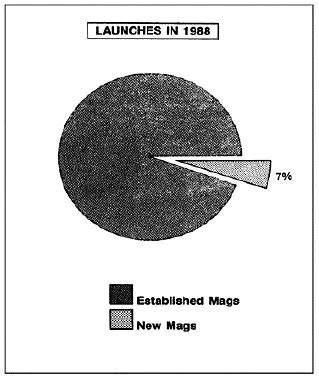
Fig 1. There have been many launches, both big and small, in recent years, adding to the size and variety of the industry. In 1988 about 7% of the total magazine market was represented by new launches. (Illustration courtesy of the Periodical Publishers Association.)
Consumer publications
Newspaper colour supplements
Women’s magazines
General interest magazines
Special interest magazines
Programme magazines
Business publications
News publications
News magazines
Newsletters
Academic journals
Society-owned
Publisher-owned
Publisher-owned
House magazines
Various sub-divisions could be identified in some detail. For example, we could divide women’s magazines into:
Weeklies
Young women’s weeklies
Monthlies
Home interest
Health, beauty, fitness
Child care
Romance
…and business magazines may be divided into almost as many sub-categories. But to consider the implications for career development our simplistic approach is adequate. Let’s look briefly at the characteristics of each group.
Consumer publications
This mass-market section of the periodical press more than any other is visibly dependent on the flair of those who work in it and the changing economic and social patterns in the marketplace. In this respect it is sometimes a more volatile sector.
If a man needs the information contained in the periodical which serves his business or profession, he will be slow to cancel his order even though the editorial team are clearly crass idiots and the journal looks like a dog’s dinner. Similarly, the advertisers will use the medium if it continues to get to the readers they wish to reach. The publication will in due course be overtaken by a competitor and probably die of inertia but this can take a little time and meanwhile opportunities arise for reform.
The mass-market consumer magazine is more immediately at the mercy of the fickle reader’s passing fancies about how to spend his disposable income. And because the reader’s fancies pass, so must the formulae which produce successful consumer magazines. They must change and evolve, lead and respond to fashion, style and social change.
Newspaper colour supplements are really in a slightly different category from the paid-for consumer magazines since their distribution depends on the success of their parent newspaper. Similarly free-distribution magazines are not dependent on copy sales for their health and wealth. But in either case, an uninteresting or irrelevant magazine will not succeed because the advertisers will not use it.
The shape of the consumer press has changed significantly in the last couple of decades. Newspaper colour magazines have become almost universal; there has been a dramatic smartening up of the women’s magazines and many new up-market launches; programme magazines (like Time Out in London) have invented successful new formulae for providing readers with this sort of information; and it would be fair to claim that much imagination has been applied to content, presentation and marketing.
After some periods of rather desultory publishing, the consumer press is enjoying a boom. In 1988 it enjoyed a 24% advertising growth rate, compared with television at 14% and the national press at 15%.
An interesting new phenomenon is the entrance of European publishers into the UK consumer magazine marketplace, especially with women’s magazines. Gruner & Jahr, the magazine subsidiary of the German publisher, Bertlesmann, launched Prima to much acclaim and this has been followed by other European invasions, with the UK consumer publishers fighting back imaginatively. The result has been a healthy growth in the size of the market.
Most consumer magazines are either weeklies or monthlies.
Business publications
Business and professional publications represent the most prolific sector of the periodical press. Their range, both in content and presentation, is wide, with black-and-white tabloid, newspaper-type product often competing in the same market as highly-designed, glossy magazines stuffed with four-colour advertisements.
Over 3,000 are published at frequencies ranging from weekly to quarterly.
The editorial content is specific and sometimes technical and many of the journalists are drawn from the business sectors covered by the publications. But again there is a wide variation: journals which are esoteric and unintelligible to the general public are sold alongside those which are editorially accessible to any interested reader.
Many are powerful instruments within the communities they serve and are often the catalysts for change within a business or profession. The general press relies heavily on them for its business and professional information. Often they are newsworthy themselves, leading campaigns for change or commenting with authority on topical subjects. Magazines serving employees in the National Health Service, for example, have been widely quoted and consulted as the great NHS debate rolls on.
In recent years, their quality and the professionalism of their staff have improved ved dramatically. Much good journalism, design and sales and marketing expertise is now clearly visible.
The style of such magazines is often influenced by the need to carry topical news and tightly scheduled recruitment advertising, creating a working environment sometimes closer to a newspaper than a consumer magazine, with late deadlines and considerable editorial, production and advertisement sales pressure, especially in the weeklies. As a medium for both editorial and advertising they have never been more successful. In 1988 ad revenues in this sector were up by 25%, according to the Advertising Association.
From the all-media total for ‘business-to-business’ advertising, the business press takes about 35%, compared with brochures and catalogues at 15%, newspapers at 8% and TV at less than 2%.
News publications
News magazines like The Economist present some of the finest and most authoritative contemporary journalism and of necessity have highly efficient sales, production and distribution systems. There are only a handful of English language news magazines but they are as big and powerful as the world’s great newspapers and their influence is international. The Economist, Time, and Newsweek are read throughout the world and employ large numbers of highly professional staff.
They are all weeklies.
Newsletters are arguably more properly considered with the professional press, but I have included them here to avoid semantic confusion.
This type of medium has increased hugely in popularity in recent years and is now a thriving sector. Most newsletters are simply presented (sometimes even word processed) with small, closely-targeted circulations. The emphasis is entirely on the quality of the information carried, in terms either of its topicality or explicit relevance to the specialist reader.
Typically they do not carry advertising and have expensive subscriptions. There are daily, weekly and monthly examples. They have small staffs but are often highly authoritative in specialist areas and frequently organise conferences and seminars which back up what is essentially an information service.
Academic journals
Academic or ‘learned’ journals are the publications in which academic papers and the results of original research are published. A learned journal can be owned by a learned society and published by a professional publisher, owned and published by a society, or owned and published by a publishing company.
Most of the editorial content is submitted by academics and no payment is made although there may be a limited amount of professionally written material.
Some publishers of learned journals have full-time publishing staff committed to editorial, production and circulation work on these publications but often they are put together by an out-house editor who selects and rejects manuscripts with the help of an editorial board. In these circumstances the publisher may arrange production and circulation and handle the business administration.
There is a trend towards carrying advertising in academic journals, although this is still far from general. Many are monthly or quarterly and some appear, by design or accident, less frequently.
Often the editorial policy is dictated by an editorial board appointed by the learned society the journal represents.
House magazines
House magazines is the generic term for newsletters, journals or magazines published by companies or other organisations for internal consumption.
There are many thousands of house magazines in the UK They range from modest in the extreme—photocopied, typewritten news sheets—to a lavishness which knows no bounds of economic restraint. Similarly, the staffing arrangements for house mags embrace the enthusiastic part timer and the highly professional team of journalists, photographers and designers.
Their purpose may be simply to communicate facts and figures, to keep one part of a company in touch with another, or to present a prestigious face and maintain a selected profile of an organisation and its place in the world.
At the highest level, polished standards of journalism, design and production are exhibited and some rewarding and influential jobs are available.
Editors of house magazines have their own organisation, the British Association of Industrial Editors (which naturally has its own house magazine!).
The career path here can be mapped differently from the trail leading through mainstream magazine publishing; we touch on it again in chapter two: The Way In.
The future
Television has been the most significant competitor for advertising revenue—the lifeblood of many magazines—since commercial TV first started, but in recent years there have been indications that the magazine press is more than holding its own after some disappointing losses of market share in the early eighties.
The Advertising Association tells us that magazine ad revenues finished 1988 just short of £1bn (including production costs) and we have noted that this represents a healthy growth in both consumer and business sectors. Total circulation also rose during the year, according to a report on the magazine market commissioned by the Periodical Publishers Association (PPA), the leading industry body.
We have also seen that new launches accounted for about 7% of the total market and, as the PPA comments in its report: ‘The ratio of successful to unsuccessful launches is quite heavily weighted on the successful side. This indicates that the market for magazines has by no means reached saturation point. There is still considerable demand for magazines and periodicals, and ample niche space for them to launch into.’
Profitability
In terms of profitability the trade performs well, having turned in a respectable average 10.5% pre-tax profit on sales in the last year for which figures are available (1986/7). Economically, therefore, the industry presents an encouraging image. As a career option it has further attractions.
Standards of professionalism within the industry are increasing rapidly and training, as we shall see in a later chapter, is becoming formalised and structured. The impact of technology, too, is being felt in all disciplines within the trade. Many outmoded and unproductive practices are being changed on the production side of the business and computerisation goes...
Table of contents
- Cover Page
- Title Page
- Copyright Page
- Acknowledgements
- Introduction
- 1: The Periodical Publishing Scene
- 2: The Way In
- 3: How a magazine is published: systems and jobs
- 4: Editorial
- 5: The Advertisement Department
- 6: The Design Studio
- 7: The Production Department
- 8: Marketing and Promotion
- 9: Circulation and Distribution
- 10: The Management
- 11: Training
- Members of the Periodical Publishers Association
- Useful addresses
- Sources
- Glossary of terms
Trusted by 375,005 students
Access to over 1.5 million titles for a fair monthly price.
Study more efficiently using our study tools.
Frequently asked questions
Yes, you can cancel anytime from the Subscription tab in your account settings on the Perlego website. Your subscription will stay active until the end of your current billing period. Learn how to cancel your subscription
No, books cannot be downloaded as external files, such as PDFs, for use outside of Perlego. However, you can download books within the Perlego app for offline reading on mobile or tablet. Learn how to download books offline
Perlego offers two plans: Essential and Complete
- Essential is ideal for learners and professionals who enjoy exploring a wide range of subjects. Access the Essential Library with 800,000+ trusted titles and best-sellers across business, personal growth, and the humanities. Includes unlimited reading time and Standard Read Aloud voice.
- Complete: Perfect for advanced learners and researchers needing full, unrestricted access. Unlock 1.5M+ books across hundreds of subjects, including academic and specialized titles. The Complete Plan also includes advanced features like Premium Read Aloud and Research Assistant.
We are an online textbook subscription service, where you can get access to an entire online library for less than the price of a single book per month. With over 1.5 million books across 990+ topics, we’ve got you covered! Learn about our mission
Look out for the read-aloud symbol on your next book to see if you can listen to it. The read-aloud tool reads text aloud for you, highlighting the text as it is being read. You can pause it, speed it up and slow it down. Learn more about Read Aloud
Yes! You can use the Perlego app on both iOS and Android devices to read anytime, anywhere — even offline. Perfect for commutes or when you’re on the go.
Please note we cannot support devices running on iOS 13 and Android 7 or earlier. Learn more about using the app
Please note we cannot support devices running on iOS 13 and Android 7 or earlier. Learn more about using the app
Yes, you can access Inside Magazines by Michael Barnard in PDF and/or ePUB format, as well as other popular books in Languages & Linguistics & Publishing. We have over 1.5 million books available in our catalogue for you to explore.