Who's Who in Gay and Lesbian History: From Antiquity to the Mid-Twentieth Century is a comprehensive and fascinating survey of the key figures in gay and lesbian history from classical times to the mid-twentieth century. Among those included are:
* Classical heroes - Achilles; Aeneas; Ganymede
* Literary giants - Sappho; Christopher Marlowe; Arthur Rimbaud; Oscar Wilde
* Royalty and politicians - Edward II; King James I; Horace Walpole; Michel de Montaigne.
Over the course of some 500 entries, expert contributors provide a complete and vivid picture of gay and lesbian life in the Western world throughout the ages.
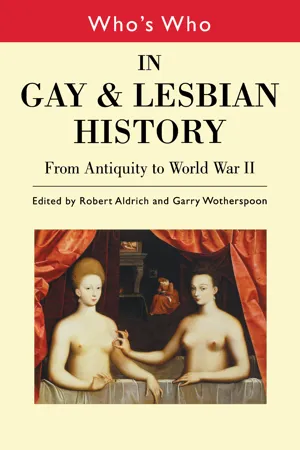
eBook - ePub
Who's Who in Gay and Lesbian History Vol.1
From Antiquity to the Mid-Twentieth Century
- 528 pages
- English
- ePUB (mobile friendly)
- Available on iOS & Android
eBook - ePub
Who's Who in Gay and Lesbian History Vol.1
From Antiquity to the Mid-Twentieth Century
About this book
Information
B
Bacon, Sir Francis (1561–1626), British king's counsel, essayist, philosopher. Bacon was born into a middle-class family, became a practising lawyer in 1582, and was appointed Queen Elizabeth's Counsellor in 1591. He rapidly rose to fame under King JAMES I, who confirmed his position as king's counsel in 1604. He was knighted in 1603, made Solicitor General in 1607, Attorney General in 1613, and Lord High Chancellor in 1618. He received the titles of Baron Verulam in 1618 and Viscount St Albans in 1621. In that same year King James fell from grace by trying to abolish Parliament, and Bacon was found guilty of having accepted bribes while serving as a judge. Bacon acknowledged receiving gifts (it was common practice for judges to accept gifts from the winning parties) but maintained that this custom never influenced his judgments; no one ever demanded a retrial of any of the suits in question.
Bacon retired to his estate at Gorham-bury, outside St Albans, to write and to conduct scientific research. New Atlantis, utopian fiction about the ideal society, had been published in 1617; the Novum Organum, a theory for organising knowledge, in 1620; The Advancement of Learning, an argument for empirical research and against superstition, in 1623; his famous Essays were expanded from 10 in 1597 to 58 in 1625. He also wrote poetry and plays; some claim that he wrote some of SHAKESPEARE'S plays (Hamlet re-uses a line from Bacon's essay ‘Of Wisdom for a Man's Self’ – ‘be so true to thyself as thou be not false to others’). In 1626 Bacon tested the effect of freezing on the preservation of meat by going out in a blizzard and stuffing a chicken with snow; the chicken was preserved, but Bacon caught pneumonia and died.
Bacon married Alice Barnham in 1606, when he was 45 years old; they had no children. Contemporary figures relate that he was a ‘sodomite’. John Aubrey in his Brief Lives says quite bluntly that Bacon ‘was a pederast’ and had ‘ganimeds and favourites’; the Puritan moralist Sir Simonds D'Ewes in his Autobiography and Correspondence discusses Bacon's love for his Welsh serving-men; in particular he says that when Bacon had to resign in 1621 he kept ‘one Godrick, a verie effeminate faced youth, to bee his catamite and bedfellow, although hee had discharged the most of his other household sevants: which was the moore to bee admired, because men generallie after his fall begann to discourse of that his unnaturall crime, which hee had practiced manie yeares, deserting the bedd of his Ladie’ (diary entry for 3 May 1621). His mother, Lady Ann Bacon, complained especially about ‘that bloody Percy’ whom her son kept ‘yea as a coach companion and a bed companion’. Many of the youths in his service were left legacies at his death. His closest friend was Tobie Matthew (later knighted), actor, spy and the inspiration for Bacon's famous essay ‘On Friendship’: ‘If a man have not a friend, he may quit the stage’.
His brother, Anthony Bacon (1558–1601), a spy in the service of the Earl of Essex, was also homosexual. He was charged with sodomy in the summer of 1586, in Montauban, France. But the case was not pursued, and he was granted mercy through the efforts of Henri, King of Navarre. After this scandal, Anthony returned to England and lived for a time with Francis, and then set up a bachelor establishment at his estate in Redbourn.
D. du Maurier, Golden Lads: A Study of Anthony Bacon, Francis, and their friends, London, 1975; D. du Maurier, The Winding Stair: Francis Bacon, His Rise and Fall, London, 1976; R. Norton, Mother Clap's Molly House, London, 1992.
Rictor Norton
Baden-Powell, Robert (Stephenson Smyth), 1st Baron (1857–1941), British soldier. Baden-Powell was the British soldier who founded the Boy Scout and Girl Guide movements. During the Boer War (1899–1902) he won national fame for holding Mafeking against a Boer siege for a grisly 217 days, and later reorganised the South African constabulary. He formed the Boy Scouts in 1908 and, with his sister, Agnes Baden-Powell, the Girl Guides a year later. In 1910 he retired from the Army and devoted his life to the scouting movement, writing over thirty books and travelling the world.
Born at Paddington, London, he was the eighth child of the Reverend Baden-Powell, a Professor at Oxford University, who died when Baden-Powell was just three years old. Baden-Powell attended Charterhouse School, where his interest in woodcraft was born. In 1876 he went to India as a young Army officer, and his unorthodox but successful methods soon led to his training others in scout techniques.
In 1907 he held a pioneering summer camp on Brownsea Island, Dorset, to try to bring together a mix of 22 boys from private upper-class schools and working-class schools. This, together with his bestselling Scouting For Boys (1908), was the spark which led within two years to the almost spontaneous formation of a Scouting movement in Britain, which quickly spread throughout the British Empire.
Much of the evidence for Baden-Powell's homosexuality can be found in Tim Jeal's monumental and definitive biography, Baden-Powell (1989), in which Jeal states frankly: ‘The evidence available points inexorably to the conclusion that Baden-Powell was a repressed homosexual’, although it seems that, like the majority of homosocial men at that time, he ‘managed to follow Plato's prescription glorifying the love of man for man, or man for boy, while remaining physically chaste’. A complex and creative man of the utmost integrity, ‘Baden-Powell was in a position of trust which made watching, at one remove, the only way to satisfy his interest’. Jeal gives several detailed instances of Baden-Powell's pleasure in seeing naked boys, his emotional enjoyment gained from living alongside them, and his delight in contemplating the clandestine ‘artistic’ nude photography of boys which was at that time circulating among English pederastic public school circles.
He did, eventually, marry, in 1912. Olave Soames was a ‘strange compound of child and grown woman … That he thought of her as a mixture of young woman, male comrade and child-friend is apparent in his earliest letters’. She also altered her appearance to suit Baden-Powell: ‘Apart from flattening her breasts and concealing any hint of cleavage with handkerchiefs, she promised herself that she would cut off most of her hair … With every hint of sex removed from a relationship he could get on reasonably well with women’.
Baden-Powell was made a baron in honour of his services. In 1938, he returned to his beloved Africa, to live in semi-retirement at Nyeri, Kenya. He died there three years later.
T. Jeal, Baden-Powell, London, 1989.
Ianthe Duende
Balbi, Giròlamo (1450?–1535), Italian humanist. Balbi probably studied in Rome with POMPONIO-LETO but, by 1485, was in Paris, where he obtained a university chair four years later. His severe and uncompromising character brought him into conflict with several colleagues whom he accused of incompetence. The quarrel became increasingly bitter and in 1490 or 1491, accused of sodomy and heresy, Balbi had to flee Paris. One of his rivals, Publio Fausto Andrelini (1462–1518), in a Latin eclogue, ‘De fuga Balbi’ (1491–1493), also published the accusations of sodomy against him. One of Balbi's former students, Jacques Morlin, wrote a defence, Invectiva in Fausti Balbi calumniatorem, in which he accused Andrelini of homosexual tastes. One Guillaume Tardif, in Antiabalbica, also claimed that Balbi had been tried for sodomy. Meanwhile, Balbi took refuge in England, then travelled to Vienna (1493) and on to the court of King Ladislas of Bohemia in Prague. In 1497, faced with new accusations of sodomy, he was again obliged to take flight. Balbi's erstwhile protector, Bohuslaw von Hassenstein (Baron Lobocovicz), published a Latin composition proclaiming that perhaps the Bohemians were not so cultured as the Italians, but at least they knew nothing about the love for GANYMEDE. Balbi found a haven in Hungary, where he was ordained to the priesthood, obtained important political and diplomatic posts and, in 1523, was made bishop of Gurk; he eventually died there.
Balbi was most appreciated during his life (in certain ways similar to Filippo BUONACCORSI) for spreading humanism in eastern Europe. His poetry, letters and philosophical tracts, written in Latin, reveal Balbi's vast learning. A number of the compositions that have homosexual themes are included in his published works. (Others, such as those in the Manoscritto Marciano Latino (No. 4689) in the Marciana Library in Venice, remain unpublished and unstudied). One published letter sent to Pomponio-Leto speaks of his new love for a youth. In another, he says that women were not allowed into his house (which he had consecrated to Hercules) but only a ‘chaste’ youth whom he called ‘Illa’ after Hercules’ male lover. Such remarks suggest that the accusations against Balbi were at least partly based on fact.
G. degli Agostini, Notizie istorico-critiche intorno le vite e le opere degli scrittori viniziani, Venice, 1752–1754, Vol. 2, pp. 240–80; Publio Fausto Andrelini, The Eclogues of Faustus Andrelinus and Ioannes Arnolletus, Baltimore, 1918: 53–7, 113–14; G. Balbi, Opera poetica, oratoria ac politico-moralia, Vienna, 1781–1792.
Giovanni Dall'Orto
Bang, Herman (Joachim) (1857–1912), Danish novelist, journalist and theatre director. After graduating from high school in 1875, Bang arrived in the rapidly expanding city of Copenhagen. He had no success in his ambition to become an actor, but very soon established himself as a feuilletonniste, a journalist and an author of critical essays inspired by French naturalism. His excessively mannered and pointed style both delighted and offended readers. Whatever subject he touched was made sensational. His early reportage included detailed descriptions of the horrifying living conditions in the slums of Copenhagen. Bang's journalism was and still is considered a pioneering achievement.
His early novel, Haabløse Slægter (A Generation Without Hope, 1880), described the life of a young degenerate and failed actor, the victim of neurotic parentage, of congenital tuberculosis, and of Countess Hatzfeldt's and other women's sexual inclinations: ‘The Countess loves children so much’. The book was banned by the Supreme Court as immoral. At the same time, as a very young man, Bang developed the persona of a decadent dandy whose homosexuality was strongly implied and widely known or suspected. He established himself as Denmark's most notorious and exemplary homosexual man.
Undoubtedly Bang was the most modern of the authors of the so-called ‘Emergence of Modernity’ from 1875 to 1890. His major novels, Ved Vejen (At the Roadside, 1886), Stuk (1887), Tine (1889), and Ludvigsbakke (1896), are still widely read and admired. They have given Bang a place in the foremost rank of Danish novelists. The less important novel, Mikaël (1904), is traditionally viewed as his most explicit representation of homosexuality.
Bang's position as an exemplary homosexual made him vulnerable to slander. In order to escape from this nerve-racking lifestyle he spent long periods as a quasiexile in the Danish provinces, and in France and Germany. During a stay in Paris from 1893 to 1895 he was engaged by Aurélien Lugné-Poë at the experimental Théâtre de l’Œuvre, where he introduced the plays of his Nordic contemporaries Henrik Ibsen, Bjørnstjerne BJøRNSON and August STRINDBERG to the Parisian audience. The crowning point of his success was to direct the primadonna Gabrielle Réjane as Nora in Ibsen's A Doll's House. However, also outside of Denmark Bang was persecuted and defamed as a sexual pervert in anonymous letters ‘from home’.
Nowhere in Bang's novels is homosexuality explicitly represented. Still, it is possible to read his œuvre as a continuous endeavour to express, implicitly, the homosexual's terms of existence by the fin de siècle, at the transition from premodernity to modernity. In Bang's novels the trauma of this transition is explained, even caused, by the lost War of 1864 between Denmark and Prussia, and by the ensuing secession of large parts of Denmark. The emergence of modern urbanity in the following period was also an emergence of sexuality. Bang described life in Denmark's pre-modern agricultural society as a pre-war paradise of innocence contrasted to the unbearably painful modern existence. The contrast is explained by the emergence of ‘sexuality’. Sexuality for Bang is separated from love, it is a force, independent of and existing beyond the will of the individual. It is fate, and mythologised as fate it cannot constitute identity. It dissolves identity with its dark and horrible Dionysian insanity devoid of meaning. Instead of giving life, sexuality can only cause death – and art. Therefore, to be a loving person in Bang's universe is to be a longing and a suffering, even a dying person, because man's deepest longing, the longing for love, can never be satisfied. The only way to survive, for Bang and for his characters, is to become an artist, a writer. Only through the paradox of the literary narrative is it possible to express, with meaning, the impossible longing for love.
Late in life, he collaborated with his German doctor, Max Wasbutzki, on a factual essay on homosexuality, Gedanken zum Sexualitätsproblem (Thoughts on the Problem of Sexuality) which was published posthumously in 1922. From the privileged position of a homosexual artist and aristocrat he described and interpreted homosexuality as a social and scientific problem. Explicitly he subjected himself to ‘medical control’ in order to contribute to the prevention of homosexuality, ‘not least out of urgent consideration for propagation’. The one love affair in Bang's life was with the German actor Max Eisfeld (Appel), whom he met in Berlin in 1885. Their relationship lasted for a little more than a year.
With great sophistication Bang exploited the new possibilities of modern mass society. He cast himself as the protagonist in a highly visible tragedy and acted out his life between the poles of success and scandal. He had the courage to be offensively effeminate; his consumption of perfume was legendary to the point where ‘perfume’ – as in ‘perfumed literature’ – became synonymous with ‘homosexual’. As a poseur and a victim of satire, disparagement and calumny, Bang has had no equal. In later life his friends and admirers gave him the sobriquet ‘The Little Fakir’. Bang's talent for manipulating the exchange of surfaces was supreme, although it was probably more a compulsion than voluntary. In his youth his dark-coloured fringe accentuated the pallor of his skin; ‘his weird whiteness made the light from his darkly burning, sad eyes secretly phosphorescent’. When he aged, he assumed the figure of an infinitely wise man of the world who carries the heavy burden of knowledge of the human condition: suffering as man's inexorable master. Although Bang died a natural death from exhaustion, on a train near Ogden, Utah, while on a lecture tour in the US, the public and some of his aquaintances believed that he had committed suicide, the only natural death for a homosexual.
C. Rimestad, ‘Herman Bang’, Dansk Biografisk Leksikon, Vol. 1, Copenhagen, 1979: 403–7; Pål Bjørby, ‘The Prison House of Sexuality: Homosexuality in Herman Bang Scholarship’, Scandinavian Studies, 58 (1986); Wilhelm von Rosen, Månens Kulør. Studier i dansk bøssehistorie 1628–1912, Copenhagen, 1993: 628–54; H. Bech, When Men Meet: Homosexuality and Modernity, Cambridge, 1997; H. Jacobsen, Herman Bang, 5 vols. Copenhagen, 1954–1974.
Wilhelm von Rosen and Øystein S. Ziener
Barnes, Djuna (1892–1982), American writer, journalist. Barnes was born in New York; a legendary recluse, she led a secluded life in Greenwich Village at odds with the reputation that she earned during the 1910s, 1920s and 1930s as a reporter, writer, artist and habitué of Bohemian circles in New York and Paris. However, her account of Bohemian life, written in a style which ranged from mordantly acerbic humour to hyperbolic and nostalgic sentimentality, might be understood as a natural precedent to the shut-in life she adopted from the 1950s to her death.
Barnes's career in journalism followed her unorthodox private schooling and formal education at the Pratt Institute in Brooklyn and the Artists’ Student League in 1912–1913. In her popular journalism and short fiction, she developed some of the idiosyncratic narrative techniques that typify her later work; at the same time she wrote decadent poetry and plays for the Provincetown Players, and developed a Beardsleyesque illustrative style. The Book of Repulsive Women (1915), a chapbook of poems and drawings, documents the lives of women living in a Bohemian and economic twilight world on the streets of Manhattan, and adopts a vocabulary reminiscent of Baudelaire to describe lesbians and their ways.
Bar...
Table of contents
- Front Cover
- Half Title
- Title Page
- Copyright
- Contents
- Introduction
- Contributors
- Acknowledgements
- A
- B
- C
- D
- E
- F
- G
- H
- I
- J
- K
- L
- M
- N
- O
- P
- R
- S
- T
- U
- V
- W
- X
- Y
- Z
Trusted by 375,005 students
Access to over 1.5 million titles for a fair monthly price.
Study more efficiently using our study tools.
Frequently asked questions
Yes, you can cancel anytime from the Subscription tab in your account settings on the Perlego website. Your subscription will stay active until the end of your current billing period. Learn how to cancel your subscription
No, books cannot be downloaded as external files, such as PDFs, for use outside of Perlego. However, you can download books within the Perlego app for offline reading on mobile or tablet. Learn how to download books offline
Perlego offers two plans: Essential and Complete
- Essential is ideal for learners and professionals who enjoy exploring a wide range of subjects. Access the Essential Library with 800,000+ trusted titles and best-sellers across business, personal growth, and the humanities. Includes unlimited reading time and Standard Read Aloud voice.
- Complete: Perfect for advanced learners and researchers needing full, unrestricted access. Unlock 1.5M+ books across hundreds of subjects, including academic and specialized titles. The Complete Plan also includes advanced features like Premium Read Aloud and Research Assistant.
We are an online textbook subscription service, where you can get access to an entire online library for less than the price of a single book per month. With over 1.5 million books across 990+ topics, we’ve got you covered! Learn about our mission
Look out for the read-aloud symbol on your next book to see if you can listen to it. The read-aloud tool reads text aloud for you, highlighting the text as it is being read. You can pause it, speed it up and slow it down. Learn more about Read Aloud
Yes! You can use the Perlego app on both iOS and Android devices to read anytime, anywhere — even offline. Perfect for commutes or when you’re on the go.
Please note we cannot support devices running on iOS 13 and Android 7 or earlier. Learn more about using the app
Please note we cannot support devices running on iOS 13 and Android 7 or earlier. Learn more about using the app
Yes, you can access Who's Who in Gay and Lesbian History Vol.1 by Robert Aldrich, Garry Wotherspoon, Robert Aldrich,Garry Wotherspoon in PDF and/or ePUB format, as well as other popular books in Social Sciences & Social Science Biographies. We have over 1.5 million books available in our catalogue for you to explore.