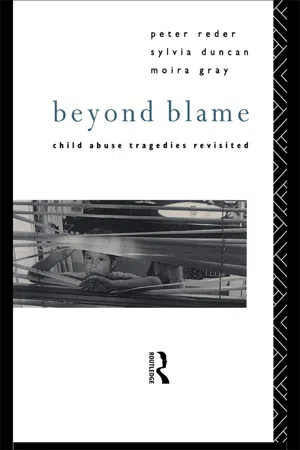
What can we learn from inquiries into cases of fatal child abuse? Beyond Blame offers a new way of looking at such cases and shows that it is possible to draw important lessons from them. The authors, all three experienced in child protection work, summarise thirty-five major inquiries since 1973, setting them in their social context and discussing the implications both for practical work in the field and for future inquiries.
They stress the need for those who work day to day in child protection to develop and apply a more sophisticated level of analysis to assessment and intervention. They identify common themes within abusing families, in the relationships between members of the professional networks, and in the interactions between the families and the professionals.
- 208 pages
- English
- ePUB (mobile friendly)
- Available on iOS & Android
eBook - ePub
About this book
Information
Chapter 1
Introduction
Neither the outcries of public indignation, nor trial by newspaper, nor emotionally tinged accusations against individuals are conducive to the atmosphere necessary for a sober appraisal and step-by-step examination of such events.
(Goldstein et al. 1979:143)
This book is an attempt to get beyond the blaming stance so often adopted when children known to statutory agencies die at the hands of their caretakers. An atmosphere of blame and criticism always surrounds the public inquiries set up to investigate the deaths and becomes encapsulated in the judgemental tones of the final reports. This book tries to make sense of events which culminated in the tragic deaths and to understand more about the behaviour of the families and the professional workers. We hope that it will make some contribution to future professional practice.
This is an emotive subject. No one can hear about the death of a child without being moved. When that child dies as a result of abuse, we inevitably feel a mixture of horror, anger, pity and sadness. If that child was already known to professional workers whose task was to help protect him or her, the question is inevitably asked: ‘Shouldn’t they have prevented it?’ It is only a small step to identify with the helpless child and focus all our rage on the professionals, even blaming them for the child’s death. Indeed, newspaper editors capitalise on this process through provocative and accusing headlines. Not only does the death of a child from abuse horrify us but front-line professionals, especially social workers, have become extremely sensitive to the critical and often mindless rage that is heaped upon them at the news that another child known to statutory agencies has died.
BACKGROUND
The authors of this book began working together in 1985 as members of the Child and Family Psychiatry Department of the Charing Cross Hospital (now known as Wolverton Gardens, part of the Riverside Mental Health Trust) in London. From our respective backgrounds in psychiatry, psychology and social work we had developed a common interest in applying systemic ideas to our clinical work together in the Department. That work included considerable involvement with problems of child abuse (Baker and Duncan 1985, 1986) and the emotional demands they make on professional workers. We had also given a great deal of thought to the psychology of inter-professional behaviour and the interaction between families and their networks of helping professionals (Reder and Kraemer 1980; Reder 1983, 1985, 1986; Reder and Duncan 1990). We were also informed by the work of colleagues who were applying systemic thinking to problems of child protection. These included teams at the Great Ormond Street Hospital for Sick Children (Bentovim et al. 1988), the Mater Misericordiae Hospital in Dublin (McCarthy and Byrne 1988), the Rochdale NSPCC Unit (Dale and Davies 1985; Dale et al. 1986), the Marlborough Family Service in London (Asen et al. 1989), the Tavistock Clinic (Furniss 1991) and in Leeds (Stratton et al. 1990).
In December 1985 we read the report into the death of Jasmine Beckford. Its conclusions began: ‘On any conceivable version of events under inquiry the death of Jasmine Beckford was both a predictable and preventable homicide…’ and continued: ‘The blame must be shared…’ (Jasmine Beckford Inquiry Report 1985:287). Statements such as this were contrary to our clinical approach and way of thinking and had more the tone of a judgement handed down by a court rather than an attempt to learn constructively from the tragedy. Although some professionals involved in the case had shown errors of judgement, such conclusions appeared ultimately unhelpful in understanding how the errors had come about. The inquiry seemed to have focussed on ‘rightness’ or ‘wrongness’ and degrees of blameworthiness. We considered that an appreciation of the psychological aspects of these complex cases was missing and there was little awareness of emotional factors within families and professional networks which can dislodge workers from objectivity. As an example, the inquiry heavily criticised the key social worker’s conduct but in studying the report we discovered that her senior had been absent from work on maternity leave during a crucial six months of the case. During that time the social worker had acted up for her senior as well as performing all her usual duties and, in a sense, she had become her own supervisor. Front-line workers know of the profound effects this can have on them but the inquiry panel accords it no significance, to the extent that we had to hunt around in different sections of the text to piece this information together.
Two years after the Jasmine Beckford report appeared, the inquiry panel into the death of Kimberley Carlile published its findings. We were struck even more forcibly by the apparent belief that blame must be apportioned and how this framework not only limited the usefulness of the report but also produced contradictory statements that undermined its credibility. Referring to the social work Team Leader, the panel concluded that: ‘[He] was the prime candidate for blameworthiness in failing to prevent Kimberley Carlile’s death… [and] we recommend that he should not in the future perform any of the statutory functions in relation to child protection…’. However, on the same page it adds:
his written statement [to the inquiry] is an outstanding document of insight into the nature of a social worker’s tasks #8230; [and his] employing authority should make the document available as an educational tool for the training of social workers generally, and for those involved in child abuse particularly.
(Kimberley Carlile Inquiry Report 1987:22)
We believed that the accusatory styles adopted in these two reports, grounded in the adversarial framework of the legal system, would have the drawback of increasing front-line workers’ defensiveness rather than helping them to examine their roles in difficult cases. Furthermore, we thought that the reports would only go some way to improve professional practice because they told us little that was new about how things can go wrong. For example, as in many of the inquiries which had preceded them, the Jasmine Beckford and Kimberley Carlile reports indicated that procedures were not always properly followed and that communication between professionals was, at times, inadequate. Although the panels recommended structural refinements in procedures and organisation their reports did not further understanding about how inter-professional communication and co-operation can break down. Without such understanding, we thought that it would be unlikely that the structural changes could be enacted effectively.
We found ourselves in agreement with the conclusions of Minuchin after he had reviewed the Maria Colwell inquiry report:
It is difficult to take a positive view and impossible to sympathize with the murderers of a child. But unless we begin to see cases like Maria’s not from the point of view of fixing the blame, but from the point of view of possible solutions, we will still be doomed only to the repetition of ineffective interventions.
(Minuchin 1984:155)
We therefore decided to review all known reports into the deaths of children from non-accidental violence or neglect in order to apply our clinical approach to the cases at the centre of the inquiries. We hoped that a systemic analysis of each tragedy might suggest some of the psychological processes which had influenced events. We anticipated that common themes or patterns might then emerge from this review.
There have been many responses to particular inquiries and their aftermath in the professional literature (e.g. Mawby et al. 1979; Shearer 1979; Allen 1983; Dingwall 1986; Parton 1986). More detailed appraisals of individual cases have also been published, for example about Maria Colwell by Howells (1974), Goldstein et al. (1979) and Minuchin (1984), about Malcolm Page by Jay and Doganis (1987) and concerning Jasmine Beckford by Greenland (1987). However, we only know of a few previous attempts to use material from several reports for a more comprehensive study. Prompted by the widespread perception that the reports had much in common with each other, the Department of Health and Social Security (1982) collated their principal comments. Just before this present book went to press, the Department of Health (1991) published a follow-up review of more recent inquiries. Hallett (1989) discussed the process of the inquiries that followed the children’s deaths, basing her review on comments made by the inquiry panels as well as involved professionals.
Greenland (1987) focussed more on the cases themselves as part of an international review of situations in which children died at the hands of their caretakers. In one study he obtained access to the Coroner’s records and the Child Abuse Register in Ontario, Canada and was able to identify a cohort of 100 confirmed child abuse and neglect deaths over a ten-year period. These cases were compared to identify common characteristics and patterns and since the findings can be taken as a valid baseline for certain features of fatal child abuse in a defined population, we shall refer to them at appropriate points in later chapters. Greenland then added to his review a group of British cases, including many of those studied by us. He identified help-seeking behaviour by the caretakers and the children and warning signs of impending danger to the child and went on to formulate a ‘high-risk checklist’ as a guide to front-line professionals.
THE BOOK
We knew our project would be an arduous one which was bound to affect us deeply as we read more and more accounts about the abuse and deaths of children. We also expected that our report of the project, this book, would be likely to provoke strong emotions in the reader. We chose the title carefully to reflect our desire to get beyond the blaming stance of so many inquiry reports and newspaper headlines. The title Beyond Blame is not meant to suggest that professionals with child care and protection responsibilities should not be held accountable for their actions. On the contrary, we believe that responsibility must always remain a core feature of professional practice, together with clear lines of accountability when cases go wrong. However, we have placed less emphasis on this aspect of the cases because such issues are all too well covered by the inquiry reports themselves. Our concern has been that the reports tended to focus overmuch on matters of professional responsibility and accountability at the expense of analysing the psychological aspects of the cases and the responsibilities of the caretakers. In our opinion, reviewing what did happen and what should have happened needed to be balanced with an attempt to understand how the errors had occurred.
We follow this introductory chapter with discussions of the historical and social context of child abuse and then how we applied our systemic thinking to the inquiry reports. We then go on to describe recurrent interactional patterns that we were able to identify within the abusing families, within the professional networks surrounding them and between the families and the professionals.
Because problems of inter-professional communication occurred in the majority of cases, we have devoted three chapters to a discussion of various aspects of this issue. The Doreen Aston case is presented separately since it illustrates the interrelationship of many of the common patterns over the course of one case. Finally, we consider some of the implications of our review for future practice and for responses to cases which end in tragedy. The Appendix contains summaries of each case we reviewed and the full reference to each inquiry report.
A brief comment is necessary about our use of the term ‘case’ throughout the book. To some this has a clinical and impersonal connotation, as though the people concerned are reduced to objects of study. This is not our intention, since we use the term in a much wider sense to describe all persons involved in the events that unfolded. We use ‘case’ as a shorthand to describe members of the family, members of the professional networks and their interaction together over time and in the present.
Chapter 2
The wider context
We have described the context within which this project was conceived and developed. In this chapter we shall consider the phenomenon of ‘child abuse’ and professional responses to it in their social, political and historical contexts. We shall discuss how the very concept of ‘child abuse’ is an evolving one and that professional practices are part of a complex social scenario. It is our view that the behaviour of families and professionals in these tragedies must be considered in relation to the contexts within which they lived and worked.
THE EVOLVING PHENOMENON OF ‘CHILD ABUSE’
Gelles (1975) pointed out that there is no objective phenomenon which can automatically be recognised as child abuse and Freeman (1983a) observes that being ‘at risk’ is not an objective ‘condition’ but is a label, a social construction. Taylor, too, refers to the phenomenon of child abuse as: ‘a social construction whose meaning arises from the value structure of a social group and the ways in which these values are interpreted and negotiated in real situations’ (Taylor 1989: 46).
Figure 2.1 depicts how acknowledgement of child abuse as a problem and the need for society to respond to it changes over the years. The figure shows some of the factors which we believe are integral to the process and the continuous feedback between them, each factor modifying the others over time. As society progressively alters its attitudes to children and their welfare, expectations of parents are reviewed and refined. Unacceptable standards of care are defined, which warrant state intervention. Professional practice is itself sensitive to prevailing social beliefs and is guided by contemporary theories and knowledge, while new research is prompted by questions arising from professional work and social beliefs. From time to time, social attitudes become consolidated through political initiatives and legislation. At other times, social concern about state interventions lead to public inquiries, the results of which help to modify practice and may lay the groundwork for new legislation.

Figure 2.1 The social construction of ‘child abuse’
Therefore, the concept of ‘child abuse’ is an ever-changing one and is a construction arising out of a number of social and historical contexts. Because these contexts are so relevant to the project reported in this book, we shall consider each of these themes in more detail. Their progressive inter-relationship is summarised in Table 2.1.
Table 2.1 The evolution of ‘child abuse’
PROFESSIONAL RECOGNITION
Kempe (1979) suggests that society’s recognition of abuse to children progresses over time through a number of specific stages. In stage one there is a denial that either physical or sexual abuse exists to any significant extent and abuse that is acknowledged is believed to be perpetrated by psychotic, drunken or drugged parents or foreign visitors. During stage two the community pays attention to the more lurid forms of abuse or ‘the battered child’. More effective ways begin to be found of coping with severe physical abuse and, through early recognition and intervention, with less severe abuse. Stage three occurs when physical abuse is better handled and attention is now paid to the infant who fails to thrive and is neglected physically. More subtle forms of abuse, such as poisoning, are also recognised. Stage four is reached when society recognises emotional abuse and neglect and patterns of severe rejection, scapegoating and emotional deprivation. In stage five the community pays attention for the first time to the plight of sexually abused children.
Although nineteenth-century physicians had considerable evidence that parents physically and sexually abused their children (Masson 1985), they appear to have largely denied its relevance. Initially, Freud believed his patients if they reported that their parents had sexually abused them during childhood. However, within a few years he was suggesting that their accounts were based in fantasy (Freud 1905). His change of heart may well have been influenced by his own personal conflicts (Reder 1989) as well as by the social attitudes and professional knowledge of the day.
The ‘rediscovery’ of child abuse by the medical profession was made in the United States by Caffey (1946), a paediatric radiologist, who described bone lesions and subdural haemotomata resulting from trauma. Woolley and Evans (1955) then proposed that some injuries were the result of parental assaults. In 1961 Kempe reported research into the physical abuse of children to the American Pediatric Association in a paper entitled ‘The battered-child syndrome’ (Kempe et al. 1962). In Britain, two orthopaedic surgeons, Griffiths and Moynihan (1963), alerted paediatricians and forensic pathologists to the problem. With the death of Maria Colwell in 1973, attention became focussed during the next few years on the extreme forms of physical abuse and it was only with the death of Heidi Koseda in 1984 that more subtle forms of abuse began to gain recognition. The 1980s was the decade of the...
Table of contents
- COVER PAGE
- TITLE PAGE
- COPYRIGHT PAGE
- FIGURES AND TABLES
- FOREWORD
- ACKNOWLEDGEMENTS
- CHAPTER 1 INTRODUCTION
- CHAPTER 2 THE WIDER CONTEXT
- CHAPTER 3 TRAGEDIES REVISITED
- CHAPTER 4 THE FAMILIES
- CHAPTER 5 THE MEANING OF THE CHILD
- CHAPTER 6 INTER-PROFESSIONAL COMMUNICATION
- CHAPTER 7 THE PROFESSIONAL NETWORKS
- CHAPTER 8 THE ASSESSMENT PROCESS
- CHAPTER 9 THE FAMILY-PROFESSIONAL SYSTEMS
- CHAPTER 10 THE CASE AS A WHOLE
- CHAPTER 11 BEYOND BLAME
- APPENDIX SUMMARIES OF THE CASES
- BIBLIOGRAPHY
Trusted by 375,005 students
Access to over 1.5 million titles for a fair monthly price.
Study more efficiently using our study tools.
Frequently asked questions
Yes, you can cancel anytime from the Subscription tab in your account settings on the Perlego website. Your subscription will stay active until the end of your current billing period. Learn how to cancel your subscription
No, books cannot be downloaded as external files, such as PDFs, for use outside of Perlego. However, you can download books within the Perlego app for offline reading on mobile or tablet. Learn how to download books offline
Perlego offers two plans: Essential and Complete
- Essential is ideal for learners and professionals who enjoy exploring a wide range of subjects. Access the Essential Library with 800,000+ trusted titles and best-sellers across business, personal growth, and the humanities. Includes unlimited reading time and Standard Read Aloud voice.
- Complete: Perfect for advanced learners and researchers needing full, unrestricted access. Unlock 1.5M+ books across hundreds of subjects, including academic and specialized titles. The Complete Plan also includes advanced features like Premium Read Aloud and Research Assistant.
We are an online textbook subscription service, where you can get access to an entire online library for less than the price of a single book per month. With over 1.5 million books across 990+ topics, we’ve got you covered! Learn about our mission
Look out for the read-aloud symbol on your next book to see if you can listen to it. The read-aloud tool reads text aloud for you, highlighting the text as it is being read. You can pause it, speed it up and slow it down. Learn more about Read Aloud
Yes! You can use the Perlego app on both iOS and Android devices to read anytime, anywhere — even offline. Perfect for commutes or when you’re on the go.
Please note we cannot support devices running on iOS 13 and Android 7 or earlier. Learn more about using the app
Please note we cannot support devices running on iOS 13 and Android 7 or earlier. Learn more about using the app
Yes, you can access Beyond Blame by Dr Peter Reder,Sylvia Duncan,Moira Gray in PDF and/or ePUB format, as well as other popular books in Social Sciences & History & Theory in Psychology. We have over 1.5 million books available in our catalogue for you to explore.