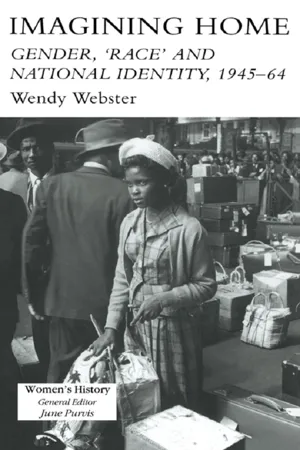
Imagining Home offers a unique examination of ideas and images of home in Britain during a period of national decline and loss of imperial power. In exploring the relationship between gender, 'race' and national identity, it higlights the continuing importance of empire in imaginings of the nation during a period of decolonization. Analyzing the significance of colonialism and racism in shaping ideas of motherhood, employment and domestictiy, it traces the process by which Englishness was increasingly associated with domestic order, and the home and family constructed as white.
Drawing extensively on oral history and life-writing, Imagining Home examines the multiple meanings of home to women in narratives of beloning and unbelonging. Its focus on the complex interrelationships of white and black women's lives and identities offers a new perspective on this period.
- 240 pages
- English
- ePUB (mobile friendly)
- Available on iOS & Android
eBook - ePub
About this book
Chapter One

Homecomings
Humphrey Jennings's film Diary for Timothy was made in 1944–5 and released in 1946. In marking a moment when the war was coming to an end, the film situates its story in a transitional place between war and post-war. At its centre is the figure of a baby boy born on the fifth anniversary of war – 3 September 1944. The film addresses him, both telling him the story of what has been happening in Britain in the first six months of his life, and entrusting him with the task of making a different world when the war is over. Timothy, representing the future generation, is both what the war has been fought for – “though we didn't exactly know it” – and the symbol of rebirth and renewal.
The film offers an image of nation which is very different from the fervent patriotism invoked during the First World War. What is heroic in Diary for Timothy is the quiet courage and endurance of the everyday round, as people keep going despite the weariness of a long war. Britishness is still “the unconquerable spirit and courage of the people” as in Jennings's 1940 London can take it, but the meaning of home is beginning to shift from the danger and heroism of the blitz to a place of safety and security. In choosing to place at its centre the figure of a baby boy, and in the intimate diary form in which it addresses him, the film foregrounds gentle domestic images – Timothy with his mother, in his cot, warm and comfortable at home. At the same time, Timothy is constantly reminded of the dangers which surround him. He is shown home as a place of safety for himself, but of danger for others as people shelter from doodlebugs under their kitchen table, and a team go out to rescue those buried in the rubble which had been their home. “It's only chance,” he is reminded, “that you're safe and sound.”
The transitional place between war and post-war is also evident in the possibility of making the world a different place after the war, although, like Timothy himself, the hopes expressed within the film are still fragile. There is continuing conflict, but the war is coming slowly to an end. Men are shown clearing the beaches of mines and mending the roofs of bomb-damaged houses, signalling a final end to the threat of invasion and the beginnings of reconstruction. Timothy is told that after the war he will be able to run safely on the beach. Renewal is also embodied in images of healing as the film traces the recovery of Goronwy the miner, injured in a pit accident, and Peter the fighter pilot, injured when his plane came down over France. Initially “lying broken and still” in hospital, Peter is shown recovering his confidence and his health – rehabilitated through physiotherapy, and finally going back to flying, limbs restored. Timothy's birth and first months of life also offer an image of new life and renewal as the miserable weather of October 1944 with continuous rain becomes infused with hope in its association with the water of Timothy's baptism.
“We've been doing most of the talking up to now,” Timothy is told at the end of the film, before the task of making the world a different place is entrusted to him. This “we” is represented as a community of people in images of social unity – the people's war. Although Timothy is told sternly that he wouldn't be so comfortable if he'd been born in Poland or a Glasgow slum, there are few signs of social conflict or class division, and a common decency is embodied in every figure shown. Division is expressed only through looking back. Through the figure of Goronwy, the Welsh miner, the film establishes its narrative concern not only with war and post-war but also pre-war, evoking the 1930s as unemployment and poverty. Goronwy's message suggests both the fragility and possibility of hope: “I was sitting thinking about the past, the last war, the unemployed, broken homes, scattered families. And then I thought, has all this really got to happen again?”
In tracing the diary of his first six months, Timothy is shown the story of Britain in this period mainly as men's activities as they hew coal, drive trains and fly fighter planes while he lies asleep in his cot. Women are shown as healers who nurture and encourage the progress of Peter's and Goronwy's convalescence and mending, preparing them to venture out into the world again. The gentle domestic images which the film foregrounds are female, associated particularly with Timothy's mother, who is shown indoors – in the nursing home where her son is born, at church for his baptism, but mainly beside Timothy in her domestic world as she baths, feeds and tends to him. In the transitional place between war and post-war, Timothy is also transitional between female and male worlds. His present is female as he lies warm and comfortable in his mother's arms, but his future is in the world of men who speak to him, and the story he is told is one where he will grow into manhood, away from mother and nursery.
No return to the past – the main message that Timothy is offered through Goronwy – imagines the new social order that can be born out of the war and the healing of the social divisions of the 1930s. Class and Englishness linger over the representation of this possibility in a way which suggests considerable limitations to the extent to which the new world envisaged will disrupt an existing social order. The baby at the centre of the film who may make the world a different place is born in a nursing home near Oxford, comes home to a rectory in Henley-on-Thames, and has a choral baptism. The task assigned to him is to listen carefully, and the voices he hears include some from Wales and from the working class. They are all male as not only Peter and Goronwy, but also Bill the engine driver and Alan the farmer speak to him, and are joined by the voice of his father who is serving overseas but sends a letter at Christmas. In a film with a script by E. M. Forster, read by Michael Redgrave, women say almost nothing. Timothy's mother is a passive figure and has no message for him, apart from love. She is waiting for the war to end and for her husband to return.
Images of the war did not always place women on the margins of representations, nor portray them as passive. As war-workers they were used as symbols of heroism, although the emphasis was usually on their taking on work temporarily as a matter of patriotism and citizenship. Jennings's own images of women's war-work were rather unheroic, and in his The heart of Britain (1941) they do everyday, routine, tedious things and are content to do so. As the commentary and images tell us:
Behind this grim work lie an infinite number of patient everyday tasks for the women. Dull jobs, like typing lists of addresses, unending ones like sorting clothes for the homeless. Routines which women fill with love and devotion.
Women as housewives could also serve as symbols of courage and heroism. In Mrs Miniver (1942), the Hollywood film based – very loosely – on Jan Struther's creation in The Times, it is a middle-class housewife who represents the spirit of Britain. There are many aspects to Caroline Miniver's home front as she encounters a wounded German in her home who threatens her with a gun, is shot at by German planes – which kill her daughter-in-law – while driving her car, and shelters with her family in air-raids which damage her home. Calm in the face of adversity, strong in the face of bereavement, steely during air-raids, Caroline is very far from passive. The film, ending with images of the destruction of the village where she lives – many of its homes in ruins, its church roofless and windowless – shows the “unconquerable spirit and courage of the people” through the continuation of family and village life. As the community attend the ruined church for Sunday worship, it is families, not decent working men, who are shown displaying the determination to carry on, and the central image of such determination is Caroline herself, surrounded by her family, singing “Onward, Christian soldiers”.
As the war ended images of women's heroism, whether as war-workers or as housewives, faded. In representing mass unemployment before the war through the figure of Goronwy, Diary for Timothy reverted to the pre-war image of unemployment as a male problem and employment as a male preserve – one in which the unemployed man had often been represented in juxtaposition to the young, brightly dressed, made-up and pleasure-seeking factory girl who was seen as barring the door against his chances of employment.1 Sir Herbert Austin, who employed thousands of women in his car factories, had nevertheless argued that “If we were to take women out of industry I believe we could absorb all the unemployment.”2 One of the major surveys of unemployment – the Pilgrim Trust Report – had called its findings Men without work, and identified the “real problem” of female unemployment as the problem of increasing the income brought in by her husband's wage sufficiently for it to be possible for a wife to reject definitely the alternative of going back to work, so settling down instead to make a home. The Report welcomed the existence of a group of women in Blackburn who, despite their tradition of continuous work in the mills, with unemployment “feel the claim of the family to their whole attention”.3
The shift away from images of women as war-workers is particularly apparent in the way demobilization was represented as a male return to home and family. Like Timothy's mother, women were increasingly seen as passive figures, who had spent the war waiting for their men's return. Their own return – from the services, from billets where they had been housed during mobilization for war-work, from the Women's Land Army, from evacuation – was obscured. In 1943, a report on Psychological problems of troops overseas had recommended that radio and film:
… illustrate essential femininity (as a reassurance against the soldiers' fears about this) and should give forth affection and the suggestion that they are waiting for the return of armies abroad. This need not be done by direct speech, of course; an unconscious glance at a photograph of a soldier on the mantelpiece, or a term of speech – “If our Harry could see me now” – are the sort of thing that can be both natural and implicit ways of conveying this attitude.4
As the war ended, the idea that women had spent their time looking at photographs of soldiers on the mantelpiece was common in many representations of demobilization, as magazines, newspapers and cinema screens were flooded with images of heterosexual reunions and their promise of fertility. The housewife, cast in a less heroic role than Mrs Miniver, returned decisively to being “ordinary” and home became the place of peace in opposition to war. In 1945, Picture Post's article on “How to welcome a soldier home” represented the housewife, “Mrs Jim Ford”, welcoming Sergeant Jim Ford with slippers by the fire.5
Diary for Timothy can thus be read as marking a particular moment when the meaning of home began to be constructed in opposition to war in the notion of a return to the normality and security of family life. The return is not shown in the film, but its hope is expressed through the voice of Timothy's father promising that “we will all be together again”, and in the final image where Timothy, lying in his cot and sucking his thumb, is portrayed looking up at a photograph of his father on the wall. This moment also marks a resolve about the shaping of the post-war world which is about the opposite of a return. The final message of the film that Timothy is given is Goronwy's: “Unemployment after the war … will it be like that again? Are you going to have greed for money or power ousting decency from the world as they have in the past? Or are you going to make the world a different place – you and the other babies?”
Mending Britain
“Never again” was generally the answer to Goronwy's question – “will it be like that again?” – in visions of reconstruction. These began to emerge during the war with the hope of a new order, expressed as early as 1940 by J. B. Priestley in a broadcast in July and by the Archbishop of Canterbury in a series of broadcasts made in September and October of the same year.6 In 1941 Picture Post published a special edition called “A plan for Britain”; a Cabinet committee was set up on “reconstruction problems”; and discussions about demobilization began. The Beveridge Report was published in December 1942 and in 1943 a Minister of Reconstruction was appointed by the government. J. B. Priestley had already argued in a 1940 broadcast that there was no return, no going back, because “there's nothing that really worked that we can go back to”.7 The resolve – “never again” – as Peter Hennessy writes:
… captures the motivating impulse of the first half-dozen years after the war – never again would there be war; never again would the British people be housed in slums, living off a meagre diet thanks to low wages, or no wages at all; never again would mass unemployment blight the lives of millions; never again would natural abilities remain dormant in the absence of educational stimulus.8
This resolve was matched by a contrasting resolve in relation to family life as the return of men promised a restoration of the proper order of the patriarchal family. In 1945 Lord Horder, in his introduction to Rebuilding family life in post-war Britain, stated: “To help the people of this land to reconstitute their family life is the purpose of this book…. In many cases [family life has been] shattered, broken or disorganised by the social upheaval of a second world war.”9 The book discussed many proposals for “helping”, outlining the need for increasing state provision – part of the resolve of “no return” to poverty. But this “helping” was also about the need to return to a pre-war order disrupted by the war, expressed particularly in concerns to stem the rising rates of illegitimacy and divorce.
As these contrasting resolves were addressed, women and men were assigned different roles, as captured in the titles of forces education programmes on the BBC where servicewomen were asked “what ought we to know about food and health in the home”, and told about “the weekly wash”.10 Although plans for reconstruction also envisaged a continuation of the nee...
Table of contents
- Cover
- Half Title
- Women's History
- Full Title
- Copyright
- Contents
- Acknowledgements
- Introduction
- 1 Homecomings
- 2 Unbelongings
- 3 Home and colonialism
- 4 This new England
- 5 Good homes
- 6 Home and work
- 7 Domestic identities
- Epilogue
- Notes
- Bibliography
- Index
Trusted by 375,005 students
Access to over 1.5 million titles for a fair monthly price.
Study more efficiently using our study tools.
Frequently asked questions
Yes, you can cancel anytime from the Subscription tab in your account settings on the Perlego website. Your subscription will stay active until the end of your current billing period. Learn how to cancel your subscription
No, books cannot be downloaded as external files, such as PDFs, for use outside of Perlego. However, you can download books within the Perlego app for offline reading on mobile or tablet. Learn how to download books offline
Perlego offers two plans: Essential and Complete
- Essential is ideal for learners and professionals who enjoy exploring a wide range of subjects. Access the Essential Library with 800,000+ trusted titles and best-sellers across business, personal growth, and the humanities. Includes unlimited reading time and Standard Read Aloud voice.
- Complete: Perfect for advanced learners and researchers needing full, unrestricted access. Unlock 1.5M+ books across hundreds of subjects, including academic and specialized titles. The Complete Plan also includes advanced features like Premium Read Aloud and Research Assistant.
We are an online textbook subscription service, where you can get access to an entire online library for less than the price of a single book per month. With over 1.5 million books across 990+ topics, we’ve got you covered! Learn about our mission
Look out for the read-aloud symbol on your next book to see if you can listen to it. The read-aloud tool reads text aloud for you, highlighting the text as it is being read. You can pause it, speed it up and slow it down. Learn more about Read Aloud
Yes! You can use the Perlego app on both iOS and Android devices to read anytime, anywhere — even offline. Perfect for commutes or when you’re on the go.
Please note we cannot support devices running on iOS 13 and Android 7 or earlier. Learn more about using the app
Please note we cannot support devices running on iOS 13 and Android 7 or earlier. Learn more about using the app
Yes, you can access Imagining Home by Wendy Webster in PDF and/or ePUB format, as well as other popular books in History & Modern British History. We have over 1.5 million books available in our catalogue for you to explore.