eBook - ePub
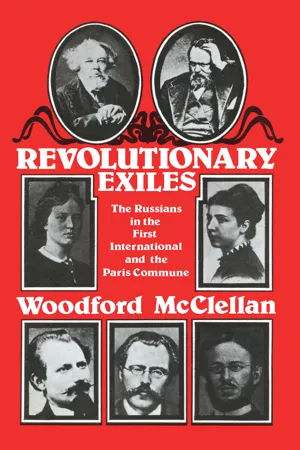
Revolutionary Exiles
The Russians in the First International and the Paris Commune
- 286 pages
- English
- ePUB (mobile friendly)
- Available on iOS & Android
eBook - ePub
Revolutionary Exiles
The Russians in the First International and the Paris Commune
About this book
This book, first published in 1979, examines the little-studied forerunners of the Russian revolutionary movement - the Russian section of the First International. It looks at the social democratic and Marxist Russians in the International, as well as examining the complex relations between the terrorist Sergei Nechaev and Marx's friends, as well as tracing the activities of Michael Bakunin. It also analyses, for the first time in English, the activities of the Russian revolutionaries in the Paris Commune. It integrates early Russian social democracy into the larger context of European socialist and working-class movements.
Information
CHAPTER ONE
The Origins of Russian Social
Democracy
The brutal Russian suppression of the Polish Rebellion of 1863 helped bring to life a new organization, one offspring of which would, half a century later, destroy tsarism. The West European working class, awakening to a sense of its own latent power and its dignity, readily understood that a tyrant—Alexander II—who shot and hanged Poles seeking freedoms already won in the West posed a threat to all Europe. European labour therefore rose up in protest against the Tsar's brutality, and in so doing took a significant step toward unity. The International Working Men's Association, or First International, would surely have come into existence even without the Polish events of 1863, but the birth would have occurred later and the organization would have taken a different form. Its origins went deep into European history, especially, of course, to the French Revolution. And its first pronunciamento, as one historian has pointed out, ‘was not the Inaugural Address [which Karl Marx wrote in 1864] but rather the Communist Manifesto.’1 The Manifesto had first proclaimed on a wide and sustained basis the general idea, ‘workers of the world, unite!’ There had been some hopes that that idea, or rather a broader version embracing all democratically-inclined social groups, might become a reality in 1848–9, but the great uprisings collapsed and a period of reaction and war followed. Out of the reaction came the First International.
The International A ssociation and the Secret Societies
After the Treaty of Paris wrote an end to the Crimean War, Louis Bonaparte made a gesture of studied goodwill toward the French working class, permitting a delegation to go to England to propose the creation of a ‘League of Workers of All Nations’. The delegation was composed largely of Proudhonists, Parisian skilled workers attracted by the prospect of reviving the old sociétés de secours mutuels.2 In London, a mixed group of ex-Chartists, trade unionists, an International Committee (composed of English radicals and various émigré groups) and other individuals met the Frenchmen. The International Committee had for some time been thinking along the lines proposed by the French, whose initiative bore fruit in August 1856. In that month, a group in London had organized the International Association, the last important precursor of the International Working Men's Association.
It remains impossible to piece together anything more than a sketch of the history of the International Association.3 In addition to the groups already cited, the German Workers' Educational Society, a group of skilled craftsmen, émigrés who had been in the Communist League in the 1840's, helped to form the new organization. Also involved were the London Revolutionary Commune (a Polish émigré group) and the Commune Révolutionnaire of the radical French émigrés.4 The organizational structure of the International Association followed that of earlier societies, especially the Fraternal Democrats of the 1840's, and that structure was to reappear in the IWMA.5 A central committee of five members of each nationality in the Association co-ordinated activities and information. There was to be an annual general meeting, and the headquarters was to be in London.
A resolution adopted at the first meeting of the International Association stated in part,
The…societies engage themselves to use all their power to induce the citizens of all countries to organise socialist and revolutionary national societies, to bind them together by means of the general association, in order to make the international propaganda profit by the strength of the association of all the individuals, and the various national propaganda profit by the strength of the association of all the people, and so prepare the success of the future revolution— success which past revolutions could not achieve, for not having known and practised the law of solidarity, without which there is no salvation either for the individuals or for the people.6
These same ideas reappeared in the Provisional Rules and Statutes of the First International.
The dearth of information on the International Association is due in part to the fact that it was only semi-public. Deeply involved in it were Masonic groups, Blanquists in the Commune Révolutionnaire and a clandestine, quasi-Masonic organization known as the Philadelphians. Secret societies had flourished in Europe since the Middle Ages, and one of the most important, Freemasonry, had been a moral and sometimes political force in many countries since the 18th century. It is therefore not surprising that such societies were represented in the International Association, which clearly had a moral and a revolutionary mission. Many of these societies (Freemasonry usually excepted) were sympathetic to terror, applauding, for example, Felice Orsini's attempt on the life of Louis and Eugénie Bonaparte on January 14, 1858.7
The International Association did not have a very active public life until late in 1858, when it issued a manifesto rejecting Mazzini's exhortation to the European left to relegate the ‘social question’ to a secondary role and emphasize the various struggles for national independence, while cooperating with the middle classes. The International Association rebuked Mazzini, but the Poles, the Philadelphians and the Commune Révolutionnaire did not sign its manifesto.8 Many members withdrew over the Mazzini issue. Some rejoined when a new central committee was elected in 1859, but the organization had clearly outlived its usefulness. It issued a manifesto on the Franco-Austrian War, held a last meeting in June 1859, then disappeared, leaving few clues to its identity.
Toward the Formation of the International, 1859–1863.
‘So England celebrated a fresh triumph of her liberty!’ Thus Alexander Herzen concluded his account of the rejoicing at the ‘not guilty’ verdict in the trial of Simon Bernard, Orsini's accomplice.9 There was more reason for the exiled Russian writer and socialist to applaud later: the ‘Conspiracy to Murder’ Bill, which would have abrogated the right of political asylum and would have permitted foreign powers to exercise police jurisdiction over their nationals on British soil, died in Parliament. The Palmerston government fell with the bill, and that, coupled with mutiny in India, the T'ai P'ing Rebellion in China and economic crisis at home seemed to bode ill for Great Britain.
But the severe economic depression had reached bottom in 1857 and the nation began to recover. The labour movement in general was making modest gains, and the labour aristocracy—skilled workers and craftsmen—was making unprecedented advances. In 1859, the aristocracy formed the London Trades Council to provide ‘mutual aid in dis-putes.’10
The London Trades Council played an important role in the founding of the International Working Men's Association. Before that took place, however, great events once again shook the world. Louis Bonaparte conspired with Cavour, his former partner in the Crimean War, to trick Austria into armed conflict. As a result of that encounter, Italy was united, France took Savoy and Nice, Garibaldi's reputation penetrated even to remote Russian and Polish villages, and the French Emperor came to believe himself invincible. The creation of the Kingdom of Italy took place on March 17, 1861. Two weeks earlier, Alexander II had decreed the emancipation of 22,500,000 Russian serfs, and three weeks later the United States plunged into civil war. Violence, upheaval and rapid change were again testing the stability of the European order and its overseas extensions.
The London Trades Council directed and publicized British labour's support for the Union in the American Civil War. Abraham Lincoln was keenly aware of the sacrifices this entailed: ‘I know and deeply regret,’ he wrote to a committee of British workers, ‘the sufferings which the workers of Manchester are undergoing in this crisis…. Under these circumstances their conduct is an exalted example of Christian heroism, which has not been surpassed in any country in any epoch’.11 The strongly pro-Union stance of labour helped dissuade Palmerston's second ministry (1859–1856) from following its natural inclination to intervene on the Confederate side.
In 1862 the captains of British industry held an International Exhibition in London, and more than mere material achievements were on display. So far had Great Britain come from the labour policies of the early Industrial Revolution that the government invited foreign workers to attend in order to see how splendidly their British counterparts were faring. About 750 French workers and a small Italian delegation (composed exclusively of Mazzinians) responded to the invitation. The British trade unionists regarded the Frenchmen with some suspicion, considering them all too comfortable with Louis Bonaparte's government, but that did not hinder discussion of further and stronger international contacts. George Odger and William Cremer agreed with the leader of the French delegation, Henri-Louis Tolain, to explore sentiment concerning the establishment of a permanent international working-class association. That was as far as things went in 1862; but the crucial first step had been taken. Enter now the Polish issue.
When detachments of the Russian army began breaking down doors in Polish cities and towns during the night of January 14–15, 1863, seizing young men secretly selected for conscription, Polish honour and self-respect—qualities long imperfectly understood by the tsars—demanded a response. Not since the reign of the unstable Paul I, grandfather of Alexander II, had such barbaric conduct occurred in Poland in peacetime. The Poles resisted, but after some initial successes the units of the revolutionary forces that dared to stand and fight were annihilated. The Russian government offered rewards and concessions to those who remained loyal, and few Polish peasants needed much encouragement to turn against the gentry. The successful attempt to split the Poles was accompanied by the introduction in Lithuania and White Russia, where the rebellion had assumed a particularly serious form, of a regime of terror associated with the name of General M.N. Muravyov. Having earned the epithetum ornans ‘Hangman’ for his work in the suppression of the Polish insurrection of 1830–1, Muravyov proved that he had not forgotten the standards of that inglorious campaign. Alexander II professed distaste for his methods, but when rebellion threatened he gave Muravyov carte blanche. (General F.F. Berg, who succeeded the Grand Duke Constantine as viceroy in Poland at the end of the summer, copied the Muravyov ‘system.’12)
Protest against Russian action in Poland began as soon as the news reached the West. French diplomats in Geneva reported that the ‘parti démagogique’ in that city organized a mass meeting at which Wladyslaw Mickiewicz (son of the famous poet), the German ‘48-er J.P. Becker, and various Geneva politicians spoke in support of the rebels. The German Workers’ Educ...
Table of contents
- Cover Page
- Half Title page
- Title Page
- Copyright Page
- Dedication
- Acknowledgements
- Contents
- Abbreviations
- Preface
- Chapter 1: The Origins of Russian Social Democracy
- Chapter 2: The New Russian Revolutionism
- Chapter 3: The Russians and the International in 1869
- Chapter 4: Sergio Furioso: Nechaev in 1869–70
- Chapter 5: The Russian Section of the International
- Chapter 6: Shifting Revolutionary Currents
- Chapter 7: The Slav Emigrés and the Crisis of 1870
- Chapter 8: The Slavs and the Paris Commune
- Chapter 9: Après Commune
- Chapter 10: The End of the First International
- Chapter 11: Conclusion
- Epilogue
- Bibliography
- Index
Trusted by 375,005 students
Access to over 1.5 million titles for a fair monthly price.
Study more efficiently using our study tools.
Frequently asked questions
Yes, you can cancel anytime from the Subscription tab in your account settings on the Perlego website. Your subscription will stay active until the end of your current billing period. Learn how to cancel your subscription
No, books cannot be downloaded as external files, such as PDFs, for use outside of Perlego. However, you can download books within the Perlego app for offline reading on mobile or tablet. Learn how to download books offline
Perlego offers two plans: Essential and Complete
- Essential is ideal for learners and professionals who enjoy exploring a wide range of subjects. Access the Essential Library with 800,000+ trusted titles and best-sellers across business, personal growth, and the humanities. Includes unlimited reading time and Standard Read Aloud voice.
- Complete: Perfect for advanced learners and researchers needing full, unrestricted access. Unlock 1.5M+ books across hundreds of subjects, including academic and specialized titles. The Complete Plan also includes advanced features like Premium Read Aloud and Research Assistant.
We are an online textbook subscription service, where you can get access to an entire online library for less than the price of a single book per month. With over 1.5 million books across 990+ topics, we’ve got you covered! Learn about our mission
Look out for the read-aloud symbol on your next book to see if you can listen to it. The read-aloud tool reads text aloud for you, highlighting the text as it is being read. You can pause it, speed it up and slow it down. Learn more about Read Aloud
Yes! You can use the Perlego app on both iOS and Android devices to read anytime, anywhere — even offline. Perfect for commutes or when you’re on the go.
Please note we cannot support devices running on iOS 13 and Android 7 or earlier. Learn more about using the app
Please note we cannot support devices running on iOS 13 and Android 7 or earlier. Learn more about using the app
Yes, you can access Revolutionary Exiles by Woodford McClellan in PDF and/or ePUB format, as well as other popular books in Politics & International Relations & 19th Century History. We have over 1.5 million books available in our catalogue for you to explore.