eBook - ePub
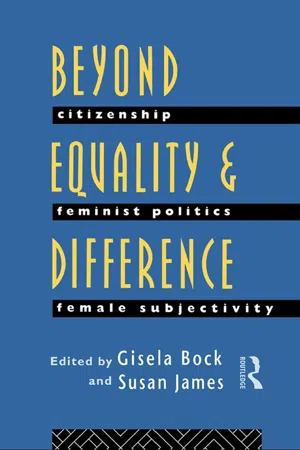
Beyond Equality and Difference
Citizenship, Feminist Politics and Female Subjectivity
- 224 pages
- English
- ePUB (mobile friendly)
- Available on iOS & Android
eBook - ePub
Beyond Equality and Difference
Citizenship, Feminist Politics and Female Subjectivity
About this book
Historically, as well as more recently, women's emancipation has been seen in two ways: sometimes as the `right to be equal' and sometimes as the `right to be different'. These views have often overlapped and interacted: in a variety of guises they have played an important role in both the development of ideas about women and feminism, and the works of political thinkers by no means primarily concerned with women's liberation. The chapters of this book deal primarily with the meaning and use of these two concepts in the context of gender relations (past and present), but also draw attention to their place in the understanding and analysis of other human relationships.
Information
Part I
Women’s citizenship, independence and sexual difference
Chapter 1
Equality, difference, subordination: the politics of motherhood and women’s citizenship
Carole Pateman
The feminist movement and feminist scholarship are frequently seen as divided between the advocates of equality on the one side and the advocates of sexual difference on the other. Some feminists are presented as demanding equality in the sense of the identical treatment of women and men, and others as demanding that the distinctive characteristics and activities of women should be given special consideration, and it appears that women are forced to choose, and have always been forced to choose, between the two. As Joan Scott has commented:
When equality and difference are paired dichotomously, they structure an impossible choice. If one opts for equality, one is forced to accept the notion that difference is antithetical to it. If one opts for difference, one admits that equality in unattainable.1
This perception of the relation between ‘equality’ and ‘difference’ is not unique to the United States; but an extremely individualist political culture combined for long periods with a conservative Supreme Court has meant that a choice between equality and difference is often posed more sharply than in, say, Britain or Australia. One of the most recent examples is the verdict in the Sears case, in which the claim of the Equal Employment Opportunity Commission that a preponderance of men employed in commission sales resulted from discrimination against women workers was rejected in favour of the argument of Sears, Roebuck that this was the consequence of differences in the interests and voluntary choices of women and men.2a
A common interpretation of the history of women’s struggle for citizenship, and especially for the suffrage, is that it was simply a campaign for equality, for the ‘rights of men and citizens’ to be extended to women. This view misunderstands the way in which our predecessors fought.for citizenship. From at least 1792, when Mary Wollstonecraft’s A Vindication of the Rights of Woman was published, women have demanded both equal civil and political rights, and that their difference from men should be acknowledged in their citizenship. Most suffragists, for example, argued that womanhood suffrage was required as a matter of justice and to make government by consent a reality, and also that the distinctive contribution that they could make to political life as women was a major reason why they should be enfranchised. A rift in the feminist movement opened up in the inter-war years in the United States and Great Britain over the question of protective legislation for women workers and welfare measures for mothers and children; supporters of the Equal Rights Amendment and ‘equal rights’ were arrayed on the one side and the advocates of social reform and the New Feminists on the other. The rift was very real and the controversy sometimes heated. Nevertheless, positions on both sides were not as clear cut as the simple opposition between ‘equality’ and ‘difference’ suggests. Indeed, it is often overlooked that since all those involved had supported women’s suffrage, the argument was carried on against the background of unanimous support for one very important aspect of ‘equality’.
Nor was there a clear division between working-class proponents of ‘difference’ and ‘protection’ and middle-class demands for ‘equal rights’. Some women workers in Britain opposed protective legislation because it excluded women from various areas of employment, and some women trade unionists and women workers supported the National Women’s Party (NWP) which led the fight for the ERA in the United States. Moreover, the NWP insisted that it was not against protective legislation if it applied to both sexes; and its leader, Alice Paul, stated, for example, that women were ‘the peace-loving half of the world and the home-making half of the world’ .3 In Britain, ‘equality’ feminists in the Open Door Council also supported protective legislation that applied to men and women, and were in favour of maternity benefits for women workers.4 From the other side, members of the Women’s Bureau in the United States, who opposed the ERA, tried to secure equal-pay legislation, and the New Feminists in Britain saw family allowances as a means to reduce a wife’s dependency on her husband, that is, as a means of increasing ‘equality’. Blurring the opposition even further, the Six Point Group demanded, ‘alongside equal pay, that “[T]he economic value of the work of women in the home must be recognized”’.5
These examples should be sufficient to indicate that even when ‘equality’ and ‘difference’ have been associated with two wings of the feminist movement, the politics of the feminist movement is a good deal more complex than is often suggested. I want to investigate, in an exploratory fashion, another aspect of this complexity: what I shall call the politics of motherhood. The fact that only women have the capacity to become pregnant, give birth and suckle their infants is the mark of ‘difference’ par excellence. Childbirth and motherhood have symbolized the natural capacities that set women apart from politics and citizenship; motherhood and citizenship, in this perspective, like difference and equality, are mutually exclusive. But if ‘motherhood’ represents all that excluded women from citizenship, mother hood has also been constructed as a political status. Motherhood, as feminists have understood for a very long time, exists as a central mechanism through which women have been incorporated into the modern political order. Women’s service and duty to the state have largely been seen in terms of motherhood, and to begin to examine the politics of motherhood it is necessary to see how women’s duty is connected to men’s service to the state as workers and soldiers.
Women’s inclusion into the political order needs special emphasis, since it is often assumed that the problem of women’s citizenship is one of exclusion. A major reason for the complexity of women’s political status is that it has never been a matter of mere exclusion. Women’s political standing rests on a major paradox; they have been excluded and included on the basis of the very same capacities and attributes. Feminist theorists have shown how political constructions of what it means to be a man or a woman are central to conceptions of the well-ordered polity. In my own work I have examined how the classic contract theorists presented sexual difference as the political difference between freedom (men) and subordination (women). Women were held by nature to lack the characteristics required for participation in political life, and citizenship has been constructed in the male image.6 Women, our bodies and distinctive capacities, represented all that citizenship and equality are not. ‘Citizenship’ has gained its meaning through the exclusion of women, that is to say (sexual) ‘difference’.
But this is only part of the story of the development of modern patriarchy. The classic theorists did not completely exclude women from the political order, from ‘civil society’. The creation of modern patriarchy embodied a new mode of inclusion for women that, eventually, could encompass their formal entry into citizenship. Women were incorporated differently from men, the ‘individuals’ and ‘citizens’ of political theory; women were included as subordinates, as the ‘different’ sex, as ‘women’. They were incorporated as men’s subordinates into their own private sphere, and so were excluded from ‘civil society’ in the sense of the public sphere of the economy and citizenship of the state. But this does not mean that women had no political contribution to make and no political duty to perform. Their political duty (like their exclusion from citizenship) derives from their difference from men, notably their capacity for motherhood.
The eighteenth-century doctrine of republican motherhood provides an illustration of the multiple layers of meaning of motherhood as a political status. The political theory of civic republicanism emphasized active political participation by citizens imbued with civic virtue, who were also capable of bearing arms. Republican citizens were thus men and soldiers—but what of women? They were to be the subordinate companions of citizens, but with their own political task; they were to be republican mothers. In America, a republican mother was excluded from citizenship, but she had a crucial political part to play in bearing and rearing sons who embodied republican virtues. She remained an auxiliary to the commonwealth but an auxiliary who made a fundamental political contribution.7 During the French Revolution—when the ‘rights of men and citizens’ were first proclaimed—women’s political rights and activities were suppressed and their place declared to be that of republican mothers.8
Why should the republican mother not be a citizen? There was, from a feminist perspective, no rational reason at all. Women would express their citizenship, in part at least, through motherhood. From the 1790s onwards, the demand was made that women’s private duty should become part of citizenship. A century after the French Revolution, in the 1890s and early 1900s, as Karen Offen has shown, a ‘familial feminism’ was predominant in France.9 Feminists argued that the state should support women in their duty as mothers and improve the material conditions of motherhood, and that those who performed this national task should be granted the standing and rights of citizens.
This argument had been made during the period of the French Revolution by Mary Wollstonecraft. As I noted above, Mary Wollstonecraft argued simultaneously for equality and the recognition of difference. She called for equal civil and political rights for women and their economic independence from their husbands—stating, ‘Let woman share the rights and she will emulate the virtues of man’—and, at the same time, for women’s citizenship to be expressed differently from men’s. Women had a ‘peculiar destination’ as mothers, and their equal citizenship would be expressed through their motherhood. She wrote that, ‘speaking of women at large, their first duty is to themselves as rational creatures, and the next, in point of importance, as citizens, is that, which includes so many, of a mother’. She hoped that the day would come when men would be despised if they were not active citizens; ‘and while he was employed in any of the departments of civil life, his wife, also an active citizen, should be equally intent to manage her family, educate her children, and assist her neighbours’.10
The problem with this feminist strategy is that it remains impaled on the horns of what I have called Wollstonecraft’s dilemma. The dilemma arises because, within the existing patriarchal conception of citizenship, the choice always has to be made between equality and difference, or between equality and womanhood. On the one hand, to demand ‘equality’ is to strive for equality with men (to call for the ‘rights of men and citizens’ to be extended to women), which means that women must become (like) men. On the other hand, to insist, like some contemporary feminists, that women’s distinctive attributes, capacities and activities be revalued and treated as a contribution to citizenship is to demand the impossible; such ‘difference’ is precisely what patriarchal citizenship excludes.
Contemporary arguments about the re-evaluation of women’s capacities, especially motherhood, also raise another question: namely, how is ‘motherhood’ to be understood? Does ‘motherhood’ refer only to the relation between mother and child; or does ‘motherhood’ also refer to women’s standing in the political order? One feminist argument, especially influential in the United States, treats motherhood in the former sense and focuses on ‘maternal thinking’.
Sara Ruddick argues that all thought is a response to social practice; in this case, the practice or discipline of motherhood. Maternal thinking grows out of a mother’s concern for the child’s preservation, growth and acceptability (will the child be an ‘acceptable’ member of society?) and is centred around ‘attentive love’.11 The notion of maternal thinking does not involve a simple return to an argument from (women’s) nature. Ruddick insists that ‘maternal’ is a social category, so that men, if they care for others, can be maternal thinkers. She argues that the conditions of women’s motherhood have largely been defined by men, thus maternal thinking is always open to determination by the dominant culture and, hence, to inauthenticity. Maternal thinking has to be transformed by feminist consciousness, and then, Ruddick argues, ‘the self-conscious inclusion of maternal thought in the dominant culture will be of general intellectual and moral benefit’. Once maternal thinking is brought into ‘the public realm’ the care of children can become ‘a work of public conscience and legislation’.12 Similarly, Jean Elshtain claims that, ‘were maternal thinking to be taken as the base for feminist consciousness, a wedge for examining an increasingly overcontrolled public world would open immediately’.13 The task for feminists, Ruddick states, is to formulate a ‘theory of justice shaped by and incorporating maternal thinking’.14
An argument based on the ‘difference’ symbolized by motherhood has inevitably provoked a response from an advocate of ‘equality’. Mary Dietz argues that maternal thinking reinforces the split between private and public. Maternal thinking is not political; it arises from a relationship between unequals (the mother and child) that is ‘intimate, exclusive, and particular’, and is thus opposed to democratic citizenship which is ‘collective, inclusive, and generalized’. The bond between mother and child is quite different from the bonds of citizenship. To argue that maternal consciousness can be a basis for feminism and citizenship is to look at political life from the wrong way round. Only when women act as citizens, not mothers, can the policies advocated by feminists be implemented. Dietz concludes that ‘accordingly, the values [feminists] must defend are not as such maternal (the growth and preservation of children) but political (freedom, equality, community power)’. Feminists should not reduce women’s identity to the single dimension of ‘mother’, but should endeavour to ‘[nurture] the reality of women as, in large part, citizens’.15
The debate therefore continues to oscillate between ‘difference’ (maternal thinking should be valued and brought into the political arena) and ‘equality’ (citizenship not motherhood is vital for feminists) and so remains caught in Wollstonecraft’s dilemma. There are also other problems when ‘motherhood’ is seen only in terms of the mother-child relation. For instance, attention is deflected from the structure of sexual relations and the meaning of ‘sex’ in contemporary society; in other words, little consideration is given to the context in which women become pregnant.16 Instead, attention becomes focused on ‘motherhood’ as part of ‘the family’, the private sphere, and motherhood appears as either non-political or outside politics, and two solutions to women’s predicament present themselves. One popular proposal is for ‘shared parenting’ within the family; men must be encouraged to be ‘mothers’. But as Lynne Segal has commented rather sharply: ‘watching childbirth, pushing prams, putting children to bed, many men now relate sensitively to women and children in ways unthinkable to their fathers—yet, the edifice of male power remains’.17 The other proposal is that ‘motherhood’ be inserted into politics and citizenship in the form of maternal thinking. But ‘motherhood’, in another sense, has been incorporated into politics for a very long time.
Motherhood as a political status, as a major vehicle of women’s incorporation into the political order, has shaped women’s duty to the state and women’s citizenship. I want to approach women’s political duty and service from two directions: the structure of the welfare state and the question of the political obligations of citizenship. (Within the confines of the present essay, I cannot discuss the way in which much of women’s political ac...
Table of contents
- COVER PAGE
- TITLE PAGE
- COPYRIGHT PAGE
- CONTRIBUTORS
- ACKNOWLEDGEMENTS
- INTRODUCTION: CONTEXTUALIZING EQUALITY AND DIFFERENCE
- PART I: WOMEN’S CITIZENSHIP, INDEPENDENCE AND SEXUAL DIFFERENCE
- PART II: MATERNITY, EQUALITY AND DIFFERENCE IN HISTORICAL CONTEXTS
- PART III: JUSTICE, THE FEMALE SELF AND THE POLITICS OF SUBJECTIVITY
Trusted by 375,005 students
Access to over 1.5 million titles for a fair monthly price.
Study more efficiently using our study tools.
Frequently asked questions
Yes, you can cancel anytime from the Subscription tab in your account settings on the Perlego website. Your subscription will stay active until the end of your current billing period. Learn how to cancel your subscription
No, books cannot be downloaded as external files, such as PDFs, for use outside of Perlego. However, you can download books within the Perlego app for offline reading on mobile or tablet. Learn how to download books offline
Perlego offers two plans: Essential and Complete
- Essential is ideal for learners and professionals who enjoy exploring a wide range of subjects. Access the Essential Library with 800,000+ trusted titles and best-sellers across business, personal growth, and the humanities. Includes unlimited reading time and Standard Read Aloud voice.
- Complete: Perfect for advanced learners and researchers needing full, unrestricted access. Unlock 1.5M+ books across hundreds of subjects, including academic and specialized titles. The Complete Plan also includes advanced features like Premium Read Aloud and Research Assistant.
We are an online textbook subscription service, where you can get access to an entire online library for less than the price of a single book per month. With over 1.5 million books across 990+ topics, we’ve got you covered! Learn about our mission
Look out for the read-aloud symbol on your next book to see if you can listen to it. The read-aloud tool reads text aloud for you, highlighting the text as it is being read. You can pause it, speed it up and slow it down. Learn more about Read Aloud
Yes! You can use the Perlego app on both iOS and Android devices to read anytime, anywhere — even offline. Perfect for commutes or when you’re on the go.
Please note we cannot support devices running on iOS 13 and Android 7 or earlier. Learn more about using the app
Please note we cannot support devices running on iOS 13 and Android 7 or earlier. Learn more about using the app
Yes, you can access Beyond Equality and Difference by Gisela Bock,Susan James in PDF and/or ePUB format, as well as other popular books in Social Sciences & Philosophy History & Theory. We have over 1.5 million books available in our catalogue for you to explore.