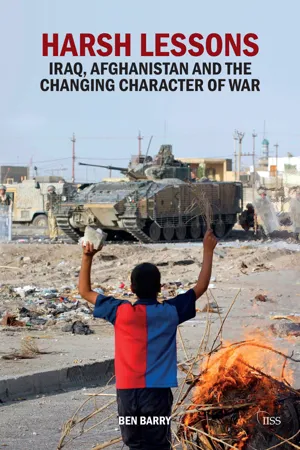
As the character of the wars in Afghanistan and Iraq shifted from regime change to prolonged counter-insurgency campaigns, they became increasingly political, even at the tactical level. Sometimes described as ‘armed politics’, these dynamics were heavily influenced by the battle of the narrative. This contest focused on influencing attitudes and involved insurgent and militia propaganda, international forces’ information operations and statements by a wide variety of political and military leaders.
The government of US President George W. Bush, who was inaugurated in January 2001, considered operations such as those in the Balkans and the 1994–95 intervention in Haiti to have fixed the US military in open-ended commitments that significantly reduced strategic flexibility. As a result, the administration sought to reduce the use of US military forces for nation building and to make them more flexible, deployable and responsive – by fully exploiting the RMA.
After the Taliban government in Kabul refused to expel al-Qaeda and hand over Osama bin Laden in the wake of 9/11, the US faced the unforeseen requirement of having to attack Afghanistan. Washington developed a plan in which CIA teams would arm and fund the anti-Taliban Northern Alliance militias, with US special-operations forces (SOF) linking up with the CIA and the Northern Alliance to coordinate supporting airstrikes. US ground troops would be introduced to complete the destruction of the Taliban and al-Qaeda. Once this was complete, there would be stabilisation operations.
From March 2002 onwards, the majority of US government and military attention switched from stabilising Afghanistan to planning the attack on Iraq. Afghanistan became a strategic ‘economy of force’ operation. In May 2003, US Secretary of Defense Donald Rumsfeld told journalists that in Afghanistan ‘we’re at a point where we clearly have moved from major combat activity to a period of stability and stabilization and reconstruction activities’.2
Before 9/11, the US had a military plan for an attack on Iraq. It envisaged a force of 400,000 troops assembling over time. The unexpectedly rapid US success in Afghanistan prompted General Tommy Franks, commander of US Central Command (CENTCOM), to develop a plan that could be implemented more quickly. It emphasised surprise and speed of manoeuvre, reducing the number of troops required:
The plan was executed largely as Franks intended. In 2003 around 170,000 troops – most of them American, and the remainder British or Australian – took part in the invasion of Iraq. They achieved a degree of surprise through the nearsimultaneous start of ground and air offensives rather than a long air campaign of the kind that US-led forces had employed in Operation Desert Storm in 1991. Operation Iraqi Freedom displayed an impressive degree of air–land synergy, in which precision attack and rapid manoeuvre by well-equipped and -trained land and air forces led to an even more decisive defeat of the Iraqi military than had occurred in 1991.4 On 1 May, Bush declared the end of major combat operations while standing on the deck of the aircraft carrier USS Abraham Lincoln, beneath a banner reading ‘mission accomplished’.
The Afghanistan War
The December 2001 Bonn Agreement, brokered between prominent Afghan leaders by the United Nations, saw Hamid Karzai appointed as interim Afghan president, and established a committee to draft a new constitution. International donors pledged billions of dollars in aid to support reconstruction, development, counter-narcotics programmes and the formation of new security forces in Afghanistan. There was to be an international effort to conduct security-sector reform. Around 10,000 US and Coalition troops remained in the country to neutralise al-Qaeda and Taliban forces. Wherever intelligence indicated promising targets, US forces launched search-and-destroy missions against the remnants of al-Qaeda and the Taliban. While these attacks were sometimes successful, the resulting civilian casualties and collateral damage increasingly alienated Afghan civilians.
At the same time, the UK assembled the International Security Assistance Force (ISAF). This was a multinational infantry brigade (later under NATO command) deployed by air to support the Afghan authorities in maintaining security in Kabul, as envisaged by the Bonn Agreement and established by a UN Security Council resolution.
In 2003 a new US-led theatre command for Afghanistan was formed: Combined Forces Command–Afghanistan (CFC–A). To assist the Afghan authorities and the UN, CFC–A commander Lieutenant-General David Barno developed a fresh concept for Coalition operations, at the centre of which was an inter-agency counter-insurgency (COIN) approach.
Barno allocated responsibility for all regions of Afghanistan to US military commanders. Conventional forces would cease their episodic deployment for search-and-destroy raids. Instead, they would be assigned to specific Afghan provinces. Most US troops were based in southern and eastern Afghanistan, where the al-Qaeda and Taliban threat was greatest.
In January 2004, the new constitution was adopted; the following October, Karzai was elected president. The international community agreed on very ambitious long-term targets for reconstruction, development and reform, particularly that of the Afghan army and police. The Karzai government’s authority was weak outside Kabul, and it often relied on the co-option and empowerment of local strongmen and militia warlords. These figures, as well as the underdeveloped and undertrained Afghan National Security Forces (ANSF), often preyed on local civilians.
The Taliban reconstituted its political and military capabilities. The group infiltrated Afghanistan from Pakistan, rebuilding its military and political networks. It exploited widespread discontent with government officials’ corruption and acts of extortion, as well as Afghan civilian deaths caused by US and Coalition forces. Attacks against the ANSF and government targets gradually increased.
In 2006 the US reduced its forces in Afghanistan to reinforce Iraq, and ISAF assumed responsibility for stabilising the whole country. British General David Richards, the new ISAF commander, formulated a COIN campaign plan that also sought to support and empower the Afghan authorities. To better coordinate Afghan and international efforts, a policy action group chaired by Karzai acted as a top-level committee. The Coalition conducted military operations to secure Afghan Development Zones. A force made up of Canadian, Dutch and UK troops was tasked with securing key areas for reconstruction and development in southern Afghanistan.
But the Taliban was much stronger in southern Afghanistan than expected, leading to intense fighting in which British troops only held their positions through the heavy use of airpower, resulting in collateral damage and civilian casualties. Coupled with an inadequate understanding of local cultural, political
Counter-insurgency (COIN) doctrine in Iraq and Afghanistan
After the Vietnam War, the US Army had deliberately neglected training and education in COIN. The US marines retained an interest in ‘small wars’, not least because they regarded some of their stability operations in Vietnam as successes.
However, some US Army and Marine officers quickly realised that the Afghan and Iraq wars were both insurgencies, requiring a COIN approach. Lieutenant-General David Barno adopted this approach in Afghanistan in 2003, and COIN thinking greatly informed 2004 planning by the marines before they assumed responsibility for Iraq’s Anbar Province. The marines and the army both used COIN approaches to clear Al-Qaim and Tal Afar.
US thinking about COIN reached critical mass in 2006, when General David Petraeus and Marine General James Mattis applied their considerable operational experience and intellectual energy to developing a new doctrine for COIN. A new COIN field manual only on the emerging lessons of and Afghanistan, but also on a historical analysis of successful and failed were that:
Military efforts are necessary and important to [COIN] efforts, but they are only effective when integrated into a comprehensive strategy employing all instruments of national power. A successful COIN operation meets the contested population’s needs to the extent needed to win popular support while protecting the population from the insurgents.
The integration of civilian and military efforts is crucial to successful COIN operations. All efforts focus on supporting the local populace and HN [host-nation] government. Political, social, and economic programs are usually more valuable than conventional military operations in addressing the root causes of conflict and undermining an insurgency.
An essential COIN task for military forces is fighting insurgents; how ever, these forces can and should use their capabilities to meet the local populace’s fundamental needs as well. Regaining the populace’s active and continued support for the HN government is essential to deprive an insurgency of its power and appeal. The military forces’ primary function in COIN is protecting that populace. However, employing military force is not the only way to provide civil security or defeat insurgents. Indeed, excessive use of military force can frequently undermine policy objectives at the expense of achieving the overarching political goals that define success. This dilemma places tremendous importance on the measured application of force.
Durable policy success requires balancing the measured use of force with an emphasis on nonmilitary programs. Political, social, and economic programs are most com monly and appropriately associated with civilian organizations and expertise; however, effective implementation of these programs is more important than who performs the tasks. If adequate civilian capacity is not available, military forces fill the gap.
COIN is also a battle of ideas. Insurgents seek to further their cause by creating misperceptions of COIN efforts. Comprehensive infor mation programs are necessary to amplify the messages of positive deeds and to counter insurgent propaganda.6
The manual also systematised the ‘clear, hold, build’ approach applied in Tal Afar. It became extremely influential, greatly informing the training and approach of US and allied forces in Iraq and Afghanistan from 2007 onwards.
and tribal dynamics, this caused further deterioration of security in southern Afghanistan. In September 2006, Canadian, US and Afghan troops conducted Operation Medusa, attacking a Taliban force assembling near Kandahar for an assault on the city. This was NATO’s first-ever brigade-level attack.5
Between 2006 and 2009, ISAF and the ANSF achieved a measure of stability in Kabul, as well as northern and western Afghanistan. But in the south and east, the Taliban’s strength increased, despite ISAF repeatedly mounting offensive operations. These efforts usually succeeded in clearing insurgents, but the lack of sufficient NATO or Afghan troops meant that international forces could not hold these areas and had to withdraw. As well as causing civilian casualties and collateral damage, these operations exposed Afghan civilians who had supported their government to Taliban retaliation after the withdrawal of Coalition troops. NATO commanders came to call this approach ‘mowing the lawn’. The Alliance was failing to make security gains sufficient to wrest the strategic initiative from the insurgents. Meanwhile, unexpectedly heavy casualties reduced the popularity of the war in NATO nations.
In March 2009, newly elected US president Barack Obama despatched an additional 17,000 US troops to Afghanistan. In a report completed in August 2009, the new ISAF commander, US General Stanley McChrystal, recommended the implementation of a comprehensive COIN campaign, applying relevant lessons from Iraq. This would require an additional 40,000 US troops. His report was leaked, sparking intense political and media speculation that damaged civil–military relations in Washington. In December 2009, Obama announced that 30,000 US troops would be sent to Afghanistan, with NATO invited to make up the difference. US objectives were to deny a safe haven to al-Qaeda and reverse Taliban momentum, preventing it from overthrowing the Afghan government. But the surge was to be time-limited, and to remain at its peak strength for only 18 months. Subsequently, the US and NATO agreed that ISAF’s combat role would end by 2015.
McChrystal assessed that the conflict’s centre of gravity was the Afghan population, which had to be protected from the insurgents and ISAF firepower. This ‘courageous-restraint’ approach was implemented through more restrictive rules of engagement. He sought to separate the Afghan people from the insurgents; improve their security, governance and economic prospects; and degrade insurgent capabilities. The military’s role included clearing the main populated areas of insurgents, conducting targeted raids to capture or kill insurgent leaders, developing the ANSF and supporting the development of Afghan governance.
ISAF’s main task was to extend Afghan government control over heavily populated areas in Helmand and Kandahar provinces. Cleared territory was to be held. The campaign began in February 2010 with Operation Moshtarak, which involved US, UK and Afghan forces in Helmand Province. The resilience of the insurgents, who fought back after the initial assault, showed that in ‘clear, hold, build’ operations, the second phase could be more difficult than the first. But the operation led to a significant improvement in security in central Helmand. In June 2010, the main effort switched to Operation Hamkari, designed to clear Kandahar city and surrounding districts. Heavy fighting by US, Canadian and Afghan troops cleared and held the districts of Panjwai, Zhari and Arghandab.7
ISAF’s understanding of the complex Afghan environment had greatly improved since 2006, as had its intelligence-gathering capabilities. Large numbers of surveillance systems and SOF were redeployed by the US from Iraq to Afghanistan. In December 2010, ISAF reached its peak strength of 131,000 troops. In May 2011, US SOF flew from Afghanistan to r...