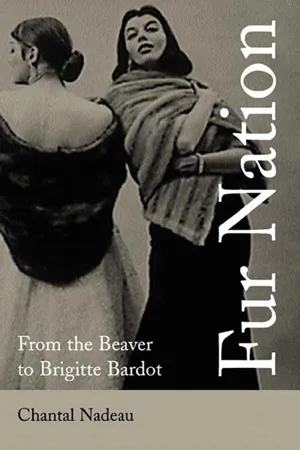
Fur Nation traces the interwoven relationships between sexuality, national identity, and colonialism. Chantal Nadeau shows how Canada, a white settler colony, bases its existence and its nationhood on a complex sexual economy based on women wrapped in fur.
Nadeau traces the centrality of fur through a series of intriguing case studies, including:
* Hollywood's take on the 330 year history of the Hudson Bay Company, founded to exploit Canada's rich fur resources
* the life of a postwar fur fashion photographer
* a 1950s musical called Fur Lady
* the battle between Brigitte Bardot's anti-fur activists and the fur industry.
Nadeau highlights the connection between 'fur ladies' - women wearing, exploiting or promoting furs - and the beaver, symbol of Canada and nature's master builder. She shows how, in postcolonial Canada, the nation is sexualised around female reproduction and fur, which is both a crucial factor in economic development, and a powerful symbol through which the nation itself is conceived and commodified. Fur Nation demonstrates that, for Canada, fur really is the fabric of a nation.
- 256 pages
- English
- ePUB (mobile friendly)
- Available on iOS & Android
eBook - ePub
About this book
Information
Part I
FUR NATION
1
MY FUR LADIES
The fabric of a nation
A fur garment is like a beauty salon. The lady who goes in comes out different. She not only looks different, she feels it.1Am I an accomplice to murder by stroking the softness of animal fur with the tips of my fingers? I have no remorse and I refuse to renounce the shiver of a body wrapped in fur, the emotion of the moment, when the evening closes with promises of night.Konopnicki (1995)2
Feeling fur
I was originally seduced into researching fur ladies by the extraordinary possibility of reaching for the timeless quality of fur, the sensational tactile value of fur in the evolving links between women, sexuality and nation. In this book, I propose the following: that fur exposes the relationship between women and nation like a touch, like a contact, a contract that goes beyond the natural property of skin. Thinking fur and skin as touches calls for a critical understanding of how the nation is both a tactile and a visual experience.
In his essay, Le toucher, Jean-Luc Nancy (2000) Derrida suggests that the very act of touching calls not only for the sensation of reaching, of knowing, but also of representing and imagining the relationship between two bodies, two textures, two moments. For Derrida, toucher goes beyond the visible appearance of an encounter, or the physicality of skins as static matter. Toucher is to expause, an expression that compresses the word peau (skin) and the verb expose. To expause the contacts between fur and women brings out a new set of points of contact that are rendered when one fabric strokes against the other; in other words, touch-ing as expause is to reach beneath the skin. Touch-ing is then a conceptualization of a network of relational effects and affects, a way to capture a sensation, to describe an encounter at once. There is a sensual dimension to this, a sensual dimension that also crosses that of experience. And because touch-ing is about reaching, it is very much about encounters. And this is what this book is about: encounters between skin and skins, between the female body, the beaver and the nation.
According to Derrida, touch-ing is as much visual as tactile: to touch is also to see. Fur too is as much about visual as tactile formations. When I look at fur, I cannot help but seeing the feeling of the fur at the tips of my fingers, I cannot help but feeling the skin that is wearing the fur; when I touch the fur ladies, I cannot help but uncover the many tangents that have made the fur nation possible as a sexual economy. In this sense, this project examines the representation of fur ladies as an encounter, an experience between skin and furs. In the word ‘toucher,’ touch and touching, there is necessarily a reflexive moment, an intimacy with the subject. When we say that we have been touched by something, by someone, there is a carnal, sensual and pleasurable quality to touch. There is the moment when the subject encounters the other, but also when the subject confronts her own boundaries. Henceforth, to be touched can also mean to be reached in a self-critical space. In his essay, Derrida uses “le toucher” (touch-ing and touch) to invite the readers to an encounter between two lives, two worlds: his and the philosopher Jean-Luc Nancy's, author of numerous phenomenological essays on “le toucher.” As a way to talk about my encounter with the fur ladies, allow me to steal from Derrida his unique encounter with Nancy, and to reappropriate it to my own use – is it, in fact, what Derrida urges the reader to do when he argues that in the touch one takes over and makes her own what originally was ‘external’ to her?
Fur Nation is about the encounter between skins – human and animal, yes – but also between an array of representations. The very gesture of touch-ing and touch in the context of this book serves a double function: a conceptual and heuristic dimension, and a methodological and analytical one. When fur pelts and the women's skin touch in their whimsicality or opposition, it is an an encounter, a contact (un “tact”, a tip, as Derrida describes it) that is established. From this interplay between the tactile and the visual, a vivid conceptualization of the ways the skin and fur feed each other to construct another space, another materiality, emerged: and it is this other texture, this third skin that is referred to as Fur Nation. In a similar fashion to Konopnicki's description cited at the opening of the chapter, a feeling (touch) of fur and women extends that of the softness of animal fur to reach that of a woman's skin. This is the moment where fur and skin becomes fur ladies and fur nation, where the sexual and the national are interwoven. In this economy of touch-ing – defined here as sexual economy – fur is not only the most pristine woman's second skin; fur reinvented in the fur ladies is the fabric of a nation. Skin, flesh, fur all act as interfaces of the female body, and in these material proximities lie the fundamentals of the national as a necessarily sexualized ensemble of geographies. In refusing to dissociate the sensuality of skin from the raw materiality/physicality of fur, I seek instead to articulate some of the cultural, political and historical interactions between women and fur. In this sense, this book unveils the sexual economy of a nation in which the ties between fur and skin are central. In other words, in the social and historical encounter between skin and pelts, fur lies at the very foundations of the sexual economy of the nation.
As part of a strategy of touch-ing, of skinning, central to my analysis is the notion of fur ladies, a term that fleshes out the multiple crossings between sexuality and nationalism in Canada, blurring the boundaries between the political, economic and sexual value of the beaver in the establishment of Canadian identity.3 The notion of fur ladies thereby condenses sexualized national narratives and encounters – tales and tails – in which the beaver appears as something more than a trading commodity, a token of value for the fur business, or a symbol of the French and British colonial enterprises. It also highlights the crucial yet shadowy role women have played as producers of the national economy. Hence, the gesture of (dis)articulating the boundaries between women, fur and nation relies on a very simple assertion: without skin there is no fur. And without ‘the beaver’ there is no trade, there is no movement of capital, there is no crossing of national borders, there is no memory, no nation. The beaver economy, drawing on the interfaces of skin, flesh, and fur, is what keeps the business of the nation going, wonderfully echoing the Hudson's Bay Company's motto Pro Pelle Cutem, a skin for a skin's worth. Fur in and of itself holds no interest in Fur Nation; the many ties and tangents that exist between skin and fur do. It is through this constant exchange, trading between sexual reference and gender that the fur ladies gain all their magnificence as national commodity. The interplay and simultaneity between the sensuality of skin and the raw materiality/physicality of fur provokes a critical reconsideration of the cultural and political formations that mark the ‘authentic Canadian beaver’ as both an emblem of national unity and a marker of national sexual economy.
In this context, the notion of fur ladies not only marks the encounter between women and fur, but also encapsulates the contractual proximities that exist between skin and fur in the construction of national spaces. The contract here is not only economic, it is also sexual. It is a touch, a contact (“tact”) that consumes and seals the nation, that sketches its representational circulation through a close bond. This double articulation between economy and sexuality begs a series of questions regarding the ways that nation, sex/uality and identity intersect: how profitable has “the beaver” – in its animal and human/female embodiment – been for the nation? How busy have the fur ladies/beavers been in the construction of a national economy? How is the representation of women as agents negotiated in a culture and a market where the expressive value of fur involves overshadowing the traces of skin? The notion of fur ladies represents a specific embodiment of the intersections of nationalism and sexuality, illustrating the connections between representations of a homosocial nation and representations of skin as more than skin. The troubling articulations between women, fur and nation embrace a broader context of signification than the one limited to the materiality and the visibility of the fabric in its most obvious form.
References to fur in the cultural economy of Canada go beyond the colonial – animal and human – imagery of the beaver to include the sexual and racial commodification and subjection of women in the more popularized manifestations of national discourses. In addition, the fact that the fur economy is necessarily transnational – after all, the fur trade is one of the many beauties of the French and British colonial legacies – accentuates its national trait. In a context of increasing transnational movement and transnational geographies, the value of fur is still shaped by the ways that gender, race and sexuality are localized and embodied within women's practices and proximities with fur and skin as production and commodity forms. At the core of my analysis on nation/women/sexuality and fur/ladies is the importance of thinking the nation through skin, and the ways that the production of the trans/national stems from a bewildering interplay between identities and performances, between the national and sexual boundaries that are constantly drawn and redrawn. As the nexus of skin and nation, fur speaks to the complex and contradictory participation of women in the shaping and mapping of the national – including the various textures of female agency in relation to the fur business. Like the process of skinning the beaver pelt to gather felt in the production of beaver hats,4 the role of women in the cultural fur enterprise in Canada is encapsulated in the very act of skinning the fur to get to the skin.
The way that sexuality unfolds to reconfigure national issues is key to my argument that without skin there is no fur. Along the same lines, the close encounter between fur and ladies seeks a reconciliation of the contradictions between the ubiquity of women in furs in the production of national imagery and popular display on the one hand, and with women's marginalization from political and economic formations of the nation on the other. If a sexual edge transpires in popular modes of representation and the consumption of popular events such as tourist campaigns, fashion trade, official commemorative imagery, and anti-fur rhetoric, the sexualization of these events within the nation and postcolonial space has yet to be explored on a theoretical level. While most feminist work addresses the centrality of gender and its bodily expressions in the process of defining the conditions of subalternity and agency for women in the national/postcolonial moment, very little attention is given to sexuality as central to the organization and development of the colonial and postcolonial enterprises. By sexuality I mean not only sexual identity and the various technologies at work in the constitution of national bodies, but also the specifics that intervene in the sexualization of the nation.
The critical gesture of dislodging sexuality from the liminalities of the body places sexuality outside of the body, or at least in its excessive and eccentric manifestations. This “distance” is not fortuitous, when one considers that the most readily available popular image associated with women and fur in Canada – and still today with the revival of the fur industry – has been that of an animal: the beaver – sex, race and class confused. Modes of production of fur imagery, even contemporary ones, consistently feature and position women – both as subject and material (skin) – as the real fur, because beaver and women in their economical reciprocity constitute the perfect marriage.
Even if the perfect match between woman and beaver originated from the outset of the fur trade, countless political events and cultural representations since then have reinforced this symbiotic encounter between skin and fur. Interrogating the obviousness between beaver and woman as surfaces uncovers the sexual value of skin in the fur economy. The trading (or contract) of proximities between women and fur is strongly entrenched in the production and representation of postcolonial ties as promiscuous ones. Promiscuity here refers to an analytical double entendre: i.e., in skinning and re-dressing the fur ladies, I question how women participate in the process of circulation of commodities, goods and the culture of national production, and how sexuality maps the development of a nation. While historically, the fur trade has been presented as an exclusively male homosocial controlled activity (Innis 1956; Newman 1985 and 1989; Mackay 1948), the production of fur as the national skin forces to reconsider the relations of intimacies that produce the national as a sexualized environment. For instance, in one of the founding texts of contemporary national history, Innis declares that “The history of Canada has been profoundly influenced by the habits of an animal which very fittingly occupies a prominent place on her coat of arms” (Innis 1956: 3). Beyond the fact that Innis's story discards a fundamental dimension of the politics of the fur trade and national formation, that of the trading of women, it does offer a close look at the origins of Canada – most notably a fascinating erotic taxonomy of fur geography where the richness of beaver (fur) is a question of northerly attitudes and exposure.5 Innis's fascination with the beaver, and the fact that his book The Fur Trade in Canada: An Introduction to Canadian Economic History starts with a chapter appropriately entitled here ‘The Beaver’ ‘resonates’ in a peculiar way here. The beaver that Innis is describing is an ethnographic matter, but also an intimate one.
Innis's beaver is compelling because it is at once a beast, a pelt, a national symbol, and captures in one word a very intimate relation to the land. It speaks to the unspeakable: the sexualization of the nation. While Innis cannot find room for women as women in his study, he clearly hints at the sensuous quality of the relations between the beaver, the nation, and its so-called habits, habits that are motherly transgendered, as was recently discovered (see chapter 2). While Innis cannot possibly talk about gender, and the troubling sexuality of the Canadensis Beaver, he does make the association between an animal – and a female intimate anatomy – and the nation the centrality of his analysis of the national development. The normative relation of the fur ladies to the nation is all the more remarkable for a critique of sexuality and nation given that Canada, as the land of the beaver, owes its foundation to the penetration of the beaver trade/trail by European traders. I cannot take credit for such an insight; Harold Innis made it in his landmark study of fur.
This detour via Innis helps us to revisit the tradition of seeing fur ladies as a sort of picturesque equivalent to the national landscape. The question of visibility is reflected in the publicness of women in furs as an accessible resource of the nation. In his study of homoerotic venues, Virtuous Vice, Eric Clarke stresses the importance of dislodging visibility as solely a matter of quantity, to actually reinscribe this visibility as a matter of normative quality; in other words, as a normative relation to publicity or publicness (Clarke 2000). What I take, and likely deconstruct from Clarke's insightful critique of representation as visibility is that, in the case of the fur ladies, the so-called ‘absence’ of women from studies of fur and the genealogy of the nation is as much a matter of sexual becoming as it is of commercial value, no matter how much the desire for representational equivalence may pose a temptation for legitimacy in constructing accounts of women's so-called involvement in the trade.
In terms of this research, the notion of ‘quality’ is intended to bring sexuality to the center of the analysi...
Table of contents
- Cover
- Half Title
- Full Title
- Copyright
- CONTENTS
- List of illustrations
- Acknowledgments
- Prologue
- PART I Fur nation
- PART II Beavers
- PART III Bardots
- Notes
- Bibliography
- Index
Trusted by 375,005 students
Access to over 1.5 million titles for a fair monthly price.
Study more efficiently using our study tools.
Frequently asked questions
Yes, you can cancel anytime from the Subscription tab in your account settings on the Perlego website. Your subscription will stay active until the end of your current billing period. Learn how to cancel your subscription
No, books cannot be downloaded as external files, such as PDFs, for use outside of Perlego. However, you can download books within the Perlego app for offline reading on mobile or tablet. Learn how to download books offline
Perlego offers two plans: Essential and Complete
- Essential is ideal for learners and professionals who enjoy exploring a wide range of subjects. Access the Essential Library with 800,000+ trusted titles and best-sellers across business, personal growth, and the humanities. Includes unlimited reading time and Standard Read Aloud voice.
- Complete: Perfect for advanced learners and researchers needing full, unrestricted access. Unlock 1.5M+ books across hundreds of subjects, including academic and specialized titles. The Complete Plan also includes advanced features like Premium Read Aloud and Research Assistant.
We are an online textbook subscription service, where you can get access to an entire online library for less than the price of a single book per month. With over 1.5 million books across 990+ topics, we’ve got you covered! Learn about our mission
Look out for the read-aloud symbol on your next book to see if you can listen to it. The read-aloud tool reads text aloud for you, highlighting the text as it is being read. You can pause it, speed it up and slow it down. Learn more about Read Aloud
Yes! You can use the Perlego app on both iOS and Android devices to read anytime, anywhere — even offline. Perfect for commutes or when you’re on the go.
Please note we cannot support devices running on iOS 13 and Android 7 or earlier. Learn more about using the app
Please note we cannot support devices running on iOS 13 and Android 7 or earlier. Learn more about using the app
Yes, you can access Fur Nation by Chantal Nadeau in PDF and/or ePUB format, as well as other popular books in Social Sciences & North American History. We have over 1.5 million books available in our catalogue for you to explore.