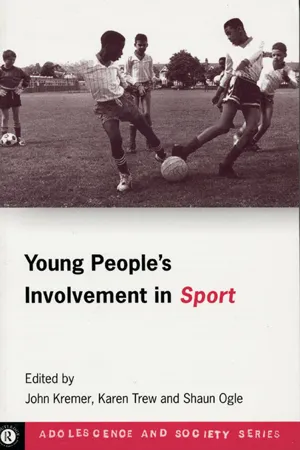
Based on survey data derived from face-to-face interviews with 2, 400 schoolchildren, 600 four-day diaries and focus groups with both elite performers, coaches and parents, the book offers a comprehensive overview of young people's involvement in sport and physical activity in the 1990s. Deliberately set in the context of the literature on sport involvement and participation motivation, and alongside wider policy concerns, individual contributors each have accessed the data in order to address a particular substantive topic.
Given the almost complete absence of hard data currently available in this field, the book should appeal not only to a local audience but to a wider international readership including sport scientists, sports' administrators, coaches, teachers and policy makers, indeed anyone with an interest in the who, what, why and how of young people's involvement in sport.
eBook - ePub
Young People's Involvement in Sport
- 296 pages
- English
- ePUB (mobile friendly)
- Available on iOS & Android
eBook - ePub
Young People's Involvement in Sport
About this book
Information
1
Introduction
Put the terms sport and young people together and almost inevitably questions about participation will spring to mind—who takes part, what do they do, where do they do it and why do they do it? As you may expect, of the four questions sport scientists have tended to busy themselves most with the last and most interesting, the why question, or the reasons or underlying motives behind involvement. An understanding of ‘why’ clearly is important but at the same time it can be argued that by artificially disentangling any single question, theme or area of concern, the totality of the picture or jigsaw which we call participation will be destroyed. For example, we may know a great deal about why young people like to take part in certain activities, and what turns them off other activities, but unless we know what is or has been available, and their opportunities for translating wishes into actions, then an understanding of underlying motives remains an artificial or academic enterprise.
It is to be hoped that the survey of young people which forms the mainstay to this book may go some way towards providing answers to a great many questions surrounding involvement in sport and physical activity, including the who, what, where and why. In aspiring towards that goal, the project joins a surprisingly small body of research which has tried to determine both the structural and the psychological determinants of sport and physical activity. The project itself has yielded four sets of data. The first set, which is the basis for the major part of this book, was derived from face-to-face interviews, the second from various psychometric measures administered to all young people who were interviewed (Chapter 3), the third from a series of focus groups with coaches, teachers, parents and élite performers (Chapter 8), and the fourth from weekly activity diaries completed by a subset of the sample (Chapter 7).
The face-to-face interviews were carried out with 2,400 young people, aged between 7 and 18 years, who were drawn from schools across Northern Ireland and who each had a unique biography of involvement in sport and physical activity. For each young person, a special set of circumstances have conspired together either to nurture or inhibit budding sporting potential. Unfortunately, there is not time to tell each of those stories. Instead, the intention here is to apply broader brush strokes across the data set, and so to identify trends across a discrete sample of young people, and from there to draw inferences which may be applicable to other samples.
From the outset of the project it was important to keep in mind key variables for subsequent analysis. The most significant of these have been afforded special attention in subsequent chapters, that is gender (Chapter 2), personality or individual differences (Chapter 3), community background (Chapter 6), and age (Chapter 5), alongside structural considerations such as the relationship between schools and clubs (Chapter 4).
Those familiar with previous surveys concerning socialisation and leisure may be surprised to learn that socio-economic class was not included as a primary variable. The reasons for this omission are twofold. First, at the time of survey a great many school principals in Northern Ireland refused to allow interviewers to gather information on parental occupations (given sensitivities over security force work); hence it was impossible to derive this variable through interviews. Second, selection at age 11 years has perpetuated the grammar/ secondary divide in post-primary schools in Northern Ireland, with those who attain certain academic standards being offered grammar school places. Inevitably, the middle classes tend to predominate in grammar schools and hence it was felt that this grammar/secondary divide could serve as a useful proxy for socio-economic class.
Chapter 9 stands apart from earlier chapters as it is a more overt attempt to tackle the more theoretical or ‘why’ question relating to participation. As such this chapter includes an innovative process model of sport participation which brings together a variety of structural, biographical, psychological and attitudinal components, set within the context of existing research, and tested against some of the key findings to emerge from the present survey.
PREVIOUS RESEARCH
Looking back at the history of work on young people’s sporting lives, it is possible to identify at least three discrete areas of activity. First there is the psychological, where, generally speaking, sport and exercise psychologists have focused on either how competitive sport may impact on children’s perception of sport and physical activity, or how models of intrinsic motivation (often derived from the wider world of education) can be operationalised in the world of sport. Second, there have been sport sociologists who have turned their attention towards socialisation, mainly during adolescence, and who look upon sport and leisure as an essential part of this process of socialisation. Third, there is a loose alliance of educationalists, developmentalists and medics who have endeavoured to chart children’s physical activity, primarily but not exclusively against the backcloth of the school curriculum. Over the years then there have been contributions from a variety of disciplines, including psychology, sociology, anthropology, education and medicine, but in all honesty with very few exceptions there has been virtually no co-ordination or liaison between these disciplines. Regrettably, this has prevented the subject moving forward on a broad front, and has certainly made the task of integrating the literature no easier.
A scan across this disparate literature reveals four themes which tend to recur. Apart from records of physical activity itself (referred to as ‘Activities’), there is concern with the factors which influence socialisation into sport itself (‘Antecedents’), the factors which encourage either continued participation or drop-out (‘Motivators and inhibitors’), and finally the consequences of participation in competitive sport (‘Outcomes’).
Major theoretical contributions are not spread evenly across this research landscape but have tended to cluster around very specific concerns in very specific ways. For example, internationally, the work on ‘Activities’ has almost inevitably been descriptive. There is a considerable literature charting physical education in schools and most especially in response to curricular changes (see Armstrong, 1990) but large-scale surveys or even estimates of activity rates outside the school curriculum are far from plentiful. In the USA, Martens (1988) drew on a variety of sources when estimating the number of young people between the ages of 6 and 18 years who were thought to be participating in sports away from school. He deduced that approximately 20 million or 44 per cent of America’s 45 million youths were involved in non-school sport, a figure made up of 20. 97 million boys (59 per cent) and 14.58 million girls (41 per cent). Softball was the most popular sport with both sexes (4.53 million), followed by baseball (4.53 million, including 3.91 million boys), swimming (3.93), soccer (3.9), bowling (3.57), basketball (3.35), tennis (2.59), gymnastics (2. 25) and athletics (1.75).
In equivalent research in 1974, baseball (4.99 million) and softball (4. 38) had topped the popularity charts, with soccer languishing in 11th place (1.24). The average age at which children had started to participate in sport was 11 years, although gymnasts (8 years) and baseball players (9 years) were both significantly younger, and ten-pin bowlers and tennis players (both 14 years) were older. Closer to home, the Sports Council (Great Britain) commissioned a survey of 4,437 young people and sport in England in 1994 (Mason, 1995), the report of which highlighted the interplay between school-based and extracurricular sport in the lives of young people, and which has the potential to become a very valuable database for further analyses of physical activity.
Other research has considered physical activity in relation to health-related fitness (HRF), an area of research which briefly mushroomed in response to the now less vociferous call for HRF as part of the new National Curriculum in the UK in the late 1980s. Despite being generally atheoretical, this descriptive work has been useful in disproving one popular ‘common-sense’ theory or misconception: that young people somehow magically and mysteriously take exercise and as a consequence are naturally fit; plainly the majority do not exercise often enough or hard enough to enjoy cardiovascular benefits and hence are not fit (Sleap and Warburton, 1992), and that the trend is towards ever poorer fitness levels among the young (see Willis and Campbell, 1992). Research has concluded, for example, that British children ‘have surprisingly low levels of habitual physical activity and that many children seldom experience the intensity and duration of physical activity associated with health related outcomes’ (Armstrong and McManus, 1994, p.23). This same study also showed that primary (5–11 years) and post-primary (11–18 years) schools in the UK were devoting among the fewest hours to physical education of all European countries, on average approximately 1½ hours per week.
Within Northern Ireland, the picture is not dissimilar. In 1991 the Sports Council for Northern Ireland (SCNI) sponsored a survey of post-primary schools which revealed that, on average, pupils in Year 8 (age 11–12 years, the first year of second-level education) received 114 minutes of curriculum-based physical education but this fell to 92 minutes for boys and only 85 minutes for girls by Year 12 (age 15–16 years, GCSE year) (Sutherland, 1992). In a similar vein, a survey of post-primary school children in 1989 revealed that approximately one-third admitted to not having taken exercise (defined as any activity that caused breathlessness) outside school in the seven days prior to the survey (Division of Physical and Health Education, Queen’s University, 1990).
Beyond childhood and even adolescence, research shows that the picture does not become any rosier. By way of example, according to the Northern Ireland Health and Activity Survey, ‘Of those aged 16–24, seven out of ten men and eight out of ten women were below the target threshold (of physical activity) likely to confer a benefit.’ (Ogle and Kelly, 1994, p.18).
In contrast to ‘Activities’, when considering ‘Motivators and inhibitors’ (usually intrinsic and extrinsic motivation respectively) then a great many theoretical contributions spring to view. Bandura’s self-efficacy theory, together with Harter’s theory of perceived self-competence, Deci’s cognitive evaluation theory and the work of Dweck, Maehr and Nicholls on achievement orientation, have all enjoyed prominence (for reviews, see Roberts, 1992; Weiss and Chaumeton, 1992). This work highlights how personal expectancies and values dominate the reasons why people take up sport, and how they can best be motivated to continue their involvement. Intrinsic motivation itself is now seen as multifaceted (Fortier et al., 1995; Frederick and Ryan, 1995), and achievement goals likewise (Roberts and Treasure, 1995). Of the many conclusions drawn from this work, an important message is just how dangerous extrinsic rewards can be in taking away from an experience which may have been enjoyable in its own right, and long before the ubiquitous cup, medal or ‘gong’ makes its appearance.
Alongside these contributions, other psychologists have sought to list ‘Antecedents’ or motivational factors, and to develop scales which can be used to measure motivation. There is now general consensus that the most significant factors appear to be perceived self-competence, fitness, affiliation, teamwork, competition and fun. These are seen to act in concert, although the combina...
Table of contents
- Cover
- Halftitle
- Adolescence and Society
- Title
- Copyright
- Contents
- List of figures
- List of tables
- List of contributors
- Preface
- 1 Introduction
- 2 Gender issues in sport participation
- 3 Individual differences and intrinsic motivations for sport participation
- 4 Predictors, patterns and policies for post-school participation
- 5 Age and sport participation
- 6 Sport and community background
- 7 Time for sport? Activity diaries of young people
- 8 Focus group interviews with élite young athletes, coaches and parents
- 9 Modelling participation motivation in sport
- 10 International perspectives on public policy and the development of sport for young people
- 11 Technical report
- Appendix: SCNI survey
- Index
Trusted by 375,005 students
Access to over 1.5 million titles for a fair monthly price.
Study more efficiently using our study tools.
Frequently asked questions
Yes, you can cancel anytime from the Subscription tab in your account settings on the Perlego website. Your subscription will stay active until the end of your current billing period. Learn how to cancel your subscription
No, books cannot be downloaded as external files, such as PDFs, for use outside of Perlego. However, you can download books within the Perlego app for offline reading on mobile or tablet. Learn how to download books offline
Perlego offers two plans: Essential and Complete
- Essential is ideal for learners and professionals who enjoy exploring a wide range of subjects. Access the Essential Library with 800,000+ trusted titles and best-sellers across business, personal growth, and the humanities. Includes unlimited reading time and Standard Read Aloud voice.
- Complete: Perfect for advanced learners and researchers needing full, unrestricted access. Unlock 1.5M+ books across hundreds of subjects, including academic and specialized titles. The Complete Plan also includes advanced features like Premium Read Aloud and Research Assistant.
We are an online textbook subscription service, where you can get access to an entire online library for less than the price of a single book per month. With over 1.5 million books across 990+ topics, we’ve got you covered! Learn about our mission
Look out for the read-aloud symbol on your next book to see if you can listen to it. The read-aloud tool reads text aloud for you, highlighting the text as it is being read. You can pause it, speed it up and slow it down. Learn more about Read Aloud
Yes! You can use the Perlego app on both iOS and Android devices to read anytime, anywhere — even offline. Perfect for commutes or when you’re on the go.
Please note we cannot support devices running on iOS 13 and Android 7 or earlier. Learn more about using the app
Please note we cannot support devices running on iOS 13 and Android 7 or earlier. Learn more about using the app
Yes, you can access Young People's Involvement in Sport by John Kremer, Shaun Ogle, Karen Trew, John Kremer,Shaun Ogle,Karen Trew in PDF and/or ePUB format, as well as other popular books in Psychology & History & Theory in Psychology. We have over 1.5 million books available in our catalogue for you to explore.