eBook - ePub
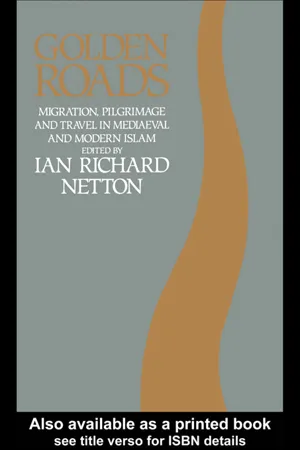
Golden Roads
Migration, Pilgrimage and Travel in Medieval and Modern Islam
- 193 pages
- English
- ePUB (mobile friendly)
- Available on iOS & Android
eBook - ePub
About this book
Essays on themes (migration, pilgrimage and travel) as old as Islam itself and integral in the development of a cosmopolitan Islamic social order embracing much of Africa and Eurasia.
Information
Section Three
Travel (Riḥla)
5
Basic Structures and Signs of Alienation in the Riḥla of Ibn Jubayr
In a previous article I have identified in the Riḥla of Ibn Baṭṭūṭa (AD 1304–1368/9 or 1377) what I termed his ‘pilgrim paradigm’.1 Using insights garnered from the three-tier approach to history devised by the great French scholar Fernand Braudel (1902–85), doyen supreme of the French Annales school of history, I maintained that this paradigm comprised ‘a series of four searches: for the shrine and/or its circumambient religious geography; for knowledge; for recognition and/or power; and for the satisfaction of a basic wanderlust’.2 Now it is frequently—and rightly—claimed that the Riḥla of Ibn Jubayr (AD 1145–1217) constituted a prototype for several others of the genre including that of Ibn Baṭṭūṭa .3 Indeed the debt of the former to other authors like Ibn Jubayr and al-‘Abdarī4 becomes ever more apparent, as recent scholarship continues to show.5 To what extent then, it may be asked, may a similar (prototype) pilgrim paradigm be identified in the Riḥla of Ibn Jubayr? As an aid to answering this question, it is proposed first in this article to analyse this Riḥla in terms of (1) its basic structures, and (2) some of its relevant semiotics.
The concept of ṭalab al-‘ilm is a noteworthy factor in the riḥlatayn of Ibn Jubayr and Ibn Baṭṭūṭa ,6 but it is one which should be handled with care. We see, for example, that Lenker has stressed the general relationship between pilgrimage and study: he notes that in certain Andalusian works after the middle of the eighth century ‘both the pilgrimage and study are two essential components of each biographical entry’;7 and, he goes so far as to maintain that ‘as a motive for travel, [ṭalab al-‘ilm] surpassed in significance all other incentives including the pilgrimage itself.8 While this statement may well have been true, however, ultimately of Ibn Baṭṭūṭa with his unquenchable wanderlust,9 it must be something of an exaggeration if applied unreservedly to Ibn Jubayr, despite his advice to the youth of the Maghrib [I.J. p. 258; see further in this article]: Ibn Jubayr’s Riḥla was undertaken for a specific religious purpose which had the pilgrimage to Mecca as its heart and goal. Indeed, his Riḥla was a pilgrimage undertaken to make expiation (kaffāra) for the specific fault of wine-drinking: even though he had been forced to drink the wine by the Almohad governor of Grenada, Abū Sa‘īd ‘Uthmān b.‘Abd al-Mu’min, to whom he was secretary, his delicate conscience bade him to make amends.10 This motive of kaffāra, rather than pure ṭalab al-‘ilm, must have been the driving force on his journey, and omnipresent to him, though it is indeed strange that Ibn Jubayr nowhere refers directly in his Riḥla to the real reasons for his journey. The details must be gleaned from other sources such as the seventeenth century of al-Maqqarī.11
Despite however, the basic difference in motivation behind each of the riḥlatayn under discussion, there is no doubting the exuberant delight which ‘ilm, and the experiences deriving from the search for ‘ilm, produced in both Ibn Jubayr and Ibn Baṭṭūṭa. The energetic visiting by both of mosque, tomb, shrine, college, saint and scholar bears ample witness to that.
Apart from their respective motivations, perhaps the other major essential difference between the works of Ibn Jubayr and Ibn Baṭṭūṭa lies in their basic structures. Ibn Jubayr’s Riḥla encompasses a much shorter timescale from the point of view of actual travel recorded(between AD 1183–1185), and consequently, far fewer cities and countries are visited than, for example, in the more wide-ranging Riḥla of his successor, Ibn Baṭṭūṭa. Ibn Jubayr’s work is much less a frame story like the latter’s (which was designed for the propagation of myths which might enhance a returning traveller’s reputation and massage an already large ego,12) and much more ‘a simple narrative of a voyage undertaken and experienced’.13 Mattock has divided the content of Ibn Jubayr’s work into two basic categories of description and narrative.14 Having observed that ‘[the Riḥla] is a straightforward, non-technical work, written in a simple style’,15 Mattock remarks:
Ibn Jubair’s descriptive writing seems to me to be good but unremarkable. It is interesting, simply written and well detailed; it does very well what it is intended to do: describe the places that he visits, so that their main features are clear to his audience.16
The structure of Ibn Jubayr’s Riḥla may, therefore, also be conceived in a simpler fashion than the more elaborate frame of Ibn Baṭṭūṭa and I propose to do so here by concentrating upon three very simple elements which seem to me to be the quintessential blocks upon which Ibn Jubayr’s work is structured and founded. These elements are, respectively, a trinity of time, place and purpose as expressed in (a) the author’s precise, almost neurotic, use of the Islamic calendar, (b) the travel or Riḥla impulse and associated ‘sense of place’ which imbues the entire narrative, and (c) the primary orientation towards, or focus on, Mecca, goal of the Islamic pilgrimage.
It is useful, in any examination of Ibn Jubayr’s usage, to examine first the later practice of Ibn Baṭṭūṭa, as far as dating is concerned. The latter author certainly deploys some dates in his text but what he provides certainly do not constitute a kind of textual punctuation or frame as happens in the earlier Riḥla of Ibn Jubayr. Indeed Gibb has noted, succinctly, of Ibn Baṭṭūṭa’s practice, which may, in any case have been that of his scribe and editor Ibn Juzayy: ‘Many of the dates give the impression of having been inserted more or less at haphazard, possibly at the editor’s request, but the examination and correction of them offers a task so great that it has not been attempted in this selection’.17 Dunn confirms this observation: ‘In composing the book, Ibn Baṭṭūṭa (and Ibn Juzayy, the literary scholar who collaborated with him) took far less care with details of itinerary, dates, and the sequence of events than the modern “scientific” mind would consider acceptable practice for a travel writer’.18 And while we do find formal dates at, for example, the beginning of the entire Riḥla [I.B.19 p. 14] and scattered infrequently elsewhere in the text [e.g. I.B. pp. 53, 110, 172, 339, 393, 529], we find that Ibn Baṭṭūṭa’s more usual narrative punctuation consists of such phrases as ‘I went next to…’20 (thumma tawajjahtu ilā…) [I.B. p. 31], ‘I travelled next through…’21 (thumma sāfartu fī …) [I.B. p. 33] and ‘We come to…’22 [I.B. p. 277].
By acute contrast, Ibn Jubayr uses his precise dating, in a surely conscious fashion, as a method of punctuating and dividing up his text. The entire Riḥla is laid out, month by month, according to the Islamic lunar calendar, [e.g. I.J.23 pp. 13, 122, 190 and passim]. Each section, thus precisely, carefully and, apparently accurately,24 introduced by date then at once contains a statement or description of the traveller’s exact present location and often a description of, or reference to, his next projected destination(s), and the journeying involved. Ibn Jubayr’s convention in his dating is to refer to the rising of the new moon, and also to provide Christian calendar equivalents; thus two typical diary entries, encapsulating all the above, read:
The Month of Rabī al-Awwal of the Year [5]80, may God acquaint us with His blessing
Its new moon rose (istahalla hilāluhu) on the night of Tuesday, corresponding to the 12th June, while we were in the previously mentioned village. Then we set out from there at dawn on that Tuesday and arrived at before midday of the same day [I.J. p. 214]
[and]
The Month of Jumāda al-Ūlā, may God acquaint us with His blessing.
Its new moon rose on the night of Friday, corresponding to the 10th August in foreign dating.
A Descriptive Survey of Conditions in the City [of Damascus], may God make it thrive in Islam. [I.J. p. 254]
The formula occasionally varies as where Ibn Jubayr refers to the new moon being obscured (ghumma hilāluhu ‘alaynā) [I.J. pp. 286, 318]. It is clear, furthermore, that the provision by the traveller of dating equivalents from the Christian calendar reflects the eclectic milieu in which he travelled, often, as is well known, using Christian ships [e.g. I.J. pp. 8, 317]. It was a strange age of real intercultural travel and trading, produced by centuries of co-operation, on the one hand, coexisting beside very real intercultural military strife produced by the Crusades, on the other, an apparent paradox upon which Ibn Jubayr himself felt moved to comment and rank among the ‘ajā’ib of his narrative [I.J. p. 260, see also pp. 271–3].
There is no doubt that, from a literary point of view, Ibn Jubayr’s passion for dating can seriously slow down his narrative, making his text appear sometimes more ponderous and monotonous than that of Ibn Baṭṭūṭa which is less obviously subject to formal considerations of strict chronology, though also less fluid in other respects. Nonetheless, the precision of the former can also have distinct advantages: it is clear that, while Ibn Baṭṭūṭa claims to have lost some of his very few notes [I.B. p. 369],25 Ibn Jubayr must have been a frequent, careful and punctilious diarist(or had an extraordinary memory). Furthermore the chronological problems encountered in any study of the Riḥla of Ibn Baṭṭūṭ26 are mercifully absent in that of Ibn Jubayr though, in fairness to the later traveller, it may be stressed that this is due as much to his predecessor’s comparative shortness of voyage as the methodical nature of Ibn Jubayr’s notetaking.
If attention to precise dating constitutes an obvious initial foundation for the Riḥla of Ibn Jubayr, then a ‘sense of place’,27 and the travel impulse ineluctably associated with that sense, constitutes a second. Here Ibn Jubayr is much more in harmony with Ibn Baṭṭūṭa. The former, like the latter, visited many of the great cities of Islam. And where Ibn Baṭṭūṭa expressed a wish to...
Table of contents
- Cover
- Half Title
- Title Page
- Copyright
- Dedication
- Contents
- List of Tables and Figures
- Preface
- Acknowledgements
- Abbreviations
- Section One: Migration (Hijra)
- Section Two: Pilgrimage (Hajj)
- Section Three: Travel (Rihla)
- Notes on Contributors
- Index of Persons
- Index of Places
Trusted by 375,005 students
Access to over 1.5 million titles for a fair monthly price.
Study more efficiently using our study tools.
Frequently asked questions
Yes, you can cancel anytime from the Subscription tab in your account settings on the Perlego website. Your subscription will stay active until the end of your current billing period. Learn how to cancel your subscription
No, books cannot be downloaded as external files, such as PDFs, for use outside of Perlego. However, you can download books within the Perlego app for offline reading on mobile or tablet. Learn how to download books offline
Perlego offers two plans: Essential and Complete
- Essential is ideal for learners and professionals who enjoy exploring a wide range of subjects. Access the Essential Library with 800,000+ trusted titles and best-sellers across business, personal growth, and the humanities. Includes unlimited reading time and Standard Read Aloud voice.
- Complete: Perfect for advanced learners and researchers needing full, unrestricted access. Unlock 1.5M+ books across hundreds of subjects, including academic and specialized titles. The Complete Plan also includes advanced features like Premium Read Aloud and Research Assistant.
We are an online textbook subscription service, where you can get access to an entire online library for less than the price of a single book per month. With over 1.5 million books across 990+ topics, we’ve got you covered! Learn about our mission
Look out for the read-aloud symbol on your next book to see if you can listen to it. The read-aloud tool reads text aloud for you, highlighting the text as it is being read. You can pause it, speed it up and slow it down. Learn more about Read Aloud
Yes! You can use the Perlego app on both iOS and Android devices to read anytime, anywhere — even offline. Perfect for commutes or when you’re on the go.
Please note we cannot support devices running on iOS 13 and Android 7 or earlier. Learn more about using the app
Please note we cannot support devices running on iOS 13 and Android 7 or earlier. Learn more about using the app
Yes, you can access Golden Roads by Ian Richard Netton in PDF and/or ePUB format, as well as other popular books in Theology & Religion & Islamic Theology. We have over 1.5 million books available in our catalogue for you to explore.