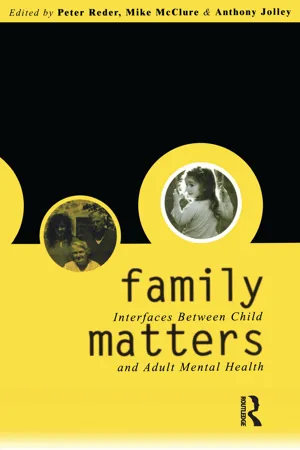
Family Matters focuses on research and clinical material which bridges the traditional gap between child and adult mental health. Rather than considering child and adult problems separately, the authors address the often complex interactions between the two, covering such topics as: · The implications of childhood trauma in later life · The impact of parental mental health problems on children · How interactions within a family can affect the mental health of all individuals within the family The authors review existing research and cover their own recent studies and practical experience, and put forward new theoretical models to underpin their recommendations for changes in practice, such as liason initiatives between child and adult services and specialised services to treat adolescents, parenting breakdown and perinatal psychiatric illness.
The findings and recommendations in Family Matters have have important implications for the organsiation and funding of mental health and related services, and staff training, and should be read by all those in professions concerned with child and adult mental health, including psychiatrists, family therapists, psychotherapists, nurses, health visitors and social workers, and health service managers.
eBook - ePub
Family Matters
Interfaces between Child and Adult Mental Health
- 320 pages
- English
- ePUB (mobile friendly)
- Available on iOS & Android
eBook - ePub
Family Matters
Interfaces between Child and Adult Mental Health
About this book
Information
Section 1
Introduction
Chapter 1
Interfaces between child and adult mental health
Introduction
What do we mean by the ‘interfaces between child and adult mental health’? One way to illustrate this is through clinical vignettes which raise issues that are probably echoed in services across the country. Consider the following.
A 7-year-old, only child of a single mother develops a sleep disturbance in which he resists going to bed and, once in his bedroom, cries for hours on end for his mother to comfort him. She regularly ends up sleeping in his bed with him as the only way to get him to go to sleep and to allow her to have any peace. She has a history of depressive episodes with suicidal thoughts which have required recurrent admissions to psychiatric wards and, in her more hopeless states of mind, she talks to her son about preparing for a life without her.
Are the problems of parent and child connected and, if so, what interventions might help resolve them? Could the impact of the mother’s problems on her child have been addressed before he developed symptoms?
A female patient is admitted to a psychiatric hospital under a Section of the Mental Health Act. The admitting psychiatrist asks about her current family and the patient volunteers that she has a daughter but she is ‘all right’. That evening, social services are called about this child, who is sitting on the doorstep of her home, unable to gain admission because her mother is not there.
Where does the responsibility lie to consider the welfare of the child—in the mother; in the extended family; in the admitting psychiatrist; in social services; or in a process previously negotiated between the professional agencies that caters for such circumstances?
A 39-year-old man with a long history of drug and alcohol misuse is referred by the court for an expert psychiatric opinion about his capacity to resume care of his two pre-adolescent children. Their mother has developed a psychotic disorder and is considered unsuitable as a long-term carer. The father spent time in the care of the local authority as a child because of neglect by his parents, and his chronic substance misuse has led to numerous concerns about his own health and his reliability as a parent. Even so, the children say that they wish to live with him.
What factors should the court take into account in determining the future care of the two children? What types of assessments would assist the court in its decision?
A 17-year-old young person comes to the attention of the police because of allegations that he has been involved in thefts, burglaries and arson. He is from a broken home, having witnessed violence between his parents before they separated, and had been referred five years previously to a child mental health clinic because of aggressive behaviour at school. The family attended the first assessment session but failed to attend all subsequent appointments offered.
What preventive work might have been possible to avoid this escalating antisocial behaviour? Is it appropriate for mental health services to be involved in his current management and, if so, should it be a team working with children and adolescents or with adults?
A 35-year-old female is admitted to a psychiatric hospital with depression. In her history, she reveals that both her parents had recurrent depressive episodes but she also hints that she experienced sexual and emotional abuse in childhood, although she appears reluctant to talk further about it. Her preoccupations include fears that her 5-year-old daughter has been molested by a neighbour.
What relevance should be given to the different elements of the mother’s history, and how important might it be for her mental health to encourage her to recall further details of her childhood? Might there be a connection between the mother’s experiences and her concerns for her daughter?
These vignettes illustrate a significant overlap between the psychological functioning of children and of their parents. Developmentally, the child will become the adult and the effects of adverse experiences of childhood will be carried through into adult life. These sequelae will interplay with genetic and other biological factors, chronic stresses and adverse life events to determine the adult’s mental health. Interactionally, children and their parents (usually) live in close contact with each other so that the mental health of one will profoundly affect the mental health of the other. Even if they live apart because of parenting or psychiatric breakdown, the meaning that each has for the other continues to affect their lives.
Interfaces between children and adults can therefore be considered from a number of different perspectives. First, there is individual development, in which childhood experiences lay the foundations for many facets of functioning in later life. Second, is the aspect of dyadic influence, through which parental behaviour and attitudes impact on the child’s developmental processes and general wellbeing and, conversely, children affect the emotional life of their parents. Third, is the aspect of mutual group influence, in which processes of the whole family system impinge on all of its members, some-times leading to distress experienced by all of them, at other times to disturbance in the one most vulnerable. The principal family influences may be found in its history or else in the members’ current patterns of interaction.
In just the same way that the interfaces between the functioning of children and adults must be considered along different dimensions, so too must discussions about the interfaces between child and adult mental health services. It will be necessary to focus on liaison between different mental health teams, on collaboration between mental health and other welfare services, on interventions to reduce the impact of a parent’s or a child’s problems on other generations within the family, on work with whole families, or on strategies to prevent psychological dysfunction later in life.
Traditional barriers
The notion of interfaces between child and adult mental health, then, is both a theoretical and a practical one, in which acknowledgement of its many aspects opens up the possibility of modifying mental health services. Before being able to examine these various interface dimensions in detail in the chapters that follow, we shall first consider why mental health professionals have only recently begun to recognise and address such overlaps.
At least three related factors can be identified which have traditionally emphasised the differences between the age groups rather than their interrelationship and thereby acted as barriers to mental heath professionals working across the child-adult interfaces. These are: the theories and knowledge bases which have dominated the specialities; the organisational structures of services; and the ways that professionals are trained. These factors become apparent if we trace the different histories of adult mental health services and child and adolescent mental health services, which reveal parallel, rather than integrated, developments.
Development of the theory and practice of adult mental health services
There have been multiple domains of influence on modern psychiatry (see Walmsley, 1988). These include the medical and neurological components (e.g. the contributions of Parkinson and Alzheimer), phenomenological description (e.g. by Jasper), the psychological approach (e.g. Freud’s study of the unconscious), the sociological component (e.g. the work of Durkheim), and the teachings of eminent clinicians (e.g. Meyer, Lewis and Henderson).
For many years, asylum was the principal intervention available for disturbed people, through which the identified patient was separated from their family and from society and placed in an institutional culture (Jones, 1991; 1993). The asylum’s Medical Superintendent position was one of considerable prestige and authority and, within a paternalistic milieu, occupation and physical forms of treatment were the mainstay of management. These treatments included: laxative cures; morphine injections; hydrotherapy; chloral hydrate sedation; bromine sedation; barbiturate-induced sleep therapy; convulsive therapy; and psychosurgery (Shorter, 1997). Freud’s psychoanalytic theories and techniques began to be applied in some settings, primarily the voluntary outpatient services (Merskey, 1991; Pines, 1991).
The National Health Service Act of 1946 brought mental hospitals into the same administrative framework as acute hospitals, and general psychiatrists closer once again to neurologists and physicians, whom many still identified as their nearest professional partners. Psychotherapy gained a temporary increase in influence after the Second World War, with development of group therapy for war neuroses and the beginnings of day units and the therapeutic community movement, which emphasised the interrelationship between the patient and their milieu. The 1950s and 1960s witnessed the introduction of the major tranquillisers and anti-depressant medication, followed by the anxiolytics. This significant breakthrough in treatment, together with a change in public policy, led to the progressive closure of the Victorian asylums, with most patients discharged back into the community. Prescription of anxiolytic and antidepressant medication increased rapidly to become the mainstay of outpatient psychiatric treatment, and only recently have the adverse consequences, such as dependency and cost, become apparent.
Meanwhile, clinical psychology can claim its own history that is both intertwined with the history of psychiatry and distinct from it (e.g. Hearnshaw, 1964; Miller, 1996). The Second World War, with the use of applied psychology in military settings, marked the consolidation of clinical psychology professionally. Initially, their work consisted mainly of psychometric and projective testing, but the introduction of behaviour therapy in the 1950s, followed by cognitive therapy in the 1970s, gave them distinct and specialist skills. Behaviourism also reasserted the role of a person’s experiences in the genesis and resolution of mental health problems, while cognitive theories reintroduced the relevance of psychological meaning. However, areas of dissonance between the professions have meant that psychological principles have not been fully integrated into British psychiatric practice, which has remained primarily concerned with ‘concepts of organic pathology, syndromal description and classification, and physically oriented treatments’ (Parry-Jones, 1996).
This is well represented in Slater and Roth’s introduction to the 1969 edition of their textbook Clinical Psychiatry, where they claimed that ‘[the psychiatrist’s] special gifts and insights are derived from intimate familiarity with the phenomena of mental disorder and, while he will not wish to define these too rigidly, they should, if he is wise, provide for him the focus of interest’ (p. 3). These influential authors expressed concern that ‘psychiatry is in danger of losing its connexion with the body of medicine’ (p. 1), which ‘gives us information about individuals…[and] teaches us much about the causes of ill health’ (p. 3), and they regarded ‘our subject matter and our approach to it as essentially medical and our final concern as being with the health of individuals’ (p. 6). Excessive interest in interpersonal relationships was dismissed as dangerous because ‘Anatomical, physiological, biochemical, neurological and other modes of investigation are thereby excluded or regarded as of secondary importance’ (p. 7). In short, they advocated that ‘the primary concern of the psychiatrist is with morbid mental states’ (p. 10).
These extreme views were clearly written as a counter-offensive against the anti-psychiatry movement of Laing, Cooper, Goffman and Szasz, and some psychiatrists’ interest in psychoanalytic teachings, yet they represented a powerful body of thought at the time, which dominated the practice and training of psychiatrists and from which it has taken decades for the profession to begin to free itself. Historians of psychiatry are still writing that: ‘Today, it is clear that when people experience a major mental illness, genetics and brain biology have as much to do with their problems as do stress and their early-childhood experiences’ (Shorter, 1997, Preface). As we hope to demonstrate through the pages of this book, both biology and experience must be given due relevance when understanding the genesis of human suffering.
Development of the theory and practice of child and adolescent mental health services
Hersov (1986), Clarke and Clarke (1986), Wardle (1991) and Parry-Jones (1994; 1995; 1996) have written interesting accounts of the history of British child and adolescent psychiatry and psychology. Childhood disorders were recognised from the mid-nineteenth century, when a small number of young people were admitted to asylums. However, emergence of mental health services for children and adolescents was primarily within a social context and the result of social concerns for vagrant, destitute, brutalised or offending youngsters. The early years of the twentieth century witnessed the identification of children’s educational needs and the emergence of educational psychology and remedial education. Since then, psychological theories of cognitive development and the process of learning have been particularly influential. Of similar importance was psychoanalytic understanding about emotional development and an individual’s vulnerability to psychological distress. Because the child was recognised as a developing being, the importance of experience and of relationships with others was accorded greater relevance to the understanding of psychological distress than was the case in adult psychiatry. Indeed, professionals in child and adolescent mental health services (CAMHS) usually had a much closer working alliance with educationalists or social welfare workers and, later, paediatricians than with adult psychiatrists.
Early child guidance was focused on work with delinquents but quickly broadened its focus to emotional and developmental problems and helping growing children adjust to their environment. According to Parry-Jones (1994, p. 806), the ‘multidisciplinary speciality which took shape in the 1920s was a confluence of theories and expertise from paediatrics, asylum medicine, training and custodial care of the mentally retarded, psychoanalysis, psychology, psychiatric social work, remedial education and criminology’. The child guidance clinics that emerged were run by education departments of the local authority, and their teams primarily comprised a tripartite alliance between psychiatrist, psychologist and psychiatric social worker.
For many years, few outpatient hospital departments of child psychiatry existed. Change began in the 1950s as the new National Health Service (NHS) funded hospital services for children. It gathered momentum when asylum-based adult psychiatric services started to be replaced with departments in district general hospitals, since child mental he...
Table of contents
- Cover Page
- Half Title page
- Title Page
- Copyright Page
- Contents
- List of tables and figures
- List of contributors
- Preface
- Section 1 Introduction
- Section 2 Developmental dimensions
- Section 3 Children of parents with mental health problems
- Section 4 Service developments
- Section 5 Future directions
- Name index
- Subject index
Trusted by 375,005 students
Access to over 1.5 million titles for a fair monthly price.
Study more efficiently using our study tools.
Frequently asked questions
Yes, you can cancel anytime from the Subscription tab in your account settings on the Perlego website. Your subscription will stay active until the end of your current billing period. Learn how to cancel your subscription
No, books cannot be downloaded as external files, such as PDFs, for use outside of Perlego. However, you can download books within the Perlego app for offline reading on mobile or tablet. Learn how to download books offline
Perlego offers two plans: Essential and Complete
- Essential is ideal for learners and professionals who enjoy exploring a wide range of subjects. Access the Essential Library with 800,000+ trusted titles and best-sellers across business, personal growth, and the humanities. Includes unlimited reading time and Standard Read Aloud voice.
- Complete: Perfect for advanced learners and researchers needing full, unrestricted access. Unlock 1.5M+ books across hundreds of subjects, including academic and specialized titles. The Complete Plan also includes advanced features like Premium Read Aloud and Research Assistant.
We are an online textbook subscription service, where you can get access to an entire online library for less than the price of a single book per month. With over 1.5 million books across 990+ topics, we’ve got you covered! Learn about our mission
Look out for the read-aloud symbol on your next book to see if you can listen to it. The read-aloud tool reads text aloud for you, highlighting the text as it is being read. You can pause it, speed it up and slow it down. Learn more about Read Aloud
Yes! You can use the Perlego app on both iOS and Android devices to read anytime, anywhere — even offline. Perfect for commutes or when you’re on the go.
Please note we cannot support devices running on iOS 13 and Android 7 or earlier. Learn more about using the app
Please note we cannot support devices running on iOS 13 and Android 7 or earlier. Learn more about using the app
Yes, you can access Family Matters by Peter Reder, Mike McClure, Anthony Jolley, Peter Reder,Mike McClure,Anthony Jolley in PDF and/or ePUB format, as well as other popular books in Psychology & Developmental Psychology. We have over 1.5 million books available in our catalogue for you to explore.