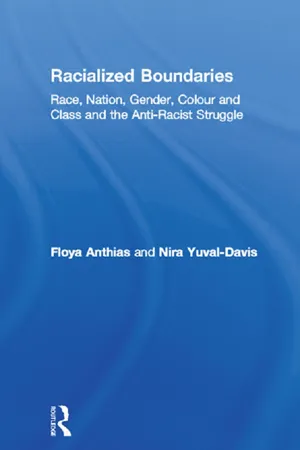
eBook - ePub
Racialized Boundaries
Race, Nation, Gender, Colour and Class and the Anti-Racist Struggle
- 240 pages
- English
- ePUB (mobile friendly)
- Available on iOS & Android
eBook - ePub
Racialized Boundaries
Race, Nation, Gender, Colour and Class and the Anti-Racist Struggle
About this book
This wide-ranging and accessible book examines race in relation to social divisions such as ethnicity, gender and class. It provides a major new approach to studying the boundaries of race, and will be of interest to students of sociology, ethnic studies and gender studies.
Information
Chapter 1
The Concept of ‘Race’ and the Racialization of Social Divisions
There has been much written on the issue of race. Most universities and polytechnics now run courses of one kind or another on race relations or racism. There is a mass of empirical writing by both academic researchers and by official bodies and the newest ‘Race Relations Industry’ has meant the emergence of both the professional ethnic and the ethnic academic as experts in the area. Two recent books, that of Gilroy (1987) on the one hand and that edited by Cohen and Bains (1988) on the other, in different ways, not only reappraise the state of the enterprise, but go some way towards clarifying some of the central theoretical and political issues involved. We want to develop this process further by contextualizing race and racism within the parameters of ethnic processes and in relation to the other prime divisions of class and gender.
In this chapter we want to provide an exploratory framework for the analysis of what have been termed ‘race’ phenomena. Our basic position is that race categories and their specification require an incorporation into the social ontology of collectivity and belongingness in order to be understood. Whilst agreeing with Miles (1982a) that the race relations problematic is inadequate and that racism has to be located within economic, political and ideological relations rather than relations between ‘races’, we do not agree that the category of race has to be ruled out of court ‘because it is a category of everyday life and should not be employed analytically (Miles 1982a:42). Certainly race typologies which derive from a scientific racism which purported to specify criteria for designating individuals to phenotypical types has been both a historical product and totally discredited (Guillaumin 1988, Rose et al. 1984, Miles 1989). None the less, from a sociological point of view, ‘race’ denotes a particular way in which communal differences come to be constructed and therefore it cannot be erased from the analytical map as Miles (1984) suggests.
On the other hand Gilroy (1987) sees it as a valid social construct. His position is that organization on the basis of ‘race’ as a socially constructed but also real cultural entity can at times have primacy over class in the class struggle which in modern societies entails race structuration. However, he fails to provide the axis upon which phenomena of race depend. In our view such an axis can be found within constructs of collectivity and belongingness (that is, ethnic phenomena) postulated through notions of common origin or destiny, not in terms of cultures of difference but in terms of the specific positing of boundaries. These involve mechanisms of both inclusion and exclusion of individuals on the basis of the categorization of human subjects into those that can belong and those that cannot.
Race is one way by which the boundary is to be constructed between those who can and those who cannot belong to a particular construction of a collectivity or population. In the case of race this is on the basis of an immutable biological or physiognomic difference which may or may not be seen to be expressed mainly in culture or life-style but is always grounded on the separation of human populations by some notion of stock or collective heredity of traits.
Our position also entails distinguishing between the specification and explication of the category of race and the question of understanding and explaining the discourses and practices of racism. As Cohen notes ‘the first and largest problem is how to devise a framework, whether analytical or organisational, which both distinguishes clearly between different types of racism and recognises the historical individuality of those subjected to them’ (1988:13). For us this entails understanding racisms as modes of exclusion, inferiorization, subordination and exploitation that present specific and different characters in different social and historical contexts. Extreme examples are those of extermination, segregation and slavery. These are differentially experienced by different class, ethnic and gender categories. There is not a unitary system of signification that can be labelled racist nor is there a unitary perpetrator or victim. This position requires addressing the ways in which the categories of difference and exclusion on the basis of class, gender and ethnicity incorporate processes of racialization and are intertwined in producing racist discourses and outcomes. In our view, the explication of racisms therefore cannot be undertaken purely with reference to ethnic or race phenomena. An adequate analysis has to consider processes of exclusion and subordination in intersection with those of the other major divisions of class and gender as well as processes of state and nation.
This chapter begins by looking at the issue of ethnic groups and their boundaries in order to develop a framework within which the understanding of race phenomena can be undertaken which recognizes on the one hand their specificity and on the other hand incorporates them within an analysis of the ways in which difference and identity are attributed and proclaimed. The axis to racism however is not confined to the arena of race attributions but requires the ethnic category more broadly conceived as a building block or raw material. We shall turn to this issue later on in this chapter.
Ethnos, Ethnicity and Nationalism
What are usually lumped together under the category of ethnos or ethnic phenomena are in fact highly heterogeneous. As we argued elsewhere (Anthias and Yuval Davis 1983),
The only general basis on which we can theorise what can broadly be conceived as ethnic phenomena in all their diversity, is as various forms of ideological construct which divide people into different collectivities and communities.
Historically, ethnic, national or racial categories have been formed in various ways, through conquests, colonization and immigration, and of course the modern variants of these categories under the sway of capitalism and imperialism as well as their most prominent political form, that of the liberal democratic state. While each of the groups and their designation require a historically specific analysis it is not possible to distinguish in an abstract way between ethnic racial or national collectivities but rather one can distinguish their different discourses and projects.
In different social and historical contexts, a process of relabelling or redesignation may occur. For example, immigrants from South Asia can be defined as ethnic, racial or religious groups, using the terms Pakistani, Black or Muslim; Jews in different contexts can be constructed as a primarily religious, ethnic or national group. Therefore, groups that have been called or have called themselves national at one point, or in one territory, have become ethnic or racial in other contexts (for example Jews have been referred to sequentially in this way in the Soviet Union, the USA and Nazi Germany). The use of one or other of these categorizations has often been determined by the political intentions of those involved (see for example de Lepervanche (1980) for the ethnicization of the Aborigines in Australia).
However, while they are difficult to ground, what is common to them, in all their diversity, is that they involve the social construction of an origin as a basis for community or collectivity. This origin, mythical or real, can be historically, territorially, culturally or physiognomically based. It can be internally constituted by the group or externally imposed, or both. As well as a social construction of an origin as unifying the group, the idea of a common or shared fate can act in the same way. Anderson (1983) refers to ethnic groups as ‘imagined communities’, since all those who belong assume a sense of commonality with others but not all members can interact concretely to form a real community.
Ethnic groups involve the positing of boundaries in relation to who can and cannot belong according to certain parameters which are extremely heterogeneous, ranging from the credentials of birth to being born in the right place, conforming to cultural or other symbolic practices, language, and very centrally behaving in sexually appropriate ways (Anthias and Yuval-Davis 1989). Although Barth (1969) makes a valid distinction between ethnic boundaries and the cultural stuff of the group, in practice the cultural stuff often provides the credentials for being able to cross the boundary or being excluded.
Although the boundaries are ideological they involve material practices, and therefore material origins and effects. The boundary is a space for struggle and negotiation. Ethnic resources (such as language, culture, religion, gender relations) can be used in interplay with the class and political resources and positionings of the group. Ethnic processes are often implicated therefore in the pursuit of diverse political ends. These may involve exclusionary and inclusionary practices for maintaining the privileges along a number of different dimensions, or for countering those of other groups. Ethnicity can therefore be a medium for class, nation or state formation. In this way, national or nationalist projects will be centred around claims and practices for separate political representation, territory or unification. Class projects may use a variety of means, which may include racist formulations of an immutable essential difference to the group for pursuing exploitation. Racial projects may be a mode for preserving ethnic exclusivity and privileges within the nation state of the dominant ethnic group. This list is by no means exhaustive and indeed racist discourses can be introduced within all the projects mentioned and others such as those that focus on gender (see Chapter 4).
The boundary of ethnic collectivities is most frequently determined by being born or marrying into the group although conversion or assimilation can also provide the right credentials. The boundaries often change over time and in response to concrete economic, political or ideological conditions. Different criteria or signifiers of inclusion may be used by those on the inside and those on the outside. For the Nazis, anyone with a Jewish grandparent was designated as Jewish; for Orthodox Jews only those who have Jewish mothers or converted according to the Halkha are Jewish; and to many secular Jews, whoever defines themselves as a Jew can be one. In South Africa, people of mixed race are defined as a separate racial category of ‘Coloured’, whilst in Britain they may be defined and/or define themselves as Black. Members of specific ethnic groups may in addition see themselves as part of a more embracing collectivity. For example Jamaicans in Britain may see themselves as part of the African-Caribbean community, and both Asians and African-Caribbeans in Britain may see themselves as part of the Black community. In other words, the notion of where and how the boundary is constructed is not only diverse, but is also contextual and relational (to other groups). What is at stake are processes by which criteria for identification emerge and are transformed.
Ethnic positioning provides individuals with a mode of interpreting the world, based on shared cultural resources and a shared collective positioning vis-à-vis other groups, often within a structure of dominance and contestation. Therefore belonging, or indeed being designated as a member of an ethnic group, is often seen to imply that one cannot belong to other groups (that is, that membership is exclusive). However, in practice individuals may belong to a number of ethnic groups. For example, British-born migrants may regard themselves, or be regarded, as both British and Asian, British and African-Caribbean, or British and Cypriot. Such cases, however, may produce conflict between different universes of meaning, and may involve identity shifts in different contexts. Therefore membership in ethnic collectivities provides individuals with a sense of roots, and is often a pivotal element in their understanding of ‘who I am’. In the modern era, Bhabha (1990) notes the growth of hybridity and ‘counter narratives’ pertaining to those who cross boundaries continually.
Having argued for a commonality to ethnic phenomena, there are important differences in the discourses of ethnicity, nationalism and, as we pointed out earlier, racism. Ethnicity is a problematic notion and has been subjected to a number of definitions (Weber 1969, Barth 1969, Cohen 1974, Wallman 1979, Kahn 1981) as well as being found sorely wanting by more radical writers (CCCS 1982, Bourne 1985, Gilroy 1987). Hall (1988), on the other hand, has attempted to retrieve the concept of ethnicity from the conceptual baggage of the ethnic studies approach and deploy it in a more radical way.
Ethnicity
Ethnicity is a term that is often identified with the ethnic studies approach, just as race is identified with the race relations tradition (Miles 1982a, Anthias 1982 and 1992). The problematic of the ethnic studies approach is that of cultural interaction between ethnic groups and its effects. Race and racism are seen as complicating variables within the central focus on questions of cultural adaptation, maintenance, integration or assimilation of ethnic minorities. Within American sociology, this tendency finds expression in the enormously influential debate about assimilation (Glazer and Moynihan 1965 and 1975). In these discussions, ethnicity is often treated as a voluntaristic normative identification process, or as a form of culture. The notion of ‘resurgent’ ethnicity reaffirms the view of ethnicity as ‘ethnic identity’ or cultural differentiation. For Glazer and Moynihan (1975), ethnic identity has become an alternative to national identity whilst at the same time class identity is seen as declining.
As Omi and Winant point out, ethnicity theory in the United States assumes that,
the key factor in explaining the success that an ethnic group will have in becoming incorporated into majority society…is the values or ‘norms’ it possesses. (1986:22)
This means that the role of racism in structuring the position of ‘Black’ groups is ignored. This racism will limit assimilation even where the norms and values adopted by a group are in keeping with those that have made other ethnic groups successful, according to Omi and Winant Such an approach also tends to treat all Blacks as belonging to the same ethnic group, ignoring the diversity within the category. They point out, however, that ‘many Blacks…rejected ethnic identity in favour of a more radical racial identity’ (1986:20). On the other hand, Gans (1979) notes the growth of symbolic ethnicity, as a personal affirmation of belonging in American society. Hall (1988), writing in Britain, sees the revival of ethnicity as an affirmation of identity which is seen as emanating from the postmodern condition.
The English ‘ethnic school’ (set up in Bristol in 1971) attempted to provide insights into the culture of ethnic minorities, Asians in particular, and its meaning for the actors. Jeffery (1976) is interested in processes by which a group maintains its culture, for example. Often a view is expressed (for example in Dahya 1974 and Wallman 1979) that ethnic groups as distinct cultures will choose certain occupations or forms of social participation.
In her review of the sociology of race relations in Britain, Bourne (1980) argues against this approach in terms of its necessary political effects. But no theorization has necessary political effects, nor can it be countered by saying that its empirical premises are mistaken. The central difficulty with the ethnic school approach is the way it formulated ethnicity merely as identity or shared culture, and the role it assigns to these in understanding the placement of ethnic groups in society. The notion of ‘reactive ethnicity’ advanced by the school sees it as a cultural affirmation. This is regarded as a response to the individual sense of rejection that the members of ethnic groups face (Ballard and Ballard 1977). This is grounded in a passive and personally instrumental response (for a fuller account of the concept of ethnicity within the ethnic studies approach see Anthias 1982 and forthcoming).
We would question the focus on relations between cultures and identities. This is also one of the reasons why Gilroy (1987) rejects the concept of ethnicity. We would also take issue with Hall’s (1988) location of ethnicity as a subjective identification process that forms part of the fragmentation of postmodern society. Ethnicity is regarded as coterminous with culture and identity here also. We will therefore present our alternative formulation, which means retaining, but redefining, the terms of reference within which the term should be located.
Ethnicity at its most general level involves belonging to a particular group and sharing its conditions of existence. This will include not only being regarded as having the right credentials for membership but also being able to muster ethnic resources which can be used for struggle, negotiation and the pursuit of political projects, both at the level of individuals making their way but also for the group as a whole in relation to other groups. Ethnic resources can be economic, territorial, cultural and linguistic, amongst others.
All ethnic groups, majorities and minorities are characterized by a notion of ‘community’. However, dominant groups, whether majorities, as in the case of the English in Britain, or minorities, as is the case of the Whites in South Africa, have the potential to naturalize their Weltanschauung. This results from their control of the means of communication and cultural production, and their dominant position within the state. This does not mean that dominant groups are always successful in doing this, however, as can be witnessed by the ethnic conflict which has emerged, for example, in the Soviet Union.
It is clear therefore, that although cultural commonality is one of the ingredients that characterizes ethnic groups, ethnic and cultural groups are not coterminous. Ethnicity is not predicated only on common culture and indeed can be focused around other signifiers of an essential or ‘natural’ community of people. These include religion, language or race. For example, Omi and Winant (1986) refer to Blacks as having a radical ‘racial’ identity. There is a potential growth in the wake of the 1992 Single European Act of a ‘White European’ identity despite the existence of diverse languages, cultures and traditions. Ethnicity is the active face of ethnic consciousness and always involves a political dimension, therefore.
At any specific time, there may be a dominant view of what characterizes the essential character, needs or interests of an ethnic group. None the less, this is always subject to shifts and transformations; myths of descent or history may be in a constant state of reinvention and re-evaluation. For example, Cypriots may be divided, on the one hand, between the different categories of Greek or Turkish under the sway of colonialism and right-wing nationalism. But they may be beginning to reinvent themselves as a Cypriot people that can encompass both Greek and Turkish Cypriots in the pursuit of a solution to the Cyprus problem (see Anthias and Ayres 1983 and Anthias 1986). We can also currently witness the changing boundaries of the category of Black British (see our Chapter 5).
Ethnicity is more than merely a question of ethnic identity, either in the personal sense vis-à-vis the individual’s identification with a group (as the term is used in the ‘British ethnic group’) or in terms of a collective sentiment (as in Schlesinger 1987). Ethnicity involves partaking of the social conditions of a group, which is positioned in a particular way in terms of the social allocation of resources, within a context of difference to other groups, as well as commonalities and differences within (in relation to the divisions of class and gender, for example, within the group). Ethnicity cross-cuts gender and class divisions, but at the same time involves the positing of a similarity (on the inside) and a difference (from the outside) that seeks to transcend these divisions.
Indeed the existence of a conscious ethnic identity ma...
Table of contents
- Cover
- Half Title
- Title Page
- Copyright
- Contents
- Preface
- 1. The concept of ‘race’ and the racialization of social divisions
- 2. Whose nation? Whose state? Racial/ethnic divisions and ‘the nation’
- 3. It’s all a question of class…
- 4. Connecting race and gender
- 5. Racism and the colour ‘Black’
- 6. Resisting racism: multi-culturalism, equal opportunities and the politics of the ‘community’
- Bibliography
- Name index
- Subject index
Trusted by 375,005 students
Access to over 1.5 million titles for a fair monthly price.
Study more efficiently using our study tools.
Frequently asked questions
Yes, you can cancel anytime from the Subscription tab in your account settings on the Perlego website. Your subscription will stay active until the end of your current billing period. Learn how to cancel your subscription
No, books cannot be downloaded as external files, such as PDFs, for use outside of Perlego. However, you can download books within the Perlego app for offline reading on mobile or tablet. Learn how to download books offline
We are an online textbook subscription service, where you can get access to an entire online library for less than the price of a single book per month. With over 1.5 million books across 990+ topics, we’ve got you covered! Learn about our mission
Look out for the read-aloud symbol on your next book to see if you can listen to it. The read-aloud tool reads text aloud for you, highlighting the text as it is being read. You can pause it, speed it up and slow it down. Learn more about Read Aloud
Yes! You can use the Perlego app on both iOS and Android devices to read anytime, anywhere — even offline. Perfect for commutes or when you’re on the go.
Please note we cannot support devices running on iOS 13 and Android 7 or earlier. Learn more about using the app
Please note we cannot support devices running on iOS 13 and Android 7 or earlier. Learn more about using the app
Yes, you can access Racialized Boundaries by Floya Anthias,Nira Yuval-Davis in PDF and/or ePUB format, as well as other popular books in Social Sciences & Gender Studies. We have over 1.5 million books available in our catalogue for you to explore.