eBook - ePub
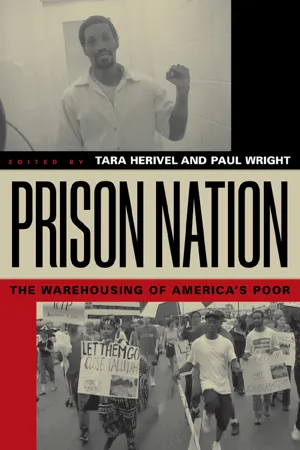
Prison Nation
The Warehousing of America's Poor
- 344 pages
- English
- ePUB (mobile friendly)
- Available on iOS & Android
eBook - ePub
About this book
Prison Nation is a distant dispatch from a foreign and forbidden place--the world of America's prisons. Written by prisoners, social critics and luminaries of investigative reporting, Prison Nation testifies to the current state of America's prisoners' living conditions and political concerns. These concerns are not normally the concerns of most Americans, but they should be. From substandard medical care the inadequacy of resources for public defenders to the death penalty, the issues covered in this volume grow more urgent every day. Articles by outstanding writers such as Mumia Abu-Jamal, Noam Chomsky, Mark Dow, Judy Green, Tracy Huling and Christian Parenti chronicle the injustices of prison privatization, class and race in the justice system, our quixotic drug war, the rarely discussed prison AIDS crisis and a judicial system that rewards mostly those with significant resources or the desire to name names. Correctional facilities have become a profitable growth industry, for companies like Wackenhut that run them and companies like Boeing that use cheap prison labor. With fascinating narratives, shocking tales and small stories of hope, Prison Nation paints a picture of a world many Americans know little or nothing about.
Information
SECTION 1
THE WAREHOUSING OF AMERICA’S POOR
The Accused Get What the System Doesn’t Pay For
Poor Legal Representation for People Who Can’t Afford Lawyers
Many of the men, women, and children sent to prison in the United States every day are processed through courts without the legal representation that is indispensable to a fair trial, a reliable verdict, and a just sentence. Eighty percent of people accused of crimes are unable to afford a lawyer to defend them. While public defender offices or dedicated lawyers capably defend some of the accused, far more are assigned lawyers who work under crushing caseloads, are paid so little that they devote little time to the cases, and lack the time, knowledge, resources, and often even the inclination to defend a case properly. The result is coerced guilty pleas or unfair trials, unreliable verdicts, and sentences that do not fit the crime or the person convicted.
A poor person arrested by the police may languish in jail for days, weeks, or months before seeing a lawyer for the first time. Sometimes, they first meet their lawyers when they are brought to court. Their “representation” consists of hurried, whispered conversations with their lawyers outside the courtroom or even in court, before entering guilty pleas and being sentenced in courts that resemble fast-food restaurants. People who insist on trial often find that their court-appointed lawyers have done no investigation, are unprepared, and thus are unable to present a defense. Although the U.S. Supreme Court has ruled that states must provide lawyers to people facing serious charges, some people accused of crimes receive no representation at all and are forced to fend for themselves—even, on occasion, in cases where they face the prospect of many years in prison. Once convicted, a poor person may face years in prison, or even execution, without a lawyer to pursue avenues of post-conviction review. While in prison, he or she may endure human rights abuses, but have no access to a lawyer to seek remedies for those violations.
In contrast, the person with adequate resources may secure a lawyer who will make a case for, and perhaps obtain release on bail, work closely with the client in conducting an immediate and thorough investigation, present a vigorous defense at trial, pursue all available avenues of postconviction relief, and challenge any constitutional violations that occur in prison. When she was Attorney General, Janet Reno observed that if justice is available only to those who can pay for a lawyer, “That’s not justice, and that does not give people confidence in the justice system.”1
Nonetheless, many state and local governments make no pretense of complying with the constitutional requirement of providing lawyers to poor people accused of crimes. They are unwilling to allocate adequate resources for the representatives of indigent criminal defendants. Yet it is the defendant who pays with his or her life or liberty for the lawyer’s ignorance of the law or failure to present critical evidence.
A Constitutional Promise Unfulfilled
The Supreme Court held in 1963 that a poor person facing felony charges “cannot be assured a fair trial unless counsel is provided for him.”2 Implementing the Court’s decision, however, has proven to be an immense challenge. Although presumed innocent by the law, they are assumed to be guilty by much of the public. They are unpopular and have no political power. These and other factors have caused state and local governments to strive not toward the much-celebrated constitutional command of equal justice, but, rather, as observed by Chief Justice Harold Clarke of the Georgia Supreme Court in his 1993 address to the legislature, toward “the embarrassing target of mediocrity.”3
Most state and local governments have been more concerned with keeping costs low than with providing quality defense services or ensuring fair trials. When they have examined factors other than costs, many evaluate indigent defense programs not from the standpoint of ensuring fair trials, but with an eye to increasing administrative convenience in moving dockets and securing convictions. In the pursuit of saving money, governments increasingly award contracts for representing indigent defendants to the lawyer who submits the lowest bid. Many states pay lawyers appointed to defend the poor such low rates that in some cases the attorneys make less than the minimum wage. Many jurisdictions have either refused outright to establish public defender programs or they have established programs but underfunded them, leaving the lawyers in those programs with staggering caseloads.
Many jurisdictions aim to process the maximum number of cases at the lowest possible cost without regard to justice. For example, three lawyers—all members of the same family—handled the cases of 776 poor people in five Georgia counties in 2002 for an average cost of $49.86 per case, less that the cost of a couple of tickets to a baseball game. As a result of placing a greater priority on economy than fairness, many poor people—even those charged with serious crimes—are still subject to the kind of “assembly line justice” the United States Supreme Court condemned 30 years ago.4 Many localities have become accustomed to systems and practices that simply do not measure up to what the United States Constitution requires. For example:
• Some adults and children who cannot afford a lawyer plead guilty—even to felony charges—and are sentenced to prison or jail without the assistance of an attorney.
• In some municipal and state courts, there are no lawyers available to represent indigent defendants. Virtually all the poor people are processed through those courts without a lawyer.
• Indigent people may languish in jail for weeks or months before meeting with a lawyer, despite professional and ethical standards that require attorneys to meet promptly with their clients after appointment.
• In some courts, the determination of whether an accused can or cannot afford a lawyer is based on factors such as ability to make bail.
• Even after a lawyer has been appointed, some indigent people cannot communicate with their lawyer because their lawyer does not visit the jail, accept telephone calls from clients, or reply to letters and family inquiries, despite professional and ethical standards and guidelines which require a lawyer to meet with his or her client promptly after appointment.
• Many appointed lawyers rarely hire investigators and expert witnesses. Many lawyers do not seek funds for investigators or experts because they do not think that there is any chance the judge will order that funds be provided.
• Because many of the lawyers appointed to defend the poor do not specialize in criminal law, they may be unaware of important developments in the law as well as in areas such as forensic sciences and mental health.
• Important legal issues are not raised by motion or otherwise in many cases. Motions practice is virtually nonexistent in some counties; in others, the same boilerplate motions are filed in virtually every case.
• Despite their poverty, those convicted are often fined and required to pay court costs and various fees and surcharges they cannot afford.
These practices affect the lives of the thousands of people who are hurriedly processed through the courts, instead of being represented by competent, zealous, and independent counsel as required by the Constitution and the ethical and professional standards of the legal profession.
A former president of the Arkansas Association of Criminal Defense Lawyers, who was also involved in the defense of many capital cases in Arkansas, has described the plight of lawyers in that state. Lawyers there are, in effect, either forced to spend their own money or to perform “a sort of uninformed legal triage,” ignoring some issues, lines of investigation, and defenses because of the lack of adequate compensation and resources. But the attorneys do not bear the greatest costs of this approach. “The lawyer pays some—in reputation, perhaps—but it is his client who may pay with his liberty or his life.”5
Factors Contributing to Deficient Representation
While there are numerous reasons, varying from one jurisdiction to the next, which contribute to failures to comply with the constitutional requirements regarding representation of the poor, the primary reasons are no secret. Nor are they isolated factors unique to a particular state or region of the country. Deficient representation is the unavoidable result of several interrelated factors: the failure of the states to provide sufficient funding, the lack of independence of attorneys assigned to defend the poor, the absence of meaningful enforcement of the right to effective assistance of counsel, and the powerlessness of the accused.
Inadequate Funding
The most fundamental reason for the poor quality or absence of legal services for the poor in the criminal justice system is the refusal of governments to allocate sufficient funds for indigent defense programs. An American Bar Association report in 1993 found that “long-term neglect and underfunding of indigent defense have created a crisis of extraordinary proportions in many states throughout the country.”6
Legislatures in many states have failed adequately to fund public defender programs, leaving public defenders with overwhelming caseloads, and the immense pressure of being responsible for the lives and liberty of too many fellow human beings. While public defender offices attract some of the most dedicated and conscientious young lawyers, those lawyers find it exhausting and enormously difficult to provide adequate representation when saddled with huge caseloads and lacking the necessary investigative assistance.
A public defender in New Orleans represented 418 defendants during the first seven months of 1991. During this time, he entered 130 guilty pleas at arraignment and had at least one serious case set for trial on every single trial date during the period. In “routine cases,” he received no investigative support because the three investigators in the public defender’s office were responsible for more than 7,000 cases per year. Additionally, no funds were available for expert witnesses.7
Even though funding for indigent defense programs has long been recognized as inadequate, some jurisdictions have reduced funding. In Pittsburgh, for example, the county commission slashed funds and job positions at the public defender’s office in 1996, leaving the office with forty-five lawyers, twelve less than the fifty-seven who were there previously. Eight full-time investigators were also fired. The attorneys were paid between $24,000 and $32,000 and are permitted to have part-time legal practice on the side.8 An independent study the year before had concluded that the public defender’s office was in crisis because of chronic underfunding and “years of neglect.”9 Judge David S. Cercone, head of the court’s Criminal Division, had expressed similar concern, saying that, “[w]e do not think there is any fat to be cut from the public defender’s office.”10 The county commissioners responded to the study by cutting $1 million from the $3.9 million budget. Nonetheless, the commissioners somehow found a way to move two of their supporters into positions that paid $50,000 each, which is double the starting salary of a new public defender.11
In Wisconsin, then-Governor Tommy Thompson proposed cuts to the state public defender’s budget, more flat rate payments to appointed counsel, increases in public defender caseloads, and limits on how much public defenders and appointed attorneys can spend on court documents and investigative services.12 When the 1996–97 budget ultimately was passed, $3.85 million was cut from the allocation for indigent defense.
Many jurisdictions have no public defender programs. Cases are assigned to individual lawyers or lawyers who have contracted to handle the cases of indigent defendants. Many states and localities compensate lawyers so poorly that it is impossible to attract capable lawyers and impossible for the lawyers to survive in practice if they devote the time required to defend cases properly.
In Virginia, for example, attorneys for indigent defendants are limited to $100 for defending someone in a misdemeanor case in district court, $132 for defending a misdemeanor case in circuit court, $305 for defending a felony case where the punishment is less than 20 years, and $845 where the punishment is more than 20 years. When one attorney challenged the limit in felony cases, arguing that once the attorney exceeds the limit and is forced to work uncompensated, it creates a conflict between the lawyer’s pecuniary interests and zealous representation of the client, the circuit judge removed him from the case. One circuit judge announced at calendar call that any attorney raising the conflict of interest issue would be removed from the list of appointed counsel. As each case was called, the judge asked the attorney whether he or she intended to raise the issue.13
The result is that these lawyers often earn less than the minimum wage for defending someone in a serious felony case or even a capital case. For example, a Mississippi lawyer who spends 500 hours preparing for a death penalty trial will be paid $2 an hour. Imagine what kind of legal representation a poor person accused of a capital crime gets for $2 an hour. Unfortunately, the old adage, “you get what you pay for,” applies with special force in the law. Most good lawyers do not work for $2 an hour or even $20, $50, or $100 an hour. Lawyers paid so little cannot afford to spend the time required to conduct interviews, investigations and negotiations, and defend cases at trials. As one Virginia prosecutor observed:
What it boils down to is, you get what you pay for. Look who’s on a court-appointed list anywhere. Very few experienced attorneys are on those lists, and the reason is, they can’t afford to be on them. So you either have very inexperienced attorneys right out of law school for whom any money is better than no money. Or you have people who are really bad lawyers who can’t make a living except off the court appointed list. The prosecutor said that such a system “doesn’t give me any satisfaction as a prosecutor, and I don’t think it serves justice.”14
In addition, lawyers appointed to defend indigent defendants are often not paid for months or years after they provide the representation. Often, their applications for compensation are arbitrarily reduced by judges and bureaucrats. This discourages lawyers from taking the cases of indigent defendants.
Frequently, lawyers are denied the investigative and expert assistance essential to providing adequate representation. The courts have constructed a Catch-...
Table of contents
- Cover Page
- Half Title page
- Title Page
- Copyright Page
- Contents
- Acknowledgments
- Introduction
- Section 1 The Warehousing of America's Poor
- Section 2 Two Million Swept Away
- Section 3 Making a Buck off the Prisoner's Back
- Section 4 The Private Prison Industry
- Section 5 Malign Neglect: Prison Medicine
- Section 6 Rape, Racism, and Repression
- Section 7 The Bars to Prison Litigation
- Contributors
- About Prison Legal News
- Index
Trusted by 375,005 students
Access to over 1.5 million titles for a fair monthly price.
Study more efficiently using our study tools.
Frequently asked questions
Yes, you can cancel anytime from the Subscription tab in your account settings on the Perlego website. Your subscription will stay active until the end of your current billing period. Learn how to cancel your subscription
No, books cannot be downloaded as external files, such as PDFs, for use outside of Perlego. However, you can download books within the Perlego app for offline reading on mobile or tablet. Learn how to download books offline
We are an online textbook subscription service, where you can get access to an entire online library for less than the price of a single book per month. With over 1.5 million books across 990+ topics, we’ve got you covered! Learn about our mission
Look out for the read-aloud symbol on your next book to see if you can listen to it. The read-aloud tool reads text aloud for you, highlighting the text as it is being read. You can pause it, speed it up and slow it down. Learn more about Read Aloud
Yes! You can use the Perlego app on both iOS and Android devices to read anytime, anywhere — even offline. Perfect for commutes or when you’re on the go.
Please note we cannot support devices running on iOS 13 and Android 7 or earlier. Learn more about using the app
Please note we cannot support devices running on iOS 13 and Android 7 or earlier. Learn more about using the app
Yes, you can access Prison Nation by Paul Wright, Tara Herivel, Paul Wright,Tara Herivel in PDF and/or ePUB format, as well as other popular books in Social Sciences & Politics. We have over 1.5 million books available in our catalogue for you to explore.