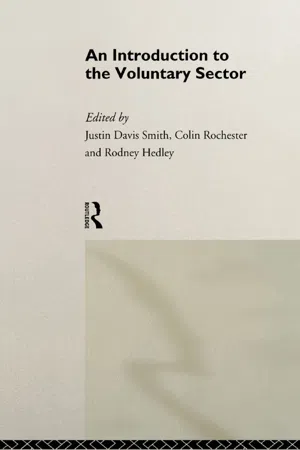
In the 1990s the voluntary and charity sector is being forced to become an increasingly important provider of health and social welfare in Britain. How can it respond to this pressure, who is running it and how should it be managed? As well as offering a full overview of the voluntary sector the editors and contributors:
examine its history and importance within welfare provision
explore its current position and responsibilities
offer practical guidance for and analysis of the issues facing the voluntary sector today including its legal framework in the UK and EU, fundraising management and accountability.
An Introduction to the Voluntary Sector will be invaluable reading to all students and lecturers of social policy and organisational studies as well as to professional policy-makers and voluntary sector personnel.
- 272 pages
- English
- ePUB (mobile friendly)
- Available on iOS & Android
eBook - ePub
Introduction to the Voluntary Sector
About this book
1
The voluntary tradition
Philanthropy and self-help in Britain 1500–1945
Justin Davis Smith
INTRODUCTION
A French visitor to the British Isles in the mid-nineteenth century was struck by the prevalence of voluntary associations. He wrote:
This tendency of the English to form groups through the attractions of certain pleasures, deserves our attention…. In France men like to meet for the sake of meeting; the Englishman is perhaps less sociable: he requires an object, a community of tastes, a peculiar tie, which draws him nearer his fellowmen…. The voluntary association in groups and series, is the great counterpoise of British personality.
(A.Esquiros, The English at Home, 4 volumes (1861–3), quoted in Bailey 1978)
Enthusiasm for voluntary action shows no sign of abating (although it is not, of course, suggested that such action is a peculiarly English or indeed British phenomenon). It is estimated that there are currently about 170,000 registered charities and perhaps as many as 300,000 voluntary organisations in England and Wales (NCVO 1992). A recent survey suggests that 23 million people take part in voluntary activities each year (The Volunteer Centre UK). Much has been written about voluntary action in recent years, about its size and shape and its role in relation to the state. However, with a few notable exceptions (for example, work by Owen and Harrison and more recently Finlayson and Prochaska), it has been the subject of little rigorous historical analysis. This chapter starts from the standpoint that, in order to understand the role of voluntary action in Britain today, it is necessary to adopt an historical perspective. And not only one going back to the nineteenth century—important though that period was in its development. The chapter will argue that the roots of voluntary action in Britain can be traced back at least as far as the sixteenth century, and possibly much earlier.
Any attempt to write a history of voluntary action in Britain over the past 500 years must of necessity be selective. David Owen (1964), the author of the major work in this field, was rightly criticised for focusing too heavily on the work of philanthropic organisations and individuals concerned with the relief of poverty and distress, and for ignoring whole fields of voluntary action to do with mutual aid and reform (see, for example, Harrison 1966). Trying to condense such a history into ten thousand words runs the risk of making the same mistakes as Owen, on a larger scale. It is necessary, therefore, at the outset to say both what this chapter is and what it is not.
First what it is not. The chapter is not a comprehensive review of voluntary action in Britain since 1500. Nor is it a discourse on the lives and work of the great men and women who shaped the development of the voluntary sector; in fact, with a few exceptions, it does not deal with individuals at all. The chapter is not a review of the history of the great organisations—the national societies which, springing up in the nineteenth century, came so to dominate the voluntary sector landscape. It deliberately chooses to steer clear of charity law and the system of governmental regulations covering the work of charitable institutions (although reference is made to some of the landmark legislation). Finally, the chapter is not concerned with any attempt to try and measure the size and shape of the sector at different times over the past 500 years.
So what is it about? The starting point is the now famous division made by William Beveridge in his 1948 Report between the two main impulses of voluntary action: philanthropy and mutual aid (Beveridge 1948). Eschewing the preference by Owen to focus exclusively on philanthropic good works, this review sets out to redress the balance and to give mutual aid its rightful place in the history of voluntary action in Britain. The first section focuses on the changing structures of philanthropic voluntary organisations, from the growth of foundations in the sixteenth century, to the rise in the late seventeenth century of associated philanthropy—an organisational form which was to reach its highest point of expression in the nineteenth century. It looks at the role of women in voluntary associations, explores the link between class and philanthropy, and examines relations between the state and voluntary action. The second section focuses on the development of mutual aid from the fraternities of the Middle Ages to the friendly societies and working men’s clubs of the Victorian age. As with the first section a major theme of this section is the attitude of the state towards mutual aid groups. To aid readability the two sections of the essay follow a general chronological course, although the emphasis on a thematic approach means that some criss-crossing over time is unavoidable.
PHILANTHROPY
The ‘origins’ of philanthropy
Philanthropy of course did not begin in the sixteenth century. Along with mutual aid (as we shall see later) philanthropy has a long history in British society, and embryonic charitable organisations, especially organised around the monasteries and religious houses, can be traced back to medieval times and beyond. G.Le Bras has called the thirteenth century ‘The Golden Age of small associations of piety geared much less towards the practice of sacraments than towards liturgy and good works’, and in England alone some 500 voluntary hospitals were founded during the course of the twelfth and thirteenth centuries (Rubin 1988:251). There are, however, several good reasons for taking the sixteenth century as a starting point for this study. For one thing, it was in this period that we see the emergence of one particular form of charitable structure, the charitable trust, which was to play such an important role in the history of the voluntary sector over the next 500 years. The period is also a good starting point for a history of voluntary action for the apparently contradictory reason that it was in the sixteenth century that the state for the first time in any appreciable way began to take an interest in the relief of poverty. The period saw the first airing of what are often seen as very Victorian notions of the deserving and undeserving poor and a questioning of the respective roles of charity and the state in dealing with poverty. Just as the Charity Organisation Society in the late nineteenth century was to question the advisability of unregulated charity, so too the Tudor period saw attempts (albeit unsuccessful) to outlaw the giving of alms to any but the deserving poor (Slack 1988).
The basic form of charity in Tudor England was the charitable trust—a gift or bequest made in perpetuity for charitable purposes. According to Jordan (1959, 1960, 1961), who carried out a detailed analysis of bequests made in ten counties of England, there was a large growth in charitable giving between 1480 and 1660. He estimated that over 3 million pounds was given to charity in the ten counties during this period, with a peak in endowments between 1610 and 1640. He also noted a change in the nature of charitable gifts, with a move away from religion towards poor relief and education. The reasons for this increase in charitable activity were held to be the rise in income of the newly emerging merchant class and an increase in levels of poverty which stimulated philanthropic action.
Recent scholars have challenged Jordan’s findings. In particular, it is argued that his figures have failed to take account of inflation, and that, once this has been allowed for, not only was there no growth in charitable giving, there was in fact a decline in the late sixteenth century, with a recovery occurring only in the middle decades of the seventeenth century (Hadwin 1978; Bittle and Lane 1976; Feingold 1979). The attack on the monasteries and chantries was an obvious cause of this decline. As one member of Parliament commented in the 1650s, ‘since Popery was abolished, charity has left the land’, and, although in fact charity had recovered by this time the explanation holds true for the earlier period (Slack 1988). But, as Chesterman (1979) points out, even if the overall volume of charitable activity declined in the late Tudor period the amount of private money given for non-religious causes such as education and health increased considerably. Charity was moving away from the church and becoming increasingly secular.
Another feature of charity in the seventeenth century was the money given to found new trusts, rather than to contribute to existing institutions. The new merchant class saw an obvious attraction in the founding of personal memorials which carried the name of the benefactor for ever more. The emphasis during this century also began to move gradually away from the giving of casual doles to the ‘undeserving poor’ to the channelling of charity through institutions such as almshouses to the ‘deserving poor’. However, it would be a mistake to conclude that all casual giving ceased. In Norwich, for example, it has been estimated that 80 per cent of all gifts to the poor by will before 1650 took the form of outright doles (Slack 1988:166).
The sixteenth century saw the first attempts by the state to regulate charity. Acts of Parliament passed in the first half of the century had tried to outlaw the giving of casual doles. Towards the end of the century the focus shifted to the promotion of endowed charities. In 1597 the Charitable Uses Act was introduced with the aim of encouraging charity by clamping down on fraudulent activity. The Act established the first charity commissioners (the so-called roving commissioners) who were charged with investigating breaches of charitable trust on a county-wide basis. The Act was repealed by Parliament but reintroduced with its main provisions largely unaltered in 1601. The 1601 Charitable Uses Act with its famous preamble laid down a basic definition of charitable activity. This statement was refined in 1805 by Sir Samuel Romilly, who gave us the ‘four heads’ of charity, and again in 1891 by Lord Macnaghten but, despite the repeal of the Act itself, the preamble from the 1601 Statute still forms the legal basis of our understanding of ‘charitable purpose’ (see, for example, Chesterman 1979 and Williams 1989).
The rise of the voluntary association
Voluntary organisations along the lines that we know them today are most associated with the nineteenth century. And indeed the period did see an explosion of such organisations. However, their development can be traced back to the late seventeenth century and to what Owen (1964) called the rise of ‘associated philanthropy’. The voluntary association differed in a number of important ways from the charitable trusts and endowments of the earlier period. It was not funded by a single individual whose name would be for ever linked with the charity, but by a group of wealthy philanthropists who combined together to support a charitable cause. According to Owen the rise of associated philanthropy can be linked to the parallel developments taking place in the commercial world with the development of the joint stock company. In place of the ‘personal memorials’ to wealthy benefactors this new form of philanthropy witnessed the development of a whole host of new voluntary organisations. One of the most shining testimonies to this new form of charity was the charity school movement. By 1729 there were over 1400 such schools in England catering for over 22,000 pupils, although the educational content of these institutions took second place to religious instruction. According to Owen:
The charity school movement…. placed its stamp on British philanthropic methods. Despite its manifest shortcomings, this first large-scale venture in associated philanthropy offered a convincing demonstration of what could be achieved by the pooling of individual effort.
(Owen 1964:30)
The eighteenth century saw the spread of this new form of charitable organisation, an expansion which owed much to the Puritan influence or, as Owen puts it, to the ‘Philanthropy of Piety’. At the same time, the period witnessed a reduction in the number of new charitable endowments created. One recent study of eighteenthcentury charity suggests that there was a shift in the nature of charity during this period in line with the changing needs of the nation (Andrew 1989). Drawing on considerable primary sources Donna Andrew argues that charity in London in the period between 1680 and 1820 was characterised by three distinct phases. The first phase from 1680 to the 1740s saw charity being used primarily to promote education and employment. Between the 1740s and the 1760s there was a distinct shift in charity away from these areas towards maternity hospitals and child welfare agencies, a shift which she claims was due to growing concern about the need to boost London’s labouring population and to meet the nation’s increased manpower requirements for military preparedness, naval expansion and colonial settlements. The third phase between the 1770s and the 1820s was characterised by a shift towards charities supporting moral reform and discipline, and is explained by the state’s growing anxiety about the threat of political unrest. Andrew’s thesis that the focus of voluntary action reflects the wider political context in which it operates is not new. And the theory (often advanced) that voluntary action has been used by the state as a form of social control will be examined more fully later in the chapter.
Not all voluntary agencies in the eighteenth century were philanthropic. The latter years of the decade saw a flowering of debating societies and political clubs, like the Kit Kat Club and the Tory Loyal Brotherhood, the forerunner to the Athenaeum, as well as radical debating clubs like the London Corresponding Society and societies stirred by the example of the French Revolution (see Morris 1990; Hobsbawm 1964). The Masonic Order spread rapidly during the eighteenth century. Certainly not all voluntary agencies were espousing views which would be regarded as progressive. The Proclamation Society of 1787, under the influence of William Wilberforce, included the publishers of Tom Paine’s Age of Reason among its targets. Some of the societies of the age appear not very different from those in existence today. The Watch and Ward Societies, for example, with their organisation of voluntary police patrols, stand out as a sort of eighteenth-century neighbourhood watch.
Much voluntary action in the eighteenth century was associated with the life of towns, and middle-class philanthropists made significant contributions to the development of museums, libraries and public gardens. Civic pride (and perhaps civic rivalry) was a major impetus to voluntary action.
The golden age of voluntary organisations
The nineteenth century can be seen as the golden age of the voluntary association and, while any attempt to put meaningful figures on the size of the voluntary sector is futile, a few statistics do help to illustrate its vitality and strength. In his famous Charities of London in 1861, Sampson Low put the aggregate income of 640 London charitable agencies at 2½ million pounds (quoted in Owen 1964:169), and in 1870 Hawksley estimated the amount of money given to charities in London to be between 5½ and 7 million pounds a year (quoted in Best 1971:159). In the 1880s The Times noted that the income of London charities was greater than that of several nation states, including Sweden, Denmark and Portugal, and twice that of the Swiss Confederation (quoted in Owen 1964:469). The first major attempt at a review of the income and expenditure of charities was undertaken by Burdett in his Hospitals and Charities. Taking the year 1896 as his point of reference he estimated that the annual income of charities in Britain was 8 million pounds, a figure which had risen to 13 million pounds in a second analysis carried out in 1910 (quoted in Owen 1964:476). But these figures must be seen simply as an approximation and serve only to reinforce the point that voluntary agencies were a significant feature of Victorian society (and a not insignificant feature of the Victorian economy).
How are we to explain the rapid growth of voluntary agencies in the nineteenth century? One explanation is that the growth was the direct consequence of the increased social need (or at least the increased visibility of such need) brought about by the population explosion and rapid industrialisation and urbanisation of the period. The traditional forms of voluntary action—endowed charities; casual doles and almshouses—were found to be inadequate to deal with the needs of the age. New forms of action were required. One response was for working people to develop their own mutual insurance groups (as we shall see later). Another response was for philanthropists to band together in voluntary associations. If the rapid industrialisation of society provided the context to the development of voluntary action, the ideological push was provided by the combination of economic liberalism, with its encouragement of self-help and distrust of the state, and evangelical Christianity with its emphasis on good works. Shaftesbury, himself one of the leading philanthropists of the period who was personally involved in over 200 charitable groups, had no doubt of the important role played by the evangelical movement in the development of voluntary action. He informed his biographer at the end of the century that he had worked with evangelicals constantly and was ‘satisfied that most of the great philanthropic movements of this century have sprung from them’ (quoted in Finlayson 1981). The history of the city missions, the visiting societies and numerous other movements bear witness to the role of evangelicalism in the spread of philanthropy in the nineteenth century. This is not to suggest that people’s motives for joining voluntary agencies were wholly tied up with the desire to do good works. As studies of the motivation to volunteer in our time have shown (see Jos Sheard’s chapter on volunteering), motives are rarely purely altruistic and the desire for a position in the community or simply to enjoy the convivial and social aspects of voluntary participation should be neither discounted nor frowned upon in any assessment of philanthropic action in the Victorian age. People no doubt joined voluntary groups and contributed to charities for all manner of reasons both altruistic and personal. But it is clear that the rise of evangelicalism played a part in stimulating such activity.
Not all voluntary action of this period was philanthropic. Ignoring for a moment the mutual-aid and self-help strand, there was a rich tradition of voluntary activity concerned with campaigning and political protest, so much so that a good case could have been made in this chapter for extending Beveridge’s simple two-fold distinction between philanthropy and mutual aid and including campaigning activity as a third element in its own right. Voluntary groups were established to campaign for all manner of causes, from factory legislation and sanitary improvements to prison reform and observation of the sabbath. The value of voluntary action to the democratic process was noted by the great social philosopher de Tocqueville, who wrote of the importance of voluntary organisations as a bulwark against excessive state power (see Poggi 1972), and Richard Cobden (who led perhaps the most sophisticated campaign of the period to abolish the Corn Laws), who stated that there could be ‘no healthy political existence’ without voluntary groups (quoted in Harrison 1971:34). Many of the techniques of campaigning and lobbying which are so familiar to contemporary pressure groups were developed during this period. Harrison has claimed that public meetings and mass publicity campaigns were invented by the anti-slavery movement of the 1830s and developed by the Anti-Corn Law League, the Temperance Movement and others (Harrison 1971). It was not only in the skills of campaigning and lobbying that nineteenth-century voluntary associations left their mark. Many of today’s fundraising techniques were learnt during this period. The Victorian bazaars were the clear forerunners of charity fetes; and charity shops were in existence as early as the 1820s. Even that apparently most modern of fundraising practices, payroll giving, was being practised by Dr Barnado’s at the turn of the twentieth century.
For many women in Victorian England voluntary work was an opportunity to break free from the confines of a patriarchal society (see, for example, Davi...
Table of contents
- Cover Page
- Title Page
- Copyright Page
- Introduction
- 1: The voluntary tradition
- 2: The perils of partnership
- 3: A loose and baggy monster
- 4: Inside the voluntary sector
- 5: From lady bountiful to active citizen
- 6: The voluntary and non-profit sectors in continental Europe
- 7: Funding matters
- 8: Voluntary agencies and accountability
- 9: Trustees, committees and boards
- 10: Management and organisation
- Select bibliography
Trusted by 375,005 students
Access to over 1.5 million titles for a fair monthly price.
Study more efficiently using our study tools.
Frequently asked questions
Yes, you can cancel anytime from the Subscription tab in your account settings on the Perlego website. Your subscription will stay active until the end of your current billing period. Learn how to cancel your subscription
No, books cannot be downloaded as external files, such as PDFs, for use outside of Perlego. However, you can download books within the Perlego app for offline reading on mobile or tablet. Learn how to download books offline
Perlego offers two plans: Essential and Complete
- Essential is ideal for learners and professionals who enjoy exploring a wide range of subjects. Access the Essential Library with 800,000+ trusted titles and best-sellers across business, personal growth, and the humanities. Includes unlimited reading time and Standard Read Aloud voice.
- Complete: Perfect for advanced learners and researchers needing full, unrestricted access. Unlock 1.5M+ books across hundreds of subjects, including academic and specialized titles. The Complete Plan also includes advanced features like Premium Read Aloud and Research Assistant.
We are an online textbook subscription service, where you can get access to an entire online library for less than the price of a single book per month. With over 1.5 million books across 990+ topics, we’ve got you covered! Learn about our mission
Look out for the read-aloud symbol on your next book to see if you can listen to it. The read-aloud tool reads text aloud for you, highlighting the text as it is being read. You can pause it, speed it up and slow it down. Learn more about Read Aloud
Yes! You can use the Perlego app on both iOS and Android devices to read anytime, anywhere — even offline. Perfect for commutes or when you’re on the go.
Please note we cannot support devices running on iOS 13 and Android 7 or earlier. Learn more about using the app
Please note we cannot support devices running on iOS 13 and Android 7 or earlier. Learn more about using the app
Yes, you can access Introduction to the Voluntary Sector by Rodney Hedley,Colin Rochester,Justin Davis Smith in PDF and/or ePUB format, as well as other popular books in Business & Nonprofit Organizations & Charities. We have over 1.5 million books available in our catalogue for you to explore.