Virtual Futures explores the ideas that the future lies in its ability to articulate the consequences of an increasingly synthetic and virtual world. New technologies like cyberspace, the internet, and Chaos theory are often discussed in the context of technology and its potential to liberate or in terms of technophobia. This collection examines both these ideas while also charting a new and controversial route through contemporary discourses on technology; a path that discusses the material evolution and the erotic relation between humans and machines.
Virtual Futures brings together diverse fields such as cyberfeminism, materialist philosophy, postmodern fiction, computing culture and performance art, with essays by Sadie Plant, Stelarc and Manuel de Landa (to name a few). The collection heralds the death of humanism and the ride of posthuman pragmatism. The contested zone of debate throughout these essays is the notion of the posthuman, or the possibility of the cyborg as the free human. Viewed by some writers as a threat to human life and humanism itself, others in the collection describe the posthuman as a critical perspective that anticipates the next step in evolution: the integration or synthesis of humans and machines, organic life and technology.
This view of technology and information is heavily influenced by Anglo American literature, especially cyberpunk, Pynchon and Ballard, as well as the materialist philosophies of Freud, Deleuze, and Haraway, Virtual Futures provides analyses by both established theorists and the most innovative new voices working in conjunction between the arts and contemporary technology.
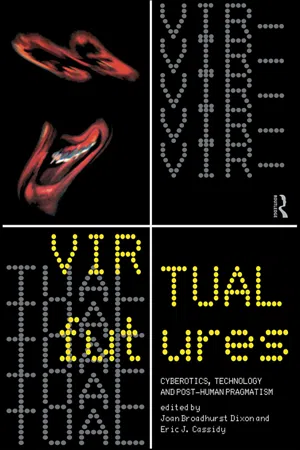
eBook - ePub
Virtual Futures
Cyberotics, Technology and Posthuman Pragmatism
- 144 pages
- English
- ePUB (mobile friendly)
- Available on iOS & Android
eBook - ePub
About this book
Information
PART I
Overload
The Information War
Hakim Bey
Humanity has always invested heavily in any scheme that offers escape from the body. And why not? Material reality is such a mess. Some of the earliest “religious” artefacts, such as Neanderthal ochre burials, already suggest a belief in immortality. All modern (i.e., post-paleolithic) religions contain the “Gnostic Trace” of distrust or even outright hostility to the body and the “created” world. Contemporary “primitive” tribes and even peasant-pagans have a concept of immortality and of going-outside-the-body (ec-stasy) without necessarily exhibiting any excessive body-hatred. The Gnostic Trace accumulates very gradually (like mercury poisoning) till eventually it turns pathological. Gnostic dualism exemplifies the extreme position of this disgust by shifting all value from body to “spirit.” This idea characterizes what we call “civilization.”
A similar trajectory can be traced through the phenomenon of “war.” Hunter/gatherers practiced (and still practice, as amongst the Yanomamo) a kind of ritualized brawl (think of the Plains Indian custom of “counting coups”). “Real” war is a continuation of religion and economics (i.e., politics) by other means, and thus only begins historically with the priestly invention of “scarcity” in the Neolithic, and the emergence of a “warrior caste.” (I categorically reject the theory that “war” is a prolongation of “hunting.”) World War II seems to have been the last “real” war. Hyperreal war began in Vietnam, with the involvement of television, and recently reached full obscene revelation in the “Gulf War” of 1994. Hyperreal war is no longer “economic,” no longer “the health of the state.” The Ritual Brawl is voluntary and non-hierarchic (war chiefs are always temporary); real war is compulsory and hierarchic; hyperreal war is imagistic and psychologically interiorized (“Pure War”). In the first the body is risked; in the second, the body is sacrificed; in the third, the body has disappeared (Clastes 1994).
Modern science also incorporates an anti-materialist bias, the dialectical outcome of its war against Religion: it has in some sense become Religion. Science as knowledge of material reality paradoxically decomposes the materiality of the real.
Science has always been a species of priestcraft, a branch of cosmology; and an ideology, a justification of “the way things are.” The deconstruction of the “real” in post-classical physics mirrors the vacuum of irreality which constitutes “the state.” Once the image of Heaven on Earth, the state now consists of no more than the management of images. It is no longer a “force” but a disembodied patterning of information. But just as Babylonian cosmology justified Babylonian power, so too does the “finality” of modern science serve the ends of the Terminal State, the post-nuclear state, the “information state.” Or so the New Paradigm would have it. And “everyone” accepts the axiomatic premisses of the new paradigm. The new paradigm is very spiritual. Even the New Age with its gnostic tendencies embraces the New Science and its increasing etherealization as a source of proof-texts for its spiritualist world-view. Meditation and cybernetics go hand in hand. Of course the “information state” somehow requires the support of a police force and prison system that would have stunned Nebuchadnezzar and reduced all the priests of Moloch to paroxysms of awe. And “modern science” still can’t weasel out of its complicity in the very-nearly- successful “conquest of Nature.” Civilization’s greatest triumph over the body. But who cares? It’s all “relative” isn’t it? I guess we’ll just have to “evolve” beyond the body. Maybe we can do it in a “quantum leap.”
Meanwhile, the excessive mediation of the Social, which is carried out through the machinery of the Media, increases the intensity of our alienation from the body by fixating the flow of attention on information rather than direct experience. In this sense the Media serves a religious or priestly role, appearing to offer us a way out of the body by re-defining spirit as information. The essence of information is the Image, the sacral and iconic data-complex which usurps the primacy of the “material bodily principle” as the vehicle of incarnation, replacing it with a fleshless ecstasy beyond corruption. Consciousness becomes something which can be “downloaded,” excised from the matrix of animality and immortalized as information. No longer “ghost-in- the-machine,” but machine-as-ghost, machine as Holy Ghost, ultimate mediator, which will translate us from our mayfly-corpses to a pleroma of Light. Virtual Reality as CyberGnosis. Jack in, leave Mother Earth behind forever.
All science proposes a paradigmatic universalism: as in science, so in the social. Classical physics played midwife to Capitalism, Communism, Fascism, and other Modern ideologies. Post-classical science also proposes a set of ideas meant to be applied to the social: Relativity, Quantum “unreality,” cybernetics, information theory, etc. With some exceptions, the post-classical tendency is toward ever-greater etherealization. Some proponents of Black Hole theory, for example, talk like pure Pauline theologians, while some of the information theorists are beginning to sound like virtual Manichaeans.1
On the level of the social these paradigms give rise to a rhetoric of bodilessness quite worthy of a third-century desert monk or a seventeenth- century New England Puritan—but expressed in a language of post-Industrial post-Modern feel-good consumer frenzy. Our every conversation is infected with certain paradigmatic assumptions which are really no more than bald assertions, but which we take for the very fabric or Urgrund of Reality itself. For instance, since we now assume that computers represent a real step toward “artificial intelligence,” we also assume hat buying a computer makes us more intelligent. In my own field I’ve met dozens of writers who sincerely believe that owning a PC has made them better (not “more efficient,” but better) writers. This is amusing—but the same feeling about computers when applied to a trillion-dollar military budget, churns out Star Wars, killer robots, etc.2
An important part of this rhetoric involves the concept of an “information economy.” The post-Industrial world is now thought to be giving birth to this new economy. One of the clearest examples of the concept can be found in a recent book by a man who is a Libertarian, the Bishop of a Gnostic Dualist Church in California, and a learned and respected writer for Gnosis magazine:
The industry of the past phase of civilization (sometimes called “low technology”) was big industry, and bigness always implies oppressiveness. The new high technology, however, is not big in the same way, While the old technology produced and distributed material resources, the new technology produces and disseminates information. The resources marketed in high technology are less about matter and more about mind, Under the impact of high technology, the world is moving increasingly from a physical economy into what might be called a “metaphysical economy.” We are in the process of recognizing that consciousness rather than raw materials or physical resources constitute wealth.
(Hoeller 1992:229–30)
Modern neo-Gnosticism usually plays down the old Manichaean attack on the body for gentler, greener rhetoric. Bishop Hoeller, for instance, stresses the importance of ecology and environment (because we don’t want to “foul our nest,” the Earth)—but in his chapter on Native American spirituality he implies that a cult of the Earth is clearly inferior to the pure Gnostic spirit of bodilessness:
But we must not forget that the nest is not the same as the bird. The exoteric and esoteric traditions declare that earth is not the only home for human beings, that we did not grow like weeds from the soil. While our bodies indeed may have originated on this earth, our inner essence did not. To think otherwise puts us outside of all of the known spiritual traditions and separates us from the wisdom of the seers and sages of every age. Though wise in their own ways, Native Americans have small connection with this rich spiritual heritage.
(Hoeller 1992:164)
In such terms (the body=the “savage”), the Bishop’s hatred and disdain for the flesh illuminate every page of his book. In his enthusiasm for a truly religious economy, he forgets that one cannot eat “information.” “Real wealth” can never become immaterial until humanity achieves the final etherealization of downloaded consciousness. Information in the form of culture can be called wealth metaphorically because it is useful and desirable—but it can never be wealth in precisely the same basic way that oysters and cream, or wheat and water, are wealth in themselves. Information is always only information about some thing. Like money, information is not the thing itself. Over time we can come to think of money as wealth (as in a delightful Taoist ritual which refers to “Water and Money” as the two most vital principles in the universe), but in truth this is sloppy abstract thinking. It has allowed its focus of attention to wander from the bun to the penny which symbolizes the bun.3
In effect we’ve had an “information economy” ever since we invented money. But we still haven’t learned to digest copper. The Aesopian crudity of these truisms embarrasses me, but I must perforce play the stupid lazy yokel plowing a crooked furrow when all the straight thinkers around me appear to be hallucinating. Americans and other “First World” types seem particularly susceptible to the rhetoric of a “metaphysical economy” because we can no longer see (or feel or smell) around us very much evidence of a physical world. Our architecture has become symbolic, we have enclosed ourselves in the manifestations of abstract thought (cars, apartments, offices, schools), we work at “service” or information-related jobs, helping in our little way to move disembodied symbols of wealth around an abstract grid of Capital, and we spend our leisure largely engrossed in Media rather than in direct experience of material reality. The material world for us has come to symbolize catastrophes, as in our amazingly hysterical reaction to storms and hurricanes (proof that we’ve failed to “conquer Nature” entirely), or our neo-Puritan fear of sexual otherness, or our taste for bland and denatured (almost abstract) food. And yet, this “First World” economy is not self-sufficient. It depends for its position (top of the pyramid) on a vast substructure of old-fashioned material production. Mexican farm-workers grow and package all that “Natural” food for us so we can devote our time to stocks, insurance, law, computers, video games. Peons in Taiwan make silicon chips for our PCs. Towel-heads in the Middle East suffer and die for our sins. Life? Oh, our servants do that for us. We have no life, only “lifestyle”—an abstraction of life, based on the sacred symbolism of the Commodity, mediated by the priesthood of the stars, those “larger than life” abstractions who rule our values and people our dreams—the mediarchetypes; or perhaps mediarchs would be a better term.
Of course this Baudrillardian dystopia doesn’t really exist—yet.4 It’s surprising, however, to note how many social radicals consider it a desirable goal, at least as long as it’s called the “Information Revolution” or something equally inspiring. Leftists talk about seizing the means of information-production from the data-monopolists.5 In truth, information is everywhere—even atom bombs can be constructed on plans available in public libraries. As Noam Chomsky points out, one can always access information—provided one has a private income and a fanaticism bordering on insanity. Universities and “think tanks” make pathetic attempts to monopolize information—they too are dazzled by the notion of an information economy—but their conspiracies are laughable. Information may not always be “free,” but there’s a great deal more of it available than any one person could ever possibly use. Books on every conceivable subject can actually still be found through inter-library loan.6 Meanwhile, someone still has to grow pears and cobble shoes. Or, even if these “industries” can be completely mechanized, someone still has to eat pears and wear shoes. The body is still the basis of wealth. The idea of Images as wealth is a “spectacular delusion.”
Even a radical critique of “information” can still give rise to an over-valuation of abstraction and data. In a “pro-situ” zine from England called NO, the following message was scrawled messily across the back cover of a recent issue:
As you read these words, the Information Age explodes …inside and around you—with the Misinformation Missiles and Propaganda bombs of outright Information Warfare,
Traditionally, war has been fought for territory/economic gain. Information Wars are fought for the acquisition of territory indigenous to the Information Age, i.e., the human mind itself. In particular, it is the faculty of the imagination that is under the direct threat of extinction from the onslaughts of multi-media overload…. DANGER—YOUR IMAGINATION MAY NOT BE YOUR OWN…. As a culture sophisticates, it deepens its reliance on its images, icons and symbols as a way of defining itself and communicating with other cultures. As the accumulating mix of a culture’s images floats around in its collective psyche, certain isomorphic icons coalesce to produce and to project an “illusion” of reality. Fads, fashions, artistic trends. U KNOW THE SCORE. “I can take their images for reality because I believe in the reality of their images (their image of reality),” WHOEVER CONTROLS THE METAPHOR GOVERNS THE MIND. The conditions of total saturation are slowly being realized—a creeping paralysis—from the trivialization of special/technical knowledge to the specialization of trivia. The INFORMATION WAR is a war we cannot afford to lose. The result is unimaginable.7
Traditionally, war has been fought for territory/economic gain. Information Wars are fought for the acquisition of territory indigenous to the Information Age, i.e., the human mind itself. In particular, it is the faculty of the imagination that is under the direct threat of extinction from the onslaughts of multi-media overload…. DANGER—YOUR IMAGINATION MAY NOT BE YOUR OWN…. As a culture sophisticates, it deepens its reliance on its images, icons and symbols as a way of defining itself and communicating with other cultures. As the accumulating mix of a culture’s images floats around in its collective psyche, certain isomorphic icons coalesce to produce and to project an “illusion” of reality. Fads, fashions, artistic trends. U KNOW THE SCORE. “I can take their images for reality because I believe in the reality of their images (their image of reality),” WHOEVER CONTROLS THE METAPHOR GOVERNS THE MIND. The conditions of total saturation are slowly being realized—a creeping paralysis—from the trivialization of special/technical knowledge to the specialization of trivia. The INFORMATION WAR is a war we cannot afford to lose. The result is unimaginable.7
I find myself very much in sympathy with the author’s critique of media here, yet I also feel that a demonization of “information” has been proposed which consists of nothing more than the mirror-image of information-as-salvation. Again Baudrillard’s vision of the Commtech Universe is evoked, but this time as Hell rather than as the Gnostic Hereafter. Bishop Hoeller wants everybody jacked-in and down-loaded—the anonymous post-situationist ranter wants you to smash your telly—but both of them believe in the mystic power of information. One proposes the pax technologica, the other declares “war.” Both exude a kind of Manichaean view of Good and Evil, but can’t agree on which is which.
The critical theorist swims in a sea of facts. We like to imagine it also as our maquis, with ourselves as the “guerilla ontologists” of its datascape. Since the nineteenth century the evermutating “social sciences” have unearthed a vast hoard of information on everything from shamanism to semiotics. Each “discovery” feeds back into “social science” and changes it. We drift. We fish for poetic facts, data which will intensify and mutate our experience of the real. We invent new hybrid “sciences” as tools for this process: ethnopharmacology, ethnohistory, cognitive studies, history of ideas, subjective anthropology (anthropological poetics or ethno-poetics), “dada epistemology,” etc. We look on all this knowledge not as “good” in itself, but valuable only inasmuch as it helps us to seize or to construct our own happiness. In this sense we do know of “information as wealth”; nevertheless we continue to desire wealth itself and not merely its abstract representation as information. At the same time we also know of “information as waf”;8 nevertheless, we have not decided to embrace ignorance just because “facts” can be used like a poison gas. Ignorance is not even an adequate defense, much less a useful weapon in this war. We attempt neither to fetishize nor demonize “information.” Instead we try to establish a set of values by which information can be measured and assessed. Our standard in this process can only be the body.
According to certain mystics, spirit and body is “one.” Certainly spirit has lost its ontological solidity (since Nietzsche, anyway), while body’s claim to “reality” has been undermined by modern science to the point of vanishing in a cloud of “pure energy.” So why not assume that spirit and body are one, after all, and that they are twin (or dyadic) aspects of the same underlying and inexpressible real? No body without spirit, no spirit without body. The Gnostic Dualists are wrong, as are the vulgar “dialectical materialists.” Body and spirit together make life. If either pole is missing, the result is death. This constitutes a fairly simple set of values, assuming we prefer life to death. Obviously I’m avoiding any strict definitions of either body or spirit. I’m speaking of “empirical” everyday experiences. We experience “spirit” when we dream or create; we experience “body” when we eat or shit (or maybe vice versa); we experience both at once when we make love. I’m not proposing metaphysical categories here. We’re still drifting and these are ad hoc points of reference, nothing more. We needn’t be mystics to propose this version of “one reality.” We need only point out that no other reality has yet appeared within the context of our knowable experience. For all practical purposes, the “world” is “one.”9
Historically, however, the “body” half of this unity has always received the insults, bad press, scriptural condemnation, and economic persecution of the “spirit” half. The self-appointed representatives of the spirit have called almost all the tunes in known history, leaving the body only a pre-history of primitive disappearance, and a few spasms of failed insurrectionary futility. Spirit has ruled—hence we scarcely even know how to speak the language of the body. When we use the word “information” we reify it be...
Table of contents
- COVER PAGE
- TITLE PAGE
- COPYRIGHT PAGE
- CONTRIBUTORS
- PREFACE: VIRTUAL FUTURES
- ACKNOWLEDGEMENTS
- PART I: OVERLOAD
- PART II: CYBEROTICS
- PART III: CYBERCULTURE SINGULARITIES
- PART IV: ANARCHO-MATERIALISM CYBERGOTHIC
- PART V: POST-HUMAN PRAGMATISM
Trusted by 375,005 students
Access to over 1.5 million titles for a fair monthly price.
Study more efficiently using our study tools.
Frequently asked questions
Yes, you can cancel anytime from the Subscription tab in your account settings on the Perlego website. Your subscription will stay active until the end of your current billing period. Learn how to cancel your subscription
No, books cannot be downloaded as external files, such as PDFs, for use outside of Perlego. However, you can download books within the Perlego app for offline reading on mobile or tablet. Learn how to download books offline
Perlego offers two plans: Essential and Complete
- Essential is ideal for learners and professionals who enjoy exploring a wide range of subjects. Access the Essential Library with 800,000+ trusted titles and best-sellers across business, personal growth, and the humanities. Includes unlimited reading time and Standard Read Aloud voice.
- Complete: Perfect for advanced learners and researchers needing full, unrestricted access. Unlock 1.5M+ books across hundreds of subjects, including academic and specialized titles. The Complete Plan also includes advanced features like Premium Read Aloud and Research Assistant.
We are an online textbook subscription service, where you can get access to an entire online library for less than the price of a single book per month. With over 1.5 million books across 990+ topics, we’ve got you covered! Learn about our mission
Look out for the read-aloud symbol on your next book to see if you can listen to it. The read-aloud tool reads text aloud for you, highlighting the text as it is being read. You can pause it, speed it up and slow it down. Learn more about Read Aloud
Yes! You can use the Perlego app on both iOS and Android devices to read anytime, anywhere — even offline. Perfect for commutes or when you’re on the go.
Please note we cannot support devices running on iOS 13 and Android 7 or earlier. Learn more about using the app
Please note we cannot support devices running on iOS 13 and Android 7 or earlier. Learn more about using the app
Yes, you can access Virtual Futures by Joan Broadhurst Dixon,Eric Cassidy in PDF and/or ePUB format, as well as other popular books in Philosophy & Critical Theory. We have over 1.5 million books available in our catalogue for you to explore.